Is ABA Only for Autism? What the Science Actually Covers
Short answer: no. ABA started outside autism and still works in hospitals, foster care, addiction, and more. Honest breakdown from a BCBA-led CEU.
Key takeaway
No. ABA is not only for autism. Around 75% of board certified behavior analysts work in autism services today, but a recent LinkedIn poll of 50 BCBAs found 60% would rather work in a different field.
Free learning path on this topic
PDA and Demand Avoidance
B. Kuereine Gray's three PDA talks plus Clelia Sigaud on the logic of anxiety. What PDA is and isn't, how to collaborate with caregivers, how to handle complex profiles and replacement behaviors, and why demand-avoidant learners respond the way they do.
On this page · 7 sections▾
No. ABA is not only for autism. Around 75% of board certified behavior analysts work in autism services today, but a recent LinkedIn poll of 50 BCBAs found 60% would rather work in a different field. That gap is not a hiring problem. It is a history problem. Before insurance reform pulled the field into autism therapy, behavior analysts worked in psychiatric hospitals, child welfare offices, prisons, and primary care clinics. The science was never built only for one diagnosis. It got pulled there by money. This page walks through what the field actually covers, where you can apply the science outside autism, and how a BCBA can start moving in that direction without blowing up their career.
The short answer (and why this question keeps coming up)#
The short answer is no. The longer answer is that ABA is a science of behavior. Behavior is anything a person does, including what they think and feel. That means ABA can show up anywhere people are trying to change what they do. Hospitals. Gyms. Foster homes. Recovery programs. Workplaces. The reason most people think ABA equals autism is simple. That is where the jobs are. That is where the insurance pays.
ABA and ASD therapy have kind of become synonymous for a lot of people. And I kind of want to teach people that that's not really the way that it has been historically, and that's not the way it needs to be going forward. From the talk — Nicole Parks
If you are a BCBA reading this and quietly hoping the answer is no, you are not alone. The numbers say a lot of your peers feel the same way. The work is broader than the job board makes it look.
How ABA and autism got tangled together#
Behavior analysis was not built around autism. The early work covered classrooms, hospitals, prisons, parenting programs, and workplace safety. Things shifted when insurance laws started requiring coverage for autism services. Money flowed in. Clinics opened. Job postings followed.
When I came into the field, ASD therapy did not, there was no insurance reform. So ASD therapy was not as prominent as it is now. From the talk — Nicole Parks
That history matters. It means the field did not narrow because the science narrowed. It narrowed because the funding pointed one way. The science itself still works in all the places it used to work. Most people who entered the field in the last fifteen years just never saw those settings up close.
The poll number is the part that sticks. About three out of four BCBAs work in autism services. About six out of ten of those people want to be somewhere else. That is a field-wide problem worth saying out loud.
Where ABA actually works besides autism#
Here is the part most BCBAs do not see in grad school. The Behavior Analyst Certification Board lists a real set of subspecialties on its public site, and each one has a long research record behind it.
We have behavioral gerontology, behavioral pediatrics, sports psychology, brain injury rehab, child maltreatment intervention and prevention, clinical behavior analysis, education, health and fitness, organizational behavior management, public health, and substance use disorders. From the talk — Nicole Parks
A quick tour of what those look like in real rooms:
- Behavioral gerontology. Working with older adults on memory, daily living routines, and care planning in nursing homes or in their own homes.
- Behavioral pediatrics. Primary care visits where a behavior analyst helps with sleep, feeding, toileting, or tantrums. The pediatrician handles meds. The BCBA handles the routine.
- Brain injury rehab. Helping someone relearn how to get dressed, follow a schedule, or manage frustration after a stroke or accident.
- Child maltreatment prevention. Home visits with at-risk families. Programs like SafeCare and Project 12-Ways have decades of data behind them.
- Clinical behavior analysis. Treating depression, anxiety, and other mental health needs using behavioral protocols. More on this below.
- Education. School-based behavior support, classroom management, and reading interventions. Not just running discrete trials at a desk.
- Health and fitness. Apps, coaching programs, and clinic-based work on weight, exercise, and chronic illness self-management.
- Organizational behavior management. Improving employee performance, safety, and culture inside companies. This is the second biggest subspecialty after autism right now.
- Public health. Smoking cessation, vaccine uptake, and other large-scale behavior change programs.
- Substance use disorders. Contingency management is one of the most effective treatments in addiction medicine. It came from behavior analysis.
That is a real list. It is not aspirational. Behavior analysts are doing all of this somewhere in the country right now. They are just harder to find than the autism clinic on every corner.
What "clinical ABA" really means#
This phrase gets confused all the time. Clinical ABA does not mean ABA in a clinic. It does not mean autism therapy that happens to be billed to insurance. It means using behavior analysis to treat socially significant problems that usually get sent to a psychotherapist. Depression. Anxiety. Substance misuse. Relationship issues.
The work still uses the same building blocks any BCBA already knows. Reinforcement. Shaping. Functional analysis. Behavioral skills training. The terms sometimes get translated into language other clinicians use. Behavioral activation. Acceptance and commitment therapy, or ACT. Functional analytic psychotherapy. Dialectical behavior therapy. Underneath the new vocabulary, the moves are familiar.
A simple example. Behavioral activation treats depression by getting the person to do small, valued actions that put them in contact with reinforcement. A BCBA would call this behavioral momentum and shaping. Same science. Different room.
If we're dealing with behavior, then we're in scope. And I think we need to know that behavior are things that happen inside of us as well. From the talk — Nicole Parks
The honest catch is billing. Insurance does not pay a BCBA to deliver ACT the way it pays a licensed psychologist. That is a real barrier. It does not mean the work is out of scope. It means the payment system has not caught up.
If you want to work outside autism, start here#
A career change does not have to be a clean break. Most people who move into a subspecialty stack their education first, then take side projects, then build a real path.
Some practical first steps:
- Read the BACB subspecialty pages. The Behavior Analyst Certification Board has a one-pager on each of the eleven subspecialties listed above. Most have a short video. Start there before you spend money on a new credential.
- Pick one subspecialty and go deep. Take a CEU course. Read the foundational book or two. Follow the researchers publishing in that area. You do not need a second degree to start. You do need a working framework.
- Find supervision that fits. A residency-style supervision model, where you rotate through different settings, is rare in behavior analysis but it exists. Look for supervisors who already work outside autism.
- Network in the other field, not just in ABA. If you want to work in substance use, go to the recovery-focused conferences. If you want to work in foster care, talk to the social workers. Ask questions first. Pitch second.
- Expect a pay cut at first. This is the part nobody likes. Autism therapy salaries are high because demand is high. Government agencies, nonprofits, and grant-funded programs pay less. Plan for it before you make the move.
- Bring other BCBAs with you. If you land in a non-autism setting, hire the next one. The field gets broader when people inside it pull others through the door.
The doctoral programs at The Chicago School and Endicott College are graduating more students with dissertations outside autism. That is a real signal. The pipeline is starting to widen.
Frequently asked questions#
Did ABA start with autism? No. Early applied behavior analysis covered classrooms, psychiatric hospitals, parenting programs, juvenile justice, and workplace safety. Autism work existed but was a small slice. The shift to autism as the dominant setting happened after state insurance reform laws in the 2000s required coverage for ABA services for autism. Funding followed the law, and the job market followed the funding.
Why do most BCBAs work in autism if the science is broader? Because that is where the jobs are. Roughly 75% of BCBAs report autism as their primary specialty. Insurance pays for it. Clinics hire for it. Most graduate programs train for it. A LinkedIn poll of 50 BCBAs found 60% would rather work in a different field. The bottleneck is not the science. It is the pay and the pipeline.
Can a BCBA legally work outside of autism services? Yes, with one important caveat. Behavior analysts can work in any setting where they have established competence under the BACB ethics code. You cannot just declare you specialize in substance use treatment after one weekend course. You need training, supervision, and ideally consultation from someone already working in that area. The credentialing rules do not lock you into autism. The job market and insurance billing rules push you there.
Want to go deeper? Watch the full CEU#
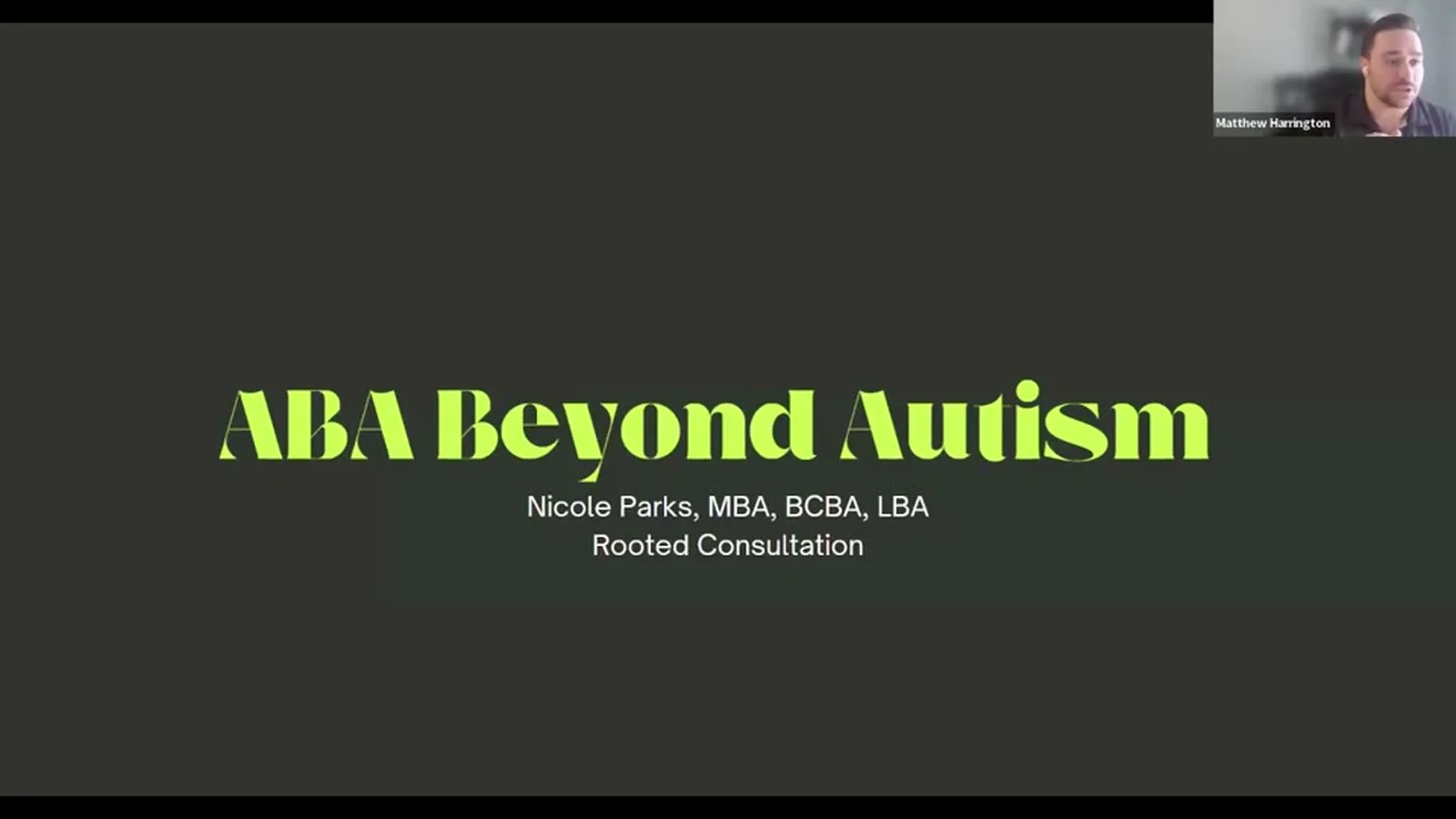
Nicole Parks runs through case studies from a psychiatric hospital token economy, a virtual reality fitness app built with behavior analysts on staff, and a smoking cessation program that used contingency management. It is one CEU, taught from inside the field. If you are a BCBA quietly wondering where else your skills could land, this is the talk.
Turn this topic into a CEU
You just studied this. Now get credit for it.
Watch ABA Beyond Autism with Nicole Parks and earn 1 free BCBA CEU. Detailed certificate, delivered the moment you finish.
Keep going with a free learning path
PDA and Demand Avoidance
B. Kuereine Gray's three PDA talks plus Clelia Sigaud on the logic of anxiety. What PDA is and isn't, how to collaborate with caregivers, how to handle complex profiles and replacement behaviors, and why demand-avoidant learners respond the way they do.