PDA: It's 'I Can't,' Not 'I Won't' (Why That Changes Treatment)
PDA 'can't vs won't' explained: why familiar baseline tasks shut a kid down and how that single distinction rewrites your intervention plan, from a BCBA-led CEU.
Key takeaway
PDA refusal is "I can't," not "I won't." The kid is not picking a fight. Their body is shutting down on a task they already know how to do.
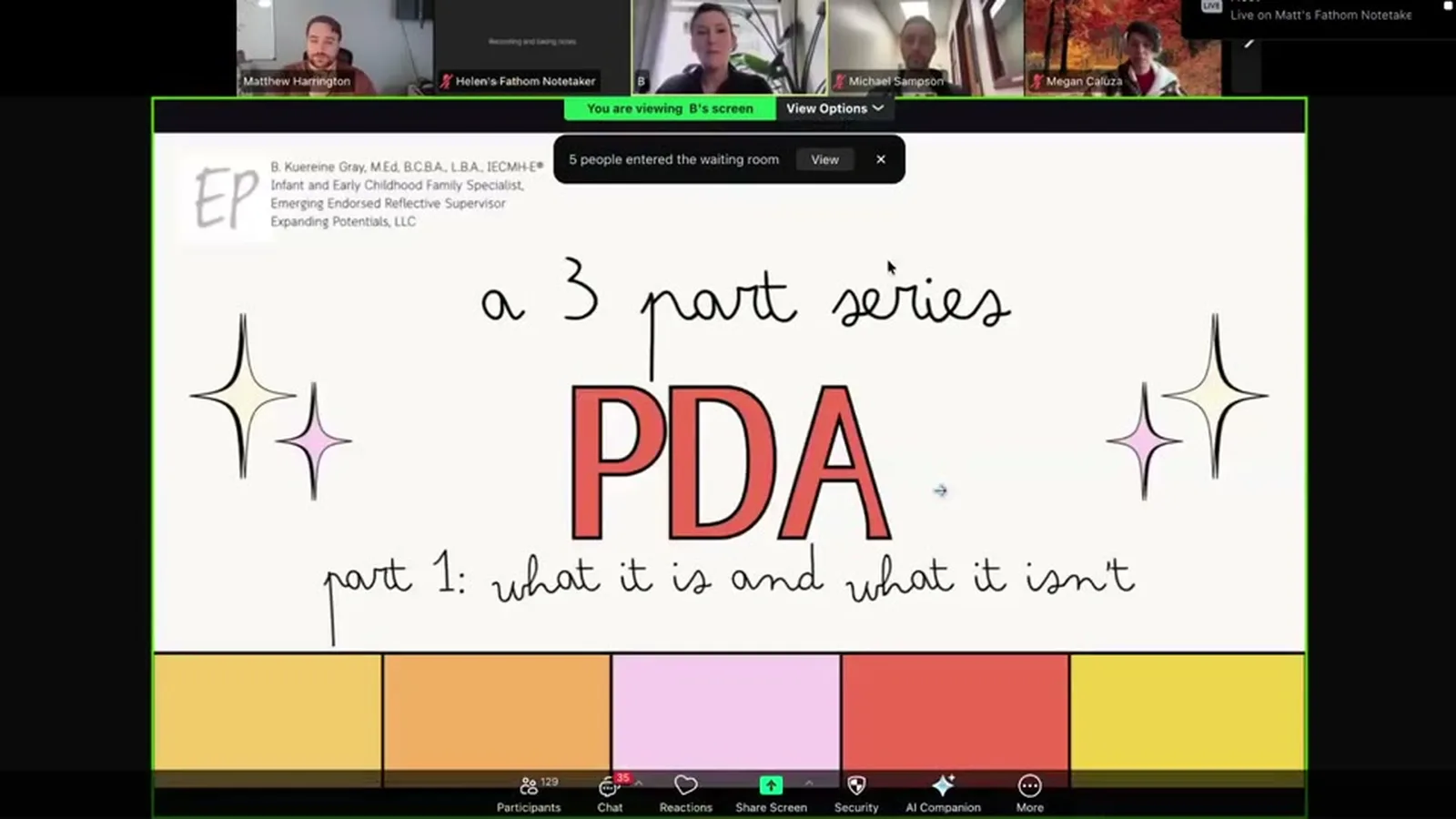
PDA: What it is and What it isn't
On this page · 7 sections▾
PDA refusal is "I can't," not "I won't." The kid is not picking a fight. Their body is shutting down on a task they already know how to do. That one shift in how you read the behavior changes your whole plan.
The 'can't vs won't' distinction in plain terms#
Most BCBAs are trained to see refusal as a choice. The kid won't brush their teeth. The kid won't sit down. We then run a plan that treats refusal like a will problem. We use extinction. We use small steps. We layer in reinforcement.
PDA breaks that model. The kid is not choosing to refuse. Their nervous system is hitting a wall. The demand itself, even a small one, sets off panic. The "no" you hear is the only thing they can get out.
This is not a soft reframe. The PDA community uses these exact words to describe their own experience. Bea quotes them straight.
It's I can't do this, not I won't do this. And that is consistent in people who have PDA, who discuss it in the PDA Society. Resisting and avoiding ordinary demands. From the talk — B. Kuereine Gray
When you treat refusal as a skill or motivation problem, you push harder. The kid escalates. The plan looks like it's failing. The real issue is that your plan was built for the wrong root cause.
Why the kid can do it Monday and not Tuesday#
This is the part that drives clinicians crazy. The kid brushed their teeth fine all last week. Today they melt down at the sink. The skill is there. The reinforcer is there. Nothing in the room changed.
What changed is the kid's threshold. Bea uses the spoon idea to explain it. You wake up with a set number of spoons. Each demand takes one. Most kids get the spoon back after a short break. PDA kids do not. The demands stack up all day. By noon, the bucket is full.
So Monday they had room. Tuesday they did not. Same task, same SD, same kid. Different internal load.
That is also why supervisees keep saying the plan "works some days." It is not the plan. It is the demand load that day. If you do not track threshold, the plan will look random.
The tell: refusal on tasks they already mastered#
Here is the diagnostic gold. PDA refusal does not show up on new skills. It shows up on the easy stuff. The stuff they have done a hundred times. The stuff in their baseline.
That is what separates PDA from a skill deficit, a low-probability task, or normal novelty resistance. With PDA, the harder the task, the less it matters. The more routine the task, the more it gets refused.
These are familiar routines. This is not novelty. It is a familiar routine, a familiar request, a familiar SD. This is something that they demonstrate the baseline competencies for. So it is not saying, oh, I don't want to try something new. They have the skills. They have the ability. And they are still resisting. From the talk — B. Kuereine Gray
So when you look at the data, sort by task type. If refusal clusters on mastered SDs, not new ones, that is your flag. Skill deficits go the other way. Kids fight the hard task and breeze through the easy one. PDA flips that.
A second tell shows up in the topography. The refusal hits things you would never expect. Toileting. Eating. Even things the kid asked for five minutes ago. That last one trips up almost every BCBA the first time they see it.
Sometimes we see it with toileting, eating, hygiene, socialization, speaking, communication, routines, even preferred activities. I can't engage in this routine or I can't engage in my preferred activity. It's not that I won't engage in it. I just can't engage in it. From the talk — B. Kuereine Gray
"Even preferred activities" is the line that should stop you cold. A kid melting down over a thing they love is not being defiant. The demand to engage with the preferred thing became a demand. The system shut it down.
Self-imposed demands count (brushing teeth no one asked about)#
Most BCBAs assume the demand has to come from outside. Parent asks. Teacher asks. Therapist asks. With PDA, the demand can come from inside the kid's own head. Nobody said a word. The kid still hits the wall.
A six-year-old wakes up. They know they are supposed to brush their teeth. No one prompted them. The knowing alone is enough.
There is a demand either a perceived demand so internalized like I need to get up and brush my teeth I know that I need to brush my teeth nobody told me I need to brush my teeth there's then anxiety or distress avoidance and then there's the temporary relief. From the talk — B. Kuereine Gray
This matters for two reasons. First, your antecedent log will be blank. There was no prompt to record. Parents will say "nothing happened, they just lost it." That data looks like the behavior came out of nowhere. It did not. The demand was internal.
Second, this is why removing the external prompt does not fix things. You can stop asking. You can drop the visual schedule. The kid still has the internal rule. They will still hit the wall on their own. The plan has to treat the autonomy threat, not just the verbal SD.
How 'can't vs won't' changes your behavior plan#
If refusal is a capacity problem, not a will problem, your plan needs three changes.
First, you stop pushing through. Extinction on a "can't" looks like making a kid run on a broken leg. The behavior gets worse. The relationship gets worse. You see the precursor R2 and R3 chain Bea described. Then you see a fast jump to dangerous behavior.
Second, you redesign the SD. The kid still needs to brush their teeth. But the demand needs to land in a way the nervous system can hold. That means lower direct pressure. Indirect language. Real choice that the kid can feel. The point is to lower the perceived demand without lowering the expectation.
Third, you track threshold, not just behavior. A standard FBA gives you A-B-C. A PDA case needs a load count too. How many demands in the last hour? What was the kid's state walking in the door? The same SD on a full bucket is a different SD than on an empty one.
This is why Bea's plans for PDA kids keep the SBT bones but tweak the delivery. The mechanics of the field still work. The framing around them has to shift.
What to write in your session notes when you see it#
Documentation is where most BCBAs get nervous. "Can't" sounds mentalistic. You do not want a peer reviewer to flag the note. You also do not want to write a note that hides what is actually happening.
The fix is to stay behavioral. Describe what you saw. Describe the task type. Describe the conditions. Let the pattern speak.
A clean PDA note has four parts. The SD that was presented. Whether the task was in the kid's mastered set. The chain of precursors before the dangerous behavior. The cumulative demand load before the session.
You can write all of that without using the word "can't" at all. You are not diagnosing PDA in the note. You are describing capability on a mastered SD under a specific demand load. That is observable. That is defensible.
Over time, the data tells the story. Refusal clusters on mastered SDs. Refusal scales with demand load, not task difficulty. Precursor chains are reliable. That data set is what justifies a referral for an EDA-8 or a fuller assessment. Bea is clear that BCBAs do not diagnose. We document the pattern and refer.
Frequently asked questions#
How do I document 'can't' instead of 'won't' on a behavior plan without sounding mentalistic?
Skip the words "can't" and "won't" in the note. Both are internal states. Write the SD, the kid's mastery status on that SD, the demand load over the prior hour, and the precursor chain. If refusal hits a mastered SD under a high demand load, the data will show that pattern without you needing to label it. Save the clinical interpretation for the assessment summary, not the daily note.
Does the 'can't' framing mean I stop running extinction?
Not as a blanket rule. It means you stop running extinction on the "can't" pattern, which is refusal on a mastered SD under a high demand load. That kind of extinction makes things worse and burns the relationship. You can still use extinction on a true skill or motivation issue elsewhere in the plan. The point is to sort the refusal first. Different root cause, different tool.
If they can do it for me one session and not the next, is that still PDA or just inconsistency?
Inconsistency on a mastered task is one of the clearest PDA signals, not a reason to rule it out. The skill is stable. The threshold is not. Track the demand load coming into each session, the kid's state at the door, and the task type. If the pattern shows refusal scaling with load, not difficulty, that is PDA shaped. If refusal scales with task difficulty, you are looking at a skill issue instead.
If your plan keeps "working some days" and you cannot explain why, that is the moment to slow down, pull the threshold data, and consider a referral for a full PDA-aware assessment.
Turn this topic into a CEU
You just studied this. Now get credit for it.
Watch PDA: What it is and What it isn't with B. Kuereine Gray and earn 1 free BCBA CEU. Detailed certificate, delivered the moment you finish.