The SCAD Framework: How to Actually Assess Your Own Bias as a BCBA
The four-step BCBA bias self-check: Self-reflect, Consult, Act, Data-review. Real prompts, not vibes, from a BCBA-led CEU.
Key takeaway
Most "assess your own bias" trainings for BCBAs hand you a long journal prompt and call it a day. SCAD is the opposite.
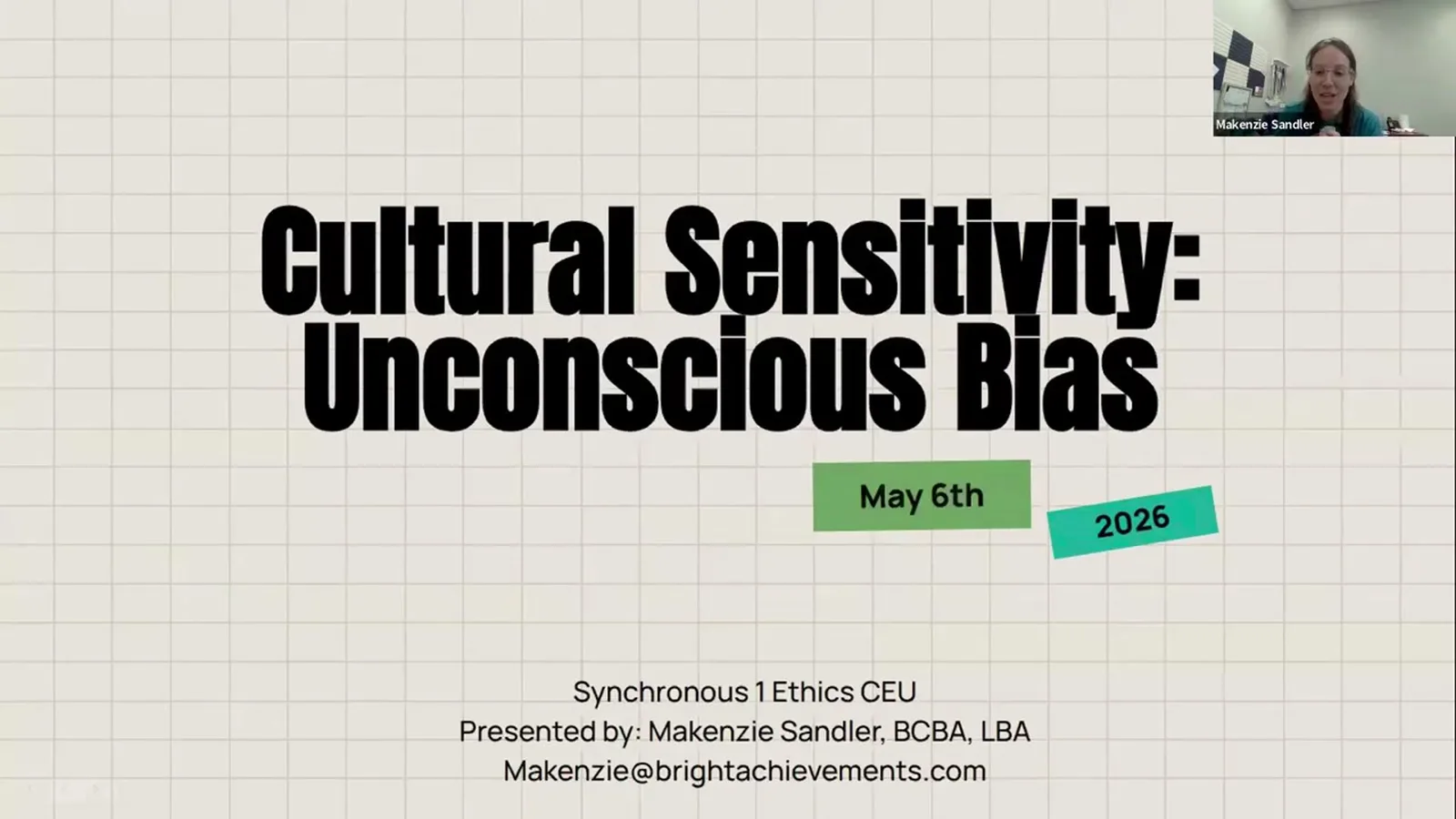
Cultural Sensitivity: Unconscious Bias
On this page · 9 sections▾
Most "assess your own bias" trainings for BCBAs hand you a long journal prompt and call it a day. SCAD is the opposite. SCAD stands for Self-reflect, Consult, Act, Data-review, and it is the four-step bias self-check Mackenzie Sandler, BCBA, built into her openceu.com ethics CEU on unconscious bias. The reason the page is built around her acronym is simple: she models it on the live call. She catches herself mid-sentence saying a family wants motor stereotypy gone so their kid does not "visually have autism," and then she stops and says out loud, "I just assumed 10 things." That is what self-reflection looks like in real time. SCAD also gives you the language swap she uses on Friday afternoons: instead of writing "that parent is inconsistent" in a session note, you write "parent performs in 65% of opportunities." Same parent. Different action.
Why Most BCBA Bias Self-Checks Don't Stick (and What SCAD Does Differently)#
The usual bias training asks you to sit down with a 30-question worksheet once a year. You answer the questions. You feel a little uncomfortable. You close the laptop. Nothing changes on Monday.
SCAD does not work that way. It is a four-step loop you run on yourself in the moment, not once a year. Each letter is a behavior you can do today: pause and self-reflect, call someone and consult, change one piece of language and act, then pull data on yourself and review. It is built for the way BCBAs already think. Operational definitions. ABC data. Dead man's test. Reinforcement and punishment. You already have the skills. SCAD just points them at you instead of at a learner.
The other thing SCAD does that a worksheet cannot do: it tells you when to use it. Bias does not show up on a quiet Tuesday when caseload is light. It shows up when you are rushed, when you are overwhelmed, when a behavior is not operationally defined, and when you feel a strong emotion. Those are the cues. We will get to them next.
S is for Self-Reflection: The Four Cues That Tell You Bias Is About to Drive#
Self-reflection in SCAD is not journaling. It is noticing four specific antecedent conditions and pausing the second any of them shows up.
Biases are most likely to surface and to create a problem or disconnect when you're rushed, when you're overwhelmed, when things are moving fast or very ambiguous and not operationally defined. When you feel a really strong emotion, when you're feeling really frustrated, really angry, really defensive. From the talk — Mackenzie Sandler
That is your cue list. Rushed. Overwhelmed. Ambiguous and not operationally defined. Strong emotion. When one of those shows up, you stop and run three questions on yourself.
- What am I labeling this behavior as? Use the words you would use in the moment. "Violent." "Non-compliant." "Inconsistent." Write the word down. That word is the bias getting on the page.
- What assumptions am I making? List them out. Mackenzie gives the cleanest live example of this anywhere: she said a family wanted motor stereotypy gone because they did not want their kid to "visually have autism," and then she caught herself.
What assumptions am I making? I just said, oh, this family wants motor stereotypy to go away because they don't want their child to visually have autism. Maybe I'm wrong. Maybe they don't want their kid to get bullied, or maybe they just don't understand what the motor stereotypy is. I just assumed 10 things. From the talk — Mackenzie Sandler
- What else could this mean? Force yourself to write three other reasons. If a kid is putting hands on a peer's neck, your first label is "physical aggression." Other options: the kid saw it once and is imitating. The kid had a sore throat. The kid is seeking pressure input. You do not have to be right. You have to break the single story.
That is the S. You ran it in 90 seconds.
C is for Consult: Who to Call, When, and What to Actually Ask#
Consult has three timing modes. Run them all.
Proactive consult is the easy one. Before you write a new treatment plan with a family from a culture or community you do not share, you go find someone who does. A pediatrician. A teacher. A pastor. A religious leader. The family themselves. You ask them how a behavior is viewed in that community. You ask the learner directly when possible. Mackenzie tells the story of a nine year old who told his mom "I did great today, Mackenzie took data." That kid wanted to be invested. Ask.
Active consult is when you are mid-case and feel the bias cue list firing. You stop, you call your mentor, you say "I'm frustrated with this family every Tuesday and I do not know why yet." You let someone outside the case look at it.
Reactive consult is the debrief. The session went sideways. You go back to the family or the team or your supervisor and you say "How did that land? Because I felt uncomfortable." You own the discomfort. You ask for feedback.
The one consult question that does the most work: "How is this behavior viewed in your family and your community?" Use it on motor stereotypy. Use it on eye contact. Use it on hand feeding a seven year old. Use it on spanking. Use it on any behavior that triggered a label inside your head.
A is for Act: One Language Swap and One Value Statement Before Friday#
Act is the step you can finish before the end of this week. It has two pieces.
Piece one is a language swap. Pick one phrase you use in your documentation and change it. Mackenzie's go-to swaps:
- "Attention-seeking behavior" becomes "seeking connection."
- "Problem behavior" becomes "target behavior" or just "behavior."
- "Non-compliant" gets deleted. Non-compliance does not pass the dead man's test. A dead man can be non-compliant. A dead man cannot follow a one-step direction with prompting.
- "Violent" becomes "physical contact with others" or a tighter operational definition like "places hands on another person's neck."
Pick one. Change it everywhere in your next treatment plan. That is the A.
Piece two is a value statement. Identify one personal or professional value and one behavior that moves you toward it this week. The value might be "treat families with compassion." The behavior is "ask each family one open-ended question about their priorities before I open the assessment." That is your motivating operation. You wrote it down so it sticks.
D is for Data Review: Take ABC Data on Yourself for One Week#
The D is the part most BCBAs skip and is also the part most BCBAs are best equipped to do. You already take ABC data. Point it at yourself.
Can you take ABC data on yourself? Start a self-management program. Where did I let unconscious bias take over this week? What goals or targets did I put in a treatment plan based on an assessment that I chose without asking the family if it's important? From the talk — Mackenzie Sandler
Run it for one week. Each day, write down one moment you felt the cue list fire. What was the antecedent? What did you do? What was the consequence. At the end of the week, look for patterns. Are you tighter with early learners and looser with teens? Do you label families from one community as "inconsistent" more often than another? The data tells you where your bias lives.
Then make the language swap permanent.
Use data instead of summaries rather than saying, oh, that parent's inconsistent. That family's not implementing. Talk about it in data. Oh, they perform in 65% of opportunities. It's going to change the way you work with that family. It's going to change action. From the talk — Mackenzie Sandler
"Inconsistent" is a summary that hides a bias. "Performs in 65% of opportunities" is a data point that drives next steps. When the family hits 70% next month, you will see it. You will feel the progress. So will they.
What to Do When the Data Says You Should Drop the Case#
Sometimes the week of self-ABC data tells you something hard. You are consistently more frustrated, more defensive, or more rushed with one specific family or one specific population. Your unconscious bias is reinforced enough that you cannot consistently move toward your stated values on that case.
That is not a failure. That is the system working.
Mackenzie is direct about this. Recognizing your unconscious bias can give you permission to say "I am not the right clinician for this case" and refer out. Self-advocacy is part of ethical practice. The case gets a clinician who can serve it. You get to keep growing on cases where you are the right fit. Both things are wins.
The trigger to pull the cord: two consecutive weeks of self-ABC data showing the same pattern on the same case, plus one reactive consult that confirms it. At that point you bring it to your supervisor with the data, not the feeling.
Building SCAD Into Supervision (and Why Trainees Need This Most)#
BACB Code 1.07 says you are responsible for evaluating biases in your supervisees and trainees, not just yourself. SCAD is easier to teach than a worksheet because every step is a behavior you can model.
In supervision, run SCAD on the trainee's case in front of them. Walk through the cue list. Ask "what assumptions are we making here?" out loud. Practice the language swap on a real session note. Take a week of self-ABC data together and compare patterns. Trainees pick this up faster than seasoned BCBAs because they have not been reinforced for years on "inconsistent" and "non-compliant." Catch them early.
A practical move: add one SCAD prompt to every supervision agenda. Just one. "What was one moment this week you felt rushed or defensive with a family, and what did you do?" That single question turns supervision into a bias self-check loop that runs every week without a worksheet.
Frequently asked questions#
How long does it take to actually feel less biased?
Unconscious bias does not get deleted. It gets identified. The realistic timeline is one week of self-ABC data to see your patterns, two to four weeks of language swaps to feel them in your documentation, and one quarter of consistent SCAD use before you trust yourself to catch a bias mid-session the way Mackenzie did on the live call. The goal is not zero bias. The goal is fast detection and a clean language swap.
Should I tell my supervisor I'm running a self-bias check?
Yes, and bring data. Telling a supervisor "I'm working on my biases" is vague. Telling a supervisor "I took ABC data on myself for two weeks and I'm tighter with early learners than teens, and here are the three labels I'm swapping" is a supervision conversation that goes somewhere. It also gives the supervisor a model to run on themselves.
What if my data review shows I'm worse with one cultural group than another?
That is the most useful possible result. You now know where to get consult, where to expose yourself to that community, and where to consider co-treating or referring out while you build skills. Do not hide the result. Bring it to a mentor. Identify the bias, label it, name it, and put a SCAD plan on yourself the way you would on any other behavior you want to change.
Keep building the skill#
SCAD works because it points the tools you already use at the clinician in the room with the family. The next step is to look at the words you use when you write a behavior plan and the goals you pick during an assessment, because that is where bias most often gets locked in for years.
Turn this topic into a CEU
You just studied this. Now get credit for it.
Watch Cultural Sensitivity: Unconscious Bias with Mackenzie Sandler and earn 1 free BCBA CEU. Detailed certificate, delivered the moment you finish.