Unconscious Bias in ABA: What It Is and Why It Matters
Unconscious bias is an automatic attitude that shapes choices without us noticing. Learn what it is and how BCBAs can spot and reduce it.
Key takeaway
Unconscious bias is an attitude or stereotype you hold without knowing it. It shapes how you see people and how you act. It works fast and quiet, below your notice.
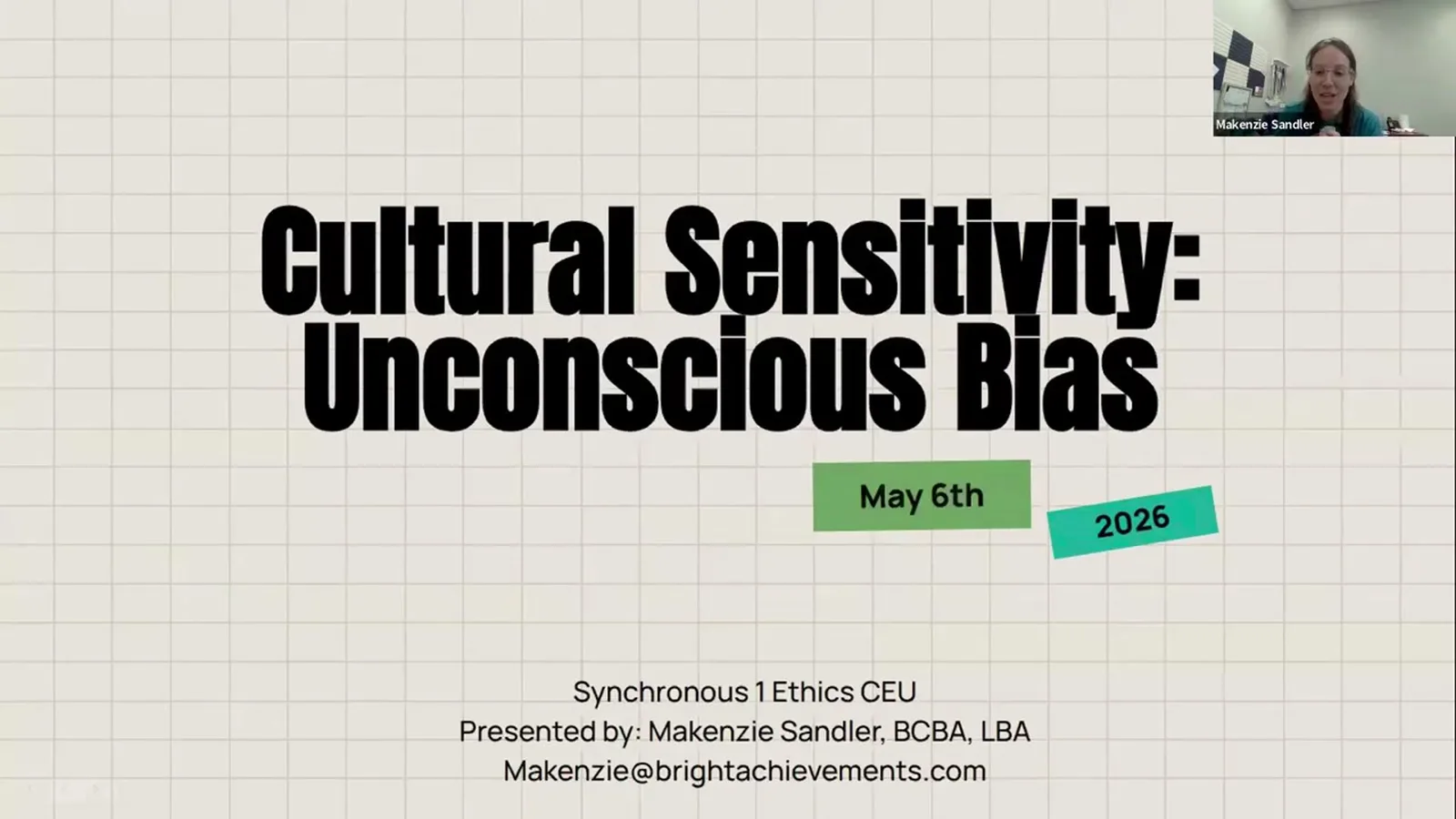
Cultural Sensitivity: Unconscious Bias
Experts who cover this
The recording behind this guide covers unconscious bias aba.
- Featured talk1 Ethics CEU
Cultural Sensitivity: Unconscious Bias
Mackenzie SandlerThe Behaviorist Bookclub
Sandler defines unconscious/implicit bias as automatic, unintentional attitudes and stereotypes operating outside conscious awareness, framing it as a normal…
On this page · 7 sections▾
Unconscious bias is an attitude or stereotype you hold without knowing it. It shapes how you see people and how you act. It works fast and quiet, below your notice. Another common name for it is implicit bias.
This matters a lot in ABA work. BCBAs, RBTs, teachers, and parents all make quick calls about people. Bias can slip into those calls without a sound. When you learn to spot it, you can serve clients and families more fairly.
What unconscious bias really means#
Mackenzie Sandler teaches that bias runs on autopilot. It is not a plan you make. It is a pull you feel before you think.
unconscious bias usually describes attitudes and stereotypes that affect our understanding, actions like behaviors and decisions in an automatic and unintentional way. From the talk — Mackenzie Sandler
The word "unintentional" is the heart of it. You are not trying to judge anyone. Your brain just sorts people into groups on its own. That sorting can color a decision before you catch it.
Sandler names the hardest part of this idea. You often cannot see your own bias at work.
And the key kind of takeaway for unconscious bias is I don't even realize I'm thinking this. From the talk — Mackenzie Sandler
Why everyone has it#
Bias is not a flaw in a few bad people. It is a normal part of being human. Your brain learns patterns from everything around you. Media, family, and past events all feed those patterns.
Sandler ties this to how behavior gets learned. Every day the world sends you signals about groups of people. Those signals keep strengthening the shortcuts in your head. You do not choose this, and it does not stop.
So your unconscious bias continues to get reinforced, like it or not, welcome to being a human being. From the talk — Mackenzie Sandler
This framing helps take away the shame. If bias is normal, you can talk about it calmly. You can study your own patterns without feeling like a bad person. That calm is what makes real change possible.
Why it matters in ABA practice#
ABA is built on close reading of behavior. You watch, you judge, and you choose a next step. Bias can bend each of those moves without warning. That can lead to unfair care for a client.
The BACB ethics code speaks to this directly. Code 1.07 asks behavior analysts to work on cultural awareness and bias. Sandler links this idea straight to the code. Spotting your bias is part of ethical practice, not an extra.
Small biased choices add up over time. Who gets more of your patience? Whose parent gets a full explanation? These quiet calls shape the quality of care a family receives.
Bias can also touch how you read data. A behavior might look "worse" only because of a group you expect trouble from. Your notes and graphs are only as fair as your eyes. So the work of checking bias protects the data too.
How bias shows up with families#
 Advertisement
Bias often hides inside everyday clinic habits. Providers may talk past a client instead of to them. They may lean on a support worker and skip the person themselves. That habit can leave clients feeling unseen.
Bias can also slow down help for some families. A provider might not take a parent's worry seriously. They might delay a referral or make a wrong guess. These small gaps can push real support further away.
These patterns hit some families harder than others. Caregivers of color often report that providers do not treat them as partners. Some feel their time, culture, and worries get less respect. Those gaps can delay a diagnosis and the help that follows.
The goal is not to feel guilty about these habits. The goal is to notice them and change the next step. Awareness is the first tool. Better routines come after that.
What the research says#
Research shows bias is real, measurable, and hard to shift. One guidance paper argues that behavior analysts must address implicit bias in ABA. Left alone, it can lead to unfair treatment of clients and staff by race. The authors offer ways to assess and reduce it in daily practice (Jaramillo & Nohelty, 2021).
Teaching facts alone may not be enough. In one study, people watched a short training video about autism made with autistic adults. Viewers gained better knowledge and warmer stated attitudes toward autism. But their unconscious attitudes did not budge. Some deep beliefs are harder to move than surface opinions.
Real contact seems to help more than facts. One study of French adults measured both stated and hidden bias toward autism. Both knowledge and familiarity lowered stated stigma. But only familiarity, real closeness with autistic people, lowered hidden bias. Knowing people, not just knowing about them, moved the automatic part.
Culture shapes bias too. One study compared views of autism in South Korea and the United States. How people described their feelings did not match their hidden thoughts. This gap reminds us that stated attitudes can hide the real ones.
Steps BCBAs can take#
Start by naming that you have bias. Everyone does, so this is not an admission of guilt. This honest start makes the rest of the work easier. It turns a scary topic into a normal skill.
Next, watch your own quick reactions with clients. Notice who you speak to and who you skip. Notice whose concerns you brush off. These small checks bring hidden habits into the light.
Then seek real contact and better routines. Spend time with the people your bias might touch. Speak to clients directly, even when a helper is present. Give every family the same full care and time. Mackenzie Sandler covers these steps in Cultural Sensitivity: Unconscious Bias.
FAQ#
What is the difference between unconscious bias and implicit bias?
They mean the same thing. Both describe attitudes and stereotypes that work automatically, outside your awareness. Some people say "implicit bias" in research, and "unconscious bias" in training. In ABA ethics work, you will hear both terms used the same way.
Can you get rid of unconscious bias?
You likely cannot erase it fully. It keeps getting reinforced by the world around you. But you can lower its power over your choices. Research suggests real contact with different groups and honest self-checks help the most.
Does unconscious bias affect ABA therapy?
Yes, it can. Bias may shape who gets more patience, time, or a fair referral. It can also cause providers to talk past a client instead of to them. That is why the BACB ethics code asks analysts to work on bias and cultural awareness.
 Advertisement
Turn this topic into a CEU
You just studied this. Now get credit for it.
Watch Cultural Sensitivity: Unconscious Bias with Mackenzie Sandler and earn 1 free BCBA CEU. Detailed certificate, delivered the moment you finish.