What Unconscious Bias Actually Is in ABA (and What It Is Not)
Plain explanation of unconscious bias for BCBAs, how it differs from explicit bias, and where it shows up in your clinical work from a BCBA-led CEU.
Key takeaway
Unconscious bias is the set of attitudes and stereotypes that shape how you read a kid, write a goal, or label a behavior, and you do not know it is happening. That is the whole definition.
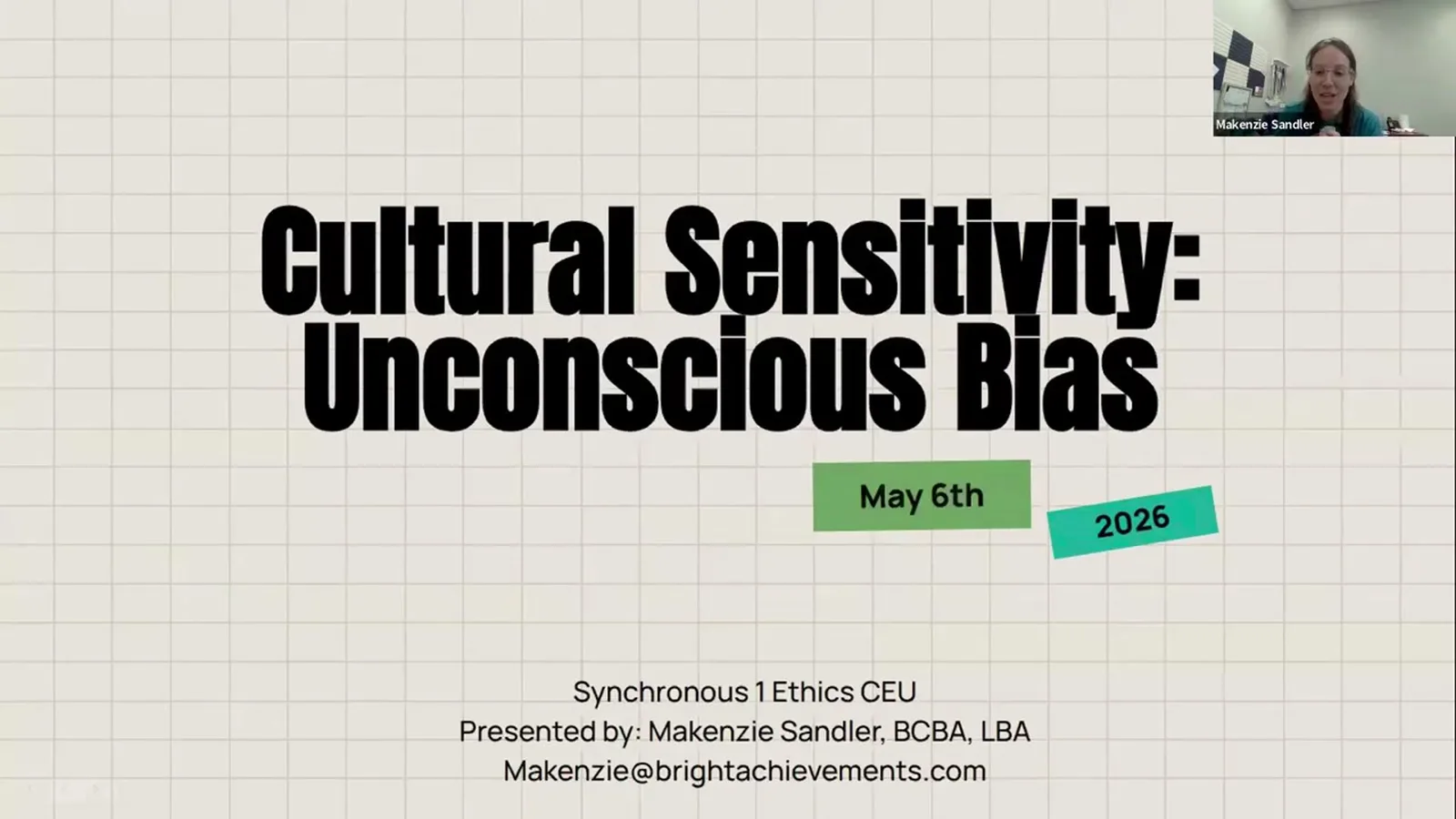
Cultural Sensitivity: Unconscious Bias
On this page · 9 sections▾
Unconscious bias is the set of attitudes and stereotypes that shape how you read a kid, write a goal, or label a behavior, and you do not know it is happening. That is the whole definition. If you can say out loud "coffee is better than tea and I will argue about it," that is explicit bias. If you walk into a home, feel something tighten in your chest, and skip a question you would have asked the family down the street, that is unconscious bias. The BACB Ethics Code 1.07 (the Behavior Analyst Certification Board's standard on cultural responsiveness and diversity) tells you, as a Board Certified Behavior Analyst (BCBA), to evaluate your own. And here is the part nobody likes to say out loud: every time you act on the bias and nothing bad happens, the bias gets reinforced. Reinforcement keeps it going. That is just behavior analysis applied to you instead of a kid.
The 30-Second Definition (and Why ABA Trainings Get It Wrong)#
Most CEU slides on bias open with a paragraph that sounds like a corporate HR video. Mackenzie Sandler skips that and gives you the working definition a BCBA can actually use.
Unconscious bias usually describes attitudes and stereotypes that affect our understanding, actions like behaviors and decisions in an automatic and unintentional way. And these really refer to our biases that operate outside of our conscious awareness. We're not necessarily aware of some of our attitudes and stereotypes. From the talk — Mackenzie Sandler
Three things matter in that definition. Automatic. Unintentional. Outside of your awareness. If you can catch yourself doing it in real time, it is on its way to becoming explicit. If you cannot, and somebody else has to point it out, that is the unconscious version. Most "unconscious bias in ABA" trainings get it wrong because they treat it as a character flaw to apologize for. It is not a character flaw. It is a behavior class that is on a reinforcement schedule, and your job is to start taking data on it the same way you take data on anything else.
Unconscious Bias vs Explicit Bias: The Coffee-vs-Tea Test#
Here is the cleanest test. Can you state the bias out loud, defend it, and feel fine about it? Then it is explicit.
The opposite of unconscious bias, which is our personal or explicit bias. And these are things that you can kind of say, like, yeah, I know I think this. Coffee's better than tea. That's my explicit bias. And I would definitely stand the ground and get in an argument with someone about this. From the talk — Mackenzie Sandler
| Explicit bias | Unconscious bias |
|---|---|
| You know you have it | You do not know you have it |
| You can name it out loud | It runs in the background |
| You defend it (sports team, coffee, religion) | It shows up in your clinical choices before you notice |
| Easier to work around because you can plan for it | Harder to spot because it feels like "just my judgment" |
| Example: I celebrate Christmas and take that day off | Example: I described a Black 14-year-old's hitting as "violent" and a white 3-year-old's hitting as "making contact" |
The coffee-vs-tea test is useful because it lets you sort your own thinking fast. If you can write a sentence that starts with "I think X is better than Y and here is why," that is explicit. If you only notice you did something after a colleague asks "why did you word it that way," that is the unconscious one, and that is the one Code 1.07 is asking you to work on.
Where Bias Comes From (and Why Behavior Analysis Says It Keeps Coming Back)#
You were raised somewhere. You watch certain news. You scroll a certain feed. Your neighborhood, your training program, the supervisors who shaped you, all of that is the learning history that built your current biases. None of that is shameful. It is just data.
The reason bias is hard to shake is the same reason any behavior is hard to shake.
Your unconscious bias continues to get reinforced, like it or not, welcome to being a human being. So your unconscious bias continues to get reinforced. Basic behavior analysis. From the talk — Mackenzie Sandler
Every time you label a Black teen's behavior as "aggressive" and the school nods, that label gets reinforced. Every time you assume a family with a cluttered house is not going to follow the parent training plan and you write a shorter plan, your assumption gets reinforced because you never tested it. Reinforcement does not care if your behavior is helpful or harmful. It cares if there was a consequence that maintained it. Treat your own bias as an operant and you can finally start to do something about it.
BACB Code 1.07: Why Self-Evaluation Is Required, Not Optional#
Code 1.07 is not a suggestion. It is the standard. As a BCBA you are tasked with evaluating your own biases and the biases of the people you supervise. You do not get to opt out because the work feels uncomfortable.
Obviously we're going to start with our ethics code. And the core principle within our code is to treat others with compassion, dignity, and respect. As a BCBA, we are tasked with evaluating our own biases. It is built into our code. From the talk — Mackenzie Sandler
Treating people with compassion, dignity, and respect is the floor. You cannot get there if you do not know what biases are steering your clinical decisions. Self-evaluation means continuing education on this stuff, mentorship, reading the work of clinicians who are not from your own background, and building real systems for catching your own patterns. You do this for yourself, and then you do it again with your supervisees because you are responsible for their growth too.
The Five Places Unconscious Bias Shows Up in a BCBA's Day#
You do not need a workshop to find your own bias. You need to look at the work you already do. Here are the five highest-yield places to look.
- Behavior labels. Did you write "violent" when "hitting" would do? Did you write "non-compliant" when "did not respond to instruction within 10 seconds" would do? Non-compliance does not pass the dead man's test and it follows the kid through every file.
- Goal selection. Whose goals are these? The parent's? The school's? Yours? The kid's? "Independence" looks different in a family that hand-feeds children until age eight and a family that hands a toddler a fork. Neither is wrong. The bias is assuming yours is the right answer.
- Assessment interpretation. The same Vineland score can be read as "scored too high, not medically necessary" or "scored high in this domain, deficits show up here." Your prior beliefs about the kid show up in the read.
- Parent collaboration. A family in the South where spanking is legal. A family with a cluttered kitchen. A family that wants their child to stop hand-flapping. You will have a reaction. The reaction is data, not the answer.
- Team and supervision dynamics. You give written feedback because that is how you learned best. Your supervisee learns best from modeling. If you cannot tell the difference between your style preference and what works for them, that is bias too.
If you want one place to start tomorrow morning, open the last three behavior plans you wrote and look at the labels.
What Unconscious Bias Is Not: Three Common Mix-Ups#
Most pushback on bias work comes from misunderstanding what the work is asking for. Three things to get straight.
It is not finger-pointing. Nobody is calling you a bad person for having biases. Mackenzie says it plainly in the talk: there is no "your bias is right or your bias is wrong." It is just being human. You were raised in a certain culture, you absorbed certain patterns, and now the work is to see them. That is the entire ask.
It is not the same as racism. Racism is a system and a set of explicit beliefs and actions. Unconscious bias is a quieter mechanism that exists in everyone and can absolutely feed into racist outcomes, but the two words are not interchangeable. You can be a kind person who would never describe themselves as racist and still write "violent" on a Black kid's BIP and "physical contact" on a white kid's. That is what unconscious bias does.
It is not something you "fix" once. There is no graduation. The goal is not zero bias, the goal is awareness and a system for catching yourself. You will be doing this for the rest of your career.
What to Do Right Now if You Suspect You Have It#
You do. Everybody does. That is not the question. The question is what you do next.
Open your last treatment plan and read the behavior definitions out loud. Anywhere you wrote "violent," "aggressive," "non-compliant," "attention-seeking," or "manipulative," cross it out and write the topography. "Places hands on others' necks." "Did not follow instruction within 10 seconds." "Approaches adults and initiates conversation." See if the new wording changes how you feel about the kid. That feeling shift is your bias showing itself.
Then pick one family this week and ask, before you write a goal, "what does success look like for you in 12 months?" Listen for whose values you have been writing toward and whose values they actually hold. That is the work.
Frequently asked questions#
Is unconscious bias the same as racism? No. Racism is a system of beliefs, policies, and actions that disadvantage people based on race. Unconscious bias is the automatic mental shortcut every human runs, and it can absolutely feed into racist outcomes in ABA (the "violent" label on a Black teen, the assumption a Spanish-speaking parent will not follow the plan). They are related but they are not synonyms. Confusing the two makes the conversation harder because people hear "you are racist" when the actual ask is "look at your defaults."
Can you take an IAT (Implicit Association Test) as a BCBA and count it toward CEUs? The IAT itself is a research tool from Project Implicit and is free. Taking it does not, on its own, count for BACB CEUs. It can absolutely be part of a CEU experience if a Board Approved Continuing Education (ACE) provider builds a course around it and you complete the full course requirements. Take the IAT for self-knowledge. Get your CEUs from an ACE provider.
If bias is automatic, am I responsible for it ethically? Yes. Code 1.07 makes self-evaluation the BCBA's job. You are not responsible for having unconscious bias (everyone does). You are responsible for building systems that catch it, taking action when you spot it, and not letting it drive your clinical decisions. Automatic does not mean unaccountable.
Watch the full talk and keep going#
The 30-second definition is the start. The harder work is catching your own bias in the goals you write, the words you pick, and the families you click with versus the ones you do not. Mackenzie's full session walks through where bias hides in your clinical day, why values work from Acceptance and Commitment Therapy (ACT) helps, and one acronym you can use tomorrow to start catching yourself in real time.
Turn this topic into a CEU
You just studied this. Now get credit for it.
Watch Cultural Sensitivity: Unconscious Bias with Mackenzie Sandler and earn 1 free BCBA CEU. Detailed certificate, delivered the moment you finish.