Behavior Changes After a Death Loss: What BCBAs Should Watch For
What the bereavement studies show in IDD clients five and eight years out, plus when SIB and dysregulation mean refer out. From a BCBA-led CEU.
Key takeaway
If your client with an intellectual or developmental disability (IDD) just lost a parent, sibling, or longtime caregiver, your BCBA (Board Certified Behavior Analyst) data is the clearest record anyone on the team has of what changed.
Interdisciplinary Grief Support for People with Disabilities: Enhancing Outcomes Through BCBA-LPC Collaboration
Free learning path on this topic
Your 4 Ethics CEUs, Done
Four ethics CEUs in three courses, all free. Start with Matt Harrington's assent and data course, then ethical guardrails in behavior reduction, then cultural considerations in clinical practice. Every course carries ethics credit, so this path covers the BACB requirement with nothing to buy.
On this page · 8 sections▾
If your client with an intellectual or developmental disability (IDD) just lost a parent, sibling, or longtime caregiver, your BCBA (Board Certified Behavior Analyst) data is the clearest record anyone on the team has of what changed. Harper and Wadsworth (1993) interviewed 43 adults with moderate to severe IDD about a recent loss. 25 of them reported the death was very disruptive. A 1997 follow-up of 50 adults who had lost a parent in the last two years found higher rates of irritability, lethargy, inappropriate speech, and hyperactivity than a matched control group. Then Bunnell and Pascal went back to those same participants two years later, which put the data point at five to eight years post-loss, and behavior had gotten worse, not better. That means a grief response in IDD can keep showing up in your data sheets long after the funeral, and the four dimensions to watch are severity, duration, topography, and latency to calm. If you only track frequency, you will miss it. You will also be working against diagnostic overshadowing, where new mental health symptoms get written off as "that's just the autism" or "that's just the IDD," when a separate diagnosis is actually driving the change.
Grief Doesn't Always Look Like Grief in IDD#
In neurotypical adults, grief tends to look like sadness, withdrawal, or talking about the person who died. In clients with IDD, especially those who don't have words for what they're feeling, it often shows up in the behavior plan instead. You may see self-injurious behavior (SIB) come back after months of stability. You may see aggression toward staff who had nothing to do with the loss. You may see a client who used to recover from a tantrum in 8 minutes now take 45.
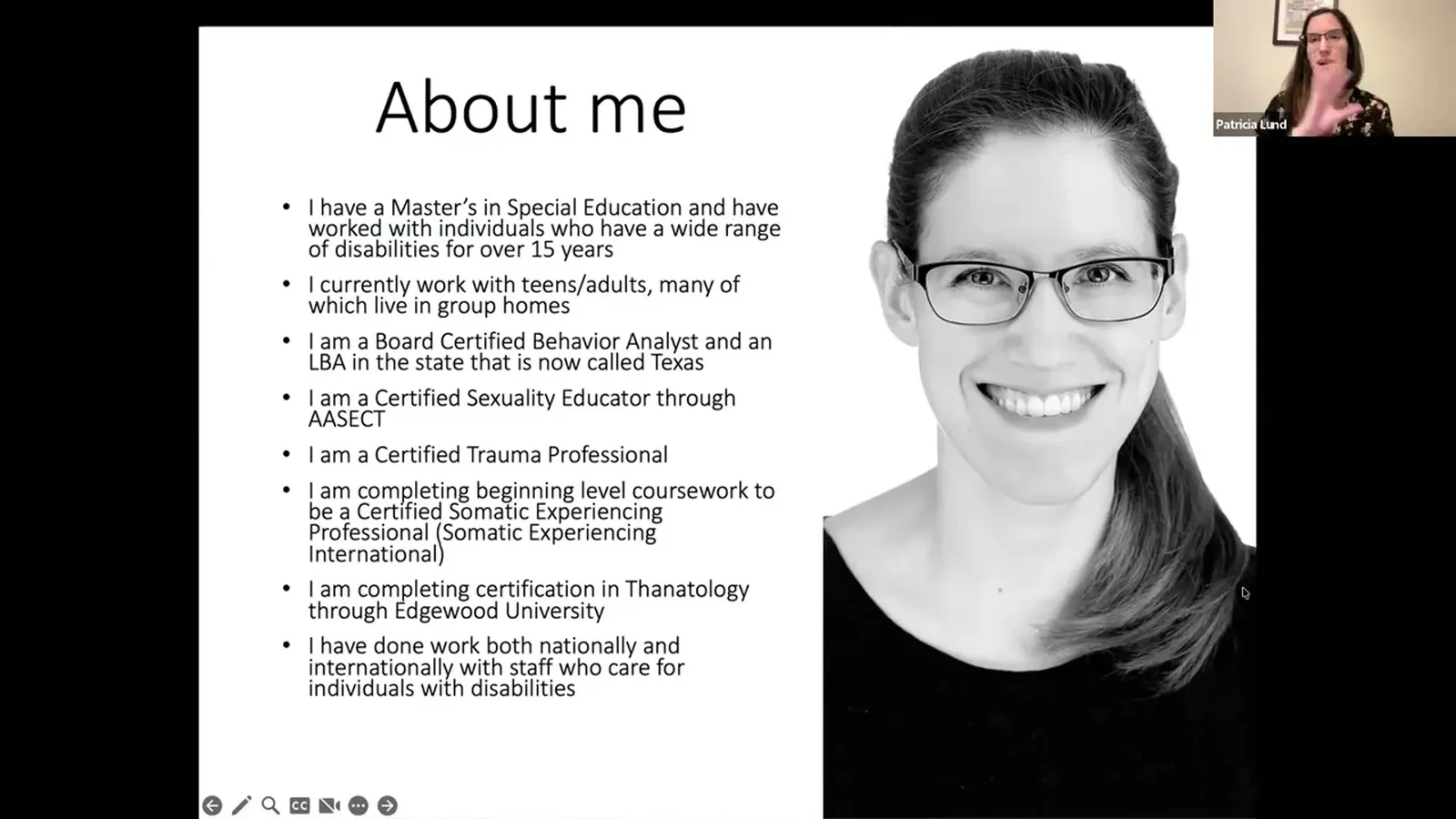
This is part of why Tricia Lund, the BCBA who led this session, frames the BCBA role inside the Reed and Elliott continuum from the UK literature. Most clients don't need formal therapy after a death. They need death education, help participating in the funeral or memorial, and a safe person who lets them talk. Your job sits inside those first three tiers. The fourth tier, focused intervention by a licensed mental health professional, is where you refer. Knowing when to make that call is the whole point of this page.
What the Bereavement Studies Actually Found (1993, 1997, Follow-Up)#
There are three studies BCBAs working in IDD should know by name.
Harper and Wadsworth, 1993. 43 adults with moderate to severe IDD were interviewed about a personal loss. 25 said it was very disruptive. They reported anger, anxiety, confusion, and discomfort. Some of that is a normal grief response. When the client and the team are both calling it disruptive, that is the signal that the response has moved past normal.
1997 parent loss study. 50 people with IDD who had lost a parent within the last two years were compared to a control group. Even two years out, the bereaved group had more irritability, lethargy, inappropriate speech, and hyperactivity.
Bunnell and Pascal follow-up. They went back to a subset of those same participants two years after the 1997 study. Five to eight years after the loss, behavioral manifestations had increased, not decreased. The original researchers split their data into psychopathology (anxiety, mood) and behavior. The behavior side is what got worse over time.
What this means for your practice. A client whose mom died four years ago and whose SIB has slowly trended up over the last 18 months may not be having a behavior plan problem. They may be having a grief problem that no one connected to the loss because too much time has passed.
The Four Behavior Dimensions to Track After a Loss#
Frequency alone will not catch this. Track all four.
Severity. Was the SIB a head tap before, and now it's leaving a mark? Was the aggression a shove, and now it's a closed fist? Score it on whatever scale your team uses and watch the slope.
Duration. How long does a dysregulation episode last from onset to back-to-baseline? If a client used to come down in 10 minutes and now takes an hour, that is a duration shift even if frequency is flat.
Topography. What does the behavior actually look like? A client who used to hit their own thigh and now bites their own hand is showing a topography shift. New topographies often get logged as "new behavior" when they are really an escalation of an old one.
Latency to calm. This is the one most teams skip. How long after the trigger is removed does it take for the client to return to baseline arousal? Long latencies often mean the nervous system is staying activated longer, which is what trauma and unresolved grief tend to do.
Pull the last 90 days before the death loss and the 90 days after. Graph all four. Bring that to the rest of the team. This is the data nobody else has.
"BCBAs can really be helpful when it comes to referring out because we know behavior. We can give information about the behaviors that we saw before the death loss and after the death loss. Maybe SIB increased in severity. Maybe dysregulation is really long, whereas before they could calm down. Maybe the topography has changed." From the talk — Patricia Lund
When SIB, Aggression, or Dysregulation Means Refer Out#
Patricia gave a short list of situations where she escalates to a Licensed Professional Counselor (LPC) or another mental health provider without waiting to see if the behavior trend reverses on its own.
- The death was a suicide. The client may have been told, may have overheard, or may have found the body. All three need a mental health professional.
- The death involved a violent crime. Especially if the client witnessed any part of it. This is closer to trauma than to grief.
- The client witnessed the death. Even a medical death at home that the client saw can produce a trauma response, not just a grief response.
- The loss was a primary caregiver. The person who handled feeding, bathing, scheduling, and emotional regulation. The disruption to daily life is large enough that almost every client in this bucket benefits from added support.
- Your behavior data shows a clear shift on severity, duration, topography, or latency that has not improved in 4 to 6 weeks.
- You don't feel competent to handle what is coming up. That is not failure. That is the ethical code (1.05) doing exactly what it is supposed to do.
Patricia does not love the phrase "refer out." She prefers collaborate, because the BCBA stays on the team. The LPC is added, not substituted.
"Usually in severe instances like suicide, a violent crime where the individual witnessed a lot, the death of a primary caregiver that can lead to a lot of disruption, that's when I would typically look to refer out." From the talk — Patricia Lund
Diagnostic Overshadowing: Why It's Probably Not 'Just Autism'#
Lisa Trelevin, the LPC on this presentation, made the point that mental health diagnoses are under-recognized in people with IDD because of diagnostic overshadowing. New symptoms get attributed to the IDD or the autism, and a separate diagnosis that would respond to a real, evidence-based intervention gets missed. The diagnoses she sees miss most often in this population after a loss are prolonged grief disorder, depressive disorders, mood disorders, post-traumatic stress disorder when the death was violent, and separation anxiety.
Your behavior data is the antidote. When you can show a counselor that severity, duration, topography, and latency all shifted in the same direction starting within days of the death, you've handed them the timeline they need to consider those diagnoses seriously instead of writing the new behavior off as a baseline feature of the IDD.
"Mental health diagnoses are under-recognized in individuals with IDD because of diagnostic overshadowing, meaning behaviors and symptoms of a disorder are falsely attributed to their existing diagnoses, when really there is another diagnosis that would benefit from targeted, evidence-based intervention." From the talk — Patricia Lund
What to Send the LPC When You Collaborate#
When you make the referral, send a one-page packet. Not a full report. The counselor doesn't need your treatment plan history. They need the change.
- Pre-loss baseline. 90 days of data on the target behaviors with all four dimensions plotted.
- Post-loss data. 90 days after the death, same dimensions.
- A timeline. Date of death, date the client was told, date of the funeral or memorial, date you started seeing changes.
- What the client knows. Have they been told the person is dead? Did anyone explain it in concrete terms? Have they been to the burial or memorial?
- Communication notes. Does the client use augmentative and alternative communication (AAC), sign, or speech? Do they have the words "dead," "died," "gone," "where," and "how long" in their system?
- Your scope statement. One line. Something like, "I'm continuing skill acquisition and behavior reduction targets and would like your support on the grief response."
This is enough for the LPC to start. They will ask for more if they need it.
Frequently asked questions#
How long after a death is it normal for behaviors to get worse? The 1997 study still saw elevated behavior at the two-year mark. The Bunnell and Pascal follow-up still saw worsening at five to eight years. There is no clean cutoff. If your data shifts on severity, duration, topography, or latency and stays shifted for 4 to 6 weeks, treat that as the signal to escalate, regardless of how long it has been since the death.
Can grief look like a regression to old behaviors we already extinguished? Yes. Clients can return to topographies you haven't seen in years. That is one of the clearest markers in the data that something separate from the current treatment plan is driving the behavior. Note the date the old topography reappeared and how it lines up with the death.
Is a prolonged grief disorder diagnosis possible for someone with IDD? Yes. Lisa specifically called this out as a diagnosis the LPC can make and that diagnostic overshadowing tends to hide. Other diagnoses she listed include depressive and mood disorders, post-traumatic stress disorder when the death was violent, and separation anxiety. A diagnosis can also be the gate that unlocks insurance coverage for the right services.
Watch the full CEU#
If you want the whole framework, including the Reed and Elliott continuum, the dead plant lesson, and the aging timeline activity, the recorded session is on openceu.com. It's free and it counts for one ethics CEU.
Turn this topic into a CEU
You just studied this. Now get credit for it.
Watch Interdisciplinary Grief Support for People with Disabilities: Enhancing Outcomes Through BCBA-LPC Collaboration with Patricia Lund and earn 1 free BCBA CEU. Detailed certificate, delivered the moment you finish.
Keep going with a free learning path
Your 4 Ethics CEUs, Done
Four ethics CEUs in three courses, all free. Start with Matt Harrington's assent and data course, then ethical guardrails in behavior reduction, then cultural considerations in clinical practice. Every course carries ethics credit, so this path covers the BACB requirement with nothing to buy.