How the Words You Pick for a Behavior Plan Create Bias
Why 'violent,' 'non-compliant,' and 'attention-seeking' bias every reader after you, and what to write instead from a BCBA-led CEU.
Key takeaway
A 14-year-old hits someone and your plan says "violent behavior." A 3-year-old hits someone and your plan says "made body contact with others." Same hand.
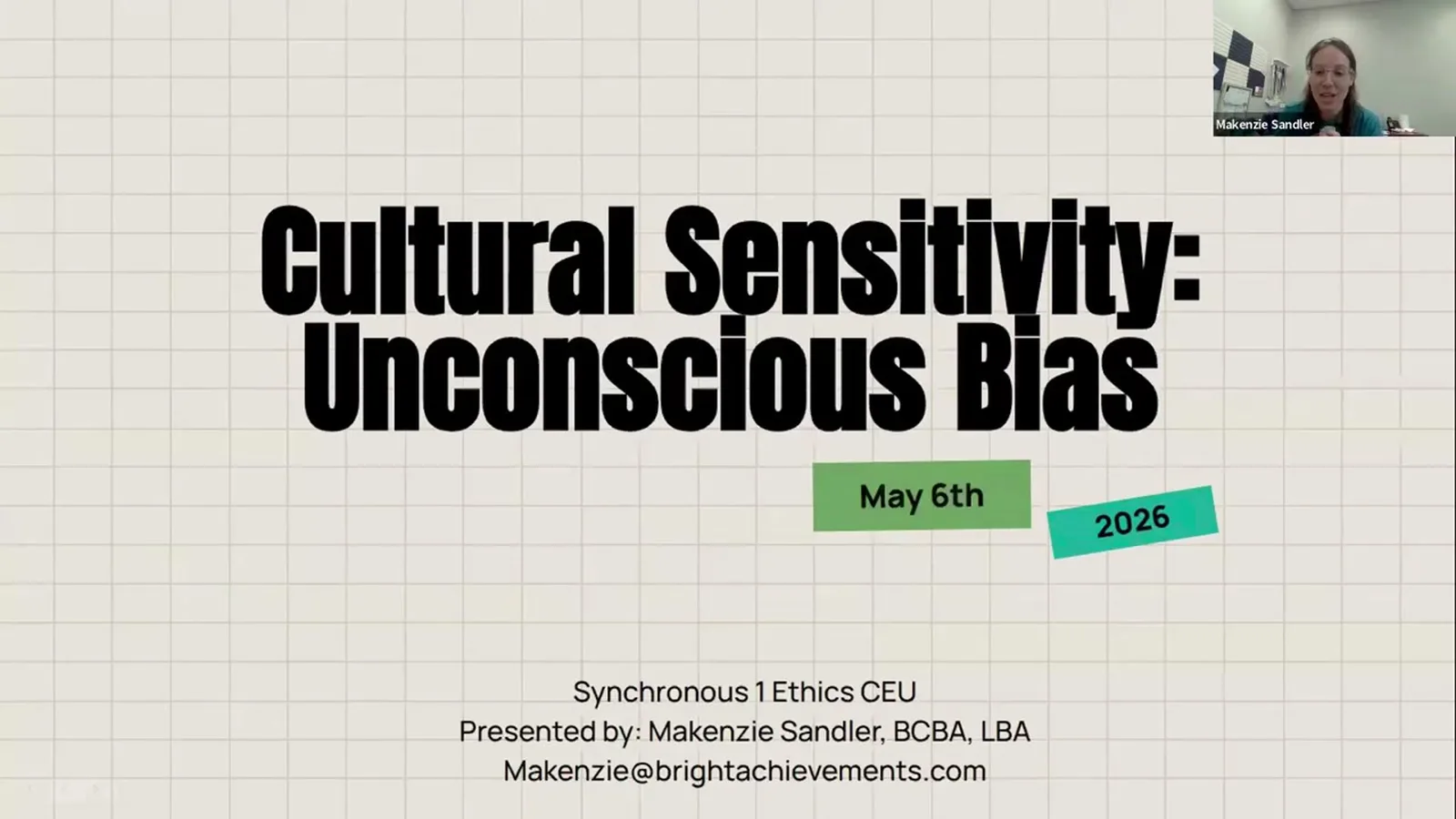
Cultural Sensitivity: Unconscious Bias
On this page · 8 sections▾
A 14-year-old hits someone and your plan says "violent behavior." A 3-year-old hits someone and your plan says "made body contact with others." Same hand. Same target. Two very different labels. That single word choice biases every teacher, RBT, insurance reviewer, and judge who reads the plan after you. Then there is "non-compliance," which does not even pass the dead man's test (a dead person can be perfectly non-compliant, so it is not a behavior). And there is "attention-seeking," which we can swap for "seeking connection" without losing one bit of clinical meaning. The labels we pick in BIPs follow learners for years. This page walks you through the swaps, the reason they matter, and the honest reason most of us were taught to write plans that sound bad in the first place.
The same behavior, two labels: why a 14-year-old gets called "violent" and a 3-year-old doesn't#
The behavior is the same. A hand makes contact with another person's body. The topography is identical. But the label that ends up in the chart is not. With a teenager we reach for "violent behavior" or "aggression." With a toddler we reach for "made body contact" or "rough play." Why?
Age. Size. Skin color. Diagnosis. The picture we already had in our head before we sat down to write.
That is unconscious bias. It is not a moral failing. It is a pattern of reinforcement from every news story, every prior chart, every IEP table we have sat at. The problem is not that you have it. The problem is that the word lands on the page, and then the page travels.
The next clinician reads "violent" and walks into the session braced. The teacher reads it and seats the student in the back. The insurance reviewer reads it and approves more restrictive supports. The label became the lens.
"Are you labeling a 14 year old that hits people as violent behavior or physical aggression, but a three year old that hits people making body contact with others? How are you labeling it? I've often sat in IEPs and asked them, please take the word violence out. Violence is very different than physical aggression." From the talk — Mackenzie Sandler
Why "non-compliance" fails the dead man's test#
The dead man's test is a basic rule from Ogden Lindsley. If a dead person can do it, it is not a behavior. A dead person never follows directions. A dead person is the world champion of non-compliance.
So "non-compliance" is not a behavior. It is the absence of one. And the second we write it in a plan, we have done two things wrong. We have failed our own field's definition of behavior. And we have planted a story in the next reader's head: this kid will not cooperate.
Write what the learner did, not what they did not do. "Walked away from the table when asked to start math." "Said no and crossed arms." "Continued tapping the iPad for 14 seconds after the SD." Those are behaviors. They are countable. They give the next clinician something to teach toward instead of a label to brace against.
"Take out non-compliance. Non-compliance doesn't pass the dead man's test and it creates unconscious bias toward that learner. Oh, they're going to be uncompliant, non-compliant." From the talk — Mackenzie Sandler
The language swap table: 7 biased labels and what to write instead#
You do not need to throw out your whole plan. You need to do find-and-replace on seven phrases.
| Biased label | Write this instead | Why the swap helps |
|---|---|---|
| Non-compliance | "Walked away from task," "said no," "remained seated when asked to stand" | Passes the dead man's test. Tells the next reader what to teach. |
| Problem behavior | Target behavior | "Problem" is in the eye of the adult. "Target" names what we are working on. |
| Attention-seeking | Seeking connection | Same function. Warmer story. Stops staff from withholding social attention as "the plan." |
| Violent behavior | Physical aggression in the form of (hitting, choking, kicking) | "Violent" implies intent and character. "Physical aggression" is a response class. |
| Tantrum | Dysregulation, or the operational form (crying, dropping to the floor, screaming) | "Tantrum" sounds willful. "Dysregulation" tells the team to co-regulate, not punish. |
| Manipulative | Skilled at getting needs met through (asking, refusing, negotiating) | Names the actual skill. Removes the moral judgment. |
| Elopement (when used as a personality trait) | Leaves the assigned area; moves more than X feet from the adult | "He is a flight risk" follows a kid for 14 years. The operational form does not. |
The point is not that "violent" is never accurate. Sometimes it is. The point is that almost every time we reach for it, we have a less loaded option that is also more measurable. Pick the more measurable one.
"Maybe we don't call it attention-seeking behavior anymore and you actually call it seeking connection. That unconscious bias won't lie in that learners or that student, you know, on their record or constantly talking, oh, that kid's so attention-seeking versus, oh, that kid seeks attention, seeks connection a lot." From the talk — Mackenzie Sandler
The insurance trap: why BCBAs were taught to make plans "sound bad"#
Here is the honest part most CEUs skip. A lot of us were taught to write plans this way on purpose.
"Make your behavior plan bad. When you submit to insurance, show that there is challenges and issues." That was the lesson. So we loaded the plan with the worst-day language. We picked the strongest verbs. Then we called the parent and said, "Hey, I wrote this very negatively so it would get approved."
It worked. It still does sometimes. Reviewers fund severity. Severity reads in nouns and adjectives.
The trap is that the plan does not stay with the reviewer. It goes to the school. It goes to the next BCBA. It goes to the group home staff who reads it 14 years later and decides the now-22-year-old cannot live on a second floor because at age eight he put on a Superman cape and tried to jump out a window. One sentence. One cape. Fourteen years of restriction.
You can show medical necessity without loading the reader. Write the operational definition crisply. Include frequency, duration, intensity, and a real risk paragraph. Document the safety concerns in the risk section, not in the noun you use for the behavior itself. "Places hands on another person's neck with enough pressure to leave redness, occurring at a mean rate of 1.2 per hour across the last 30 sessions" gets funded. It also does not tell the next reader that this child is "violent."
"When I was a baby BCBA, I was taught, make your behavior plan bad. Like when you submit to insurance show that there is challenges and issues. And then I would turn around and tell the parents, Hey, I wrote this very negatively." From the talk — Mackenzie Sandler
How to define a choke or hit without loading the reader#
Some behaviors really are dangerous. The reframe is not to soften them. The reframe is to break the response class apart so the words you do use carry only what they need to carry.
Instead of "physical aggression," try two separate operational definitions. One for hitting. One for choking. Each one gets its own count, its own antecedent, its own teaching plan. Then roll them up under a neutral category name like "physical behavior toward others" for reporting.
You keep the precision. You lose the loaded noun. The reviewer sees the data. The next clinician sees the topography, not the story.
And on "problem behavior" itself, ask the question Mackenzie keeps asking: who is it a problem for? If the answer is "the adult in the room" and not "the learner," that is a clue to look harder at the goal before you look harder at the kid. Usually the behavior is adaptive and functional for the learner. The problem is ours. So we drop "problem behavior" and write "target behavior." A target to increase, or a target to decrease. Same plan. Less freight.
Auditing your active treatment plans this week#
You do not need to rewrite everything. Spend 30 minutes this week and do a label audit on your active plans.
- Open each active BIP and search for "non-compliance," "violent," "tantrum," "attention-seeking," "manipulative," "problem behavior," and "aggression."
- For each hit, ask: does the word add clinical information that the operational definition does not? If no, swap it.
- For each "problem behavior," write down who the behavior is a problem for. If it is not the learner, consider whether the goal belongs in the plan at all.
- Read the first paragraph of each plan as if you were a teacher meeting this learner Monday morning. What picture is forming in your head? That picture is the bias the words just installed.
- Pick one plan, send it to a peer, and ask them to circle every word that primed them. That is your starting list.
You will not catch every label. You will not catch your own unconscious bias on the first pass. That is fine. The point is to start the data review on yourself.
Frequently asked questions#
Is it ever okay to use the word "aggression" in a behavior plan? Yes, when it is the most precise word available. "Physical aggression in the form of hitting and slapping" is fine. The trap is "violent," "aggressive," or "violent aggression" as a stand-alone trait. Use aggression to name a response class. Do not use it to name the kid.
What do I write for insurance reviewers who need to see severity? Move severity into the data and the risk paragraph, not the label. Frequency, duration, intensity, injury history, and ER visits get funded. So does a crisp operational definition with a real risk statement. You do not need the word "violent" to clear medical necessity. You need the numbers.
How do I push back when a school district insists on the word "violent"? Bring the dead man's test argument and the response class argument. Offer to keep the operational definition the team wants, but ask to swap the category noun to "physical behavior toward others" or "physical aggression." Frame it as protecting the student from being prejudged by every reader downstream. Most teams will agree once you name the downstream reader.
Watch the full session and rewrite one plan today#
The talk has more examples than this page can hold, including the Superman cape story and the chokehold definition discussion. It is one hour, free, BACB-eligible.
Watch the full CEU on openceu.com
Then pick one active plan and do the label audit above. The next clinician who reads that chart will thank you.
Turn this topic into a CEU
You just studied this. Now get credit for it.
Watch Cultural Sensitivity: Unconscious Bias with Mackenzie Sandler and earn 1 free BCBA CEU. Detailed certificate, delivered the moment you finish.