How a BCBA Consults With an LPC on a Grief Case Without Crossing Scope
Practical script for BCBA and LPC collaboration on a grieving client with IDD or autism. Who owns what, from a BCBA-led CEU.
Key takeaway
This is the BCBA-side playbook for picking up the phone and starting a real partnership with a licensed professional counselor on one specific grief case, when your client has IDD or autism and you have never run a co-treatment like this before.
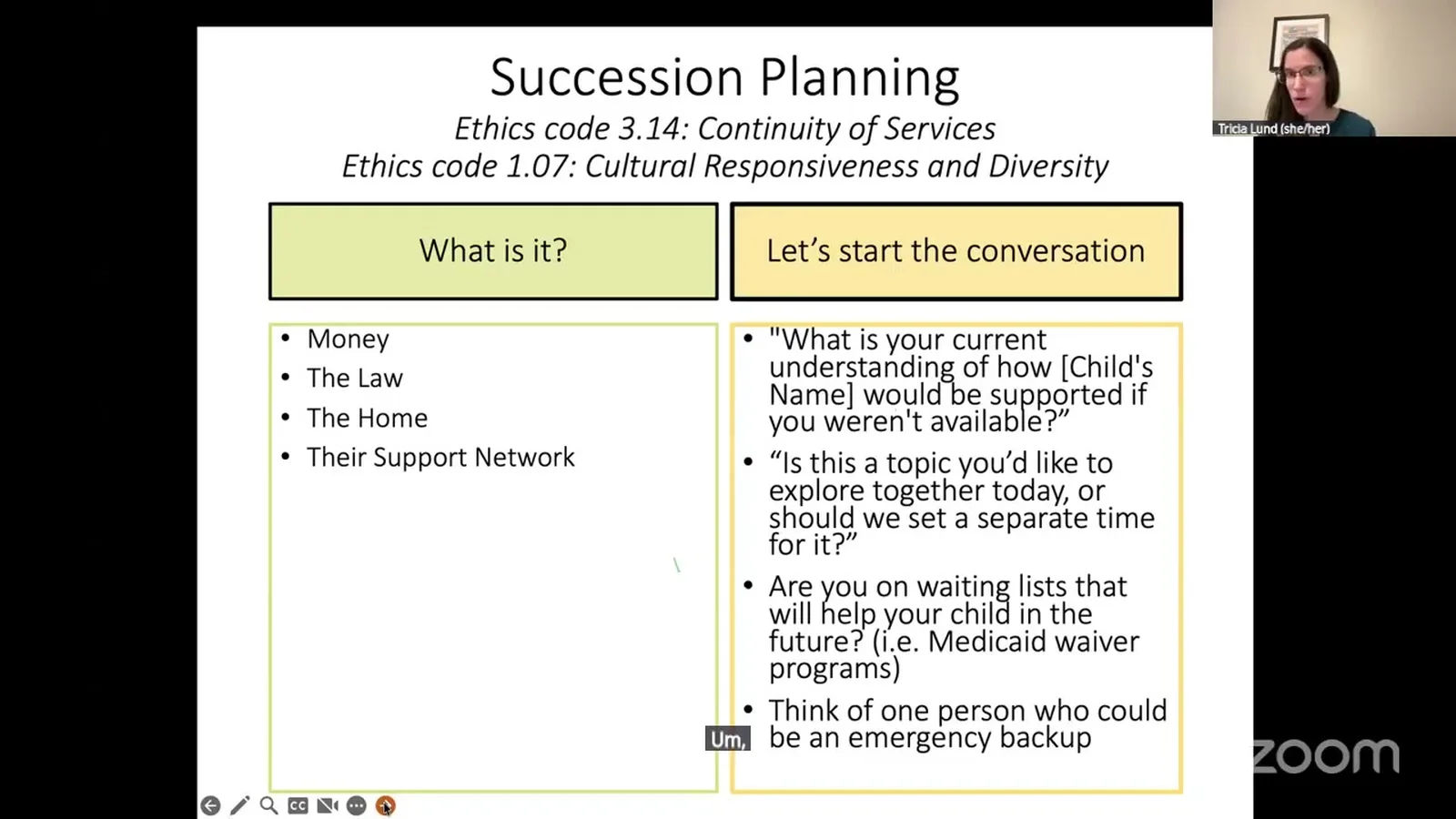
Increasing Competence and Confidence in Helping People with Disabilities through Grief
Free learning path on this topic
Your 4 Ethics CEUs, Done
Four ethics CEUs in three courses, all free. Start with Matt Harrington's assent and data course, then ethical guardrails in behavior reduction, then cultural considerations in clinical practice. Every course carries ethics credit, so this path covers the BACB requirement with nothing to buy.
On this page · 10 sections▾
This is the BCBA-side playbook for picking up the phone and starting a real partnership with a licensed professional counselor on one specific grief case, when your client has IDD or autism and you have never run a co-treatment like this before. You are not going to become a grief therapist. You are going to bring what you already know about the client, hand the emotional processing work to the LPC, and build a shared plan that keeps the case from falling apart in the messy weeks after a caregiver dies.
Why a BCBA-only or LPC-only plan usually fails for clients with IDD#
A BCBA-only plan tends to treat every new behavior as a behavior plan problem. The client starts hitting more, eloping more, refusing to eat. The team writes a new intervention. Nobody on the team is trained to sit with a grieving adult and help them process what just happened to their world. The behavior plan papers over the grief instead of making space for it.
An LPC-only plan has the opposite problem. The counselor is trained to do grief work, but if the client uses few words, scripts a lot, or needs visual supports, the LPC may not know how to adjust. Standard talk therapy was not built for a client who points to a picture board to say goodbye. Patricia Lund put it this way during the CEU:
Very well-meaning LPCs and mental health practitioners don't always know how to adapt some of their therapies to work with individuals that have some of these differences.
The clean answer is both providers in the room, with a clear split. When the LPC has the emotional processing seat and the BCBA has the environment seat, the client gets a real grief response and the day-to-day support holds together.
What the LPC owns: emotional processing, grief therapy modality#
The LPC owns the inside work. That includes naming feelings, choosing a grief therapy approach, deciding when the client is ready to look at a photo of the person who died, and tracking how the client is moving through the loss over time. The LPC also owns any formal grief-related diagnosis, like prolonged grief disorder. BCBAs do not diagnose, and the BCBA does not pick the grief modality.
When you bring an LPC in, you tell them clearly: you are here to do grief therapy. We are here to set up everything around the therapy so it can work.
What the BCBA owns: behavior data, setting events, environmental supports#
The BCBA owns the outside work. You already know how to do this part, you just need to point it at grief.
- Behavior data. Frequency, duration, and topography of any behaviors the team is worried about, before the loss and after. This is the data the LPC almost never has and almost always needs.
- Setting events. Sleep, food intake, medical appointments, schedule changes, loss of access to a favorite staff member, the new ride to the day program. Each one of these can spike a grief response and look like a behavior plan failure.
- Environmental supports. Visual schedules, choice boards, communication systems, a person-mapped support network on the wall. Anything in the client's day that lowers demand and raises predictability.
- Advocacy with the team. Group home staff, day program staff, family. You are the one who can say in a team meeting that the new behavior is a grief response and not a misbehavior to be punished.
If the LPC is doing the inside work and you are doing the outside work, the client gets both at once, which is what they needed all along.
The shared zone: communication adaptations and visuals#
The middle of the Venn diagram is communication. The LPC has a session goal. The client has a way they communicate. You translate.
That can look like a few different things. You might build a feelings choice board with the client's existing icons before the LPC session so the client can point to "sad" or "angry" or "I miss him" instead of having to say it. You might create a visual timeline of the day the person died so the LPC can use it as a session tool. You might write a short script for the staff who drive the client to the session so the transition does not blow up before the counseling even starts.
The rule of thumb: if the support is about how the client talks about grief, you both touch it. If the support is about what the client feels inside, the LPC leads.
A sample intake call between BCBA and LPC#
This is the call you have not made yet. Here is a version that has worked. Keep it to twenty minutes.
- Open with the client, not your title. "I work with Marcus. He is 31, has Down syndrome, and his dad died three weeks ago. I am his BCBA. I am calling because I think he needs grief therapy and I think we need to do this together."
- Name what you do not do. "I do not run grief therapy and I do not diagnose. I can bring you a clear behavior history and I can shape his environment around your sessions."
- Ask what the LPC needs from you. Common answers: a behavior baseline, a list of setting events, a sense of how Marcus communicates, family contact info, and what already changed in his daily routine.
- Offer the shared zone. "I can build any visual supports you want to use in session. I can prep his staff for the day of each appointment."
- Agree on a check-in cadence. A fifteen-minute call every two weeks is usually enough. Put it on the calendar before you hang up.
- Decide how you will write this up. One shared treatment summary is better than two parallel notes that never meet.
That is the whole first call. You are not asking for permission. You are offering a real partnership.
How to write a joint treatment summary#
The joint summary should fit on one page and answer five questions in plain language. Who is the client. What happened. What the LPC is doing. What the BCBA is doing. How we will know it is working.
Write the behavior section in measurable terms, the way you always do. Ask the LPC to write the grief therapy section in their own words. Do not rewrite their part to sound more behavioral. The point of the summary is that two professions are saying, on the same page, that they are working on the same client.
Share it with the family and with the group home or day program. Ask for a signature if your setting requires one. Keep a copy in both clinical records.
Handling disagreements about challenging behavior versus grief response#
You will disagree. The most common version: the LPC thinks every new behavior is grief. You think some of it is a function the client had before the loss. Or the other way around, the LPC thinks the client is "doing fine" because she is quiet, and you are watching a slow rise in self-injury that nobody else has noticed.
A few things help here.
- Bring the data. Not a feeling about the data. The actual chart.
- Separate the question. Ask, "Is this behavior new since the loss, or was it already happening at this rate?" If it is new or much higher, grief response gets the first hypothesis. If it is the same rate, your existing function still applies.
- Remember the client. As Patricia Lund noted, advocacy is part of the BCBA role here:
We can talk to, I mean, not just fellow BCBAs, group home staff that we work with, parents that we work with.
You are both advocates on the same side of the table. The disagreement is about how to read the data, not about who cares more.
Documenting the handoff so nothing falls through the cracks#
The week the LPC starts seeing the client, write down five things and share them with the whole team:
- Day and time of LPC sessions for the next month.
- Who drives the client to the session and what the prep looks like.
- What the LPC has asked the team to do or avoid between sessions.
- What the BCBA is tracking and how often that gets shared with the LPC.
- One emergency contact for each provider in case a session brings up something big.
A grief case falls apart when one person quits, one staff member rotates off, or one parent misses a meeting. Written handoffs hold the line.
FAQ#
Should a BCBA refer every grief case to an LPC? Not every one. If the client is showing mild, time-limited grief responses and the family has support, you may just need to coach the environment. Refer when grief responses are intense, when they last more than a few weeks at high rates, when the client asks for help processing, or when you feel out of your competence.
What does a BCBA bring to an LPC-led grief case? Behavior baseline data, setting event analysis, communication supports, advocacy with staff and family, and a steady presence in the client's everyday environment. You are the LPC's eyes between sessions.
How do I get an LPC on board with a behavior analytic view of grief? Lead with the client, not the jargon. Show one chart that maps behaviors before and after the loss. Most LPCs respond to clear data and to a BCBA who says, "I am not here to do your job."
Who writes the goals when grief overlaps with challenging behavior? Each provider writes the goals in their own scope. The LPC writes the grief processing goals. The BCBA writes the behavior reduction or skill acquisition goals. The joint summary shows how they connect.
What if the LPC has never worked with a client with IDD? Offer to coach the communication side. Share what works for this specific client. Send a one-page client snapshot before the first session. Most LPCs are grateful for the bridge.
What to do this week#
Pick one client whose caregiver has died in the past year. Look up two LPCs in your area who list grief or bereavement on their profile. Call the first one with the script above. If you want the behavioral framing that anchors the rest of the case, watch Patricia Lund's full CEU and bring her language into your first session with the LPC.
Turn this topic into a CEU
You just studied this. Now get credit for it.
Watch Increasing Competence and Confidence in Helping People with Disabilities through Grief with Patricia Lund and earn 1 free BCBA CEU. Detailed certificate, delivered the moment you finish.
Keep going with a free learning path
Your 4 Ethics CEUs, Done
Four ethics CEUs in three courses, all free. Start with Matt Harrington's assent and data course, then ethical guardrails in behavior reduction, then cultural considerations in clinical practice. Every course carries ethics credit, so this path covers the BACB requirement with nothing to buy.