Whose Values Are Driving the Goal? A BCBA's Guide to Culturally Responsive Goal Selection
How to pick ABA goals that match the learner's culture instead of yours, with the independence-vs-interdependence test from a BCBA-led CEU.
Key takeaway
Independence or interdependence? Compliance or autonomy? Those are the questions a BCBA has to ask before they write a single goal, and most goal banks never make you ask them.
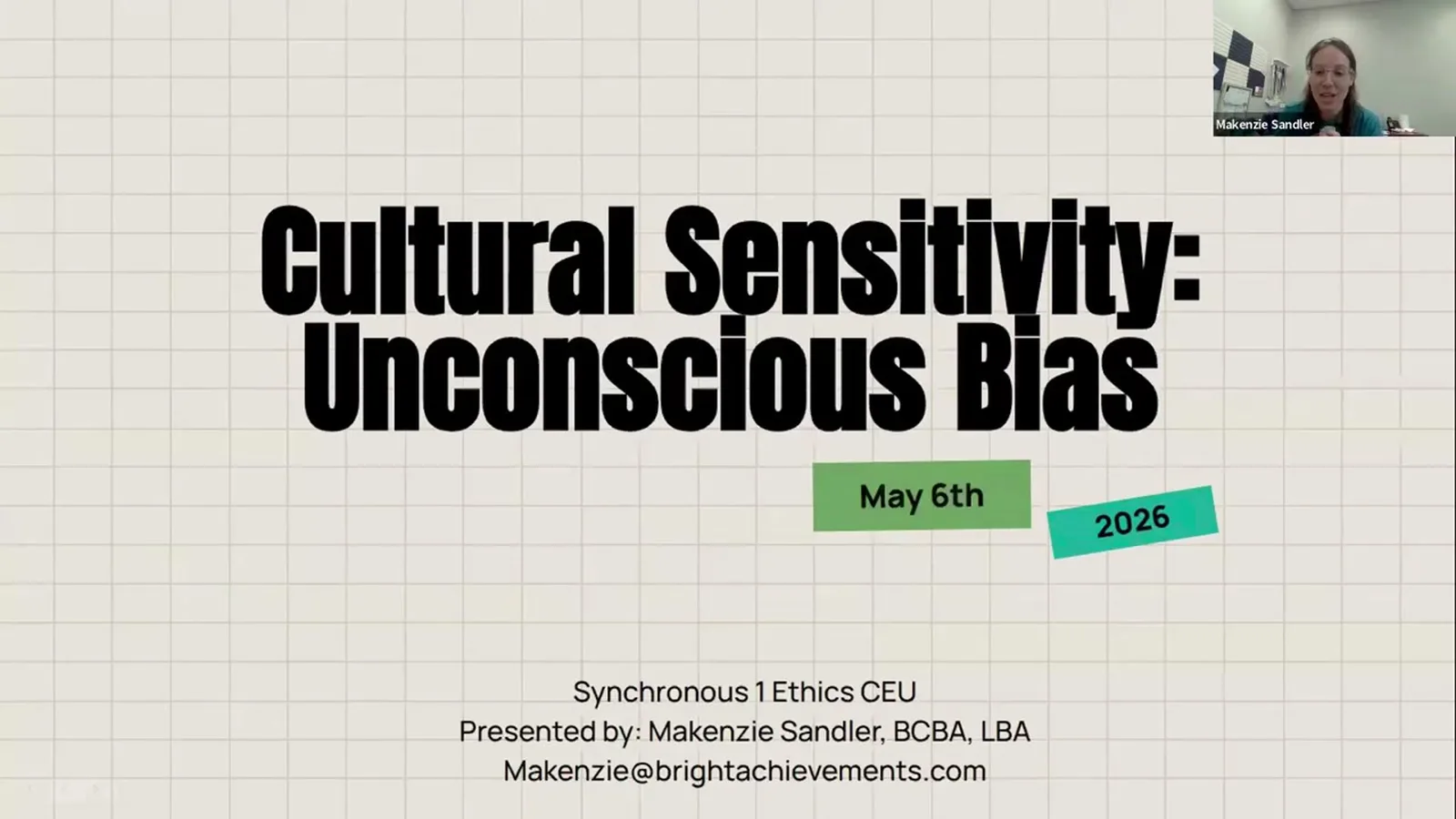
Cultural Sensitivity: Unconscious Bias
On this page · 8 sections▾
Independence or interdependence? Compliance or autonomy? Those are the questions a BCBA has to ask before they write a single goal, and most goal banks never make you ask them. Mackenzie Sandler put it plainly in her CEU: she has worked with families who hand-feed their children until they are eight or nine years old because that is what their community values, and she also grew up where kids hold a fork at age two. Both are real. Neither is wrong. She also named a harder one. In the South it is legal to spank a child as punishment. In New York, the same act gets CPS at the door. A BCBA writing a behavior plan does not get to skip that gap. And here is the part that makes this a behavior-analytic problem and not just a values problem. Every goal you write will hit a reinforcement schedule the second the session ends. If the goal gets reinforced at home, it grows. If the goal gets punished at home, you are setting that learner up to lose. Culturally responsive goal selection is not a vibe. It is a reinforcement check.
The Question That Reorders Every Goal Bank: Whose Values Are Driving This?#
There are 1,200 goals in the latest assessment on your desk. You cannot pick all of them. So which ones do you pick first? Most BCBAs pick based on what they were trained to think a child should be able to do at a certain age. That is your value. That is your background. That is your unconscious bias talking. The first move in culturally responsive goal selection is to stop and name whose values you are actually pulling from.
Sandler is direct about this. Before you lock a goal into the treatment plan, ask three questions. Whose values are driving this goal? Where is the end point for this specific target? Which behavior is correct? That last one is a trick question. Values are not right or wrong. They are important to the person who holds them. A goal that is "correct" in your head can be wrong for that family. Your job is alignment, not correctness.
Independence vs Interdependence: The Test That Catches 80% of Cultural Mismatches#
Here is the cleanest filter in the whole talk. Independence versus interdependence. Some families want their child to do things alone. Some families want their child to do things as part of the group. Both are healthy. Both are functional. The mismatch shows up when a BCBA who grew up valuing independence writes a treatment plan for a family that values interdependence and calls the family "non-compliant" when the goals stall.
Maybe things like independence versus interdependence, compliance versus autonomy. Think about that as a cultural kind of norm, if you will, where some cultures really prioritize compliancy, being part of the routine, being part of the group, following directions, not speaking up for yourself. From the talk — Mackenzie Sandler
Run this test on every goal you write this week. Pick one. Ask: does this goal move the learner toward doing more on their own, or does it move them toward fitting better with their group? Then ask the family which one they actually want. You will be surprised how often the two answers do not match. The mismatch is not the family being wrong. The mismatch is the goal being wrong.
When the Goal Will Be Punished at Home: The Reinforcement Schedule Check#
This is the section that makes the rest of the page behavior-analytic instead of just thoughtful. Every goal you teach in session has to survive in the home. The home has its own reinforcement schedule. If the goal lines up with what gets praised, fed, hugged, and noticed at home, it grows. If the goal gets ignored, corrected, or punished at home, you are running an extinction trial five days a week against your own program.
A teen learning to "speak up for yourself" in session who comes from a family where speaking up gets you sent to your room is not learning a skill. They are learning that the BCBA's session is the one place that behavior works, and the rest of life punishes it. That is not generalization. That is a setup for failure.
What voice are you giving that learner when you're making these behavior changes, these behavior goals, these targets, are they appropriate in their cultural setting? Will they be reinforced or will they actually be punished? From the talk — Mackenzie Sandler
So before you write the goal, ask the family one operational question. When my client does this behavior at home, what happens next? If the answer is "we praise it" or "we celebrate it" or "we give them more of what they wanted," the goal has a runway. If the answer is "we tell them to stop" or "we send them away" or "that is not how we do things in our family," the goal is wrong. Pick a different one.
The Hand-Feeding-at-Eight Story (and Three More Like It)#
This is the story that makes the whole frame real. Sandler has worked with families who hand-feed their children until age eight or nine because feeding the child is how love and connection get expressed in that culture. She grew up in a family where a toddler holds a spoon. Both are real childhoods. Both produce competent adults.
I've worked with families that choose to hand feed their children until they're eight, nine years old, because that is important and valuable in their community and culture where I'm from a background where I grew up where kids are feeding themselves at one, two years old with spoons and knives and forks. From the talk — Mackenzie Sandler
Three more like it that come up in real caseloads. A family who shares a bed with their nine-year-old, because co-sleeping is the norm in their home country, and your "independent sleep" goal is going to die on contact. A family who values quiet over expression, where your "request preferred items vocally" goal will get the learner shushed. A family who values strict structure, where your "tolerate flexibility" goal will get the learner praised for resisting it. Same skill, different home, opposite reinforcement. The goal has to match.
Compliance vs Autonomy: Why Some Cultures Want Their Kid to Sit Down and Some Want Them to Speak Up#
Compliance is treated like a dirty word in a lot of modern ABA training. It should not be. For some families, being part of the unit, following the routine, and not speaking up out of turn is a core cultural value. That is not oppression. That is a way of being a family. For other families, autonomy is the value, and a child who says "no thank you" is doing exactly what their parents want.
You cannot pick which one is "correct." You can only pick which one matches the family in front of you. A goal that builds autonomy in a family that values compliance will be punished at home. A goal that builds compliance in a family that values autonomy will get you fired. Ask. Do not assume.
And then there is the harder version. The South-versus-New-York example.
In the South, it's perfectly legal to spank your child as a punishment. And in New York, it's not, you'll get CPS called on you immediately. So what does that look like? How do you have these conversations where maybe you're like, Oh, spanking is, you know, should never be done, but the family is legally allowed. From the talk — Mackenzie Sandler
That is a real BCBA conversation, not a hypothetical. It happens every week. You are not going to "fix" the family's worldview in a 45-minute parent training. You can ask what they want for their child, where they want to end up, and what other strategies match their values. Then you can offer those strategies. That is culturally responsive practice. That is also still ethical practice.
Three Reflection Questions Before You Lock a Goal Into the Treatment Plan#
Before that goal goes into the EHR, run it through these three.
- Whose values are driving this goal? If the only answer is "mine" or "the assessment's," send it back.
- What is the reinforcement schedule at home for this exact behavior? If the home will punish it, the goal is wrong. Pick one the home will support.
- What does the learner think? If they can answer, ask them. Show them their data. Run a forced-choice preference assessment if they cannot answer in words. Their voice belongs on the page.
If the goal makes it through all three, write it. If it fails one, change it before you write it. That is the entire workflow.
Frequently asked questions#
What if the family's value will block the learner's safety or future independence?
Safety overrides. If a behavior is going to get the learner choked, hit by a car, or hospitalized, the goal targets safety, full stop. For everything else that is not a safety question, slow down. A lot of "future independence" arguments are actually the BCBA's value sneaking in dressed up as clinical urgency. Ask whose future. Ask the family what independence looks like for their child at age 30 in their community. Then write goals that get to that version, not yours.
How do I write a goal that respects culture but still passes insurance medical necessity?
Medical necessity does not require the goal to match middle-class American developmental norms. It requires the goal to address a deficit that interferes with functioning. Frame the goal around safety, communication, and access to the learner's own community. A goal that helps a child function in their family and culture is medically necessary. Use operational definitions, take data, and write the goal in the language of skill acquisition. The cultural frame goes in the rationale and the social validity section, not in the goal statement itself.
Is "cultural responsiveness" the same as "cultural competence" in ABA?
No. Cultural competence implies you can become "competent" in another culture, finish the box, and move on. Cultural responsiveness is ongoing. It is a practice, not a credential. Sandler's frame is honest about this. You will never be done. You will always have unconscious bias. The work is to name it, pause before goal selection, ask the family, and update the plan when you learn you were wrong.
Lock the goal to the right reinforcement schedule#
Whose values are driving the goal? If the answer is not the family and the learner, change the goal. If the home will punish the behavior you are teaching, change the goal. Watch Mackenzie Sandler's full CEU on cultural sensitivity and unconscious bias to see how she walks through the SCAD framework that gives you a way to do this every week, not just once.
Turn this topic into a CEU
You just studied this. Now get credit for it.
Watch Cultural Sensitivity: Unconscious Bias with Mackenzie Sandler and earn 1 free BCBA CEU. Detailed certificate, delivered the moment you finish.