A Day in the Life of a School-Based BCBA: Practical Routines That Work
What a school BCBA actually does all day: pre-meetings, observations, coaching, IEP work, and consent checks, from a BCBA-led CEU.
Key takeaway
By 7:45 a.m.
Practical Takeaways for School-Based Behavior Analysts
Free learning path on this topic
Supervision, Done Right
Four supervision CEUs that build on each other. What reflective supervision is, how to build a supervision system, how to assess supervisee competence instead of counting hours, and how supervision affects provider outcomes. The BACB asks supervisors for three supervision CEUs per cycle. This covers it.
On this page · 9 sections▾
By 7:45 a.m. you are on the phone with the principal for a pre-meeting, by 9:30 you are sitting in the back of a kindergarten classroom watching the morning routine, by 11:00 you are coaching the teacher in the hallway about prompts and behavior-specific praise, and by 2:00 you are reviewing data with the team to see if the plan held up. That is what a school-based BCBA, also called a board certified behavior analyst, actually does on a normal day. The work is less like running a clinic session and more like running a relay race with teachers, aides, the administrator, and the special education team.
This page walks through that day the way Dr. Kaci Ellis frames it in her CEU. She has been a special education teacher, a department chair, and now a BCBA, so she has lived both sides of the IEP table. Her main argument is simple. If you walk in as the hero who has all the answers, you will fail. If you walk in with an inquiry stance, ask the right questions up front, and protect your role with clear contracts, you will build a routine you can sustain.
What a school-based BCBA actually does (vs. what people think)#
People picture a BCBA in a school running 1:1 ABA sessions with one student all day. That is not the job. The job is mostly setup, observation, coaching, and team support. You may be on contract from a clinic, you may be an independent consultant, or you may be hired at the district level. Your scope shifts with each setup, but the core loop stays the same: ask, watch, coach, check the data, repeat.
Ellis ran a survey of 1,680 teachers in Florida and found that 79% who worked with a BCBA wanted to work with one again, mostly because the BCBA was a second set of eyes and made plans easier. The teachers who did not want to work with a BCBA again gave three reasons: the plans were not realistic, no resources were provided, and the BCBA stepped outside their role. Your day should be designed to avoid those three traps.
Morning: pre-meetings before you ever step in the classroom#
The first move of the day is a pre-meeting. This is true if you are the district BCBA and it is true if you are being consulted in from the outside. The point is to set a contract before any observation happens.
We want to have a pre-meeting. If you are the district BCBA, still having those pre-meetings with the school admin, or you're being consulted in, we want to have a contract, clear boundaries, clear expectations. From the talk — Dr. Kaci Ellis
A contract sounds formal, but it is really just a written page that says what you can do under your ethical code and what is outside your role. Ellis suggests building a personal matrix you bring to every new school. When the school later asks you to do something that crosses a line, you can point back to the page you both signed. That saves a hard conversation later.
In the same pre-meeting you also ask to review student data, look at what supports have already been tried, and listen. Ellis is clear that 15 minutes of listening before you ever sit in the classroom changes the rest of the engagement. If you cannot get 15 minutes face to face, send a short Google form or email with three questions: what is working, what is not, and what do you need.
The must-ask questions: IEP status, consent, and restraint policy#
There are three questions you do not skip. Ellis treats these as non-negotiable.
Does the student have an IEP? Has the parent been notified? And has consent been signed if needed? I would have these conversations up front before I step foot in the school. From the talk — Dr. Kaci Ellis
If the student has an Individualized Education Program, also called an IEP, under IDEA the school needs parent consent before a new assessment, before a functional behavior assessment, and before adding services. Reading the law carefully, that line covers your observation too if you are gathering data to drive a recommendation. The safe rule is to err on the side of consent every time.
The fourth must-ask is the restraint and seclusion policy. Only a small group of staff at most schools is trained in physical holds, and every state tracks restraints differently. You need to know the policy before a situation forces you to act.
You need to ask for the school's restraint policy. You as the BCBA need to be aware of what is the policy. From the talk — Dr. Kaci Ellis
Ask in the pre-meeting. Get it in writing. Know who to call if a student escalates. This is the kind of question that feels awkward to ask on day one and obvious on day thirty.
Midday: observations with an inquiry lens, not an evaluative one#
Once consent is set and the policies are clear, you go observe. The frame matters more than the form. You are not there to grade the teacher. You are there to gather information so the team can solve a problem together.
A useful observation has a few moving parts. You take objective notes on what the student does and what happens right before and right after. You also watch the classroom around the student. If most of the room is up and walking, the issue is not one child. It is a Tier 1 routine issue. If the teacher gave 35 negative feedback statements and three positive ones in 15 minutes, the climate is part of the picture. None of that is a teacher attack. It is data.
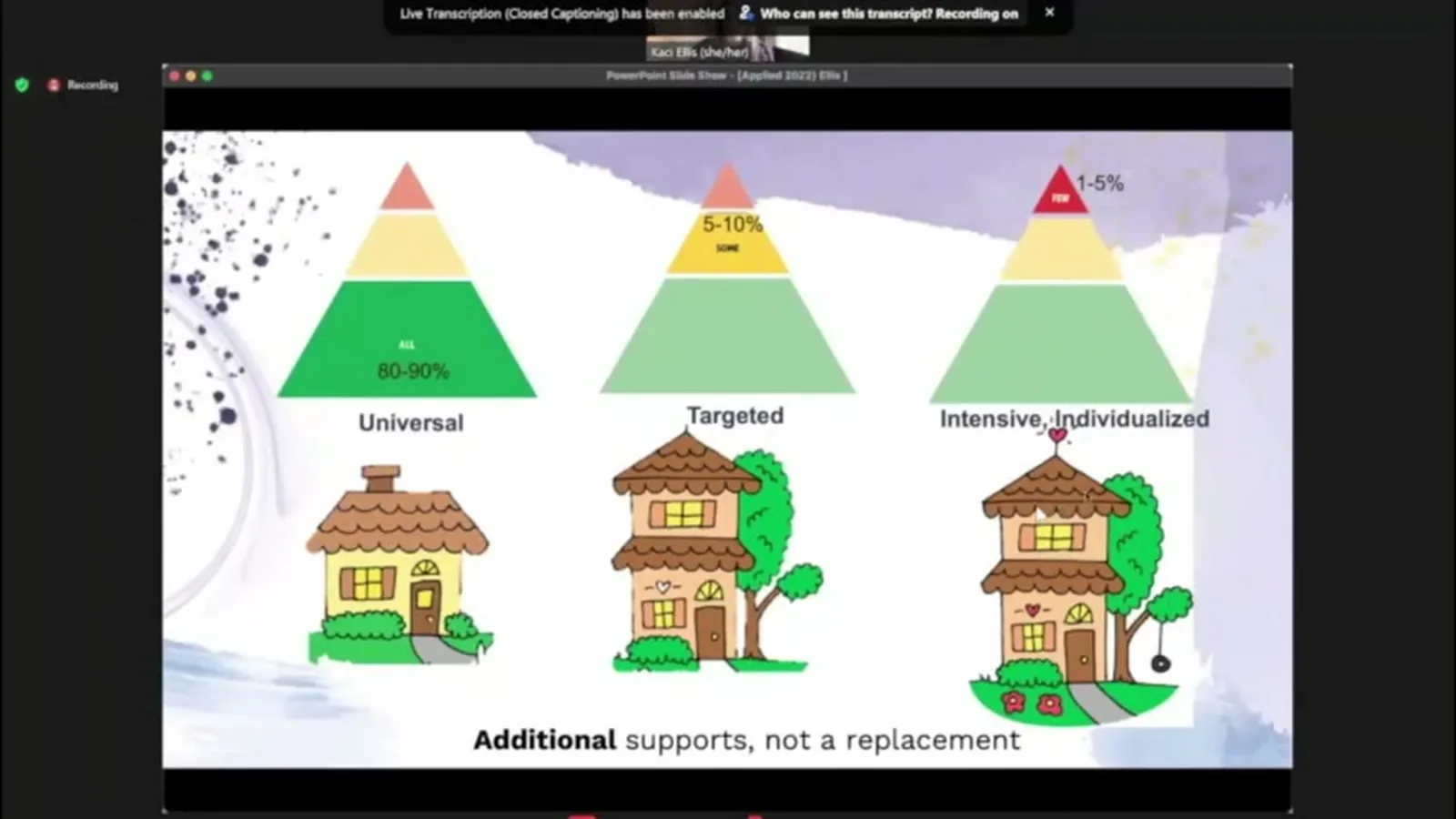
Ellis suggests a quick check before you write anything strong. If 16 of 20 students are meeting the expectation, Tier 1 is probably holding. If fewer than 16 are meeting the expectation, the foundation needs work before you write a Tier 3 plan. That single number can save you from writing a beautiful plan on a broken base.
Other things to count during the observation: opportunities to respond, prompts before transitions, behavior-specific praise, group contingencies, and any token economy in use. If you see a token economy running but the rules were never taught, that is something to bring back to the team as a friendly question, not a verdict.
Afternoon: coaching teachers and writing feasible plans#
After the observation, you sit with the teacher or the team. The script Ellis uses sounds like, "Here is what I saw. Here is what worked. Here is what I am wondering about. What is possible for you to try this week?" That last sentence is the one most BCBAs skip. A plan the teacher cannot run on a Tuesday at 10:15 in a class of 22 is not a plan. It is paper.
Feasibility shows up in three places. The intervention has to fit the time the teacher has. The materials have to be made or provided, not just named on a page. And someone has to be on the hook for fidelity checks. If you write a first-then board into the plan, you also leave the first-then board behind, or you build it together that day.
When you are coaching, keep the ratio in mind. Five positives for every correction is the target for the teacher with students. It is also a good rule for you with the teacher. Lead with what worked. Then ask the question that opens up the change.
End of day: data review, fidelity checks, and follow-ups#
The last block of the day is data and follow-up. You look at progress monitoring on the student, you look at implementation fidelity on the adult, and you write a short note for the next visit. Email the teacher one thank-you and one next step. Email the admin if a policy question came up. Note anything you owe the parent.
If you collected observation data on a student who has an IEP, double-check that consent was on file before you act on it. If consent was not in place, slow down. Ask the team to route the consent first. The line Ellis draws here is firm.
What is NOT in your day (and why that protects you)#
There are things that are not your job, and saying so is part of staying ethical and sane.
Tips to remember, create a culture of collaboration. Respect the restraint and seclusion policies on the school campus. Your job is not to provide academic instruction. Don't be left alone with the student. From the talk — Dr. Kaci Ellis
You do not write the academic curriculum. You do not run small reading groups. You do not sit alone with a student in a back office or a courtyard. You do not write the BIP by yourself in a vacuum. Each of those lines protects you, the student, and the school. If a request crosses one of them, that is what the contract from the pre-meeting is for.
FAQ#
What does a school-based BCBA do every day?
The core loop is pre-meeting, observation, coaching, data review. Most days include one or two observations, one or two coaching conversations, paperwork tied to IEP meetings or behavior plans, and email follow-ups to teachers, admin, and parents.
How is a school BCBA different from a clinic BCBA?
A clinic BCBA usually runs or supervises 1:1 sessions in a controlled space. A school BCBA mostly coaches the adults who are already with the student all day. The unit of change is the classroom system, not the session.
Do I have to write IEPs as a school BCBA?
You contribute to the behavior side of the IEP, including the functional behavior assessment and the behavior intervention plan when one is needed. You do not write academic goals. The special education teacher and related service providers lead the rest.
Can I work alone with a student during the day?
No. Do not be left alone with a student, especially during an escalation. Know which adults are on the response team before you ever go in, and make that call early instead of late.
How long should a classroom observation actually take?
A focused observation is usually 15 to 30 minutes. The goal is enough data to see a pattern, not a full day of watching. Pair the observation with a short conversation before and after.
Build the day that builds the plan#
A school-based BCBA day is not glamorous. It is a stack of small, repeatable moves: a pre-meeting that sets the contract, a question list that checks the IEP, the consent, and the restraint policy, an observation framed as inquiry, a coaching conversation that names what is working, and a data review that closes the loop. Run that loop every visit and the plans you write will actually run on the ground.
Ellis spends the full hour of her CEU walking through the survey data, the PBIS tiers behind these moves, the ethics code lines that hold them, and the real classroom scenarios she has lived through. If you want the long version with the slides and the audience questions, the full talk is one click away.
Watch the full CEU with Dr. Kaci Ellis
Turn this topic into a CEU
You just studied this. Now get credit for it.
Watch Practical Takeaways for School-Based Behavior Analysts with Dr. Kaci Ellis and earn 1 free BCBA CEU. Detailed certificate, delivered the moment you finish.
Keep going with a free learning path
Supervision, Done Right
Four supervision CEUs that build on each other. What reflective supervision is, how to build a supervision system, how to assess supervisee competence instead of counting hours, and how supervision affects provider outcomes. The BACB asks supervisors for three supervision CEUs per cycle. This covers it.