School BCBA Caseload Management: Triage Without Burning Out
How school BCBAs triage caseloads, set scope contracts, and avoid the superhero trap on overload, from a BCBA-led CEU.
Key takeaway
If your school caseload feels impossible, the fix is not working harder; it is a triage system built on a written scope matrix tied to your ethical code, an intake form that screens requests before they reach you, and a clean process for declining cases that need lower tiers of support first.
Practical Takeaways for School-Based Behavior Analysts
Free learning path on this topic
Supervision, Done Right
Four supervision CEUs that build on each other. What reflective supervision is, how to build a supervision system, how to assess supervisee competence instead of counting hours, and how supervision affects provider outcomes. The BACB asks supervisors for three supervision CEUs per cycle. This covers it.
On this page · 9 sections▾
If your school caseload feels impossible, the fix is not working harder; it is a triage system built on a written scope matrix tied to your ethical code, an intake form that screens requests before they reach you, and a clean process for declining cases that need lower tiers of support first. That is the move Dr. Kaci Ellis walks through in her CEU on practical takeaways for school-based behavior analysts, and it is the single thing that separates a school BCBA who keeps showing up from one who quietly burns out by March.
Why your caseload feels impossible (and it's not just volume)#
The volume is real. But the deeper problem is that almost every case lands on your desk after the building has already tried everything it knows how to try. The classroom is on fire, the team is fried, and the request that hits your inbox says something like, "Can you observe and write a plan?" By the time you arrive, you are not consulting on a behavior; you are absorbing the weight of a whole system that did not have a behavior-analytic voice at any earlier point.
Dr. Ellis frames it bluntly:
"By the point that BCBAs are asked to come into the school, teachers are done. Everyone's frustrated. The BCBA is seen as Superman, but that is not the case. We're not Superman."
That single sentence reframes the whole job. You are not a rescue unit. You are a behavior analyst who can help, on the conditions you set, for the cases that actually need you.
The superhero trap: getting called in only at Tier 3#
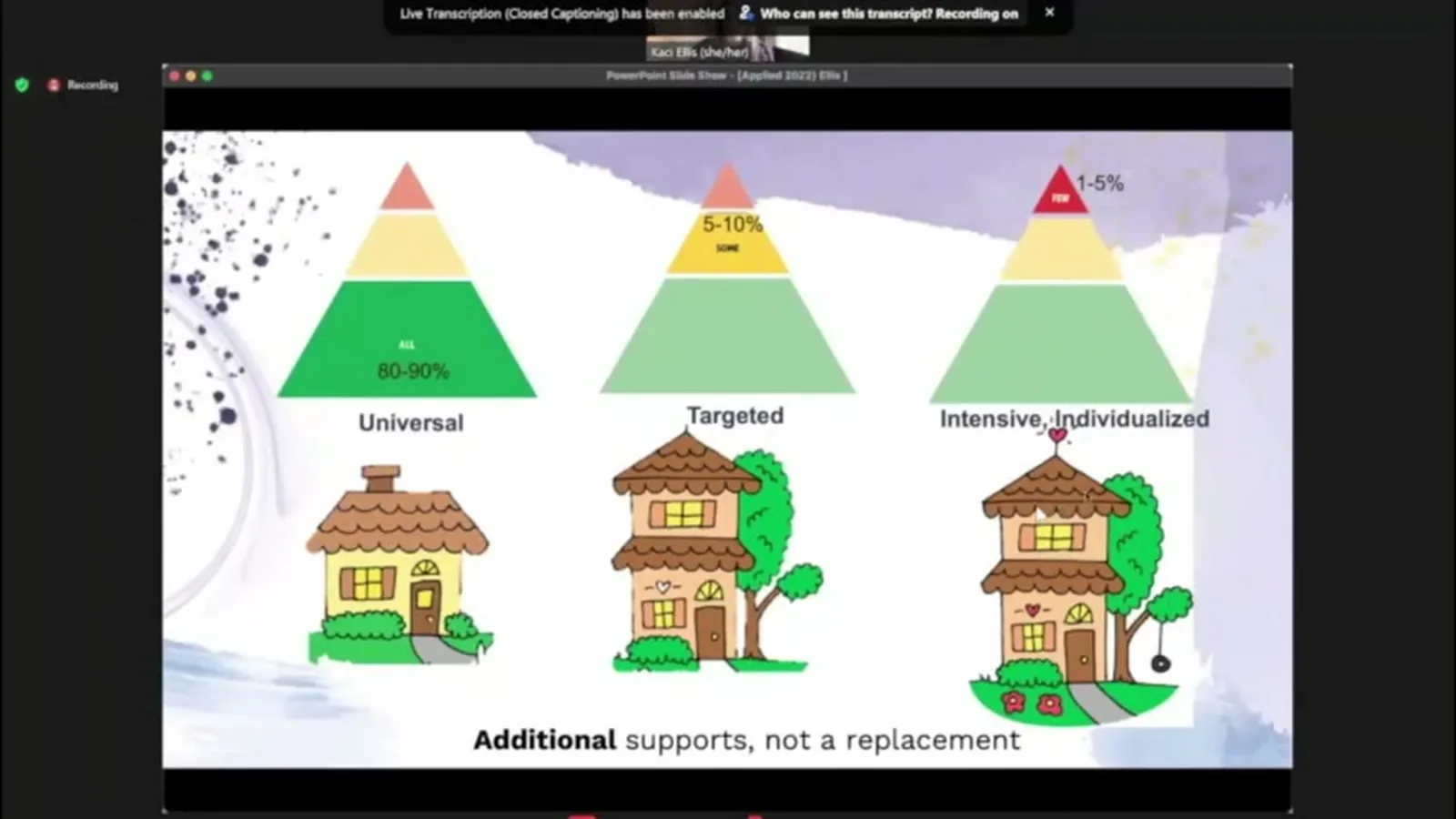
The structural reason your caseload is unmanageable is that you are usually invited at Tier 3 and almost never at Tier 1 or Tier 2. By the time anyone calls, the only available diagnosis is "intensive individualized support," because that is the only tier you have been asked to staff.
"BCBAs are not being included in these school-based decisions at other tiers. They get to this point of tier three where they're needing to pull in behavior expertise."
So you walk into rooms where universal expectations were never posted, where opportunities to respond are near zero, and where the negative-to-positive feedback ratio runs five to one in the wrong direction. The student you were called about is not the only kid struggling; they are the loudest signal of a Tier 1 that was never built. Your caseload feels impossible because you are being asked to do Tier 3 work on Tier 1 problems, one student at a time, forever.
The way out is not to refuse the work. It is to change what arrives in your inbox.
Build a scope matrix tied to your ethical code#
Before you touch the intake form, write your scope matrix. This is a one-page grid that says, in plain language, what you do, what you do not do, and which BACB code item backs each line. Informed consent, assessment, FBA scope, plan writing, coaching, restraint involvement, academic instruction, group-skills delivery; each gets a row. Each row gets a yes, a no, or a conditional, and a short why.
Two reasons this matters. First, school teams genuinely do not know the ethics code, and that gap is where scope creep lives. Second, when you have the matrix on paper, every future "can you just" conversation becomes a one-second lookup instead of a negotiation.
"I have found that if you even create your own matrix of this is what I can do in the school setting based on my ethical code, that way, if you're ever put into a position, you can say, this is what I can do."
Bring the matrix into your pre-meeting and walk the admin through it before any case is assigned. You are not lecturing them on ethics; you are showing them what a useful BCBA partnership actually looks like, and you are pre-empting every awkward decline you would otherwise have to make later.
A request intake form that filters cases before they hit you#
The matrix protects you in conversation. The intake form protects you before the conversation ever starts.
If you are a district BCBA, every case request should run through a short Google Form. If you are contracted in, the same form lives with the admin who routes work to you. The questions are not paperwork; each one is a filter.
"If you're a district BCBA, if there's a way for schools to request your help, a part of the request process is asking these questions because it's really, really important that you know before you step foot in the school."
A working intake form asks at minimum:
- Does the student have an IEP?
- If yes, is parent consent on file for a new observation, FBA, or plan revision?
- If no IEP, is the team starting eligibility?
- What Tier 1 and Tier 2 supports have been documented for this student?
- What data exists, and for how long?
- What is the school's restraint and seclusion policy, and who is on the response team?
- What does the team think the student needs, and what does the teacher think is in the way?
Three things happen when you put this in front of every requester. Cases that do not belong at Tier 3 self-select out, because the team realizes they do not have answers to the Tier 1 questions yet. Cases that do belong at Tier 3 arrive with consent, data, and context already attached. And admin starts seeing your role through the matrix, not through the hallway gossip version of what a behavior analyst is "supposed to do."
Triage rules: who needs you now vs. who needs Tier 1 first#
Once requests are filtered, you still have to rank them. The triage rule is simple. A student needs you now if there is an active safety concern with consent on file, or if a documented Tier 2 cycle has run with fidelity data and outcome data and the student is not responding. Everything else routes back, with a specific Tier 1 or Tier 2 recommendation attached.
The single most useful Tier 1 question to ask before accepting a case is the one Dr. Ellis uses out loud: in a class of twenty, how many students are currently meeting the expectation? If sixteen or more are, Tier 1 is doing its job and the referred student likely does need additional support. If fewer than sixteen are, the building has a Tier 1 problem, not a Tier 3 student, and your honest answer is that a behavior plan written into that environment will not survive contact with the classroom.
Routing a case back is not refusing the work. It is naming the work correctly so the right intervention happens before yours.
Saying no without burning the bridge#
The decline is where most school BCBAs flinch, because it feels like you are abandoning a kid or fighting a teacher. The reframe that holds up is that you are not declining the student; you are declining the wrong intervention for the moment.
The script has four moves. Acknowledge the urgency the team is feeling. Name what you saw and what you can document. State the scope-code or fidelity reason this case is not yet a Tier 3 referral. Offer the specific next step that is in scope, whether that is a consult on classroom expectations, a token-economy review, a praise-assessment coaching block, or a Tier 1 walkthrough using the free Classroom Assistance Tool from pbis.org.
That last move is the bridge-saver. You are not vanishing; you are handing them something concrete that solves a real piece of their problem this week, while making clear what would need to be in place before a Tier 3 referral is appropriate.
Run all of it from the collaboration stance, not the audit stance. The inquiry frame is what keeps the relationship intact when the answer is not yes.
When to push back to admin (and how)#
Sometimes the case keeps coming back, or admin keeps adding students to your caseload without going through intake. That is the moment to escalate, and the way to escalate is to return to the contract.
Bring three things to admin. The matrix you walked them through at the pre-meeting. The intake form that has not been used for the last three referrals. A short summary of what would have happened differently for those three cases if it had been.
Do not frame the conversation as "I am overloaded." Frame it as "Here is what is currently slipping through, here is the cost to students when Tier 3 swallows Tier 1 work, and here is the small process change that protects both me and the building." Admin can argue with overload. They cannot argue with a scope matrix, a code citation, and three concrete cases that should have been Tier 2.
If admin is the source of the pressure to skip consent or rush observations, the ethics code is not optional, and the polite version of that conversation is still that you cannot proceed without it. That one is non-negotiable, and you will be glad later that it is.
FAQ#
How many students should be on a school BCBA caseload? There is no single magic number, and any number you pick will be wrong without a scope matrix and a triage system. A caseload of twelve students with no intake filter is harder than a caseload of twenty-five where Tier 1 and Tier 2 cases have been routed away. Build the system first, then negotiate the number.
How do I decline a case without making the team angry? Decline the intervention, not the student. Acknowledge urgency, name what you can do that is in scope this week, and tie the no to a code item rather than a personal opinion. Hand them a concrete Tier 1 or Tier 2 next step instead of an empty refusal.
What if admin keeps adding kids to my caseload? Bring the matrix, the intake form, and three recent cases that should have been filtered. Frame the conversation as a process gap, not a workload complaint. Ask for the intake form to become the only way a case gets assigned to you.
Can I refuse to write a BIP if Tier 1 isn't in place? You can decline to write a plan that you do not believe will be implemented with fidelity, and you can document why. The cleaner move is to write the Tier 1 and Tier 2 prerequisites into the recommendation, take observation data on classroom-level variables, and tie the BIP timeline to those prerequisites being met.
How do I document scope creep? Keep a running log with date, requester, request, your response, and the code item or matrix row you referenced. Three months of that log is the single most persuasive document you can bring to an admin conversation.
Watch the full CEU#
Dr. Ellis goes deeper on PBIS tier mapping, the inquiry stance, classroom-level observation cues, and consent under IDEA in the full session.
Turn this topic into a CEU
You just studied this. Now get credit for it.
Watch Practical Takeaways for School-Based Behavior Analysts with Dr. Kaci Ellis and earn 1 free BCBA CEU. Detailed certificate, delivered the moment you finish.
Keep going with a free learning path
Supervision, Done Right
Four supervision CEUs that build on each other. What reflective supervision is, how to build a supervision system, how to assess supervisee competence instead of counting hours, and how supervision affects provider outcomes. The BACB asks supervisors for three supervision CEUs per cycle. This covers it.