Behavior-Specific Feedback for RBTs (Without Making It Personal)
Swap vague critiques for behavior-specific RBT feedback that partners instead of points fingers, from a BCBA-led CEU.
Key takeaway
Behavior-specific feedback for RBTs means you name the action you saw, not the person doing it. Instead of "you need to be more playful," you say, "I noticed the client looked less engaged during the puzzle activity.
Dunder Mifflin’s Guide to BCBA Supervision: Lessons from The Office
Free learning path on this topic
Supervision, Done Right
Four supervision CEUs that build on each other. What reflective supervision is, how to build a supervision system, how to assess supervisee competence instead of counting hours, and how supervision affects provider outcomes. The BACB asks supervisors for three supervision CEUs per cycle. This covers it.
On this page · 9 sections▾
Behavior-specific feedback for RBTs means you name the action you saw, not the person doing it. Instead of "you need to be more playful," you say, "I noticed the client looked less engaged during the puzzle activity. Can we brainstorm one or two things that might pull him back in?" Same concern. Very different landing.
That tiny swap is the whole point of this page. It comes from Mellanie Page's session on BCBA supervision lessons hiding inside The Office. She uses Michael Scott, Toby, and the Dunder Mifflin fire drill to show why most feedback feels like an attack. Then she gives you the rewrite.
Why "you need to be more playful" lands as an attack#
The phrase sounds light. It is not. The RBT (registered behavior technician) hears one thing. You are the problem. You are not playful enough. You are failing.
Now their guard is up. The feedback never gets in. They walk to their car frustrated and the client engagement does not change next week.
Mellanie names the rule plainly. Focus on behavior, not the person. We do this with kids all day. We forget to do it with adults.
in the first example, the BT is the problem. And we don't ever want them to feel like they are the problem. We're really focusing on behavior versus people. From the talk — Mellanie Page
That is the whole shift. Not the person. The behavior.
The two-part rewrite: observation plus invitation#
Every piece of behavior-specific feedback has two halves. Use both.
Half one is the observation. You say what you saw with your own eyes. No labels. No adjectives about the RBT. Just the action and the result.
Half two is the invitation. You ask the RBT to think with you. You become a teammate instead of a judge.
That second half is the part most BCBAs skip. They observe well. Then they prescribe. The RBT goes quiet and nods. Nothing sticks.
When you invite instead, the RBT solves the problem with you. They own the fix. They use it the next day.
A worked example for low session engagement#
Here is the swap on a real moment. Your RBT is running a session. The client is drifting. Eyes off the table. Not bidding for activities.
The bad version sounds personal. "You need to be more playful with him."
Now here is the rewrite. Mellanie says it like this:
constructive feedback might look less like you're not keeping the client engaged during sessions. You need to be more playful... It might look more like I have observed that during some activities, the client seems less engaged. From the talk — Mellanie Page
Then you keep going. "Let's brainstorm some other activities he might like better. What has worked at home?"
Now you are side by side. You are looking at the same client. The RBT is not on trial. They are problem-solving with you. That is when ideas show up.
A worked example for thin session notes#
Same pattern. Different domain. Documentation.
The bad version: "Your session notes need more detail. You aren't writing enough."
That tells the RBT they are bad at writing. It does not tell them what to write. So next week's notes get longer but not better.
The rewrite focuses on the actual gap.
your session notes need to be more detailed. You aren't writing enough... I've noticed your session notes lack some detail, particularly... in describing the client's responses to interventions. From the talk — Mellanie Page
Notice what is happening. You named the exact missing piece. The client's responses. Now the RBT knows what to add. Then you close with the invitation. "Want to walk through one note together?"
That feedback is usable. The note next week will get better because you said what was missing, not that the person was missing it.
When to use "you" instead of "we"#
A lot of supervision advice tells you to always use "we" language. That is half-right. Mellanie pushes back on the always part.
Some things are not a team problem. Punctuality. Attendance. Showing up dressed for work. Those are RBT actions. Calling them "we" things makes the expectation fuzzy.
if you do use a lot of us and we language, you can kind of muddy some of the expectation for the BT... it's okay to use you if it's something particularly that they need to do, say, being punctual. From the talk — Mellanie Page
So here is the rule. Use "we" for shared problems. Treatment planning. Engagement strategies. Pairing ideas. Use "you" for hard requirements that only the RBT can act on.
"We need to think about how to handle escapes during DTT" works. "We need to be on time" does not. You are already on time. They are the one running late. Just say it. "I need you here by 9. What is getting in the way?"
Clarity is kind. Fuzziness is not.
Three questions to ask before you open your mouth#
Before you give the feedback, run through three quick checks. They take maybe ten seconds.
First. Did I actually see this, or am I guessing? If you did not watch the session yourself, name your source. "I reviewed the data" hits different than "I heard."
Second. Am I describing the action or the person? If your sentence has the word "you" plus a personality word, rewrite it. "You're unprofessional" is a label. "You arrived 20 minutes late three times this week" is a behavior.
Third. What do I want them to do differently tomorrow? If you cannot answer that in one sentence, you are not ready to give feedback yet. You are still venting.
These three questions also protect you from the Michael Scott trap. Michael could not stand Toby. He had no real reason. He just did not vibe with him. Your "I just don't click with this RBT" feeling can leak into every piece of feedback you give them. The three checks force you to point at behavior, not chemistry.
What to track so feedback stays anchored in data#
Behavior-specific feedback falls apart without data. If you cannot point to numbers or specific moments, the RBT will hear opinion. Opinions are easy to dismiss.
Pick two or three things to track per RBT. Mellanie's audience listed these in the chat. Treatment fidelity checks. IOA (interobserver agreement, where two people score the same session and compare). Quality of caregiver conversations. Detail in session notes. Active engagement during play.
Then share the rubric. Tell the RBT what you are scoring. Walk them through it.
Self-evaluation works even better. Record a session. Have the RBT score themselves on your rubric while you score them too. Now they see what you see. Most "won't" problems turn out to be "can't" problems once the RBT watches the tape.
When you sit down to give feedback, you are not arguing. You are pointing at a shared score. The data did the hard work. You just translate it into one observation and one invitation.
That is the whole loop. Watch. Score. Observe. Invite. Repeat next week.
Frequently asked questions#
What if the RBT gets defensive even when I use behavior-specific language?
Two things to check. First, your tone. The words can be perfect and your face can still say "you are in trouble." Soften the body and the voice. Second, your trust account. If you have only ever given critical feedback, the RBT braces for impact every time. Start banking positive behavior-specific feedback too. Catch them doing one thing well per session and name it the same way you name the gaps. After two weeks of that, the defensive wall starts to drop.
How often should I deliver behavior-specific feedback during a supervision visit?
Aim for live and short over saved-up and long. If you wait until the end of a two-hour session to drop five pieces of feedback at once, the RBT shuts down. Try one observation plus one invitation roughly every 20 to 30 minutes of direct work. That keeps it conversational. It also lets the RBT try the fix before you leave, which is the whole point.
Can I deliver behavior-specific feedback over Slack or text, or does it have to be in person?
Text works for short positive feedback and for tiny tweaks. "Great pairing today. The way you matched his pace on the trampoline kept him engaged for 8 minutes straight." That kind of thing builds trust. Save corrective feedback for live conversation. Tone goes missing in text. A correction the RBT would shrug off in person can sting for three days on a screen. If you cannot meet in person, do a five-minute video call. Voice and face matter when the message is harder to hear.
Watch the full talk#
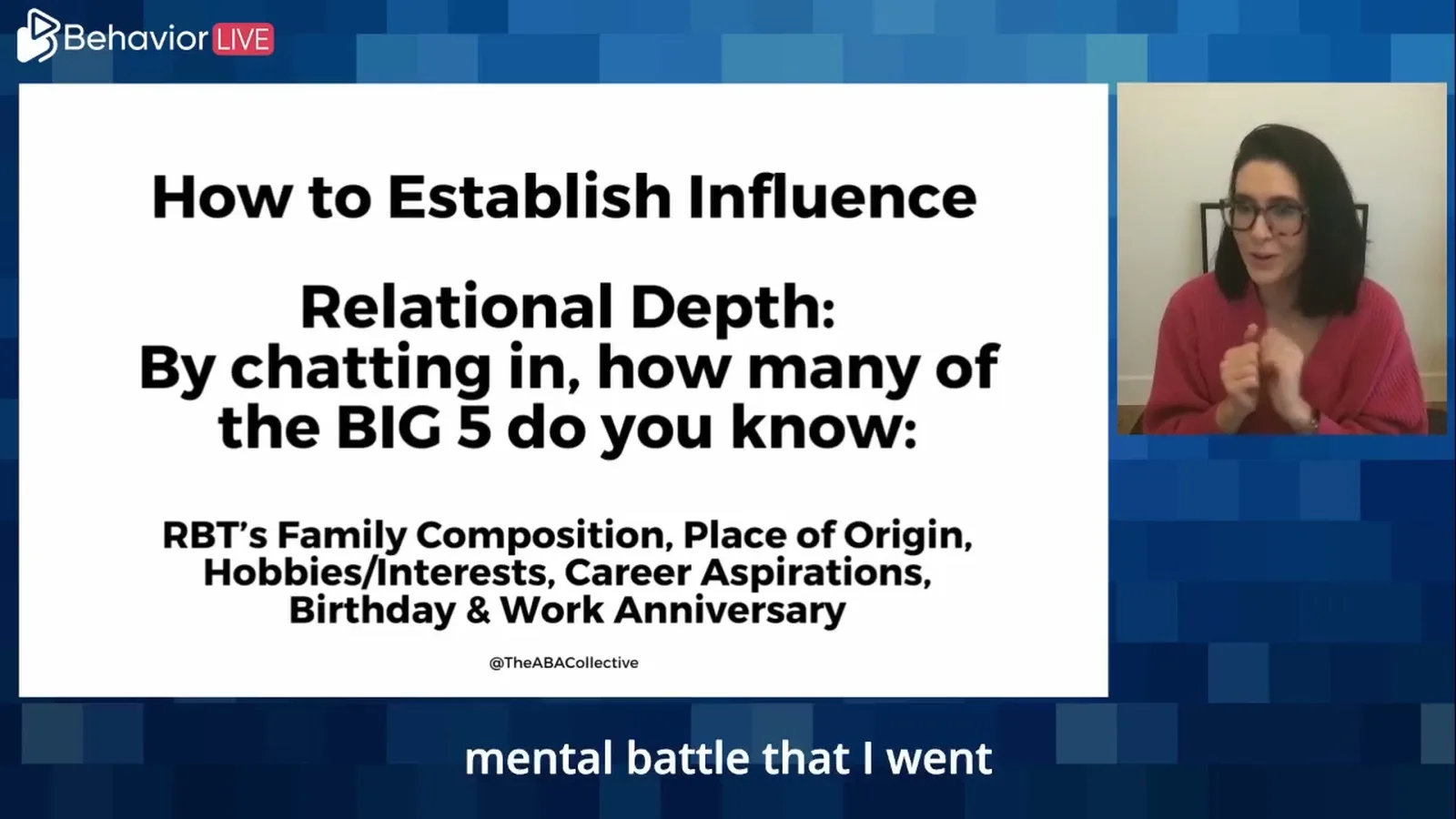
Mellanie Page walks through more examples, the "Big Five" relational depth exercise, and her conflict resolution model in the full session. The behavior-specific feedback section is the most quoted part, but the rest of the hour is worth your time if you supervise RBTs.
Turn this topic into a CEU
You just studied this. Now get credit for it.
Watch Dunder Mifflin’s Guide to BCBA Supervision: Lessons from The Office with Mellanie Page and earn 1 free BCBA CEU. Detailed certificate, delivered the moment you finish.
Keep going with a free learning path
Supervision, Done Right
Four supervision CEUs that build on each other. What reflective supervision is, how to build a supervision system, how to assess supervisee competence instead of counting hours, and how supervision affects provider outcomes. The BACB asks supervisors for three supervision CEUs per cycle. This covers it.