Caregiver Training in ABA: What It Really Is and Why It Falls Apart
Plain explanation of caregiver training in ABA, why 60% of 97156 hours go unused, and what to do about it from a BCBA-led CEU.
Key takeaway
Caregiver training in ABA is the part of a behavior plan where the BCBA teaches the parent how to run pieces of the plan at home. A BCBA is a board certified behavior analyst.
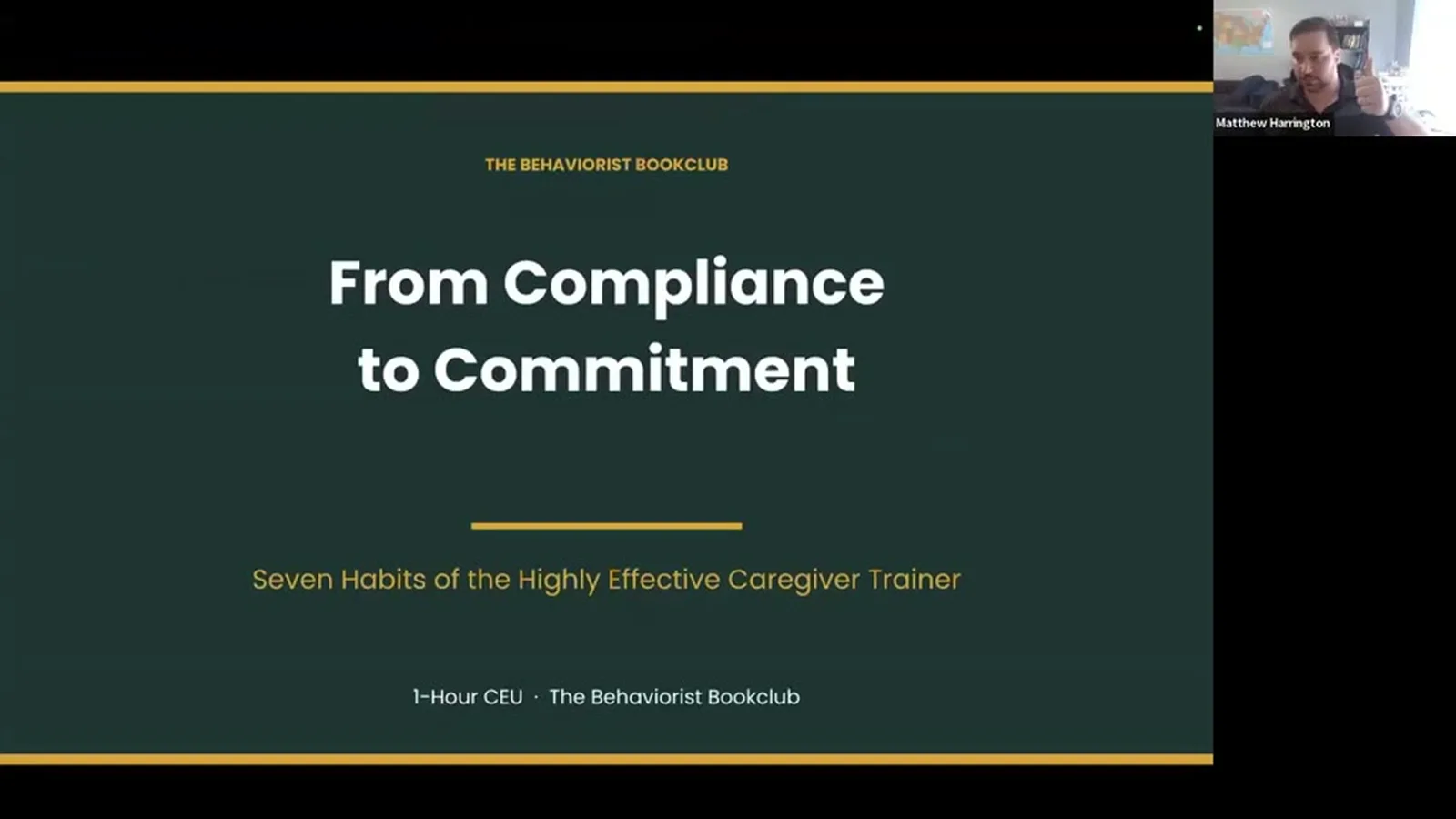
Compliance to Commitment: Seven Habits of the Highly Effective Caregiver Trainer
On this page · 9 sections▾
Caregiver training in ABA is the part of a behavior plan where the BCBA teaches the parent how to run pieces of the plan at home. A BCBA is a board certified behavior analyst. The work is billed under code 97156, the carryover training code. Here is the part most pages will not tell you. About 60% of those 97156 hours never get used. BCBAs ask for the hours on the treatment plan. Then they sit there. It is the most underused code in our whole system. Buy-in is also not a yes or no thing. Most parents do not show up at zero, ready to learn. They show up below zero. The reasons are bad past care, mistrust, or just being tired. The job is to move them up the scale, one small step at a time.
The 30-Second Definition (and the 60% Stat That Tells the Real Story)#
Caregiver training is the structured work of teaching a parent how to use the behavior plan in real life. It is not a one-time class. It is a weekly meeting. You pick a target, model it, watch the parent try it, give feedback, and track if it sticks. The code that pays for it is 97156. Here is the truth of the matter:
Nine, seven, one, five, six, our carryover training code. That five, six code is the most underutilized code, which means BCBAs ask for it, but then never use it. Depending on which source you go to, I think it's something like 60% of nine, seven, one, five, six codes never get used. From the talk — Matt Harrington
That stat is the whole story. Plans get written. Hours get approved. Then the work that drives most of the gains never happens.
The 100-Hour Problem: Why You Cannot Skip This Work#
Here is the math you do not see on most pages. A kid is awake about a hundred hours a week. A BCBA and BT (behavior technician, the person running daily sessions) get maybe 15 to 20 of those hours. That is it. The other 80 hours belong to the parents, the grandparents, the sibling, the teacher, the bus driver.
There are over a hundred waking hours in the natural environment and we get about 15 to 20. So we are just small little buckets in the child's life. It's not just one caregiver that we're looking at, but maybe there's a father, a mother, a brother, a grandmother, a grandfather, a teacher, et cetera. From the talk — Matt Harrington
If the family is not bought in, the gains you build in session leak out by Monday morning. That is why this work moves the needle more than any other thing a BCBA does.
Caregiver Training vs Caregiver Coaching vs Parent Training: Same Thing, Different Words#
You will see all three names used. Some clinics say parent training. Some say caregiver coaching. Some say family support. They all point at the same job. You help the adult in the home use the plan with fidelity for the full week between your visits. Fidelity means doing it the same way every time. Pick the name your billing and your family like best. The work does not change.
The reason this name matters is that the goal of the work is not the one-hour class. The goal is the other 167 hours.
Caregivers not only implementing, but also implementing with fidelity and being bought in not for a one hour training session, but for the entire week that they have to go in between parent training sessions is arguably the most crucial variable when it comes to an overall successful behavior intervention plan. From the talk — Matt Harrington
The Buy-In Scale: Why Most Caregivers Start at Negative, Not Zero#
Here is the reframe that changes everything. Stop thinking of caregiver buy-in as on or off. Think of it as a scale that runs from negative one to positive one. Negative one is a parent burned by bad past care. Maybe abusive school staff, or a culture clash they were never asked about. Zero is neutral. Positive one is the parent who is already excited to start.
I encourage you to not consider a caregiver buy-in as a fixed trade. Most parents are cautious. Most caregivers are cynical. Most folks who enter ABA services are not ready to jump directly in and trust this random 20 to 40 year old with their entire child's future. From the talk — Matt Harrington
Most families show up below zero. Your job is not to drag them all the way to one in a session. Your job is to move them from negative point nine to negative point eight. Then to negative point seven. Trust gets built one kept promise at a time.
What 97156 Actually Covers (and What It Doesn't)#
97156 is the CPT code for caregiver training without the kid in the room. CPT codes are the billing codes insurance uses. The code covers time you spend teaching skills, reviewing data, and talking through barriers. It does not cover the time you spend running a session with the kid present while a parent watches. That is a different code, 97155.
The other thing 97156 does not cover is vibes. Spending a session listening to a parent vent with no follow-up plan is hard to justify in a note. Listen first. Always. But end the session with one small action and write that action in your note. That keeps the time billable and the trust growing.
Why the In-Between Step Is Missing From Most Grad Programs#
Grad school teaches you how to write a behavior plan. The research base teaches you how to run BST (behavioral skills training, the model where you instruct, model, rehearse, and give feedback). What no class teaches you is the step before BST.
How do you get a tired, skeptical parent to show up to the first BST session at all? How do you handle the parent who agrees to everything in the meeting and does none of it during the week? That gap is where 60% of 97156 hours die. It is not a technique gap. It is a relationship gap. The research has a name for it. The therapeutic alliance. Most programs skip past it on the way to clinical content.
The Seven Habits in One Paragraph (and Where to Read Each One)#
The talk this page draws from lays out seven habits for the BCBA who wants to close the buy-in gap. Habit one is assess before you assign. Do not pick the first goal off the behavior plan. Pick the goal the family is ready to work on. Habit two is build the alliance by giving the family a reason to trust you. Habit three is use motivational interviewing. That is just asking open questions and reflecting back what you hear. Habit four is shape, do not assign. Break the goal into tiny steps. Habit five is engineer early wins by picking a first target the family will see pay off inside a week. Habit six is handle barrier conversations by digging past the first reason to the real one. Habit seven is use data as a tool. Simple color blocks the parent can fill in. The plan stops being your opinion and starts being a shared picture.
Each habit has its own page on this site. Use this page as the map, and read the habit pages for the how.
Frequently asked questions#
What is the difference between 97156 and 97155 for caregiver training?
97156 is for caregiver training without the child present. You are teaching the adult. 97155 is for direct treatment with protocol modification, which usually includes the child. If the kid is in the room and you are running the plan while the parent watches, that is 97155. If the kid is at school and you are reviewing data with the parent, that is 97156. Most caregiver work that drives the 100-hour problem lives in 97156.
Is caregiver training the same as parent training in ABA?
Yes, in plain use. Some clinics use parent training, some use caregiver training, some use family coaching. The billing code is the same. The only reason to pick one name over another is fit with the family. If a parent flinches at the word training, call it coaching. If a grandparent is the main adult, caregiver is more honest than parent. The work is the same.
How many hours of caregiver training does a typical case need?
Most plans ask for one to four hours a week of 97156. The honest answer is the number you actually use is the one that matters. A plan with four hours approved and zero used is worth less than one with one hour approved and one used. Start by asking if you are running the hours you have. If you are skipping them, the issue is rarely the hours. It is the buy-in.
Watch the full talk#
If this lined up with what you are seeing in your cases, the full one-hour CEU walks through all seven habits. It pulls examples from in-home, clinic, and telehealth work. It is free and counts for one general learning credit.
Watch the full CEU on caregiver training
Turn this topic into a CEU
You just studied this. Now get credit for it.
Watch Compliance to Commitment: Seven Habits of the Highly Effective Caregiver Trainer with Matt Harrington and earn 1 free BCBA CEU. Detailed certificate, delivered the moment you finish.