How to Get Parents to Follow Through in ABA Without Begging
Why parents stop following through between sessions and the buy-in scale that gets them back, from a BCBA-led CEU.
Key takeaway
The parent who stopped texting you back was lied to by five providers before you got the case, and somewhere in there she gave up on the idea that another clinician's words would change her Tuesday.
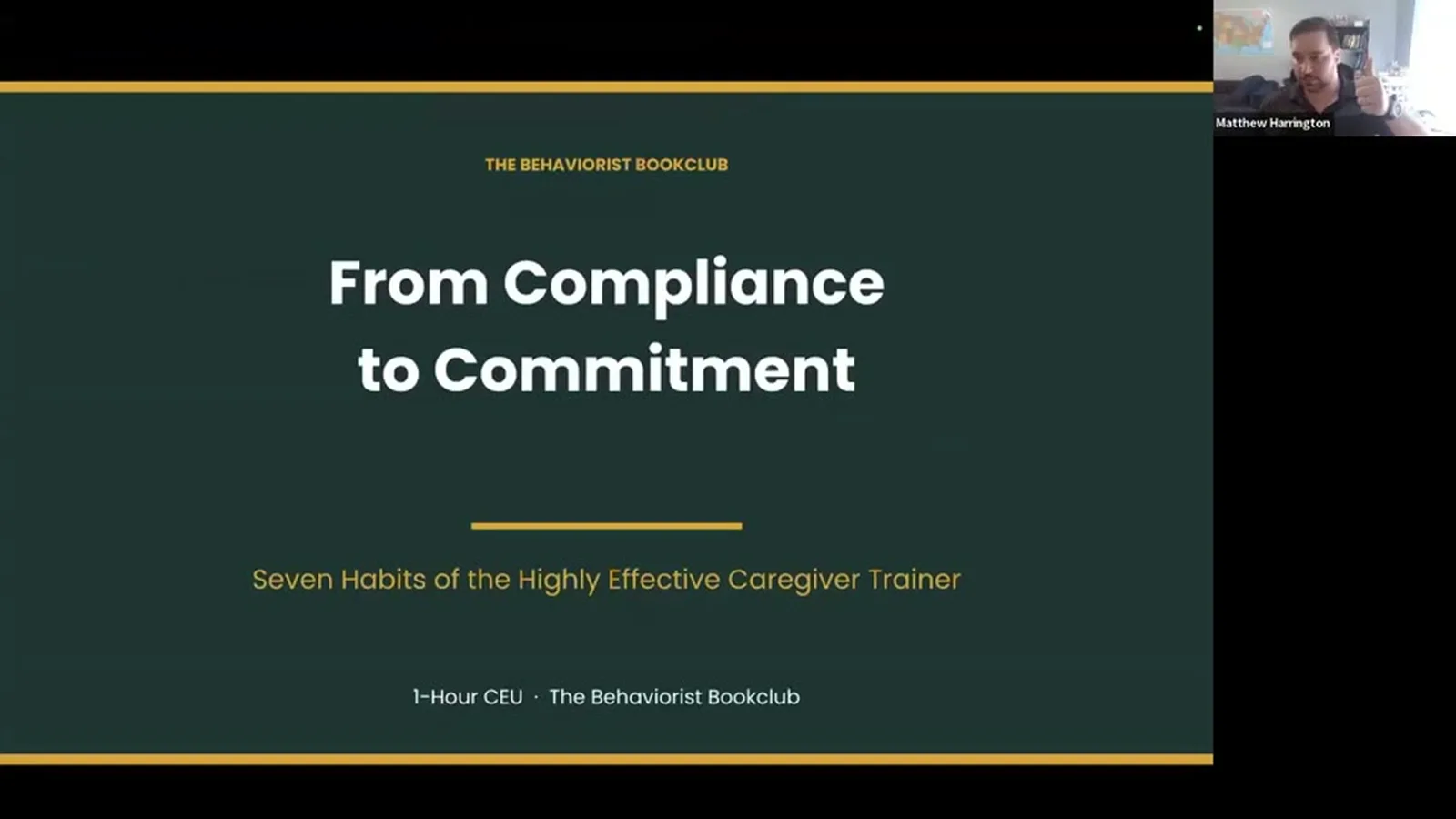
Compliance to Commitment: Seven Habits of the Highly Effective Caregiver Trainer
On this page · 9 sections▾
The parent who stopped texting you back was lied to by five providers before you got the case, and somewhere in there she gave up on the idea that another clinician's words would change her Tuesday. Maybe what she actually wants is a coffee date with a friend every Tuesday morning, and that means no calls home from school three times a week. That coffee date is the reinforcer. Until your plan touches it, the texts stay unread and the homework sheet stays in the binder. A Board Certified Behavior Analyst (BCBA, the credentialed clinician who designs ABA programs) who treats follow-through as a buy-in problem instead of a compliance problem can get the parent back. Begging cannot.
Why Parents Stop Following Through (It Is Almost Never Laziness)#
The first move is to stop calling it non-compliance. Parents who stop running the plan are almost never lazy. They are running a cost-benefit equation in their head, and right now your homework is on the wrong side of it. The plan asks for thirty minutes of work and pays them nothing they can feel by Friday. So the work stops.
Reframe buy-in as a scale, not a yes or no. Negative one is a parent who walked in already burned by prior ABA or a bad school placement. Zero is neutral. One is fully bought in. Most parents start somewhere between negative half and zero. The job is not to drag them to one in a single session. The job is to nudge them one tick at a time, and a tick requires a small thing you said would happen actually happening.
Follow-through is a reinforcement question. You cannot reinforce a behavior you have not given the parent a reason to do. Your text asking when she wants to schedule is the behavior. The reason to respond is the relief on the other end of the response. If the relief is vague ("we'll work on tolerating no"), the text does not get a reply. If the relief is concrete ("we'll cut the bedtime fight in half by Sunday"), it does.
The Medical Gaslighting Problem: What Came Before You#
By the time you show up, the parent has been told by a pediatrician that the meltdowns are not a big deal, by a speech therapist that everything is on track, by a school counselor that he will grow out of it, and possibly by a prior ABA team that the behavior spike is normal and they should keep going. That is a pattern. The parent has learned to nod, say "okay, sounds good," and assume the next adult is the same.
Many caregivers are gaslit by medical professionals on a daily basis. So the caregivers are going to be used to being ignored. They're kind of BS detector for this person's just talking versus actually caring is going to be pretty high. From the talk — Matt Harrington
What this means in practice. The parent's silence is not about you yet. It is about the five people before you. Your first job is not to teach. It is to be the first person who said a thing would happen and then made it happen. Until that ledger flips, every text is read through the lens of "another one." That is the entire reason a softball first goal matters more than a clinically optimal one.
The First-Week Softball: Pick a Goal That Pays Off in Seven Days#
Pick the smallest goal you can defend, then pick one smaller than that. The first parent training goal is not the clinically most important goal. It is the one most likely to pay the parent back inside a week.
I encourage you to be a little bit selfish with that first target. You need to give yourself a softball. The best caregiver training goal to start with is one that visibly improves quality of life for the caregiver. And it's accomplishable within like a week, like in a perfect world. From the talk — Matt Harrington
Three rules for picking the softball:
- It moves something the parent already cares about. Not "tolerate no" if she is up to her knees in laundry. Make it dry intervals.
- It pays off in seven days, not six weeks. A goal that pays off in six weeks dies on day eight.
- It needs no new equipment, no new childcare, no new sleep. If the goal requires the family to buy a thing or rearrange a schedule, the goal is too big.
Then write the goal down in front of the parent and say: this is the one thing I am asking you to do this week. Not the ten things on the behavior plan. This one. Run that, and the rest of the plan keeps making sense.
Reverse-Engineering the Caregiver's Reinforcer#
The parent has a reinforcer. You have not asked about it yet. Most parent training plans skip the reinforcement assessment for the adult in the room and run one for the kid only. That is the bug. Find the parent's reinforcer and the plan starts to write itself backwards from there.
Maybe what they really want is to be able to have a coffee date with their friends every Tuesday morning. And that means that they can't be having calls home from school to pick up their kid three times a week. So by looking at the caregivers, reinforcers, we can then reverse engineer where we want to start. From the talk — Matt Harrington
How to find it without sounding like a therapist. Ask three questions over a couple of sessions:
- What would you do this week if your kid had a great day at school every day? The answer is the reinforcer. Coffee with a friend, a full grocery run, a nap, a phone call with her sister.
- What is the thing you keep canceling because of how the week goes? That is also the reinforcer, just framed as a loss.
- If we could fix one thing by next Friday, what fight goes away? That answer points at the goal.
Now pick the right-now goal that, if it lands, removes the obstacle between the parent and that reinforcer. The coffee date is the terminal reinforcer for the parent. Cutting the calls from school is the right-now move. The two are the same plan, just at different scales.
The Three Words That Restart a Stalled Parent: 'I Hear That'#
When a parent has gone quiet and you are not sure why, three words do most of the heavy lifting. "I hear that." Not "I understand." Not "that makes sense." "I hear that," followed by silence, followed by a real question.
The reason it works. The parent has been told for years that her experience is wrong, exaggerated, or imagined. The phrase "I hear that" does not agree, does not disagree, and does not problem-solve. It just confirms that you received what she said. That is the first reinforcer in the alliance, and it costs nothing.
Use it in a specific pattern. The parent says the plan is not working. You say "I hear that. Can we walk through one moment from this week where it did not work?" Then you shut up. The parent fills in the variables you need. What time of day, who was home, what the kid wanted, what the parent did. Now you have an actual ABC trail, not a vague complaint, and you have spent zero capital arguing.
This is motivational interviewing reduced to its smallest workable unit. You do not need the full motivational interviewing curriculum to use it. You need to ask open-ended questions, reflect back what you hear, and shut up long enough for the parent to keep talking. That is the move.
What to Do When You Have Already Lost Them#
Sometimes the parent has already stopped responding. Texts go unread. Sessions get canceled. You are one no-show from a discharge conversation. Do not write the discharge note yet. Try a smaller play first.
Send one message. Not "checking in." Not "wanted to follow up." Name the pain you already know about and offer a single small thing that removes part of it. Example: "I know mornings have been rough. If you have fifteen minutes Thursday, I want to try one thing for the school drop-off, and that's it. No homework after." Then stop.
Three things make this work. The message names a specific pain ("mornings"), it asks for a tiny commitment ("fifteen minutes"), and it ends with the relief built in ("no homework after"). You are giving the parent a reason to text back that has nothing to do with you. The pain is going to go away. That is the only reason a stalled parent picks the phone back up.
If she still does not respond after one of these, send one more. If she does not respond to that either, hold the discharge conversation and be honest about why. The win condition for the discharge conversation is the parent saying out loud what stopped working, which is information you can use on the next case.
A One-Week Reset You Can Run on Monday#
Use this when a case is alive but stuck. Five steps, one week.
- Monday: Call, do not text. Ten minutes. Lead with "I hear that this has been rough. I want to try something small this week. Can I run it by you?" Pick the smallest softball you can find. Get a yes.
- Tuesday: Send the goal in writing. One line. "This week: client mands for bathroom three times across the week. That is the only thing I am asking you to track." Include a three-color data sheet, nothing else.
- Wednesday: Check in once. One text. "How's it going so far?" Read the answer carefully. If the parent reports green, reinforce her by name. If she reports yellow or red, ask what got in the way and shut up.
- Thursday: Run the parent training session. Spend the first ten minutes on what she said about Wednesday. Then run Behavior Skills Training (BST, a teach-model-rehearse-feedback cycle) on the one skill the softball needs. End with the next week's softball already in mind.
- Friday: Send the data sheet back as a screenshot. Highlight the green days. Name the pain that shrunk. "Three bathroom mands this week. That is three trips to the laundry room that did not happen." That is the reinforcer.
Run the reset once and the parent is back at the table. Run it twice and the alliance has its first real data point on the say-do correspondence ledger. That ledger is the whole game.
Frequently asked questions#
What do I do when a parent stops replying to my scheduling texts?
Stop sending scheduling texts. Send one message that names a specific pain ("mornings have been rough"), asks for a tiny commitment ("fifteen minutes Thursday"), and ends with a clear relief ("no homework after, just one thing for the drop-off"). The parent is not avoiding you. She is avoiding another adult who is going to ask her to do more work for no felt payoff. Give her a reason to reply that is about her week, not about your calendar.
Should I drop a family from caregiver training if they keep no-showing?
Not yet. Run the one-week reset above first. Pick a goal so small it almost feels silly, attach it to a pain you have already heard her name, and pay her back inside seven days with visible data. If after two of those resets she still no-shows, hold the discharge conversation and treat it as a learning artifact. Ask out loud what stopped working. The answer is data for the next case.
How long should I give a parent to follow through before changing the plan?
One week per right-now goal. If a goal does not pay off inside seven days, the goal is too big or the wrong target. Shrink it or swap it. Do not give the same goal a second week to fail. Each failed week without a felt result moves the parent down the buy-in scale, and that is the variable you are actually managing. Speed of small wins beats clinical purity here.
Where to take this next#
Follow-through is a buy-in scale, not a compliance switch. The parent who stopped texting is not lazy and is almost never wrong about her own week. She has been lied to before, she has a real reinforcer you have not asked about yet, and she will come back if you can name a pain and shrink it inside seven days. That is the work. Pick the softball, run the reset, and let the data sheet do the talking on Friday.
The full session goes deeper into the seven-habit framework, including the motivational interviewing pieces and the data-as-a-tool moves that hold the alliance together once it is real. Worth the hour if any of this is landing.
Turn this topic into a CEU
You just studied this. Now get credit for it.
Watch Compliance to Commitment: Seven Habits of the Highly Effective Caregiver Trainer with Matt Harrington and earn 1 free BCBA CEU. Detailed certificate, delivered the moment you finish.