The 7 Mistakes BCBAs Make in In-Home Parent Training
The most common in-home parent training mistakes, from leading with the BIP to skipping data, from a BCBA-led CEU.
Key takeaway
You walked in with the behavior intervention plan (BIP, the written plan that says how you will reduce a problem behavior) already written. You read the parent the ten steps.
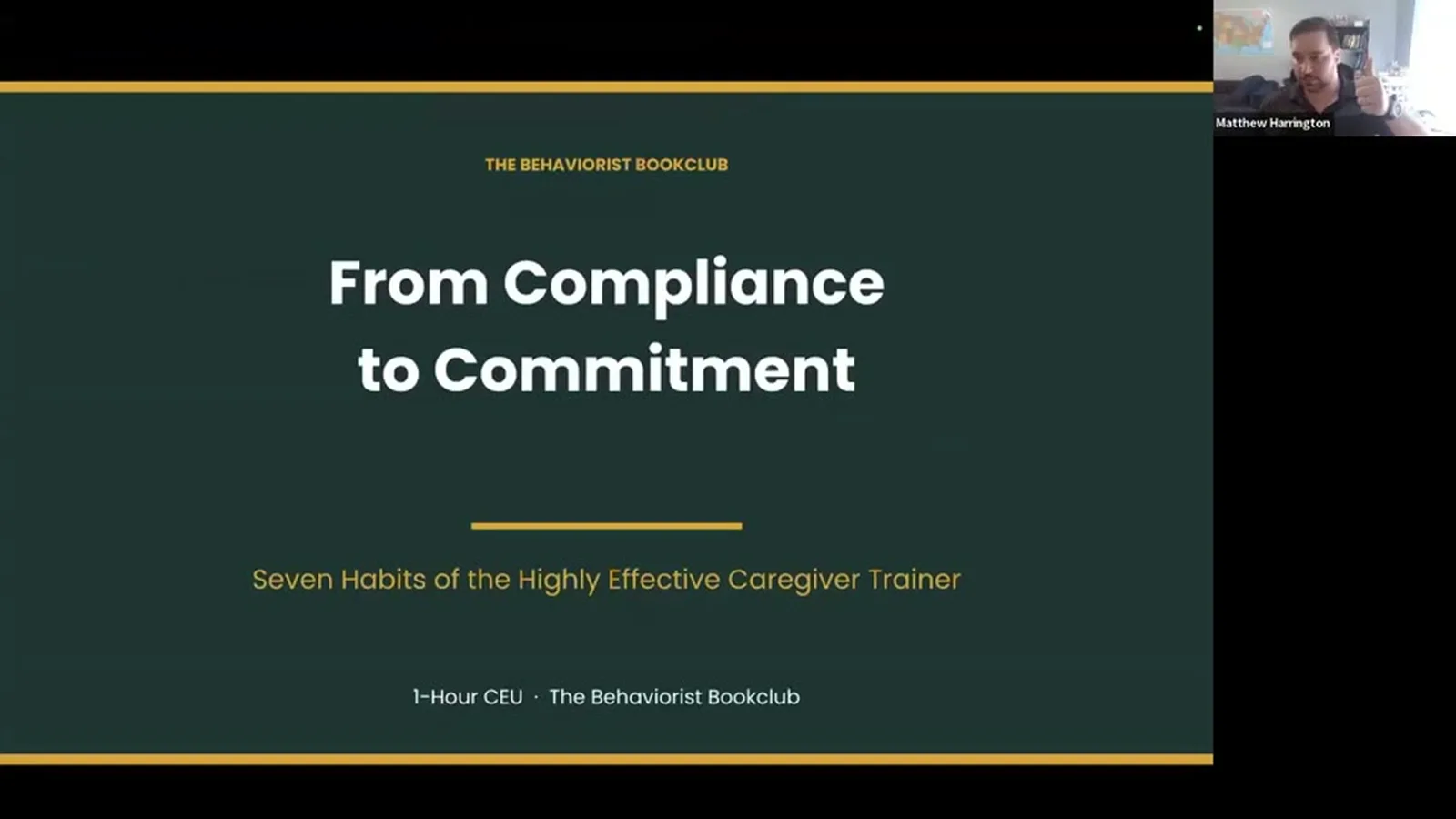
Compliance to Commitment: Seven Habits of the Highly Effective Caregiver Trainer
On this page · 9 sections▾
You walked in with the behavior intervention plan (BIP, the written plan that says how you will reduce a problem behavior) already written. You read the parent the ten steps. They nodded, said "okay, sounds good," and you left thinking session one went fine. It did not. That is mistake number one. Mistake number two is the one that fixes it: four thirty-minute listening sessions before you run a single Behavior Skills Training (BST, a teach-model-rehearse-feedback cycle) drill.
This page is for the Board Certified Behavior Analyst (BCBA, the credentialed clinician who designs ABA programs) who does in-home parent training and keeps watching the plan fall apart between visits. It is a mistakes-first audit, not a checklist of tips. Every mistake names the moment it happens on the couch, and the one small move that fixes it.
Mistake 1: Leading With the BIP You Already Wrote#
You wrote the plan in the office. The parent signed it. You show up to the first in-home session ready to teach the ten steps. The parent goes quiet. They say "okay, yeah, I'll try it." You leave confused.
The problem is not the plan. The problem is that you decided the priority before you knew the parent. Tolerating "no" might be the right clinical target. But if the parent is exhausted from changing diapers on a five-year-old, "tolerating no" is not what is keeping them up at night. Potty training is. And you just told them their pain does not matter.
I step into those first few meetings. I talked to a parent. I'm all excited about my plan. I give them the 10 steps and they're completely disengaged. From the talk — Matt Harrington
When you dive in deeper, they are so tired of diapers. So when I stepped in, assuming that I knew the priority, because that was what the behavior plan said, what it actually told the parent was, I'm coming in with my way or the highway. From the talk — Matt Harrington
The fix is to walk in with the BIP in your bag, not on your lap. Ask first. Pick the first training target after you hear what the parent is actually tired of.
Mistake 2: Skipping the First Four Listening Sessions#
Most BCBAs treat session one like a training session. They open with goals, run a BST drill on prompting, and leave a data sheet. Then they wonder why the parent ghosts session two.
The parent did not need a drill. They needed to be heard by a professional who was not in a rush. Open-ended questions and reflective listening do more for the therapeutic alliance than any BST script. That alliance is the thing that decides whether the parent runs the program during the 100+ hours you are not in the home.
There's been plenty of times with caregivers when the first four parent training sessions were 30 minute listening sessions. Nothing else. Me coming there and saying you are the expert on your child. I'm here to learn as much as possible. I'm just here to be curious. From the talk — Matt Harrington
Four sessions of listening is not a soft skill. It is the assessment. You are mapping reinforcers, finding the real priority, and earning the right to teach a skill in session five. If your billing reviewer asks what you did, your note says you collected ABC data (antecedent-behavior-consequence, the standard observation format) on the home environment and identified reinforcers and barriers. That is true. That is also exactly what you did.
Mistake 3: Letting Vents Go Nowhere#
Once the parent trusts you, they will vent. Twenty-five minutes about the school, the IEP team, the grandmother, and the older sibling. You nod. You say "that sounds hard." Session ends. Nothing changes.
That is worse than not listening at all. It is the staff-survey problem. You asked, they answered, you did nothing. Trust drops.
If they're venting about three different things, pull out one of those and say, oh, well, I think that's something we can really start to tackle. Just keep something actionable. So you can say like, yes, we're moving to that. We're going in this direction versus just staying stuck in kind of a mental trap. From the talk — Matt Harrington
The fix is one sentence. Pick one item from the vent and offer to work on it next session. You do not have to solve all three. You just have to show that the conversation moves into action. That is what proves the alliance is real.
Mistake 4: Picking a Goal That Pays Off in Six Months Instead of One Week#
You picked the right priority. You listened for four sessions. Now you pick the goal, and you pick the big one. Full toilet training. Inviting seven friends to a birthday party. Independent play for thirty minutes.
These are good terminal goals. They are terrible first goals. The parent will not see progress for weeks. Their reinforcement schedule goes flat. They quit.
Be selfish with target one. Pick something so small that the parent sees a win in the first week. For the diaper-tired parent, target one is not "fully toilet trained." It is "mands for the bathroom three times this week" or "stays dry for ten minutes after lunch." For the birthday-party parent of a teen, target one is not "seven friends." It is "one peer over for forty-five minutes."
The math is simple. If the parent does the thing, and their life gets measurably better that week, the next ask is easy. If the parent does the thing and nothing changes for a month, the next ask is impossible. Shape the goal the way you shape any other behavior: small steps, fast reinforcement, then raise the bar.
Mistake 5: Treating the Living Room Like a Clinic Room#
In a clinic, you can control the environment. In the home, you cannot. The TV is on. The toddler is screaming in the next room. Dinner is in the oven. The dog wants out.
Most BCBAs respond to home chaos by trying to make the home look like the clinic. They ask the parent to clear the table, mute the TV, and put the other kids in another room. The parent complies for one session. By session three, they stop scheduling.
The fix is to design the program for the actual home, not the clean version of it. If the parent can only run the intervention during the fifteen minutes after the younger sibling naps, that is your window. If the only quiet space is the car at pickup, that is your setting. Parental stress is close to a constant variable in your model. Do not try to lower it. Build around it.
That includes barriers the parent says are deal-breakers. When they say "I cannot do that," do not push. Ask what would make it possible. Usually it is not the task. It is one piece of the task they cannot fit in. Find that piece, shrink it, and the goal moves again.
Mistake 6: Sending a Calendar Link Instead of Asking#
Scheduling parent training is the hardest logistical piece of in-home work. Parents miss texts. They cancel the morning of. The 97156 code (the carryover-training CPT code, currently the most underbilled code in ABA) sits unused for the month.
The temptation is to automate. Send a calendar link. Let it auto-repeat. Move on. One BCBA in this session described doing exactly that and called it "a little impersonal." That is the right read. A calendar link works fine after the alliance is built. Before that, it tells the parent they are one of forty names on a schedule. The fix is not heroic. Text them. Ask what time works this week. Confirm the day before. The cadence is the same. The signal is different.
The other piece of scheduling is what you are scheduling for. If the only reason to show up is to get coached, attendance drops. If the reason to show up is "I want to fix the thing that ruined dinner on Tuesday," attendance holds. Tie every session to a specific problem the parent already told you they wanted to fix.
Mistake 7: No Data, or Data the Parent Cannot Read#
You ran four listening sessions. You picked a small first goal. The parent ran the program. Now you need to know if it worked. So you hand them a frequency data sheet with sixteen columns.
They will not fill it out. Even if they do, they will not look at it. And without the parent looking at it, they cannot see the progress, which means the reinforcement loop you built breaks.
Data for parent training has to be dead simple and dead visual. The version that works best in the home is an Excel sheet with one column per day and a colored square for each. Green for a one to five day. Yellow for six to twelve. Red for thirteen plus. Define the scale, hand them one sheet, ask them to color one box a day.
You are not simplifying because the parent is not smart. You are simplifying because they are carrying three kids, two jobs, and the laundry. The data sheet is the third thing that has to fit on the fridge. If it does not fit, it does not happen.
The visual is also the argument. When you need to tell a parent that their current strategy is not working, words are debatable. A row of seven red squares followed by a row of yellow squares is not.
Frequently asked questions#
How long should the first in-home parent training session run?
Thirty minutes is enough for the first four sessions. You are listening, not teaching. Long sessions early signal that you have an agenda. Short ones signal that you are there to learn.
What do I do if the home is too chaotic to run a session?
Do not try to fix the chaos. Find the fifteen-minute window inside it. After the younger sibling naps, during the older kid's screen time, on the porch after dinner. Design the entire intervention for that window. If even fifteen minutes is impossible, the session is a listening session, not a BST session.
Should I bring the BT to in-home parent training sessions?
Not for the first four sessions. The behavior technician (BT) makes the visit feel like a clinical session, which pushes the parent into observer mode. Once the parent has tried the intervention for a week or two and you are moving into model-and-rehearse, then the BT helps. Before that, it is just you and the parent.
Ready to go deeper?#
Watch the full session: Compliance to Commitment: Seven Habits of the Highly Effective Caregiver Trainer. It is one CEU, free, and the full version of every fix above.
Turn this topic into a CEU
You just studied this. Now get credit for it.
Watch Compliance to Commitment: Seven Habits of the Highly Effective Caregiver Trainer with Matt Harrington and earn 1 free BCBA CEU. Detailed certificate, delivered the moment you finish.