Succession Planning in ABA: Helping Families Plan Ahead
Succession planning helps families decide who cares for a disabled loved one after a caregiver dies. Learn how BCBAs can start these talks.
Key takeaway
Succession planning is making a plan for a person's future care. It answers one hard question. Who will care for a disabled loved one after the main caregiver dies?
Increasing Competence and Confidence in Helping People with Disabilities through Grief
Free learning path on this topic
Your 4 Ethics CEUs, Done
Four ethics CEUs in three courses, all free. Start with Matt Harrington's assent and data course, then ethical guardrails in behavior reduction, then cultural considerations in clinical practice. Every course carries ethics credit, so this path covers the BACB requirement with nothing to buy.
Experts who cover this
2 recordings on openceu cover succession planning aba.
- Featured talk1 Ethics CEU
Increasing Competence and Confidence in Helping People with Disabilities through Grief
Patricia LundThe Behaviorist Bookclub
Framed as the comprehensive plan for who will support a disabled client financially, residentially, and decision-wise once a caregiver dies; the speaker gives…
- 1 CEU
Grief Support at the Front Lines: Training Day Hab and Group Home Staff to Support Adults with IDD Through Bereavement
Tricia LundThe Behaviorist Bookclub
Mentioned as a related area of practice Lund is developing a future CEU on: BCBAs are often uniquely positioned to prompt aging parents of adults with IDD to…
On this page · 6 sections▾
Succession planning is making a plan for a person's future care. It answers one hard question. Who will care for a disabled loved one after the main caregiver dies? This plan covers money, housing, and legal support.
Many families never make this plan. Aging parents worry about it but do not act. BCBAs often see these families up close. That gives us a rare chance to help. This page explains what the plan covers and how to start the talk with care.
The stakes are high for adults with disabilities. A parent has often been the main support for decades. When that parent is gone, the gap can be sudden. A plan made early keeps the person safe and steady.
What succession planning covers#
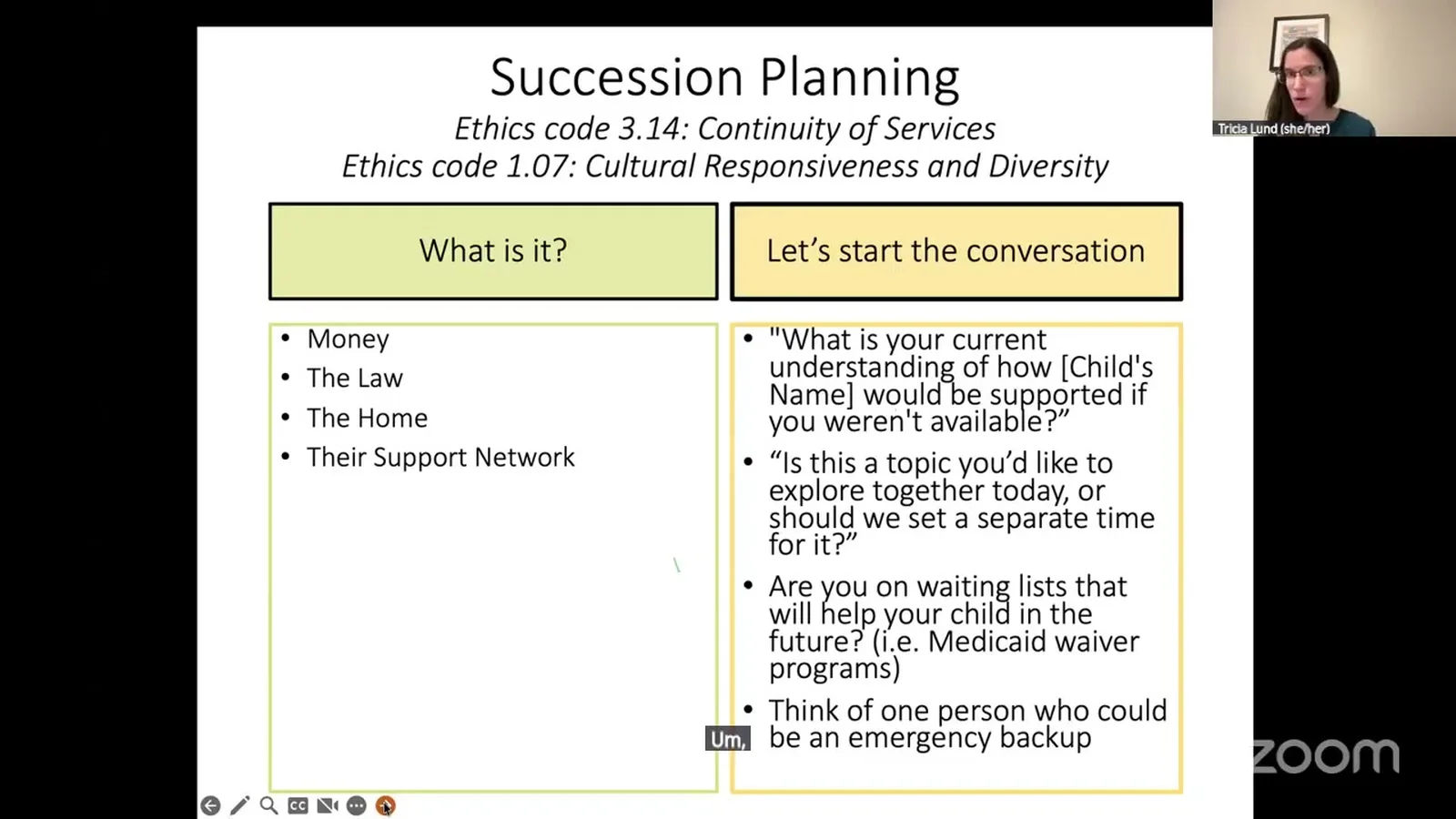
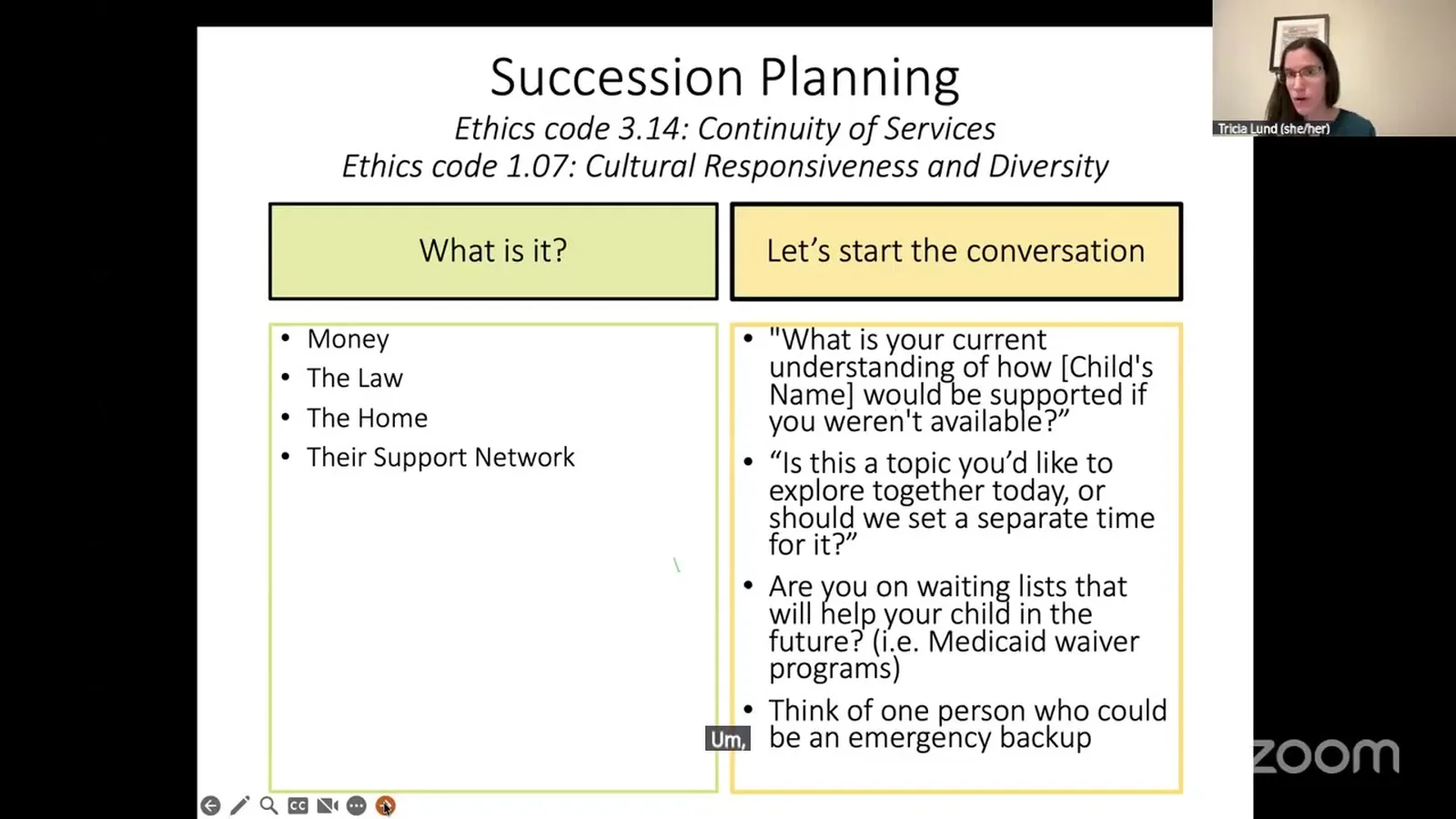
Succession planning is more than a will. It maps out a whole support system. It looks at where the money comes from and where the person will live. It also asks who makes legal choices for them.
Patricia Lund frames it in plain terms. The goal is a good life for the client, even after loss.
succession planning, there's lots of different terms for it. You know, you might hear transition planning, person first planning, end of life planning. But it's really just the process of creating this comprehensive plan that's going to ensure that the client is safe and has a good quality of life, even when the caregiver does. From the talk — Patricia Lund
Money is often the first piece. A disabled adult may rely on a parent for daily costs. When that parent dies, the income can stop. So the plan must sort out funds early.
So when you're looking at succession planning, you're looking at money. Where's the money coming from, right? How is this person going to live financially? From the talk — Patricia Lund
Housing and guardianship come next. Someone new may need to become the legal guardian. The plan names that person before a crisis hits.
Why BCBAs are in a unique spot#
BCBAs spend many hours with families over the years. We build trust that few other providers have. That trust puts us in a rare position. We may be the only ones asking these questions.
we as BCBAs are in a very unique position to start having some of those conversations with parents. In fact, we might be some of the only ones that are having those conversations with them. From the talk — Tricia Lund
This work matters most for adults with intellectual and developmental disabilities. Their parents often act as lifelong caregivers. Many of those parents have no plan in place.
I'm also finishing up one about how BCBAs can be involved in succession planning... a lot of the parents don't have a plan in place for what's going to happen when they die. Who's going to take care of the money? Where's the person going to live? Who's the support system? Is guardianship going to be moved to someone else? From the talk — Tricia Lund
How to start the conversation#
 Advertisement
These talks feel heavy for parents. So you start gently and early. You do not wait for a health scare. You raise it while things are calm.
Simple questions open the door. They invite a parent to picture the future. Patricia Lund uses a soft, direct prompt.
questions like, what are your plans when you can't take care of your child anymore? From the talk — Patricia Lund
Frame the talk around the client's quality of life. You are not pushing paperwork. You are helping the family protect someone they love. That framing lowers the fear a bit.
The pieces of a strong plan#
A full plan covers a few key areas. Each one protects a different part of the person's life. Money is the first area to sort out. You look at income, benefits, and any special needs trust.
Housing is the next big piece. The plan names where the person will live. It might be with a sibling or in a group home. You want that choice made calmly, not in a crisis.
Legal support ties the plan together. Someone may need to become the legal guardian. Others may hold power of attorney for health or money. These roles should be clear and in writing.
The plan also names a support network. No single person can do everything alone. Friends, family, and providers each play a part. A wide network keeps the person safe if one helper drops out.
Where this fits in your practice#
Succession planning sits next to grief support and long-term care. It is a values-driven part of the job. You lead with care for the whole family, not just the client's goals.
You do not have to be a lawyer or a financial planner. Your role is to start the talk and point families to the right help. You can connect them with attorneys, social workers, or estate planners.
Keep the client at the center of every step. Their safety and dignity guide the plan. That focus keeps the work meaningful and clear.
Start the topic early and come back to it. A plan made in calm times is stronger. You can revisit it as the family's life changes. Small check-ins keep the plan current and real.
Write things down as the plan takes shape. A verbal wish is easy to forget or lose. A written plan gives the family a clear record. It also helps a new guardian step in without confusion.
You can go deeper on this topic in Grief Support at the Front Lines: Training Day Hab and Group Home Staff to Support Adults with IDD Through Bereavement.
FAQ#
What is succession planning in ABA?
It is a plan for who cares for a disabled client after a caregiver dies. It covers money, housing, and legal guardianship. BCBAs can help families start this plan early. The goal is a safe, good life for the client long term.
Why should a BCBA bring up succession planning?
BCBAs often have the most trust with a family. That makes us well placed to raise hard topics. We may be the only provider having these talks. Starting early gives the family time to plan without panic.
How do you talk to parents about future care?
Start with gentle, open questions during calm times. Ask what their plans are for when they can no longer provide care. Keep the focus on the client's quality of life. Then help connect the family to legal and financial experts.
 Advertisement
Turn this topic into a CEU
You just studied this. Now get credit for it.
Watch Increasing Competence and Confidence in Helping People with Disabilities through Grief with Patricia Lund and earn 1 free BCBA CEU. Detailed certificate, delivered the moment you finish.
Keep going with a free learning path
Your 4 Ethics CEUs, Done
Four ethics CEUs in three courses, all free. Start with Matt Harrington's assent and data course, then ethical guardrails in behavior reduction, then cultural considerations in clinical practice. Every course carries ethics credit, so this path covers the BACB requirement with nothing to buy.