Fear Hierarchy for an Autistic Kid: How to Build One Step at a Time
A fear hierarchy is not just a list. Here is how a BCBA builds one for an autistic kid using violins, school doors, and Play-Doh, from a BCBA-led CEU.
Key takeaway
A fear hierarchy works when each rung is so easy that the kid gets bored on it, and you only move up once the boredom shows. That is the whole mechanism.
Hey, Chillax Man! Understanding the Logic of Anxiety
On this page · 9 sections▾
A fear hierarchy works when each rung is so easy that the kid gets bored on it, and you only move up once the boredom shows. That is the whole mechanism. It is the same idea behind graduated exposure and systematic desensitization. The trick with an autistic kid is that the rungs usually need to be much smaller than what a textbook ladder shows. In her openceu.com CEU, Dr. Clelia Sigaud, a psychologist and Board Certified Behavior Analyst (BCBA), walks through a case where a kid was scared of violins. Her first real rungs were writing the word violin, shaping peanut butter and jelly into a violin shape, building one out of Play-Doh, and walking by the music room from outside the building. That is how small the rungs can get. I had a parallel case with a kid who could not enter his new school. My first rung was a drive-by in the parking lot. Then sitting in the parked car for two minutes. Then stepping out onto the sidewalk. Then the cafeteria after hours. The classroom did not show up on the ladder for weeks. This page is the mechanism page. It explains what a fear hierarchy is, how small the rungs need to get, the two anchor cases that prove it, the boring test that tells you a step is done, and the mistakes that collapse the ladder.
What a fear hierarchy is and what it is not#
A fear hierarchy is a list of situations sorted from the least scary version of a fear to the most scary version, where each rung is something you can actually set up and practice. It is the ladder that graduated exposure climbs. Systematic desensitization is the method you use on each rung: get the kid into the rung, keep the rung calm, and stay there until the rung is not interesting anymore.
What a fear hierarchy is not: a list of feelings. A list of feared topics. A worksheet a parent fills out at home with no plan to use it. A ten-step list where step one is the goal already. If the kid is at "cannot walk past the music room without crying" and step one of your hierarchy is "sit in music class," there is no hierarchy. There is a wish.
The thing that makes a real hierarchy work is that step one is so much smaller than the goal that it feels silly to write down. The silliness is the signal. If step one feels too easy on paper, it is probably the right step one.
How small the rungs need to get for an autistic kid#
For most autistic kids I work with, the first rung is one or two steps below what a typical anxiety workbook would suggest. There are a few reasons for that.
Sensory load stacks fast. A new room is not just a new room. It is new lights, a new smell, a new floor surface, and a new soundscape all at once. If the fear is the room, you cannot put the kid in the room and expect the ladder to start there. The room is rung ten.
Language about the fear is often thin. Many of my autistic clients cannot rate their fear from one to ten. They can tell me "no" and they can show me their body. That means the BCBA has to build the hierarchy from observation, not from a fear thermometer. You watch what they walk toward, what they walk away from, and what they tolerate without escape behavior.
Generalization is not free. A neurotypical kid who masters "spider across the room" often gets "spider on the table" half-free. An autistic client may not. Each rung may need its own targeted teaching, which means the ladder usually has more rungs, not fewer.
Put together, those three facts push the rungs smaller. Writing the word. Drawing the shape. Walking past the building from outside. Sitting in a parked car. Those are not warm-up activities. Those are the first real rungs.
Sigaud's violin hierarchy, step by step#
The violin case is the cleanest example of how small rungs can get and still count. The kid was scared of violins. Sigaud and her team did not start the ladder in a music room. They did not start with a real violin. They started with the word.
So we developed that hierarchy. And then we systematically desensitized, right? So things like writing the word violin, shaping like his peanut butter and jelly into a violin shape, using Play-Doh, drawing it, walking by the music room from outside the building where you couldn't, you know, there's no door leading outside. From the talk — Dr. Clelia Sigaud
Look at what is on that early-rung list. A written word. A sandwich shaped like the feared object. A Play-Doh model. A drawing. A walk-by from outside the building where there is not even a door to the music room. None of those rungs involve a real violin. None of them require the kid to be near the music room from inside the school. Every one of them is a test of whether the kid can tolerate a tiny piece of the fear in a place where escape is easy.
That is the right shape of a hierarchy for an autistic kid. The fear gets broken into pieces, and the pieces are practiced separately. Only after a stack of those pieces is boring does Sigaud start moving the kid closer to the real thing.
A school case, from drive-by to classroom#
I had a client who was supposed to transition into a new school setting. Walking in the front door was not on the table for the first month. The ladder I built started in the parking lot.
Rung one: drive past the school during lunch. We just drove by twice. Rung two: park in the lot for two minutes with the engine running. Rung three: step out onto the sidewalk. Rung four: walk to the front entrance and back. Rung five: stand in the lobby for two minutes after hours. Rung six: sit in the empty cafeteria. Rung seven: cafeteria with one staff member he knew. Rung eight: hallway outside his future classroom after school. The actual academic schedule was rung sixteen. Each rung looked too easy on paper. That is how I knew the ladder was right.
The reason why we went slow is because we wanted to really reduce that aversive nature of the school setting. Spoiler alert, he was transitioning into a school setting. And once we truly reduced the aversion of it slowly and systematically, only then did we actually start generalizing and transitioning and fading out of the case. From the talk — Dr. Clelia Sigaud
The slow part is the trade-off. The ladder looks like nothing is happening for the first month. But the aversive value of the school is going down the whole time, one quiet rung at a time. The case closes because of that month, not in spite of it.
The boring test: how to know a step is mastered#
The simplest mastery rule on a fear hierarchy is one word: bored.
Basically, you want to desensitize each rung of the ladder until it's boring. So if someone is afraid of spiders and one step of the anxiety hierarchy is having a spider across the room, that step would be mastered if the person were just under-stimulated and bored with the spider across the room. From the talk — Dr. Clelia Sigaud
That word does a lot of work. Bored means the body has stopped reacting. Bored means the rung is no longer a test. Bored means the kid would rather be doing something else, and the rung is the something else. If you move up before bored, the next rung lands on a body that is still primed, and the ladder snaps.
A few ways I check for bored in practice: the kid asks for a snack or a different activity while the rung is in progress, posture and breathing settle to home baseline, the kid starts an unrelated conversation, or they stay on the rung longer than it requires. If two of those four show up across at least three exposures, the rung is done. Not before.
Why the early rungs feel slow and the later rungs fly#
The most surprising thing about a well-built hierarchy is the shape of the curve. The first three or four rungs take a long time. The last six or eight rungs go fast. New BCBAs almost always expect the opposite.
This is a really common pattern when you're working with students with anxiety. Once they really handle that initial fear and they get through those beginner steps of the desensitization process, you'll find that it starts accelerating pretty fast. From the talk — Dr. Clelia Sigaud
There is a reason the early work is the grind. The early rungs are where you are teaching the body a new pattern: a piece of the fear shows up, nothing bad happens, the body settles. Once that pattern is laid down, every later rung gets to use it. The kid does not have to learn the pattern again on rung eight. They only have to apply it to a new piece of the fear.
If a hierarchy is dragging at rung six, the usual fix is not to push. The usual fix is to look back at rung one through three and check whether they were actually boring before you moved up. Most stalled ladders are not stuck. They are built on rungs that were called mastered too early.
Common mistakes that collapse the ladder#
Four mistakes show up over and over when a hierarchy stops working.
Step one is already the goal. The kid cannot tolerate the cafeteria, so step one is the cafeteria with one peer. There is no ladder. Build a smaller step one.
You move up at "okay." Okay is not bored. Okay is the body still working. Wait for bored.
You bundle two dials. New room, new staff, and a new task all at the same time. If the rung fails, you do not know which dial broke it. One change per rung.
No data. The parent says the kid did fine. The BCBA writes "tolerated." Three weeks later nobody can remember whether rung four was really mastered. Keep a one-line rung log: date, rung, behavior observed, bored or not.
The hierarchy is a clinical tool. It earns its keep when each rung is small, well-controlled, run to boredom, and logged.
Frequently asked questions#
How many steps should a fear hierarchy have for an autistic kid?
There is no fixed number, but I plan for more rungs than I would for a neurotypical client, usually somewhere between eight and twenty. The right number is whatever lets each rung be small enough to be boring within two to four exposures. If a rung takes ten exposures and is still not boring, the rung is too big and you need to split it.
What if the kid will not tell me what scares them most?
You do not need a fear thermometer to build a real hierarchy. Build it from observation. Watch what the kid walks toward and what they walk away from. Use caregiver and teacher interviews to flag the situations where avoidance is most reliable. The strongest avoidance behavior is usually pointing at the top of the ladder. Work backward from there.
Can I build a hierarchy without a fear thermometer?
Yes. The boring test is the mastery criterion, not the rating. If your client can rate their fear, ratings are useful as extra data. If they cannot, observable behavior is enough. The body tells you when a rung is done, and the body is the more honest signal anyway.
Keep going#
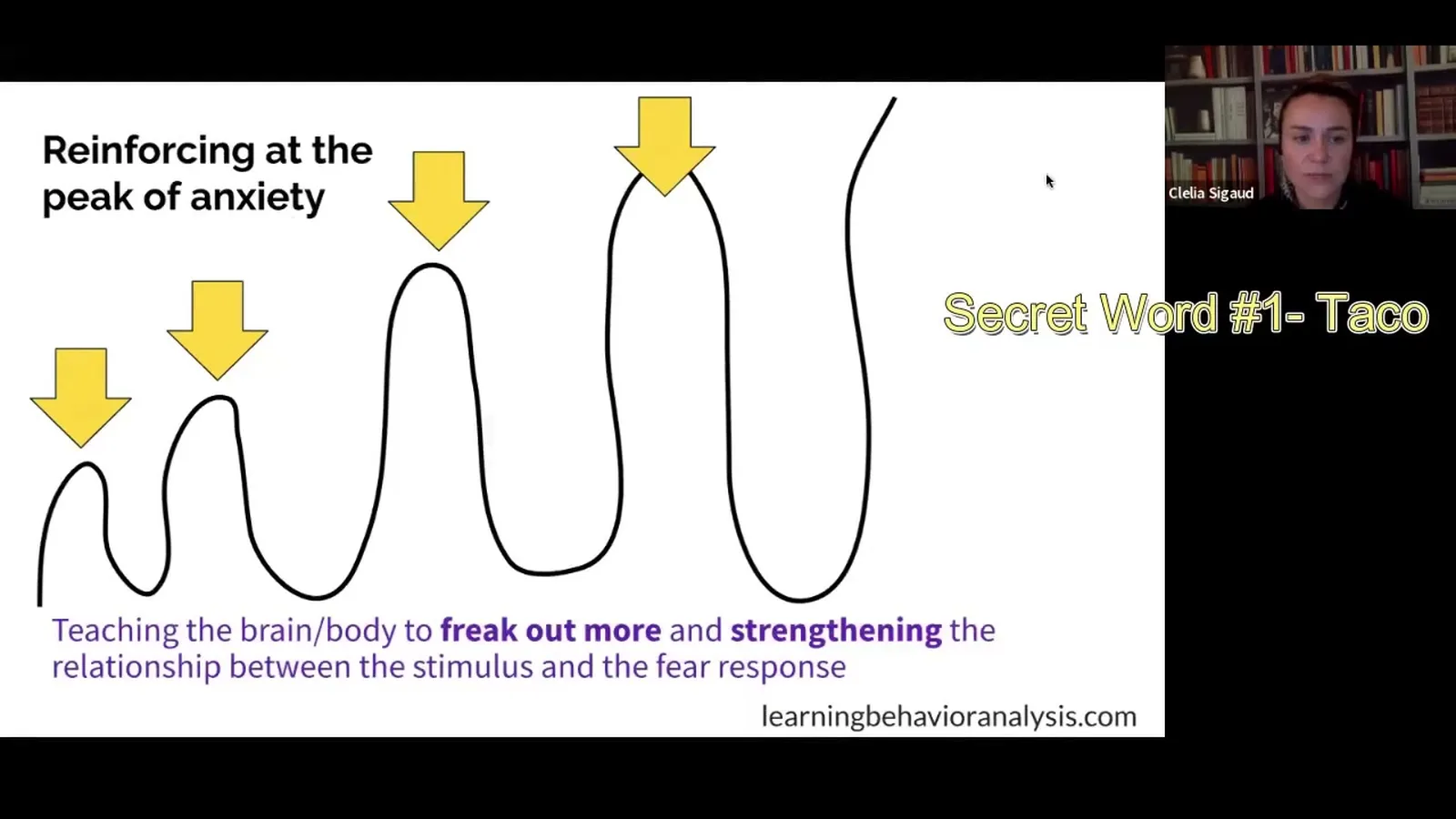
The hierarchy is the mechanism. The next questions are how to write it into a behavior plan, why mistaking anxiety for plain avoidance backfires, what a functional analysis can and cannot pull out of a fear case, and why anxiety as a private event is the wave shape that makes graduated exposure work at all. The siblings below pick up each thread.
Turn this topic into a CEU
You just studied this. Now get credit for it.
Watch Hey, Chillax Man! Understanding the Logic of Anxiety with Dr. Clelia Sigaud & Matt Harrington and earn 1.5 free BCBA CEUs. Detailed certificate, delivered the moment you finish.