Assent and Compassionate Care: Ethical Issues and Considerations for Practice
Presented by Matthew T. Brodhead, Ph.D., BCBA-D
Of course, compassionate care and consumer assent are of utmost importance in the delivery of high-quality behavior-analytic services. Though interest in each has (rightly) increased over the last 5 years, little is known about how both technological constructs apply to and can aid in service delivery. Providers, including behavior technicians, should understand this, and be prepared to acknowledge gaps when creating systems of service delivery that are compassionate and consider consumer assent whenever it is appropriate and feasible to do so. Therefore, the purpose of this presentation is to introduce the topics of compassionate care and assent, and then provide behavior-analytic conceptualizations and discuss ethical considerations and nuances associated with each. Ultimately, the author hopes that by the end of the presentation listeners are better equipped as skeptical science-based practitioners to implement behavior-analytic strategies that most definitely align with the values of compassion and honoring consumer assent.
Register free & watch nowCancel any time. Cert delivered to your inbox the moment you pass the quiz.
About this CEU
Of course, compassionate care and consumer assent are of utmost importance in the delivery of high-quality behavior-analytic services. Though interest in each has (rightly) increased over the last 5 years, little is known about how both technological constructs apply to and can aid in service delivery. Providers, including behavior technicians, should understand this, and be prepared to acknowledge gaps when creating systems of service delivery that are compassionate and consider consumer assent whenever it is appropriate and feasible to do so. Therefore, the purpose of this presentation is to introduce the topics of compassionate care and assent, and then provide behavior-analytic conceptualizations and discuss ethical considerations and nuances associated with each. Ultimately, the author hopes that by the end of the presentation listeners are better equipped as skeptical science-based practitioners to implement behavior-analytic strategies that most definitely align with the values of compassion and honoring consumer assent.
Credits
1 ethics CEU · 59 min
From the talk
What was covered
A skeptic's look at compassionate care and assent in ABA. It covers what the research shows and how to teach assent as a skill.
- Hold compassionate care as a value you believe in. Still check the evidence behind it as a method.
- Know the numbers before you build policy. ABA has 15 articles on compassionate care so far. Only 8 are empirical, and 14 of the 15 ran in one journal.
- Separate assent from informed consent in your paperwork. Research rules about assent do not transfer straight to practice.
- Teach assent as a skill: tell options apart, build a choice response, and know what the choice produces.
- Never judge assent by how a face looks. A smile, a frown, or a repeated answer can all mislead you.
- When a provider claims assent-based care, ask for specifics: the exact behaviors, a learner example, and how success is measured.
Why Being Skeptical About Compassionate Care Is Not an Attack On It
Dr. Brodhead set his ground rules early. He is all in on compassion (acts that ease a person's suffering). He is all in on more choice and more say for people with disabilities. He said he wants his own kids to live in a world like that. The values are not what he doubts.
What he doubts is the evidence behind compassionate care. Compassionate care means soft skills that reduce suffering. He questions treating it as a method we just adopt and roll out. Being skeptical just means asking about the worth and the proof of something. He framed that as his job. He also said he would be fine if listeners ended up disagreeing with him. The goal was to get people thinking.
That stance shapes the rest of this article. Nothing here argues against being kind to families. It argues against treating a good idea as a finished technology (a ready-to-use set of procedures). Ideas can be exciting and fashionable at the same time. Our job is to ask what is actually known.
And really being skeptical is to ask questions about the validity or value of something.
From the talk — Matthew T. Brodhead, Ph.D., BCBA-D
What Compassionate Care Means in Behavior-Analytic Terms
In treatment, compassion means turning empathy into action. The action aims to reduce another person's suffering. Said in behavioral terms, compassionate care is a complex operant (a behavior built from smaller skills). We often call these soft skills. Their function is to reduce aversive (unpleasant) events in a person's world. Their form is what we label as empathy.
Brodhead credited Bridget Taylor and colleagues with starting today's wave of interest. He pointed to their 2019 paper and the excitement it caused. That work also led to a special issue in the journal Behavior Analysis in Practice. He called that kind of impact, in that short a span, a real contribution.
He was also clear that the idea is older than the label. He pointed to Skinner in 1953. He pointed to Wolf's paper on social validity (do outcomes matter to families). He pointed to Sidman's coercion and fallout, and to Schwartz and Baer in 1991. Those authors did not use the term compassionate care. They were still writing about the same values.
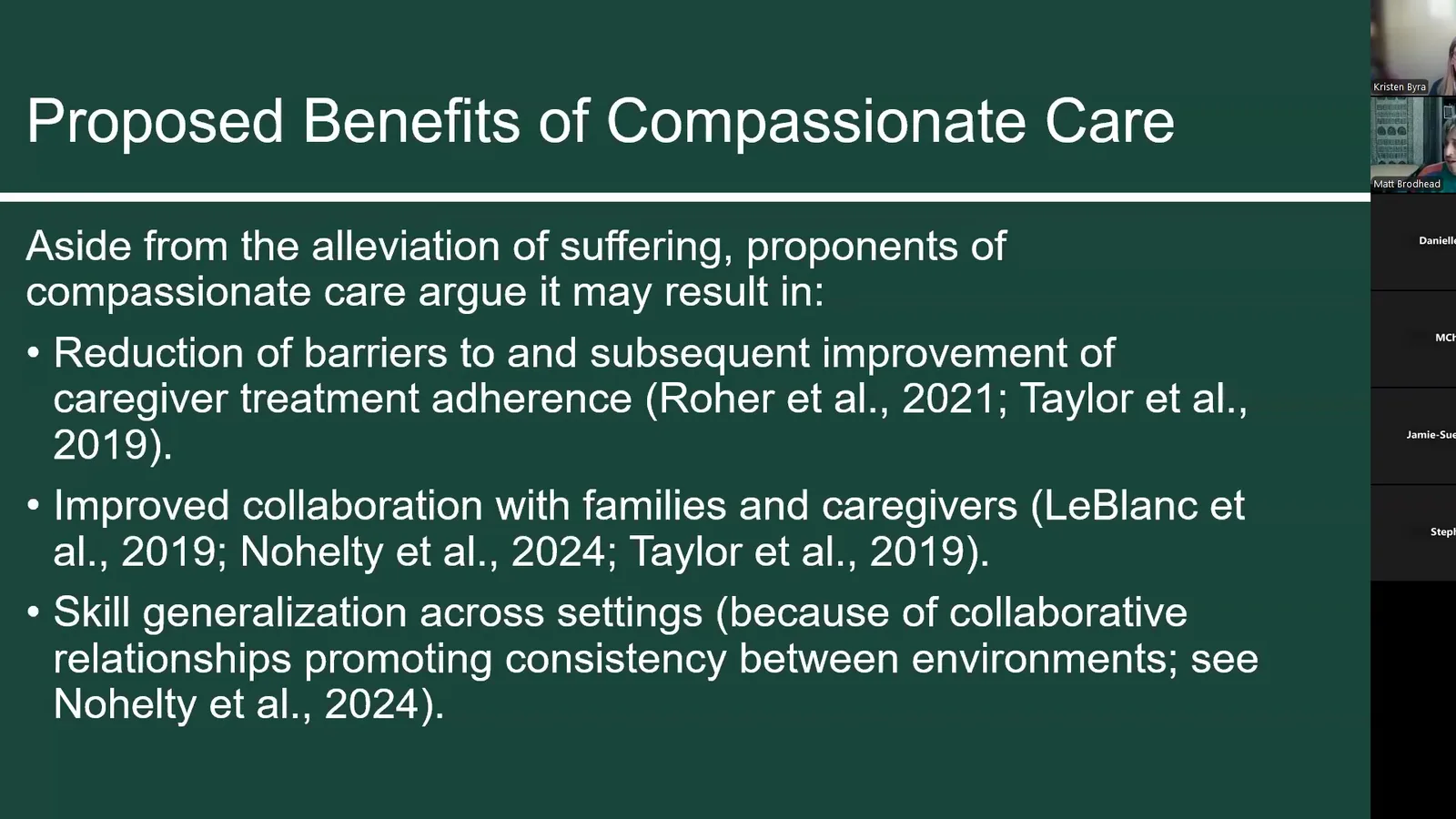
The claimed benefits are easy to like. Caregivers may stick with plans better. Work with families may get smoother. Skills may show more generalization (skills carry over to new places), since steady relationships keep home and clinic consistent. He named one more draw. The term helps show ABA as a humane, person-focused science.
the idea of compassion in ABA is not necessarily one that is novel or new
From the talk — Matthew T. Brodhead, Ph.D., BCBA-D
What the Literature Review Found: 15 Articles, 8 of Them Empirical
Brodhead and doctoral students reviewed the compassionate care literature in ABA. He shared a slice of the data. They plotted total publications from 2019 through 2024. The count starts with the 2019 paper and stays low for a while. Most of the papers came out in 2023 or later.
The totals are small. They found 15 articles. Eight were empirical (based on collected data). The other seven were discussion papers. And 14 of the 15 ran in a single journal.
He was careful on this point. He likes that journal, has served on its editorial board, and plans to publish there again. The worry is not the outlet. The worry is that one outlet holds nearly all of the work.
The team also coded who each recommendation was aimed at. Researchers got 68. Graduate training programs got 23. Practitioners got 18. Brodhead himself described that practitioner share as about 14 percent of the recommendations. That split makes sense for a young topic. Most advice goes to the people who still have studies to run. It also means a clinician who goes looking for guidance finds thin material.
a body of research becomes stronger when that research is reviewed and published and made available in more than just one or two outlets
From the talk — Matthew T. Brodhead, Ph.D., BCBA-D
Fad or Pseudoscience: Why the Difference Matters Here
A fad treatment (adopted fast with thin proof) spreads before the research arrives. Sometimes the research catches up and all is well. Sometimes it never does, because the method fails or interest moves on.
Pseudoscience (used after proof it fails) is different. That is when we keep using something after the data say it does not work. He listed flat earth claims and DARE (the school drug-prevention program). He also named facilitated communication (an unproven communication technique) and rapid prompting (another unproven communication technique). He said he learned DARE belonged on that list from a paper by Jason Travers.
So where does compassionate care land? His answer was honest. Probably not a fad. Clearly not pseudoscience. But adoption may be running well ahead of the proof. He also flagged two warning signs to watch in any trend. Fads travel on testimonials from people with authority. They also travel on single success stories. Social media makes both easy. Low-quality evidence is not the same as no evidence. It is just hard to generalize from.
He gave one more example from inside our own field. He described Hanley's ISCA (an assessment method in ABA) as a case where use has outpaced the literature. He said plainly that he was not calling it a fad. His point was about replication (repeating a study to check its results) by groups outside the original authors.
A fad is something where adoption precedes evidence. Sometimes evidence catches up and that fad treatment ends up being really, really effective.
From the talk — Matthew T. Brodhead, Ph.D., BCBA-D
Assent and Informed Consent Are Not the Same Thing
Informed consent (legal permission to begin treatment) is the official okay to take part. A proxy (someone who decides for another person) can give it when the person cannot. Parents and guardians do this every day. In medically necessary autism treatment, a guardian usually signs.
Assent (agreement to take part) comes from the person themselves. In most practice settings, assent is not required by law. Research is the clear exception. Research must be voluntary, so assent is always in play there. Brodhead thinks that is where the confusion starts. We take the rules written for research and apply them to practice. He also noted that some law runs the other way. Part of IDEA (the federal special education law) is explicit on this point. A student does not get to assent to FAPE (free appropriate public education).
None of that settles the ethics. Legal and ethical are not the same thing. We may still want assent to support autonomy (control over one's own choices), shared decisions, and choice.
There is one more catch. Offering a chance to assent does not mean the person understands. They may not grasp what is being asked. They may not grasp the treatment or the long-term effects of saying no. He used a family example. His kids cry at the needle during a vaccine visit. Assent is gone in that moment. He still consents, because he understands what comes later.
So just because something is or isn't legally required, right, doesn't mean that we shouldn't pay attention to it.
From the talk — Matthew T. Brodhead, Ph.D., BCBA-D
Assent as Verbal Behavior: The Three Skills You Have to Teach
If we want clients to assent, we should treat it as a skill. Brodhead framed assent as verbal behavior (behavior another person reinforces). A person states a willingness to engage or not engage. The clinician or teacher then responds to that. Reinforcement comes through a listener.
Assent is also choice behavior. He named three skills that have to be taught to fluency. First, conditional discrimination (telling the options apart). The person must know what each option is and what it means. His example was fun: do you want Bach or Beethoven? A simpler one is: do you want to play or work?
Second, a choice-making response. You cannot choose without a way to answer. A selection-based response means scanning an array and picking one. Handing over a picture from a binder is one form. A topography-based response (the shape of the response) varies in form. Sign language, a text to a caregiver, or speech all count.
Third, the contingency (what the behavior produces). A choice changes the environment. That change may be instant or delayed. The behavior should come under the control of the outcome it produces. As delays grow, rule-governed behavior (acting on a stated rule) matters more. Many young children do not have that repertoire (set of skills) yet. That is a heavy load when the choice is about opting out of treatment.
Assent is also choice behavior, where all behavior occurs in a choice context, where we always have at least two or more response options available to us at all times.
From the talk — Matthew T. Brodhead, Ph.D., BCBA-D
Do Not Judge a Choice by Its Cover
Brodhead spent real time on one trap. A response can look like a choice and not be one. In his own slide example, the student kept repeating the first option offered. The form looked like choosing. The function (the purpose a behavior serves) was something else.
The same trap applies to reading assent. What a response looks like is not the same as its function. He used himself as the case. When he is nervous or in a tight spot, he laughs and smiles. An observer might score that as a sign of happiness.
It cuts the other way too. A sour face does not always mean assent is gone. So treat a happy or relaxed look as a clue, not as proof of assent.
He closed this part with a caution about scope. Over-generalizing assent can do harm. It may not be functional for a given learner. It can cost instructional time. If a student opts out of everything, that is worth a closer look. It may mean the treatment needs to change. It may also mean lost time on the very needs you were hired to address.
Some things are difficult and I may not have the best look on my face, but I still want to do them and I still want to participate in them as well.
From the talk — Matthew T. Brodhead, Ph.D., BCBA-D
Ethics Codes, Risk, and Questions to Ask Your Own Program
Code standard 2.01 asks for services that fit behavioral principles and rest on scientific evidence. Brodhead does not think using compassionate care lands you in ethics trouble. He does think we should be honest about how early the data still are. He argued that broad support in peer review should come before broad adoption. He also gave the counterargument its due. Peer review is slow, and families need help now.
He tied it back to the codes on risk. Weigh risks, benefits, and side effects. Design plans that hold up in natural settings. Risk here includes the state of the evidence itself. Lost instructional time and misspent resources are the usual costs. He also returned to the right to effective treatment, citing Van Houten et al., 1988. More evidence makes it easier to give people the treatment they are owed.
In the Q and A he offered two practical moves. One: break compassionate care into its parts, define them, measure them, and tie them to outcomes. Work from related professions may help name those parts, even if it sits outside our own evidence base. Two: when a provider says it does assent-based care, ask for specifics. What behaviors would I do? What would that look like with this learner? How would we measure whether it worked?
His last word was about posture, not procedure. Do not let the analysis get fuzzy just because the construct (the idea itself) is fuzzy. Lean in, operationalize (turn an idea into something measurable), and keep acting like a behavior analyst.
And I think a good supervisor would be excited that a student or RBT would ask those kinds of questions
From the talk — Matthew T. Brodhead, Ph.D., BCBA-D
Common questions
Is compassionate care evidence-based in ABA?▾
The research base is young and small. A review shared in this talk found 15 articles in ABA. Eight were empirical, and 14 of the 15 ran in one journal. Most of the papers came out in 2023 or later. Brodhead's take is to proceed with caution and track outcomes yourself.
What is the difference between assent and informed consent?▾
Informed consent is the legal okay to take part. A parent or guardian can give it for someone who cannot. Assent is the person's own agreement to take part. In most practice settings assent is not required by law, though research participation always must be voluntary.
Is assent legally required in ABA practice?▾
Usually not. Research is the clear exception, since participation there must be voluntary. Brodhead noted that part of IDEA (the federal special education law) says a student does not get to assent to a free appropriate public education. He added that legal and ethical are different questions. A missing legal mandate does not end the discussion.
How do you teach assent as a skill?▾
Treat it as verbal behavior and choice behavior, then teach the parts to fluency. First, the learner must tell the options apart. Second, the learner needs a usable way to respond, by selection or by form. Third, the learner must understand what the choice produces. Teach those pieces first, then the full assent skill.
Can you tell a client is assenting by watching their face?▾
Not reliably. What a response looks like is not the same as what it does. Brodhead said he laughs and smiles when he feels nervous. Some hard tasks are still ones a person wants to do. Treat a happy or relaxed look as a clue, not as proof of assent.
Is compassionate care a fad treatment?▾
Brodhead said probably not, and clearly not pseudoscience. His concern is that adoption may be ahead of the evidence. A fad is a method that spreads before the research arrives. Pseudoscience is a method kept in use after data show it fails.
About the speaker
Matthew T. Brodhead, Ph.D., BCBA-D, is an associate professor at Michigan State University. He serves as an associate editor of the Journal of Applied Behavior Analysis. His work focuses on ethics and professionalism in ABA. He also studies restraint and seclusion in public schools, plus choice and social skill development in children with autism. He received the 2024 Outstanding Mentor Award from the Association of Behavior Analysis International. He also received the Association of Professional Behavior Analyst Excellence and Ethical Practice Award in 2026. He discloses compensation from book sales, consultation fees, and speaking fees.
This summary was generated from the recording’s transcript. Quotes are taken word for word from the talk.
What you'll learn
- 11) Participants will be able to describe behavior-analytic conceptualizations of compassionate care and consumer assent. 2) Participants will be able to identify ethical considerations and nuances associated with providing compassionate care and honoring consumer assent in service delivery. 3) Participants will be able to identify gaps in current knowledge about compassionate care and assent and describe how to account for those gaps when designing systems of service delivery.
Related talks
Talks that cover the same concepts

Crash Course in Behavior Analytic Toilet Training: Translating Research to Practice
Copper Consulting Group
Open the Door: Low Dosage ABA as an option
Nicole L. Stewart LLC

Rad N Bad: The Other Side of the Table — Ethical Failures, Compassionate Care, and Consumer Realities in ABA
Hickory Learning Group

Rad N Bad: Dosage by Tradition: What the Research Actually Says About ABA Hours, and the Contingencies Behind Them
Hickory Learning Group

Harm Reduction Within ABA Practice
The Behaviorist Bookclub

Roadmapping: A Guide to Lasting Independence
Hickory Learning Group
More from Upskill ABA
A Panel on Collaboration in Practice: SLP, OT & ABA Services
Upskill ABA
From Peer to Professional: Becoming & Supporting Early Career Behavior Analysts
Upskill ABA
From Idea to IRB: Conducting Research in Your ABA Practice
Upskill ABA
OpenCEU is supported by advertising from third-party sponsors. Sponsors are clearly labeled, have no influence over course content, instructors, or CEU decisions, and never appear on certificates. The BACB does not sponsor, approve, or endorse OpenCEU sponsors or their products.