Interdisciplinary Grief Support for People with Disabilities: Enhancing Outcomes Through BCBA-LPC Collaboration
Presented by Patricia Lund
What You’ll Learn & How It Applies to Your Practice This session will review how BCBAs can practice within their scope of competence while effectively collaborating with mental health professionals. Participants will learn practical strategies to support ethical, coordinated care and improve interdisciplinary collaboration.
Register free & watch nowCancel any time. Cert delivered to your inbox the moment you pass the quiz.
Learner ratings
from 48 learners
97% would recommend this CEU to other professionals in their field (38 responses)
“Such a great way to look at this topic and how BCBA's can help and support families through these challenging times.”
— Danielle M.“The presentation was informative and practical. It provided a clear understanding of grief support for people with disabilities and the importance of interdisciplinary collaboration.”
— Fatematuz Z.“good”
— Hongjun J.
About this CEU
What You’ll Learn & How It Applies to Your Practice This session will review how BCBAs can practice within their scope of competence while effectively collaborating with mental health professionals. Participants will learn practical strategies to support ethical, coordinated care and improve interdisciplinary collaboration.
From the talk
What was covered
How BCBAs (board certified behavior analysts) can support grieving clients with disabilities inside their scope. When to add a licensed counselor to the team.
- Teach what death means before anyone dies. Use neutral things like a dead plant, a dead bug, or a movie scene.
- Check your client's communication system for words like dead, died, gone, where, and how long. Add them if they are missing.
- Use front loading (preparing someone before an event), site visits, real choices, and a safe object. These help a client take part in a funeral instead of being left home.
- Treat laughing, anger, denial, jealousy, and relief as normal grief responses, and listen without trying to run therapy.
- Bring in a counselor after a suicide, a violent crime, a witnessed death, or the death of a primary caregiver.
- Hand that counselor your behavior data from before and after the loss. Include changes in severity, duration, and topography (what the behavior looks like).
Where grief support fits in a BCBA's scope
Death reaches every client you serve. Age does not change that. Patricia Lund works mostly in group homes with adults in Texas. That adult work is what pulled her into studying grief. But she opened by pointing at the early intervention people in the room. A young child who cannot explain death still feels it. Their nervous system (the body's alarm and stress system) still reacts.
Lund said the research points at a hard pattern. People with disabilities tend to face more deaths. They also tend to face them earlier than the neurotypical (developing in the usual way) population. They also face more loss in general. The field was slow to notice this. She said real research on how people with disabilities grieve did not start until the 1980s. She repeats that date in every talk because it still stings.
Two ethics codes frame the work. Code 1.05 asks you to stay inside your scope of competence (the work you were trained for). Code 2.01 asks you to work well with other professionals. Lund's whole point sits between those two. There is real grief work inside your lane. There is also work that belongs to someone else.
If you're not a mental health practitioner, then we're not going to do mental health practitioner things.
From the talk — Patricia Lund
The four-level continuum that shows where BCBAs belong
Lund builds her model on one article. It is by Sue Reed and David Elliott, two UK researchers who study disability and grief. It ran in the Journal of Intellectual Disabilities. Neither author is a behavior analyst. But Lund said their visual maps this work more clearly than anything else she found.
Picture a triangle with four bands. The wide base is education. Above it is participation. Then comes facilitation. The narrow top is focused intervention, like one-on-one therapy with someone who holds those credentials. Most grieving people need the bottom bands. Far fewer need the top one.
That shape changes the job. A death does not send everyone straight to a therapist. It also means parents, day hab staff, and group home staff can carry real weight, with training and guidance. Lund places BCBAs across the first three bands. The overlap sits at facilitation, where a behavior analyst and a counselor both have something to offer.
We're not assuming everyone who's experienced a death of a caregiver needs to immediately go into therapy, because they may not.
From the talk — Patricia Lund
Death education: teach it before the loss
Death education sounds grim. It is not. It means giving plain facts about death and dying, and saying that death is part of life. Lund said the research here is encouraging. Talking about death, reading books about it, and using the words dead and died all help. People who get that teaching early tend to have fewer complications when a real loss lands.
Most of her teaching is informal. She does not sit a client down and announce a death lesson. She uses what is already in front of them. A live plant next to a dead one. A dead bug. Roadkill on the side of the road. A cartoon where a character dies and then pops back up. She does not lecture about the wrong depiction. She asks guiding questions instead. What do you think happened here? Do you think that happens in real life?
She also uses aging timelines. One chart runs baby, child, adult, older person. At each stage you list what the person could do alone and what they needed help with. Lund used this with a client whose parents were getting older and planning ahead. They named what a parent used to do and what he cannot do now. They called it a bummer, out loud. Then they talked about how the client's own role in the family could shift. They also talked about what he could now help with.
Vocabulary is the piece she calls huge. If a client uses an AAC device (a tool that speaks for them), open it up. Are dead, death, and died in there? What about gone, where, and how long? If those words are missing, the person cannot ask about a loss even if they understand it. Build a plan to add them.
The time to teach is before something has happened.
From the talk — Patricia Lund
What a person needs to understand for death to make sense
A mature concept of death has parts, and Lund walked through five. Death is permanent, so the person is not coming back. Everyone and everything will die. Only living things die, so a stuffed animal cannot. Death happens because the body stops working. And a real breakdown in the body is what causes it.
That last piece pushes back on magical thinking (believing your own thoughts caused it). A child decides the crash happened because they forgot to say I love you. Naming the body part that failed gives them something truer to hold.
Children who develop in the usual way reach this between about seven and nine. Some get there at ten. Clients with cognitive differences may never hold all five pieces. Lund thinks some of her adult clients hold two. She is not saying drill it into them. She is saying it should buy everyone more patience. A child who keeps asking where grandpa is may simply not have the concept yet. Frustration in that moment teaches nothing.
There is also a ladder of harder losses. A dead plant is easy. An acquaintance is harder, with more feelings and more routine changes. The death of a caregiver is the big one, and Lund sees it often with adult clients. Last comes facing your own death. She pointed to Irene Tuffy-Wine, a researcher in the Netherlands. Tuffy-Wine works with adults with IDD (a lifelong learning and thinking disability) in hospice and palliative care. That work explains serious illness to the person so the world is not just moving them around.
So neurotypical children get this concept usually around between the ages of seven and nine, sometimes as old as 10.
From the talk — Patricia Lund
Helping clients take part in funerals and memorials
People with disabilities often get left out of funerals. Lund named the reasons without judging them. Staff worry about behavior. Families worry the person will not understand. Sometimes the adults are barely holding themselves together and cannot take on one more person. All of that is real. But research shows that taking part in death rituals helps the grieving process.
This is work BCBAs already know how to do. Front load the event (tell them what will happen first). Use video, visual schedules, and a visit to the site before the day. Offer real choices. Sit through the pastor or step outside. Flowers here or flowers there. Let them carry an object that helps them feel safe.
Change the setting when that helps more. Find a side room where they can regroup and come back, more than once if needed. Let them pick a seat. Limit how many people are there. Hold a small service the client attends and a larger one later. Maybe they come for the graveside part only.
Then give them a role. A message programmed on their device for the person who died, or for the room. A drawing you display. Picking the flowers or the songs. Small jobs move a person from bystander to mourner, which is the point.
But there's research that shows that participating in these death rituals can actually help the grieving process.
From the talk — Patricia Lund
Facilitation: being the safe person who listens
Facilitation is where you normalize what the person feels. Lund was blunt about how wide that range runs. Laughing happens. Insisting grandpa is not really dead happens. Anger, jealousy, isolating, and relief all happen. None of it means something is broken.
Your role here is narrow and still valuable. Let the person talk. Be the safe one in the room. Do not try to process their feelings with them unless you hold the degree that covers it.
Know the signals that call for another professional. Lund flags suicide, a violent crime, and a death the person witnessed. She also flags the death of a primary caregiver that upends daily life. She does not like the phrase refer out, because it sounds like dropping responsibility. She calls it collaborating. She also said to reach out any time you simply do not feel comfortable.
This is also where your data earns its place. You know the behavior before the loss and after it. Did self injury (behavior that hurts your own body) get more severe? Does dysregulation (loss of emotional control) last longer now than it used to? Did the topography (what the behavior looks like) change? A counselor cannot see any of that from the outside. You can hand it over.
All responses to grief are normal, even ones that we think aren't.
From the talk — Patricia Lund
What a licensed counselor adds to the team
Lund co-presented with Lisa, an LPC (a licensed mental health counselor) in Texas. Lisa specializes in chronic illness and medical complexity. Her question was practical. Why add one more person to a team that is already crowded? Part of the answer is about the people already on it. Caregivers often shield the person from the loss. Sometimes they are shielding themselves. That is common when the caregiver lost the same person too. It is also common when talking about death is simply not something they can do.
She listed what an outside counselor brings. Objectivity, because there is no dual relationship (holding two roles with one person). No personal grief from that same death. No stake in the behaviors grief stirs up, so no quiet reason to avoid the topic. Training in grief, trauma, IDD, medical complexity, or AAC use. And in many states, including Texas, the ability to diagnose.
Diagnosis matters because it opens doors. Most grief does not need a label and should not be pathologized (treated as an illness). But it can veer into prolonged grief disorder, a mood disorder, post-traumatic stress disorder, or separation anxiety. A diagnosis can unlock programs, services, and insurance coverage. It also pushes back on diagnostic overshadowing (blaming new symptoms on an old diagnosis). That pattern is why mental health conditions often go unrecognized in people with IDD.
She backed the long view with three studies. Harper and Wadsworth, 1993, interviewed 43 people with moderate to severe IDD. Of those, 25 said a death had been very disruptive to their lives. A 1997 study surveyed 50 people who had lost a parent within two years. Even after those two years, irritability, lethargy, inappropriate speech, and hyperactivity were all higher than in a control group. Bunnell and Pascal followed up two years later, putting some participants five to eight years past the loss. Things had gotten worse, not better, and the behavioral side had grown.
Making the team actually work together
Adding a counselor only helps if the team functions. Lisa walked through best practices for team based care. The first framing matters: the client and the family are members of the team, not the subject of it.
Start with shared values and ethics. Say out loud what each profession brings and what each one's scope allows. Then get roles straight. Know your own job and know what the other person is expert in. Attending a session like this one is part of that work.
Communication is the piece that breaks most often. Drop the terms that only your field uses. Build a shared vocabulary. Give feedback that pulls the goals into line. Talk about how the team is doing, not only how the client is doing. Keep cultural humility (respecting a family's own customs) in the mix, since death rituals differ widely by culture.
One more thing shapes all of it: your own state. An attendee asked how a grieving clinician supports someone else through a loss. Lund said take care of yourself first, which she admits is hard in this field. She leans on somatic practices (calming the body, not the thoughts) like deep breathing, grounding, and stretching. Lisa added that passing a case to a colleague when it hits too close is a valid choice. It is not a failure.
But I do think, I do think that finding ways to regulate yourself is huge.
From the talk — Patricia Lund
Common questions
Can a BCBA provide grief support without going outside their scope?▾
Yes, across three of the four levels on the Reed and Elliott continuum. You can provide death education and help the person take part in funerals and memorials. You can also normalize their feelings while you listen. What sits outside your scope is focused therapy, unless you hold credentials for it. Ethics code 1.05 is the line to keep checking yourself against.
When should a BCBA bring a mental health counselor onto the case?▾
Lund named suicide, a violent crime, and a death the client witnessed as clear triggers. She also named the death of a primary caregiver. She also said to reach out when behaviors keep going for a long stretch. Reach out too when needs are not being met. And reach out any time you simply do not feel comfortable. She frames it as adding someone to the team rather than handing the case off.
How do you teach a client about death before anyone has died?▾
Use neutral, low-stakes examples. Try a live plant next to a dead one, a dead bug, or roadkill. You can also use the life cycle of an animal, or a movie scene that gets death wrong. Talk about aging and how abilities change, using a simple timeline from baby to older person. Teaching after a caregiver dies is too late, because that moment is already traumatic.
At what age do children understand what death means?▾
Children who develop in the usual way generally get there between seven and nine, sometimes as late as ten. Understanding means holding five ideas. Death is permanent, everything living dies, and only living things die. The body stops working, and a breakdown in the body causes it. Clients with cognitive differences may hold only some of those pieces, or none, at any age.
What can a BCBA give a counselor that no one else on the team can?▾
Behavior data from before and after the loss. You can report whether severity increased and whether episodes last longer than they used to. You can also report whether the form of the behavior changed. That comparison is hard for anyone who met the client after the death. It also helps the counselor tell a normal grief response from one that needs targeted intervention.
About the speaker
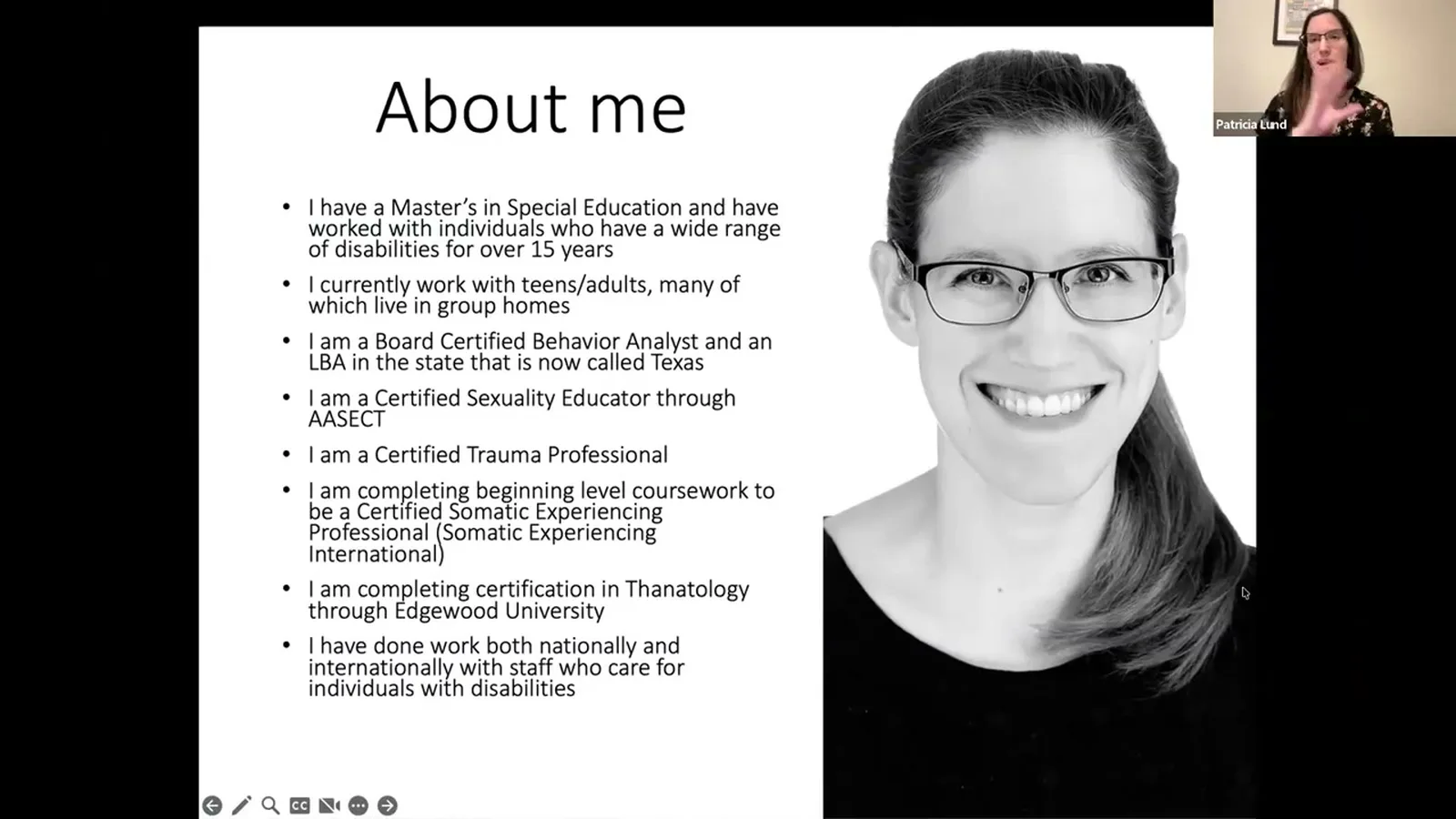
Patricia Lund is a board certified behavior analyst in Texas. She started in special education and taught high school. She now works mostly in group homes with adults, along with some younger clients. She is a certified sexuality educator through ASECT (a sexuality education certifying body) and a certified trauma professional. She is also completing coursework in somatic experiencing (body based trauma therapy) and in thanatology, the study of death and dying.
This summary was generated from the recording’s transcript. Quotes are taken word for word from the talk.
What you'll learn
- 1Learning Objectives
- 21. Identify appropriate scope of practice and competence for BCBAs.
- 32. Describe practical strategies to implement within their current role.
- 43. Identify best practices for collaborating with mental health professionals.
Concepts in this CEU
Related talks
Talks that cover the same concepts
Grief Support at the Front Lines: Training Day Hab and Group Home Staff to Support Adults with IDD Through Bereavement
The Behaviorist Bookclub
Hey, Chillax Man! Understanding the Logic of Anxiety
The Behaviorist Bookclub
That's Outside My Scope of Competence
Willow Mentorship & Consulting, LLC
School Collaboration as an Area of Competence - Applied 2022
The Behaviorist Bookclub
Beyond 1:1: The Ethical Path to Creating a Scalable Course as a BCBA
The Behaviorist Bookclub
Increasing Competence and Confidence in Helping People with Disabilities through Grief
The Behaviorist Bookclub
More from The Behaviorist Bookclub

Harm Reduction Within ABA Practice
The Behaviorist Bookclub
Supervising Beyond Technical Skills: Professionalism, Communication, and Clinical Judgment
The Behaviorist Bookclub
Reflective Supervision and Client Outcomes
The Behaviorist Bookclub
OpenCEU is supported by advertising from third-party sponsors. Sponsors are clearly labeled, have no influence over course content, instructors, or CEU decisions, and never appear on certificates. The BACB does not sponsor, approve, or endorse OpenCEU sponsors or their products.