School Collaboration as an Area of Competence - Applied 2022
Presented by Dr. Clelia Sigaud
This session translates “school collaboration” into concrete, ethical competencies for behavior analysts working in educational settings. The presenter contrasts scope of practice with scope of competence and offers practical decision aids for determining when to accept, defer, or seek supervision on school-based cases. Attendees review the IDEA/IEP landscape—what an IEP is, why it is legally binding, how teams operate by consensus, and how to secure informed consent for assessments and interventions. The talk centers collaborative behaviors that prevent “being the jerk at the IEP meeting”: plain-language communication, humility, pairing, and truly treating families and students as full team members. Interdisciplinary strategies show how to co-design goals (e.g., FCT) with SLPs/OTs while accounting for access methods and response effort. The session also provides a framework for responding to non-behavioral or low-evidence proposals—prioritizing safety, data, and relationships—while articulating a compassionate behavior-analytic worldview oriented around function, dignity, and socially significant outcomes.
Register free & watch nowCancel any time. Cert delivered to your inbox the moment you pass the quiz.
Learner ratings
from 92 learners
97% would recommend this CEU to other professionals in their field (69 responses)
“I work in a lot of schools so much of this is familiar to me; however, this is a great overview of integrating outside providers into the IEP process and how best to do so.”
— Walter C.“N/a”
— Marie M.
About this CEU
This session translates “school collaboration” into concrete, ethical competencies for behavior analysts working in educational settings. The presenter contrasts scope of practice with scope of competence and offers practical decision aids for determining when to accept, defer, or seek supervision on school-based cases. Attendees review the IDEA/IEP landscape—what an IEP is, why it is legally binding, how teams operate by consensus, and how to secure informed consent for assessments and interventions. The talk centers collaborative behaviors that prevent “being the jerk at the IEP meeting”: plain-language communication, humility, pairing, and truly treating families and students as full team members. Interdisciplinary strategies show how to co-design goals (e.g., FCT) with SLPs/OTs while accounting for access methods and response effort. The session also provides a framework for responding to non-behavioral or low-evidence proposals—prioritizing safety, data, and relationships—while articulating a compassionate behavior-analytic worldview oriented around function, dignity, and socially significant outcomes.
From the talk
What was covered
Scope of competence, IEP basics, and the collaboration habits that keep behavior analysts useful at school team tables.
- Write out your own scope of competence before you take a school referral. Then accept, defer, or ask for supervision based on it.
- Treat the IEP as a promise: anything written in it becomes a service the school must deliver, staffing problems and all.
- Drop the jargon in meetings and check for understanding, because consent is not informed if the family cannot follow you.
- Ask an occupational therapist or speech-language pathologist to help pick the form of a communication response. Look beyond just the function it serves.
- Use a decision model for low-evidence proposals: check safety first, ask for data, and protect the working relationship.
- Practice a short, plain statement of what a behavior analyst does. You may be the first one a school staffer meets.
Scope of Practice Versus Scope of Competence
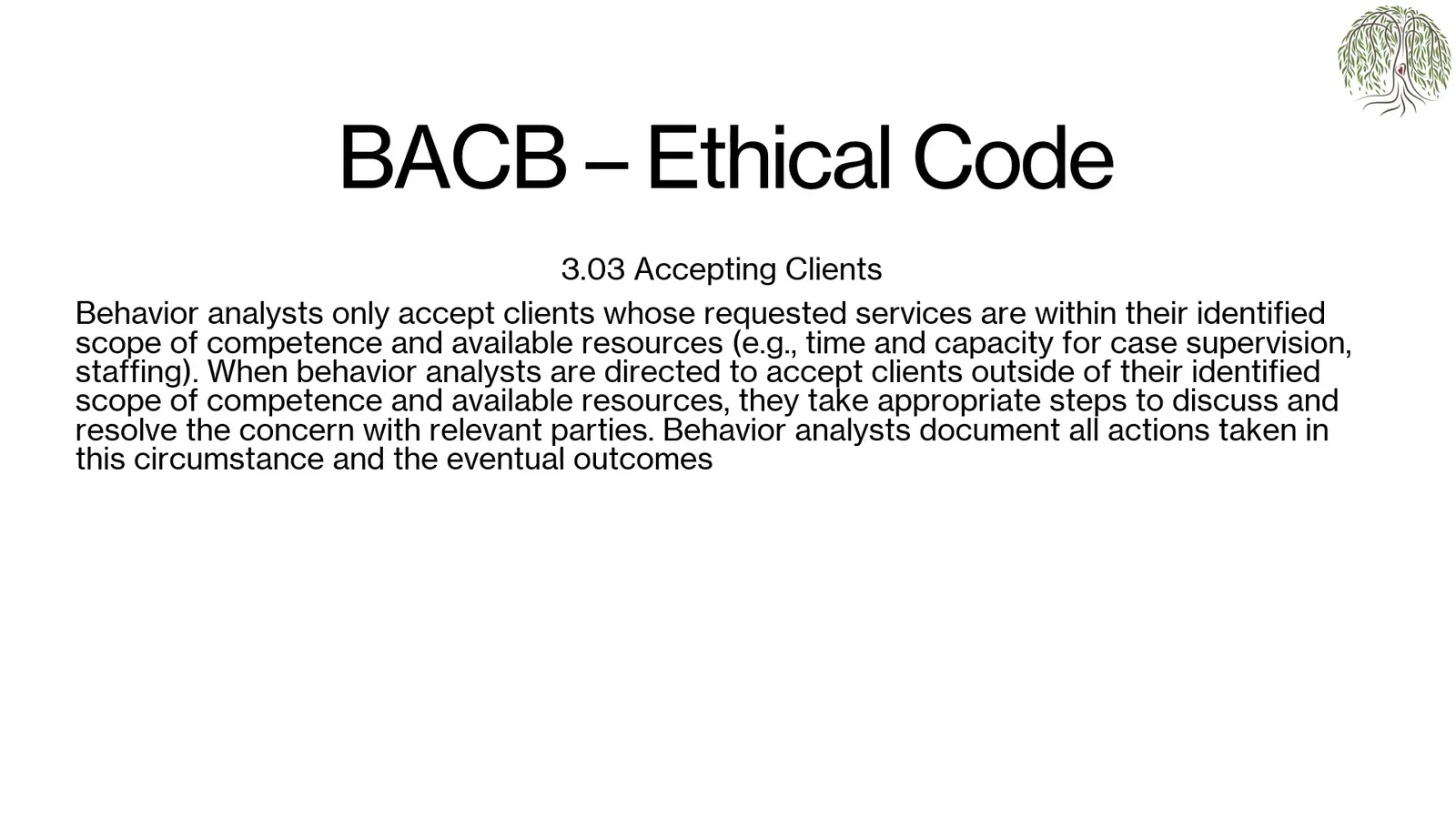
Scope of practice is what a whole profession may do (the full range a field allows). For behavior analysts, that range is wide. Classroom consultation sits inside it. So does feeding treatment. Some states add their own limits, so know your state rules. Surgery, flying planes, and diet coaching do not fit. Those sit outside the credential unless you hold another one.
Scope of competence is what one person can actually do well with real clients. It is always the smaller circle. Nobody has the hours to master every population and every setting. Your competence comes from your coursework, your reading, and your supervised practice. The talk used a simple picture of colored circles to make this concrete.
One circle held skills you have as a private person, not as a professional. Giving a friend diet advice over dinner is fine. Giving that advice with your professional hat on is not. Another circle held work the field may do that you personally cannot do yet. Treating psychotic disorders was the example. Some behavior analysts do that work well. If you are not one of them, hand the case on.
Scope of competence is going to always be smaller than scope of practice for us as behavior analysts.
From the talk — Dr. Clelia Sigaud
Why Competence Gaps Turn Dangerous in School Settings
Schools create steady pressure to take on cases you are not trained for. The need is real and the staff are stretched. The talk named three school examples where that pressure led somewhere bad. Each one carried heavy consequences.
The first was setting up chances for a child to masturbate at school. Depending on local law, that can put the analyst, the school, and the family at legal risk. The second was treating attention-maintained elopement (running off to get a reaction) with extinction (stopping the reaction that used to follow the behavior) alone. The plan matched the function, but the child was still leaving the building. Safety has to shape the plan too.
The third was reading a student's suicidal statements as an attempt to escape work demands. In one case the student later attempted suicide at school. The wider cost is real as well. Presenting yourself as competent to funders or employers when you are not is a form of deceit. Over time, thin practice damages how the whole field is seen.
The thing is, I'm not sure that we're really helping when we do things that potentially put our clients and ourselves and the field in general at risk.
From the talk — Dr. Clelia Sigaud
A Checklist for Deciding Whether You Are Competent Yet
There is no single method the field agrees on for judging competence. That gap is part of the problem. It is not a reason to skip the question. The talk pointed to a 2018 article by Broadhead and colleagues. It is called A Call for Discussion About Scope of Competence. It includes a checklist you can print and use. It works well in supervision and in peer consultation.
Competence rests on more than one thing at once. You need coursework and a real command of the current literature (published research) on the topic. Sleep was the honest example given: without reading the sleep literature, that area is off the table. You also need quality supervised experience. Have you shown you can do this skill well while someone watched?
Competence also cuts across dimensions. There are procedures and strategies, like token economies (earning and trading tokens for rewards) and visual schedules (picture-based routines). There are populations, which means far more than a diagnosis code. A diagnosis does not tell you who a person is or what matters to them. Then there are settings, and schools are a large one. None of this flips on in a single day.
But just because something is complex or has shades of gray to it doesn't mean that we shouldn't think about it and try to address it appropriately.
From the talk — Dr. Clelia Sigaud
What an IEP Is and How the Team Actually Decides
Special education is specially designed instruction built around one child's needs. It is not a room, and it is not a program you get placed into. The point is a free and appropriate public education. The IEP (the written plan holding that student's goals and supports) is the guiding document. It states present levels, the goals for the coming year, and the accommodations and services that go with them.
The plan is built for the individual, not for the eligibility category. Two students with the same label should not get the same services. Once the IEP is finalized, it is legally binding. The school owes those services no matter who called out sick that day. That should change how carefully you write. If it goes in, it gets delivered, every time and not sometimes.
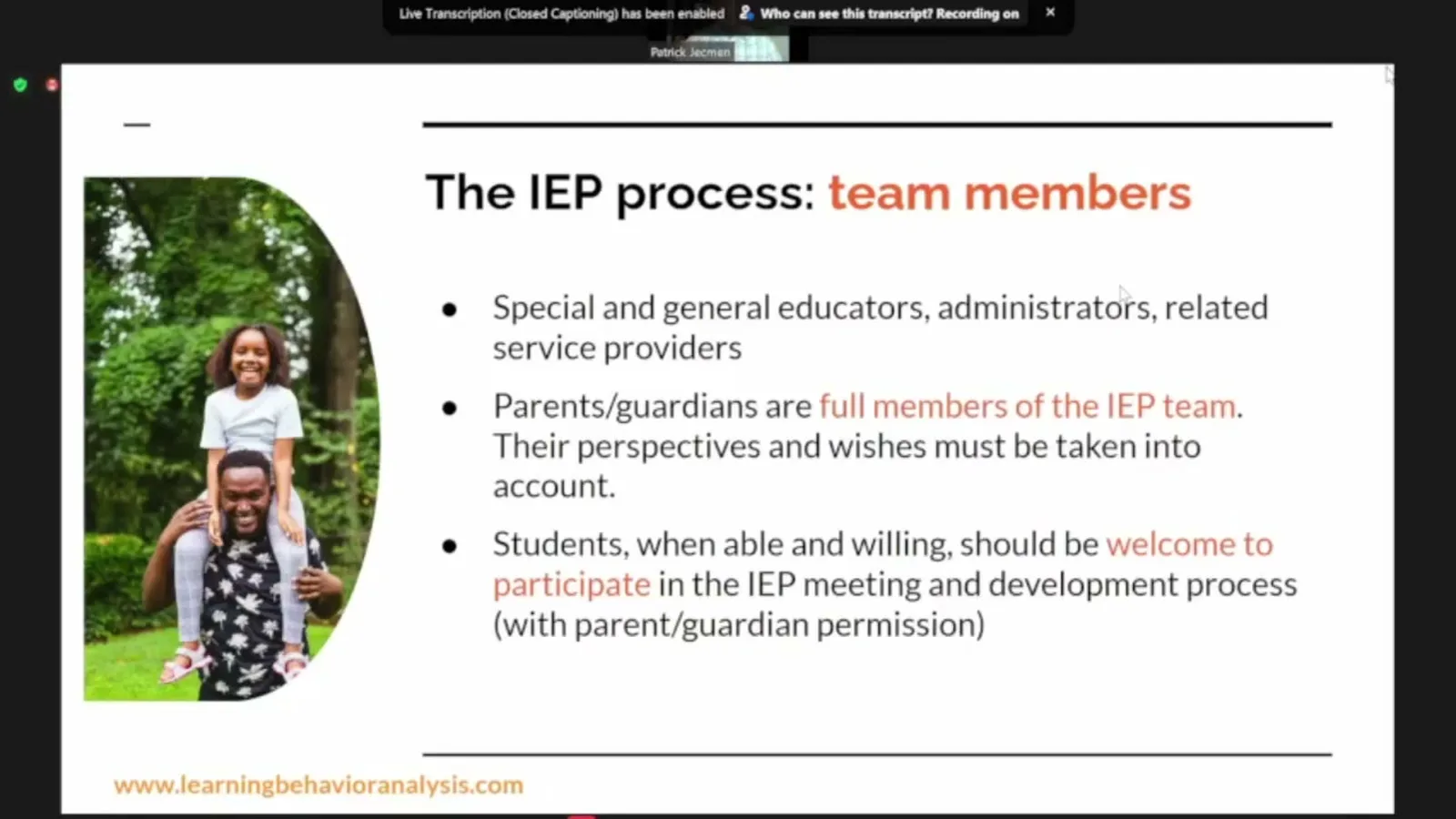
The team includes special and general education staff and administrators. It also includes related service providers, such as social workers, psychologists, occupational therapists, and physical therapists. Parents and guardians are full members, not an audience. Students should join when they are able and willing. The team also works like a jury rather than a democracy. There is no vote and no majority rule. The goal is a decision everyone can leave the room standing behind.
Collaboration Behaviors That Build Trust at the Table
Start with what to stop doing. Do not alienate people, or they will learn to avoid you. Do not lean on jargon that makes your plan hard to follow. Do not assume that what feels socially significant (meaningful and important) to you is automatically right for this family. Decentering your own norms (setting aside your default assumptions) is part of the job, not a nicety.
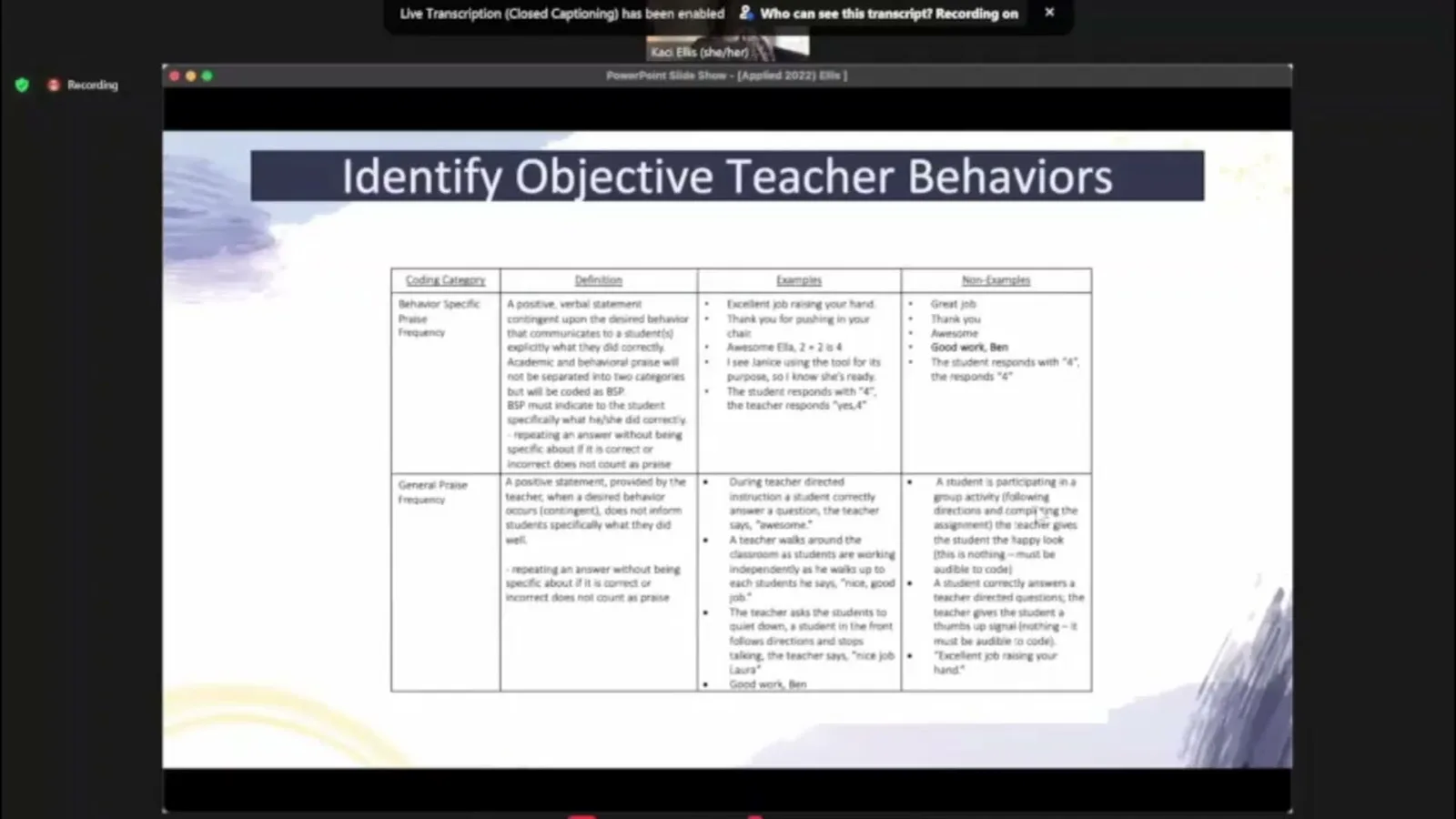
Then build the other side. Pair yourself with good things so people are willing to approach you (pairing means becoming a signal for reinforcement). Use behavior-specific praise often and mean it. Name what other disciplines do well and leave room in the conversation for their read of the student. Listen to learn rather than to reply. Do not dodge the places where your views differ.
Plain language is also a consent issue. Describe assessments in real words before a parent signs. Practice explaining your report, your goals, and your progress monitoring to a lay person. Then ask them to push back and tell you where you lost them. General consent is not informed consent. The talk also pointed to a 2019 article, borrowed from social work, with reflection questions about power imbalances. Remember that for many staff, you are the first behavior analyst they have ever met.
Co-Designing FCT Goals With SLPs and OTs
Functional communication training (FCT: teaching a better way to ask for something) does not belong to behavior analysts alone. Other providers have real expertise about the form the response takes. One example from the talk involved a student with an eye gaze device who was refusing to use it. A large choice board was tried instead. The student had limited finger use and mostly gross motor reaching.
The occupational therapist built a board that sat right in front of the student, enlarged and easy to see. That choice cut the effort needed to respond. The student made strong progress, and the skill later transferred back to the eye gaze device. Access method, motor demands, and response effort all shape whether a communication response wins out.
The same logic applies with speech-language pathologists. A worked example in the talk paired a BCBA (board certified behavior analyst) and an SLP on elopement using FCT. The behavior analyst brought data-based decision making, use of motivating conditions (what makes a behavior more or less likely right then), and attention to response effort. The SLP brought heavy direct service experience, speech modalities, and vocabulary growth for generalization (using a skill in new places). When an all-purpose request starts breaking into specific ones, an SLP is the person you want beside you.
Responding to Non-Behavioral or Low-Evidence Proposals
Many of us leave grad school with real zeal for evidence-based practice. That drive is good. It gets clients results. It can also turn rigid. A flat refusal shuts down the people who spend the most time with your client. It also closes you off from learning something new.
Two resources anchored this part of the talk. The 2010 article How to Behave Ethically in the World of Fads offers a decision model. It applies to treatments with little or no empirical support (proof from research studies). It replaces one yes or no question with a set of better questions. A 2015 Broadhead article, Maintaining Professional Relationships in an Interdisciplinary Setting, adds a checklist for analyzing a proposed treatment. Do not get stuck arguing over whether a rating is low or medium. The models guide thinking, not scoring.
The key idea is easy to say and easy to forget. Non-behavioral does not mean unsupported. Client safety stays inside every one of these models. Some proposals are still a hard no, and saying so is fine. Flexibility here is about what counts as evidence, not about giving up your science.
non-behavioral is actually not synonymous with not supported by evidence.
From the talk — Dr. Clelia Sigaud
Writing Your Behavior-Analytic Worldview in a Few Sentences
Behaviorism (the science of how the environment shapes behavior) is not the lens most school staff bring to work. Our field is still fairly new in schools. Some team members have never met a behavior analyst. Others have, and it did not go well. That learning history (their past experiences shaping how they react) walks into the meeting with them. So it helps to have a short, clear way to say what you do and why.
The version shared in the talk was built for parents of children with severe challenging behavior. That often came after years of it. It opens by naming the unsafe behavior. Then it makes the order of operations plain: understand first, then help. It also names what the analyst does not believe, which is that something is wrong with the child.
The closing frame is worth keeping. Society tends to locate the flaw inside the person when behavior looks unusual. Behaviorism rejects that. If a person simply has not met an environment that supports their needs, then the environment can change. That is why the presenters called this a compassionate worldview. Write your own version down, out loud, before you need it.
I need to understand why this challenging behavior is happening for your kid in the context in which it occurs so that I can help.
From the talk — Dr. Clelia Sigaud
Common questions
What is the difference between scope of practice and scope of competence?▾
Scope of practice is everything the profession as a whole may do, and it is broad. Scope of competence is what you personally can do well with real clients, and it is always smaller. Competence is built from coursework, current literature, and supervised experience in that specific area. Work can sit inside the profession's scope and still sit outside yours.
Is an IEP legally binding on the school?▾
Yes. Once the IEP is finalized, the school is obligated to deliver the services and supports written in it. Staffing shortages and absences do not change that obligation. Write only what the team can truly deliver, because there is no sometimes.
Does an IEP team vote on decisions?▾
No. The team works more like a jury than a democracy, so there is no majority rule. The goal is a decision the whole team arrives at together and can move forward on. That is exactly why collaboration skills matter so much at the table.
Can a BCBA and an SLP work on the same communication goal?▾
Yes, and the talk treats that as a strength rather than a turf problem. A behavior analyst brings data-based decisions, attention to motivating conditions, and response effort. An SLP brings direct service experience, speech modalities, and vocabulary growth for generalization. Occupational therapists can help pick a response form that matches a student's motor abilities.
How should I respond when a school proposes a non-behavioral treatment?▾
Use a decision model instead of a yes or no reaction. Check client safety first, ask what data exist, and stay open to evidence that does not come in behavioral language. Non-behavioral is not the same as unsupported. Some proposals still get a firm no, and that is compatible with being a good collaborator.
About the speaker
Dr. Clelia Sigaud is a doctoral-level behavior analyst and a school psychologist. She does clinical work across Maine and New Hampshire, much of it with people who engage in severe challenging behavior. She also does peer consultation with school-based behavior analysts. She co-runs learningbehavioranalysis.com with co-presenter Patrick Jackman, which offers a plain-language breakdown of the full fifth edition task list, plus supervision and study resources.
This summary was generated from the recording’s transcript. Quotes are taken word for word from the talk.
What you'll learn
- 1Learning Objectives • Differentiate scope of practice from scope of competence, and use structured checklists to decide when to accept, defer, or seek supervision on school-based referrals.
- 2• Identify key legal and procedural features of IDEA/IEPs, including team composition, consensus decision-making, and requirements for informed consent and ongoing progress monitoring.
- 3• Explain collaboration behaviors that build trust at IEP tables (e.g., minimizing jargon, de-centering one’s own norms, pairing, and behavior-specific praise).
- 4• Design cross-disciplinary goals (e.g., FCT) in coordination with SLPs/OTs by selecting response topographies that consider access method, motor demands, and response effort.
- 5• Evaluate non-behavioral or low-evidence treatment proposals with an ethical decision model that prioritizes client safety, data-based judgments, and preservation of effective working relationships.
- 6• Develop and deliver a concise “behavior-analytic worldview” elevator statement that frames behaviorism as compassionate, functional, and collaborative in IEP contexts.
Concepts in this CEU
Related talks
Talks that cover the same concepts
Shaping Behavior Change when ADHD is in the Picture
The Behaviorist Bookclub
That's Outside My Scope of Competence
Willow Mentorship & Consulting, LLC
Practical Takeaways for School-Based Behavior Analysts
The Behaviorist Bookclub
Stronger Together: Care Collab
The Behaviorist Bookclub
Beyond 1:1: The Ethical Path to Creating a Scalable Course as a BCBA
The Behaviorist Bookclub
Hey, Chillax Man! Understanding the Logic of Anxiety
The Behaviorist Bookclub
More from The Behaviorist Bookclub
Harm Reduction Within ABA Practice
The Behaviorist Bookclub
Supervising Beyond Technical Skills: Professionalism, Communication, and Clinical Judgment
The Behaviorist Bookclub
Reflective Supervision and Client Outcomes
The Behaviorist Bookclub
OpenCEU is supported by advertising from third-party sponsors. Sponsors are clearly labeled, have no influence over course content, instructors, or CEU decisions, and never appear on certificates. The BACB does not sponsor, approve, or endorse OpenCEU sponsors or their products.