The Math Behind Behavior Reduction
Presented by Matt Harrington
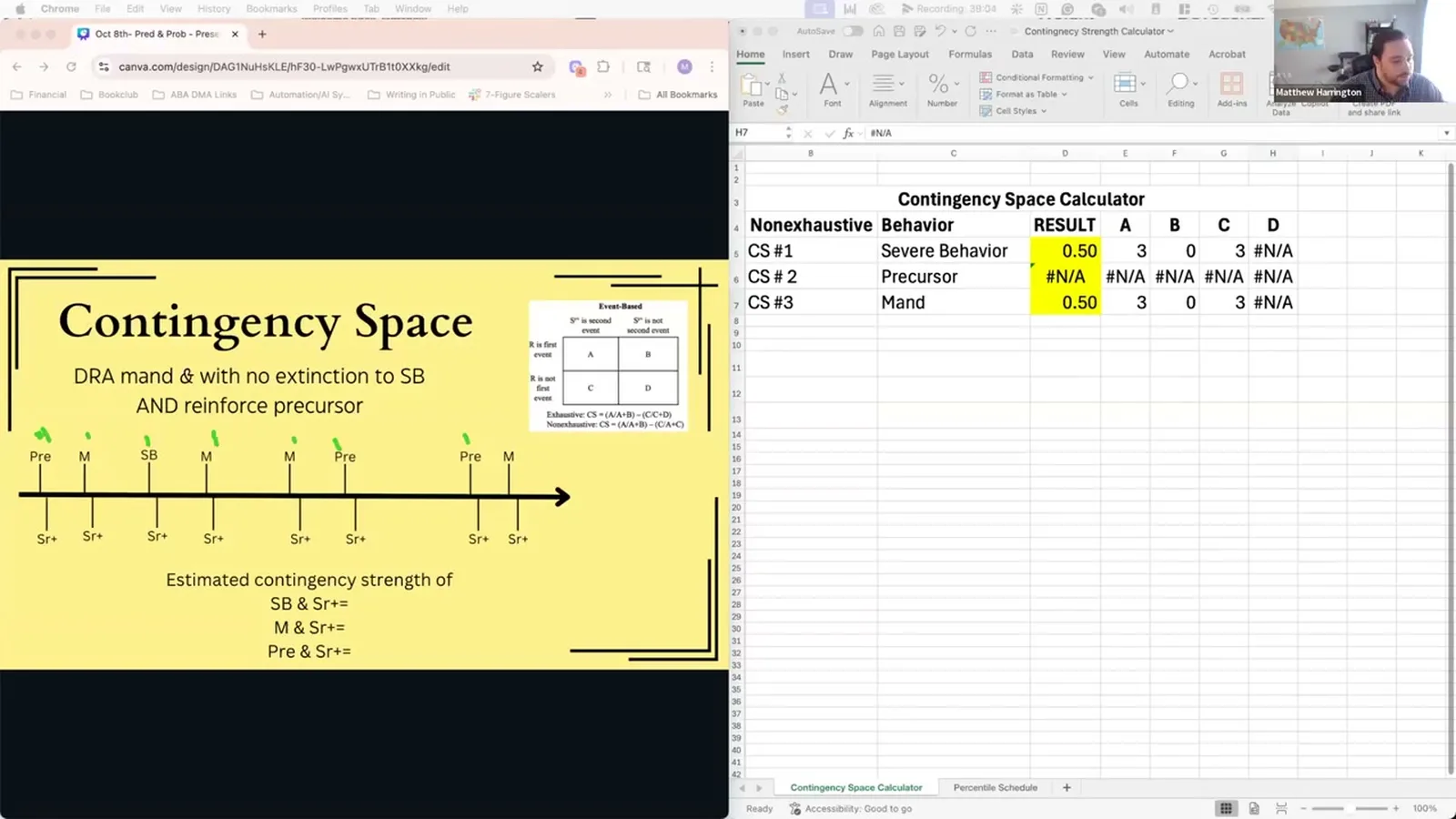
This webinar explores the mathematical foundations underlying behavior reduction interventions, moving beyond traditional "copy-paste" approaches to truly individualized treatment design. The presentation focuses on two primary mathematical frameworks: contingency strength analysis and percentile schedules for shaping. Participants learn how to use contingency space equations to objectively assess the probability that behaviors will result in reinforcement, enabling clinicians to predict intervention outcomes before implementation. The webinar demonstrates how interventions like Functional Communication Training (FCT) work through manipulating contingency strength differentials between target behaviors and replacement behaviors. Additionally, the presentation covers the percentile schedule equation for objectifying the shaping process, including how to adjust reinforcement density and observation windows to optimize skill acquisition while managing risk. Through practical examples and calculations, attendees gain tools to make data-driven decisions about intervention modifications in real-time, reducing reliance on clinical "instinct" and increasing precision in behavior-analytic practice. The content emphasizes understanding the "why" behind interventions to enable truly customized treatment approaches across diverse populations and settings.
Register free & watch nowCancel any time. Cert delivered to your inbox the moment you pass the quiz.
About this CEU
This webinar explores the mathematical foundations underlying behavior reduction interventions, moving beyond traditional "copy-paste" approaches to truly individualized treatment design. The presentation focuses on two primary mathematical frameworks: contingency strength analysis and percentile schedules for shaping. Participants learn how to use contingency space equations to objectively assess the probability that behaviors will result in reinforcement, enabling clinicians to predict intervention outcomes before implementation. The webinar demonstrates how interventions like Functional Communication Training (FCT) work through manipulating contingency strength differentials between target behaviors and replacement behaviors. Additionally, the presentation covers the percentile schedule equation for objectifying the shaping process, including how to adjust reinforcement density and observation windows to optimize skill acquisition while managing risk. Through practical examples and calculations, attendees gain tools to make data-driven decisions about intervention modifications in real-time, reducing reliance on clinical "instinct" and increasing precision in behavior-analytic practice. The content emphasizes understanding the "why" behind interventions to enable truly customized treatment approaches across diverse populations and settings.
What you'll learn
- 1Learning Objectives Upon completion of this presentation, participants will be able to:
- 2Analyze the contingency strength of behaviors within an intervention using the contingency space equation to predict the likelihood of behavior change before implementation.
- 3Apply mathematical principles of contingency strength to design and modify behavior reduction interventions that are individualized to client needs rather than copied from previous cases.
- 4Evaluate shaping procedures using the percentile schedule equation (K = M + 1(1-W)) to determine appropriate reinforcement density and observation windows based on client risk factors and acquisition goals.
Concepts in this CEU
More from The Behaviorist Bookclub
Foundations of Reflective Supervision in Behavior Analysis
The Behaviorist Bookclub
Teaching WH-Questions Isn’t Enough: Building True Conditional Discrimination
The Behaviorist Bookclub
Reframing Behavior through an ADHD Lens
The Behaviorist Bookclub
OpenCEU is supported by advertising from third-party sponsors. Sponsors are clearly labeled, have no influence over course content, instructors, or CEU decisions, and never appear on certificates. The BACB does not sponsor, approve, or endorse OpenCEU sponsors or their products.