Reframing Behavior through an ADHD Lens
Presented by Nicole Stewart, BCBA
Cancel any time. Cert delivered to your inbox the moment you pass the quiz.
Learner ratings
from 230 learners
98% would recommend this CEU to other professionals in their field (159 responses)
“Fantastic!”
— Sarah G.“Loved this topic! Would love to have more on ADHD”
— Danielle M.“This helped shape my thoughts on treating ADHD. As well as, thinking about what works for me personally, as someone who also has ADHD”
— Mirella P.“This ceu expands the use of ABA in a way that can be used across diagnoses.”
— Cearah S.
About this CEU
ADHD changes how learning, regulation, and effort show up, and when those differences are ignored, behavioral treatment can miss the mark or unintentionally cause harm. This ethics-focused workshop explores why it is not only clinically important, but ethically necessary, to meaningfully consider ADHD in behavioral assessment and intervention. Participants will look at how attention, emotional regulation, persistence, and internal experiences shape behavior, and how misinterpreting these features can lead to unrealistic expectations, ineffective treatment, and erosion of dignity. The session emphasizes ethical responsibility, compassion, and thoughtful clinical decision-making when ADHD is part of the picture.
From the talk
What was covered
ADHD changes how effort, attention, and reward work. Here is how to spot the mismatch in your plans before it causes harm.
- Treat ADHD as a medical diagnosis in your assessment, not as a personality note in the intake file.
- Before you ask why a client escapes a task, ask if it gives their brain enough to work with.
- Expect reinforcers to lose their power faster with ADHD, and plan for novelty and thin reward schedules (spacing out rewards over time) from day one.
- Learners who are bored and craving dopamine (a reward chemical) may check out. Teaching them to request a break can make the room even less stimulating.
- Check response effort against what that brain can sustain right now, then shape up (build the skill in small steps) from a smaller ask.
- Run every current case through five questions. Is this a symptom? Is the behavior itself the reinforcer? Does the task fit the brain? Am I treating the need or the surface? Is the effort within reach?
Why ADHD Belongs in Your Ethics Analysis, Not Just Your Notes
ADHD is a medical diagnosis. That one fact does a lot of work. It means what you see at the table is not only behavior. It also comes from how a brain grew and how it runs. This session tied that idea straight to the ethics code.
Four codes came up again and again. The first is scope of competence (only doing work you were trained for). Most caseloads already include clients with ADHD, so this training is not optional. The second is providing effective treatment. A plan that ignores ADHD may simply not work for that learner. The third is considering medical needs. The fourth covers selecting, designing, and implementing behavior change plans. Those choices look different when ADHD is in the picture.
This talk was the first of three. It was built as a lens, not a protocol. Later sessions cover what to change in programming. This one asks you to look at your own cases and find the mismatch. The goal is to understand why the diagnosis changes a client's response to treatment.
ADHD is a medical diagnosis. There are biological impacts.
From the talk — Nicole Stewart, BCBA
What the DSM-5 Criteria Actually Require for an ADHD Diagnosis
The DSM-5 (the manual clinicians use to diagnose ADHD) sets criteria that are stricter than most people assume. Behaviors must last longer than six months. They must show up in two settings. They must hurt school, social, or work life. Signs must be present before age twelve. For people under seventeen, at least six symptoms are needed. For people seventeen and older, five is enough. The speaker's read on that gap is simple. Young children show some of these signs as part of normal development. So you want to see more signs and more impact at a younger age.
There are three subtypes: inattentive, hyperactive and impulsive, and combined. The signs also cannot be better explained by something else. A traumatic brain injury can look like ADHD. So can the highs and lows of bipolar disorder.
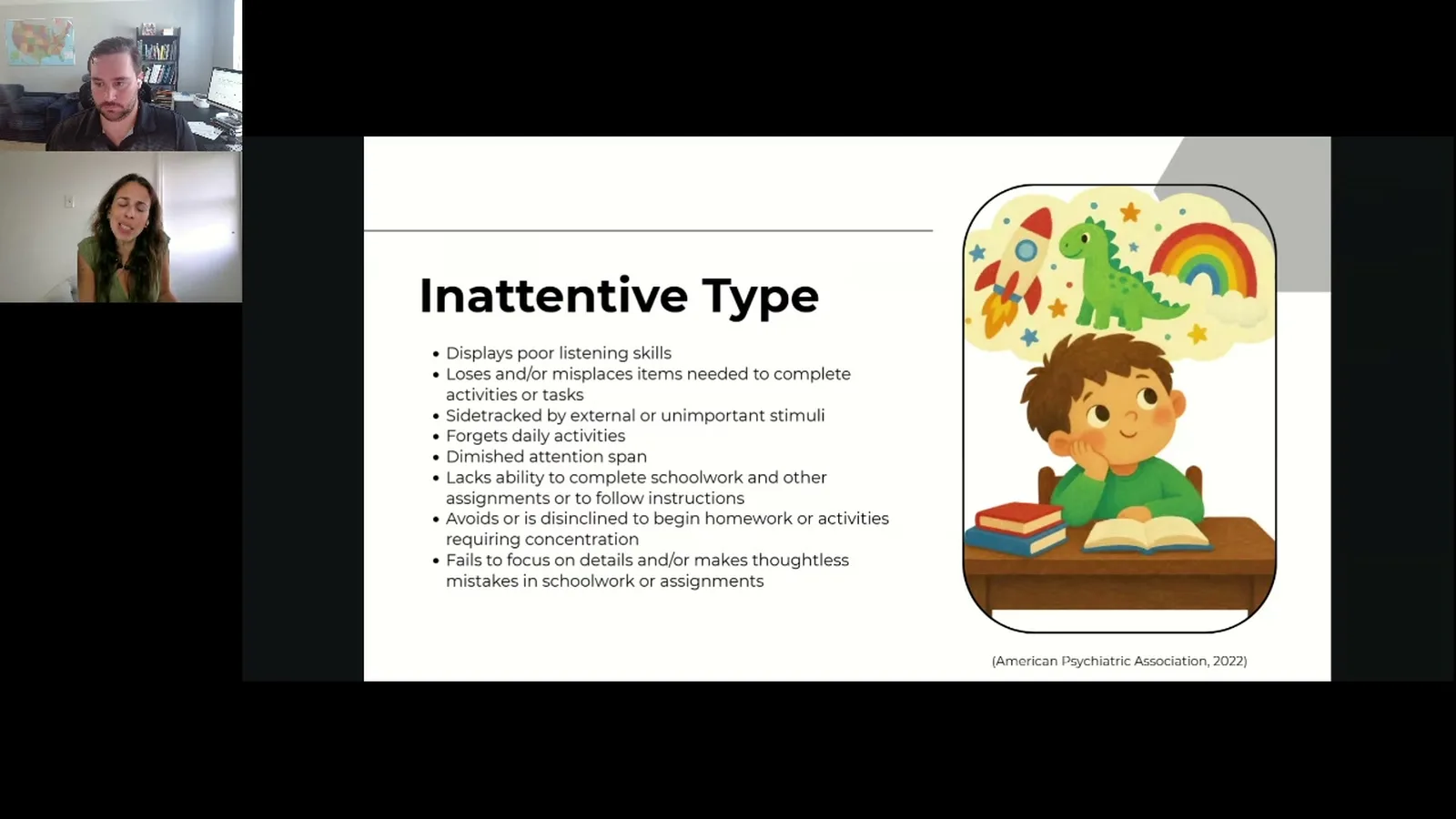
The inattentive list gets less attention than it should. These are the learners who lose the items they need for a task. They get pulled off course by small outside things. They forget daily activities. They struggle to finish work or follow steps. They avoid tasks that ask for hard focus. They miss details and make quick mistakes. The hyperactive and impulsive list is the one most people picture. These learners squirm and fidget. They show restlessness that is hard to control. They struggle with quiet play and staying seated. They talk a lot, struggle to wait their turn, and blurt out answers early.
Impulsivity also changes shape with age. An adult has fewer chances to cut a line. So it may show up as impulse buying, gambling, or quick decisions. Two things clinicians report are not in the DSM at all. One is task paralysis (being stuck before starting). The other is rejection sensitivity dysphoria (real body pain from feeling rejected).
Even a neutral stimulus. Can evoke those feelings.
From the talk — Nicole Stewart, BCBA
How Heritable Is ADHD? The Research on Genes, Siblings, and Screens
The room guessed high, and the room was right. Research is mixed, as research always is. Still, the general finding is a genetic link between 74 and 88 percent. That is high.
The speaker walked through a 2019 literature review. One sibling study found a nine times higher risk of ADHD in the siblings of people with ADHD. An adoption study went after the nature and nurture question directly. Biological siblings of adopted children were more likely to have ADHD than adoptive siblings were. If the cause were mostly the home, you would expect the children raised together to match. They did not.
Screens came up too, because families ask about them constantly. The finding is narrower than the headlines. Screen time can affect how severe ADHD symptoms are. It does not predict who gets diagnosed. Kids who use screens four times as much are not four times as likely to be diagnosed. The link runs the other way as well. People with ADHD are more likely to struggle with screen use, likely because of how their brains develop.
Because other people do research besides us.
From the talk — Nicole Stewart, BCBA
Dopamine, the Reward Center, and Why Motivation Looks Different
Dopamine (a brain chemical tied to reward) sits at the center of this. People with ADHD either have low levels of it or a problem with how it is used. Researchers are not sure which. The animal work is old and consistent. A 1991 study found that damage to dopamine neurons produced hyperactivity, poor stress responses, and ADHD like signs. A 1976 study found that destroying those pathways after birth produced ADHD symptoms. A 2003 study found deficits in the striatum (a dopamine rich part of the brain) in patients with ADHD. Change the genes tied to dopamine and ADHD signs go up.
Here is the part that matters for your programming. The brain needs dopamine to grow. The prefrontal cortex is where executive functioning lives (planning, memory, and self control). It depends on dopamine the way a plant depends on water. When the supply is off, that area develops differently. Working memory, impulse control, emotional regulation, task management, planning, and organization all take a hit.
So behavior starts to make sense as dopamine seeking. The brain is hungry and goes shopping. That can look like impulsivity, screens, or bids for negative attention. Reprimands still deliver something when nothing else is on offer. The reward center also runs on interest, not importance. A person can know a task matters and still feel nothing light up. That is not defiance. That is a reward system that did not fire.
Your brain needs dopamine to develop.
From the talk — Nicole Stewart, BCBA
Picture the Table: What Discrete Trial Teaching Feels Like to an ADHD Brain
Try the scenario the speaker gave the room. A child has autism and ADHD. That overlap is common, with studies putting it somewhere between 50 and 80 percent. So many of your clients are already in this group. The child sits at a desk. Cards go down. Show me the fireman. Show me the police officer. Over and over, then move on.
Now track the dopamine. The task is repetitive, low in stimulation, and offers no choice. Reinforcer satiation (the reward losing its pull) happens faster in an ADHD brain. Worse, sameness can act as an abolishing operation (something that kills the value of a reward). This brain runs on novelty. The same token board every day stops paying. Meanwhile the response effort of attending to a boring, repeated instruction is very high. High effort plus weak reward means the behavior drops.
What competes is often richer than anything on the table. Learners with inattentive ADHD carry a whole inner world, and it is far more interesting than the cards. That counts as competing reinforcement (something else is more rewarding right now) even when nothing looks overt. Others go loud. You see aggression, property destruction, yelling, refusal, or arguing. The fight itself can deliver stimulation. Some just put their head down and withdraw, which is hard to even define cleanly.
Kids with inattentive ADHD. Have a whole rich inner world.
From the talk — Nicole Stewart, BCBA
Three Standard Interventions and How They Miss With ADHD
Start with increasing reinforcement. It often works, for a while. You run a preference assessment (testing what the learner likes best), find something strong, and compete with what is already in play. That is good practice and it gives you real information about whether a skill is there. But it treats the symptom, not the cause. It leaves response effort untouched. It leaves the repetition untouched. And novelty fades, so the reinforcer stops lighting up the reward center. A 2019 study compared three reinforcement schedules. Continuous reinforcement led to faster extinction (loss of a learned skill) in both ADHD and typically developing groups. It is a weak spot for everyone. Learners with ADHD lose the skill faster when you stop rewarding it or fail to thin the schedule (slowly reduce how often rewards come).
Escape extinction (withholding escape until the behavior stops) is the hardest one. It acts after the child tries to leave. It never changes what they were trying to leave. Research on classrooms shows they often fail to meet the basic psychological needs of students with ADHD symptoms. Autonomy is the big one. Those students report less autonomy support than peers, and that predicts worse engagement. So you block the one relief valve left, on top of a task that was already a poor fit. Add rejection sensitivity and the cost can include the relationship with the technician.
Functional communication training (teaching a request instead of a behavior) can miss for a different reason. Say the assessment shows escape maintained behavior (behavior that gets someone out of something). You teach a break request. But if the real driver is a hungry brain, a break gives no dopamine. A quiet break can make the room even less stimulating, which leads to more behavior. The replacement has to match the need. I need to move. I need to go outside. That is a different target than I need a break.
It's a consequence-level intervention. it does not address the underlying issue of what made the task aversive or under stimulating.
From the talk — Nicole Stewart, BCBA
The Harm Cycle: How Good Practice Compounds Into a Bad Outcome
The speaker drew this as a loop, not a line. Step one is discrete trial teaching (DTT), which is a fine tool for a real skill deficit. Step two is what happens next. In a repetitive, low stimulation setting with no autonomy, ADHD signs get worse. Not the diagnosis itself, but the presentation (how the symptoms show up). More inattention, more impulsivity, more escape. Step three is a functional behavior assessment (FBA). It finds escape maintained behavior, because that is what is there to find.
Step four is the quiet failure point. Standard assessment tools do not ask whether the task meets a learner's dopamine needs. It is not a category on the form. So the plan cannot program for it. That is not a failure of rigor or of skill. It is a gap in what we were taught to look for. The plan then treats a need it never measured, and the behavior keeps going or changes shape into something new.
Two findings make the loop expensive. A 2025 study showed that striatal dopamine systems keep maturing through adolescence. That maturing is shaped by what gets reinforced over and over. So repeatedly reinforcing escape is not a moment. It is brain building. A 2024 study found that children who experience more controlling adult behavior show lower self esteem over time. Lower self esteem then predicts even more perceived control. That is a two way loop. Real harm can grow out of a plan that only meant to teach community helpers.
Repeatedly reinforcing escape and problem behavior. Isn't something that just disappears when the child. Leaves the room.
From the talk — Nicole Stewart, BCBA
Five Questions to Run Your Current Cases Through This Week
This session was built to change the question you ask, not to hand you a protocol. The wrong question is how do I get compliance with this task. The right one is whether the task, as you designed it, meets this child's needs at all.
Question one: is this behavior a visible symptom of ADHD? Check it against inattention, impulsivity, and hyperactivity before you call it attention seeking or escape. Question two: could the behavior itself be the reinforcer? Look for automatic reinforcement (the behavior feeling good on its own), overt or covert. Aggression can be self generated stimulation. Question three: is the room giving enough? If the instruction is repetitive and the setting is flat, the brain will go find its own supply.
Question four: am I addressing the underlying need or suppressing the surface behavior? Escape extinction will often work on the surface. At some point the effort stops being worth it and self esteem takes the hit. The environment is still wrong. Question five: is the response effort within this child's current capacity? Twenty minutes of attention to something dull may be past what that brain can hold. Then the dopamine seeking starts.
The preview for the next session was one word: shaping. Lower the effort, start smaller, and build. Many learners with ADHD will meet you once they clear that first hump.
Am I addressing the underlying need? Or am I suppressing the surface behavior?
From the talk — Nicole Stewart, BCBA
Common questions
Is ADHD really inherited, or is it caused by screens and modern life?▾
Research suggests a genetic link between 74 and 88 percent. Sibling studies show a nine times higher risk. Adoption studies show the link follows biology rather than the shared home. Screen time can affect how severe symptoms are, but it does not predict who gets diagnosed.
Why does a token board work for two weeks and then stop working?▾
An ADHD brain runs on novelty, so the same reward loses its pull quickly. A 2019 study also found that continuous reinforcement led to faster loss of a learned skill. Learners with ADHD lose skills faster when the schedule is never thinned. Plan for varied reinforcers and a real fading plan from the start.
What is wrong with teaching a break request to a client with ADHD?▾
Nothing, if escape is truly the need. But if the child is under stimulated and seeking dopamine, a quiet break makes the setting even flatter. That can lead to more behavior, not less. Targets like I need to move or I want to go outside may match the real need better.
Does DTT hurt kids with ADHD?▾
DTT is appropriate standard practice for a genuine skill deficit. The risk comes from what happens around it. A repetitive, low stimulation, low autonomy setting can make ADHD symptoms look worse. Standard assessment tools never ask whether the task fits the learner's brain chemistry. The fix is task design, not abandoning the method.
How does ADHD change an ethics analysis in ABA?▾
It touches four codes at once: scope of competence, effective treatment, considering medical needs, and designing behavior change interventions. ADHD is a medical diagnosis with biological effects. Ignoring it can lead to unrealistic expectations and plans that do not work. It can also strip autonomy from a client who already feels little of it.
What is rejection sensitivity dysphoria, and is it in the DSM?▾
It is a strong reaction to feeling rejected, and people describe real physical symptoms. It is not part of the DSM criteria for ADHD, but it is widely reported. Even a neutral prompt, like being asked to stop tapping, can set it off, which then drives more restlessness.
About the speaker
Nicole Stewart, BCBA, has about 20 years of experience across settings and profiles as both a special education teacher and a behavior analyst. She focuses on the neurobiology behind behavior (how brain biology shapes behavior) and on neurodiversity affirming, whole person practice. That approach comes from years of work in multidisciplinary teams. She runs a private practice serving children with ADHD and their parents, hosts a podcast, teaches at the graduate level, and trains behavior analysts.
This summary was generated from the recording’s transcript. Quotes are taken word for word from the talk.
What you'll learn
- 11. Identify how ADHD symptoms impact the ethical assessment and interpretation of behavior. 2. Analyze ethical risks associated with failing to consider ADHD when designing or implementing behavioral interventions 3. Apply ethical decision-making principles to adjust behavioral treatment in ways that reduce harm and promote client dignity when ADHD is present
Concepts in this CEU
Related talks
Talks that cover the same concepts

Shaping Behavior Change when ADHD is in the Picture
The Behaviorist Bookclub
Empowering Autonomy and Self-Management in ADHD Learners
The Behaviorist Bookclub
Solving Clinical Challenges with Research
The Behaviorist Bookclub
Analyzing Assent and Taking Data
The Behaviorist Bookclub
Hey, Chillax Man! Understanding the Logic of Anxiety
The Behaviorist Bookclub
Leadership Alignment in Supervision
Behavioral Wellness Coaching, LLC
More from The Behaviorist Bookclub
Supervising Beyond Technical Skills: Professionalism, Communication, and Clinical Judgment
The Behaviorist Bookclub
Reflective Supervision and Client Outcomes
The Behaviorist Bookclub
When the Foundations Are Right: Unlocking Advanced Verbal Repertoires
The Behaviorist Bookclub
OpenCEU is supported by advertising from third-party sponsors. Sponsors are clearly labeled, have no influence over course content, instructors, or CEU decisions, and never appear on certificates. The BACB does not sponsor, approve, or endorse OpenCEU sponsors or their products.