Contingency Strength in ABA: The Math of Change
Contingency strength is the odds a behavior earns its payoff. Learn how BCBAs use this number to explain, predict, and adjust behavior change.
Key takeaway
Contingency strength is a number behind a behavior. It measures how reliably a behavior has paid off in the past. A behavior that always works has high strength.
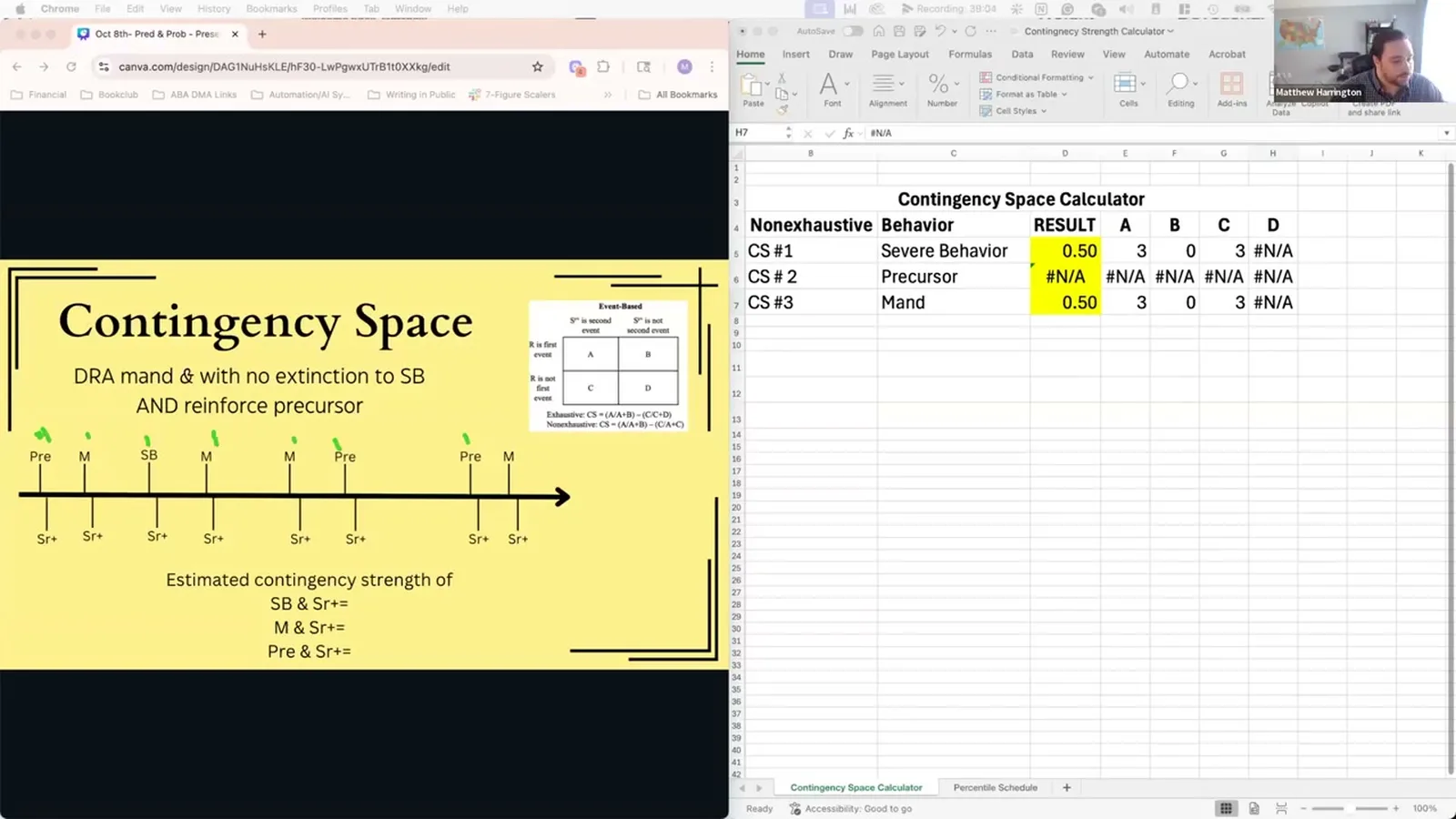
The Math Behind Behavior Reduction
Free learning path on this topic
Master PFA and SBT
Matt Harrington's 12-article walk through practical functional assessment and skill-based treatment, from Hanley's 2014 study to the enhanced choice model. Then assent, since SBT depends on it, and the ethical guardrails that keep behavior reduction defensible. Five CEUs, one of them ethics.
Experts who cover this
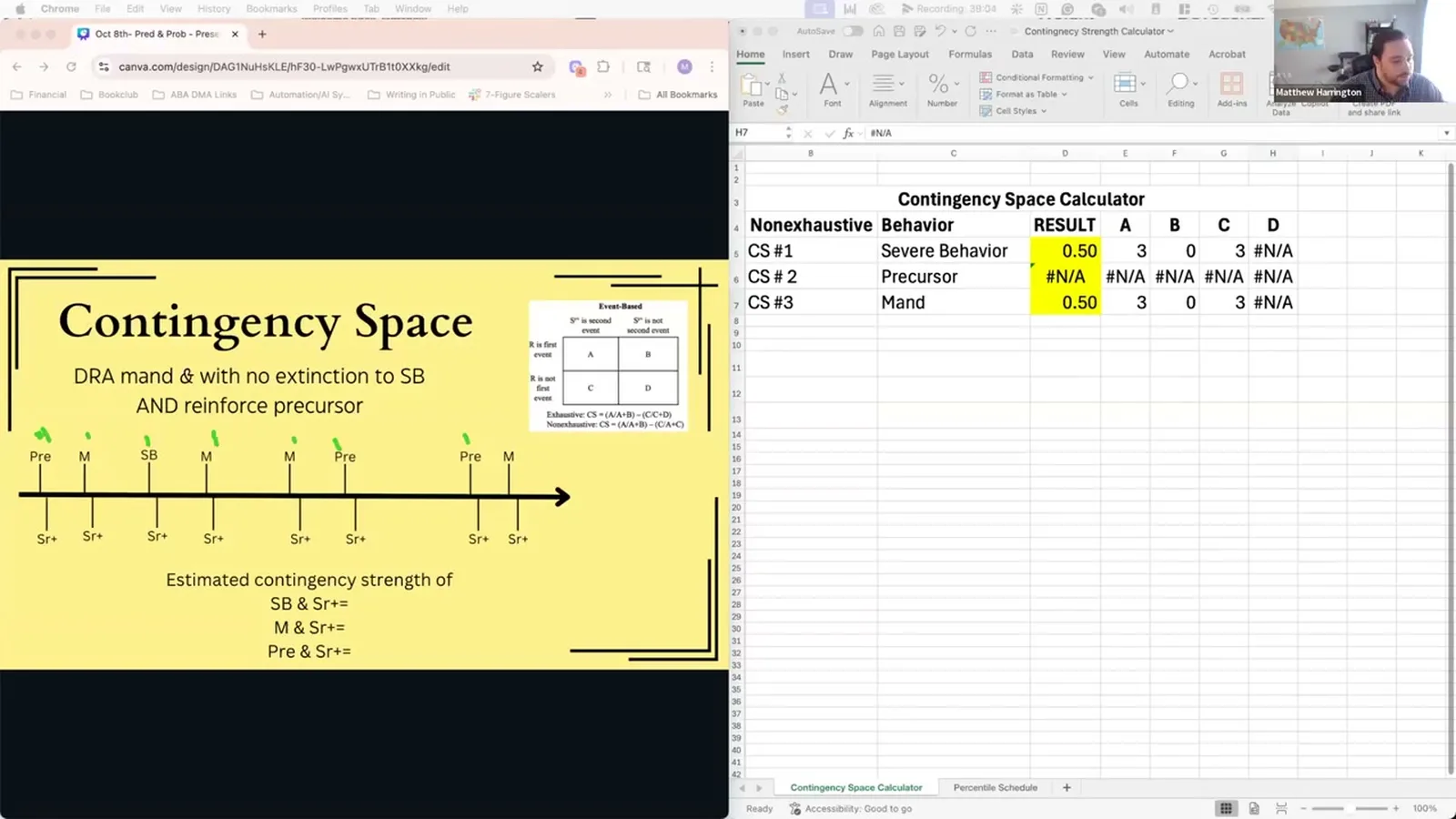
The recording behind this guide covers contingency strength.
- Featured talk1 CEU
The Math Behind Behavior Reduction
Matt HarringtonThe Behaviorist Bookclub
Harrington's central framework: a calculated probability (ranging -1 to 1) reflecting how reliably a response has produced reinforcement historically, used to…
On this page · 8 sections▾
Contingency strength is a number behind a behavior. It measures how reliably a behavior has paid off in the past. A behavior that always works has high strength. A behavior that rarely works has low strength.
This idea helps BCBAs and RBTs think clearly. Instead of guessing why a behavior is stubborn, you can point to its history. The more often it earned a payoff, the harder it is to change. That history is what you are really working against.
What the number means#
Matt Harrington gives a plain definition first. He ties strength to how deeply a behavior has been learned.
Contingency strength is how resistant or how taught a behavior is. From the talk — Matt Harrington
A well-taught behavior is a strong one. It has a long record of success. That record makes it show up fast and often, even under pressure.
Then he sharpens it into a rule about odds.
contingency strength is the probability that future behavior will result in stimuli being provided based on past events. From the talk — Matt Harrington
Read that as a simple bet. Based on what happened before, how likely is this behavior to work again? High odds mean a strong contingency. Low odds mean a weak one.
The math is a subtraction#
The number is not just one probability. It weighs two against each other. Harrington breaks it down.
Because contingency strength is a calculation of the probability something happens minus the probability something doesn't happen. From the talk — Matt Harrington
Picture a child who hits to escape work. Sometimes hitting removes the work. Sometimes it does not. You subtract the failures from the successes. The result lands somewhere between minus one and plus one.
A score near plus one means the behavior almost always works. A score near zero means it is a coin flip. That single number tells you how much history you are up against.
Every intervention is the same move#
 Advertisement
Harrington makes a bold claim about behavior reduction. Under the hood, all the methods do one thing. They shift these numbers.
all you're doing in any behavior reduction intervention, whether it's demanding, DRO, DRL, any of the acronyms, is you're trying to increase the contingency strength of an alternative behavior and decrease the contingency strength of a severe behavior. From the talk — Matt Harrington
This reframes a long list of tools as one goal. You want the safe behavior to pay off more. You want the severe behavior to pay off less. The acronyms are just different routes to that same split.
This view keeps your plan honest. If a severe behavior still pays off sometimes, its strength stays high. You have to close that gap, not just teach a new skill and hope. Harrington walks through the full framework in The Math Behind Behavior Reduction.
A quick worked example#
Picture a learner who screams to get a break. Out of ten screams last week, eight earned a break. That is a high payoff. The contingency strength of screaming is strong.
Now the learner also has a break card to hand over. Out of ten tries, only three earned a break. The card is weak. No wonder the learner still screams. Screaming simply works better.
Your job is to flip these numbers. Make the card pay off almost every time. Make screaming pay off almost never. When the card wins the math, the learner switches to it. The graph will follow the odds.
Why it beats clinical instinct#
The point of a number is to replace a hunch. Strength lets you predict outcomes before they happen. It also lets you adjust in real time. You can watch the two numbers move and tweak the plan as you go.
That is a shift from reacting to planning. You are not waiting to see if a method worked. You are steering the odds on purpose. When progress stalls, you check which number is stuck and fix that one.
Where the numbers come from#
Contingency strength is not a guess. It comes from data you already collect. You track how often a behavior happens and how often it earns its payoff. Over time, those counts give you the odds.
This is why good data matters so much. Sloppy records give you a shaky number. Clean records give you a number you can trust. The measure is only as strong as the data behind it.
You do not always need an exact figure at the bedside. Even a rough sense of the odds guides your choices. Ask which behavior is paying off more right now. That question alone points you toward the fix.
What the research says#
Researchers have tested this idea in careful ways. One study compared four methods for estimating contingency strength using a simulated data set. It found that event-based methods matched the expected values for behaviors that produced their own reinforcement (Lloyd, Staubitz, & Tapp, 2018). The takeaway is that how you measure the strength matters.
Strength also predicts real drops in problem behavior. In one evaluation, researchers set a neutral contingency, where a behavior and its nonoccurrence were equally likely to earn reinforcement. Under that arrangement, aggression fell to low levels for both participants. When the payoff for the behavior no longer beat the payoff for stopping, the behavior faded.
A study of low-rate reinforcement schedules found the same link. A schedule that reinforced slow responding reduced severe problem behavior for four participants. A contingency strength analysis showed a strong negative link between the problem behavior and the reward. The number told the same story the graphs did.
FAQ#
Is contingency strength the same as resistance to change? They are close cousins. A behavior with high contingency strength has paid off often, so it tends to resist change. Strength is the underlying record of payoffs. Resistance is what that record looks like in practice.
Can contingency strength be negative? Yes. The score runs from minus one to plus one. A negative score means a behavior tends to block the payoff more than earn it. Some reduction schedules aim to push a problem behavior into that negative range.
How do I use contingency strength in a treatment plan? Track two behaviors, not one. Work to raise the strength of a safe alternative and lower the strength of the severe behavior. If the severe behavior still pays off now and then, its strength stays high, so keep closing that gap.
 Advertisement
Turn this topic into a CEU
You just studied this. Now get credit for it.
Watch The Math Behind Behavior Reduction with Matt Harrington and earn 1 free BCBA CEU. Detailed certificate, delivered the moment you finish.
Keep going with a free learning path
Master PFA and SBT
Matt Harrington's 12-article walk through practical functional assessment and skill-based treatment, from Hanley's 2014 study to the enhanced choice model. Then assent, since SBT depends on it, and the ethical guardrails that keep behavior reduction defensible. Five CEUs, one of them ethics.