Feedback, Why So Serious? Removing Barriers to Feedback Delivery, Tolerance, Incorporation, and Learner Progress Through a Card-Based System (Part 1)
Presented by Mark Malady, M.S., BCBA
Feedback as a construct is commonly used within the business world, behavior analysis, educational system, and almost all helping professions. Although feedback as a construct has a long history and empirical support, the complications of the current literature base may leave clinicians having difficulty when designing feedback systems (Johnson, Johnson, and Dave, 2023). The current workshop will review the process of discovery, design, and implementation within a day habilitation program for adults with disabilities that spanned several years. The result of that process led to the development of a multiple component package for feedback within clinic based human service settings. The process of creation and the results of implementation will be discussed. Participants will be supported to identify and analyze their current approach to feedback in order to identify entry points for progress to quality services for direct service providers.
Register free & watch nowCancel any time. Cert delivered to your inbox the moment you pass the quiz.
About this CEU
Feedback as a construct is commonly used within the business world, behavior analysis, educational system, and almost all helping professions. Although feedback as a construct has a long history and empirical support, the complications of the current literature base may leave clinicians having difficulty when designing feedback systems (Johnson, Johnson, and Dave, 2023). The current workshop will review the process of discovery, design, and implementation within a day habilitation program for adults with disabilities that spanned several years. The result of that process led to the development of a multiple component package for feedback within clinic based human service settings. The process of creation and the results of implementation will be discussed. Participants will be supported to identify and analyze their current approach to feedback in order to identify entry points for progress to quality services for direct service providers.
Credits
1 supervision CEU · 69 min
From the talk
What was covered
Mark Malady on why feedback hurts both sides, and how a card based system cut turnover and restarted learner progress in a day program.
- Treat feedback as a stimulus that can take any function, so predict its effect on this person in this moment before you deliver it.
- Check whether the staff member's reasons for being there line up with your plan, because corrective feedback only lands when values match.
- List every feedback method you have designed and sort it by purpose, then fix the skew toward corrective feedback.
- If a learner needs daily plan changes, build daily feedback, since monthly or quarterly review cannot keep pace.
- Name your targets in advance and keep in the moment delivery short, then route all debate to a later time and a different person.
- Pick a small set of three to five targets, build the names and rewards with staff, and set a date to review the data together.
Our Field Has No Settled Definition of Feedback
Feedback runs through almost all of our work. It shows up in supervision, staff training, and parent coaching. Mark Malady opened with a hard point. Our field has no settled definition of feedback. Studies define it by what it does in the moment. They do not define the thing itself. That makes the research base very hard to add up. Two papers by the same group of authors walk through this problem. One came out in 2023 and one in 2024. The same content sits in an article and in a book chapter.
So what can we say for sure? One thing holds up. Feedback is a stimulus (an event that can change behavior). Like any stimulus, it can take on any function our science knows. It can evoke behavior (make it more likely right now) or abate it (make it less likely right now). It can reinforce. It can punish. It can also mean nothing at all. The function depends on the person and the moment.
That should change how you plan. Zoom in on one small skill and the task looks simple. You taught a prompt step, and the staff member now runs it well. Zoom out and it gets hard. One card or one comment can shift what a person values. It can change the work rules they follow for years. Malady asked us to look at the effect on the whole person. Plan for both levels, not just the skill in front of you.
the one thing that we can definitively say about feedback is feedback is a stimulus.
From the talk — Mark Malady, M.S., BCBA
What Giving Feedback Costs the Supervisor
Malady split the cost of feedback into two sides. Start with the person who gives it. When you watch someone in order to judge them, what you see can change you. You may believe an RBT (a front line behavior technician) loves kids. Then you watch and hear rude, belittling talk. Your picture of a valued coworker shifts. That change is not easy to carry, and it hurts.
Next, the act itself can work as punishment (a change that makes behavior less likely). Most people trained in the last ten years were steered away from punishers. So the job feels strange. We hold one set of rules for learners and another for staff. Punishment also wears down your own value as a reinforcer (something a person will work for). The easy morning chat with that coworker loses its old flavor.
Then there is counter control (pushing back against the person giving feedback). A person who feels hurt often wants to hurt back. You get the yeah buts, the sure whatevers, and the side comments that stall you out. Malady added one more cost he calls the monsters of our journey. Under pressure, we copy the bad manager we had at seventeen. Authority also carries culture. Holding power over groups who have long held presumed authority over you can feel very aversive (hard to tolerate).
it's not uncommon that we've hurt the person experientially, and now that person is motivated to hurt us back.
From the talk — Mark Malady, M.S., BCBA
What Getting Feedback Costs the Staff Member
The receiving side has its own costs. One comment can change how a person reads their own work. They hear that they spoke rudely to a kid. Then the spiral starts. Does everyone think I am mean? Do the moms and dads think I am a horrible person? That spiral is a value altering effect (a shift in what matters to someone).
Daily life at work changes too. Morning chats lose their warmth for the receiver as well. Escape (avoiding the hard situation) shows up fast. They avoid that BCBA (the supervising behavior analyst), skip those caseloads, and stay less available. Feedback can also evoke signs of damage and self doubt. Many staff report a loss of autonomy (the sense of free choice at work). They feel that each move is dictated for them.
The largest cost is a signal of something big and lasting. The staff member fears losing the job or the hours. Rent and groceries sit behind that fear. They also have little room to push back without risk. So the two sides of a feedback event do not carry equal stakes. Design your system with that gap in full view.
There's a lot of avoidance that comes from faulty and good feedback depending on the situation.
From the talk — Mark Malady, M.S., BCBA
Process Feedback, Outcome Feedback, and the Values Gap
Malady walked through a simple split from the feedback book he recommends. Feedback can target process (how the work is done) or the outcome. Positive process feedback usually feels good. It also has limited value. It tells a person they are on track for their goals. Think of it as maintenance. Negative process feedback holds the most information. It tells a person they are off goal and how to get back on track.
He then added the piece the heuristic (quick rule of thumb) leaves out. That effect assumes the person's values match the view behind the feedback. If an RBT is there to help people change their lives, a correction lands well. They pivot. If they are there to earn money on the way to law school, it will not land the same way. So read values first. Then predict the effect of the feedback.
There is also the feedback spiral. You give feedback to fix a thing. The feedback creates new motivation that makes more of that thing. Now the checked out staff member thinks you are an idiot who visits once a month. So they go do their own thing. The idea that feedback can never hurt is simply wrong.
The feedback sandwich came up as a live example of our thin evidence. Say something good, then something hard, then something good again. The findings are mixed. It helps in some conditions and backfires in others. Malady guessed the context matters most. Behavior analysts already give more supportive feedback than many workplaces do. So the sandwich may add little for an RBT and more for a worker who never hears anything kind.
feedback can be very dangerous feedback can pull you away from your goals
From the talk — Mark Malady, M.S., BCBA
A Matrix for Auditing Your Own Feedback System
Malady offered a grid to sort what you already do. The first axis is the medium. Some feedback comes straight from the product of the interaction. The letters look right or they do not. The transition stays calm or it does not. That kind skips the extra social layer. Most of our feedback adds a person. A face, a word, and the next move all become part of the event. Add a boss and you add a judgment: does the product match the expectation. You can also have purely social feedback, where someone shares how the moment felt.
The second axis is purpose. Evaluative feedback asks whether the work matches the plan as written. Experiential feedback asks whether the moment is meaningful for the person. Feedback to access expertise taps what the other person already knows. Malady noted we rarely do this with RBTs, even though they know their learners best. Supportive feedback keeps the good stuff going and makes it known. He left corrective feedback off the grid because everyone already knows it.
Here is the audit. Write out each feedback method you have designed. Drop each one into the grid. Then look at the skew. Most teams sit heavy on corrective and thin on expertise and support.
He also flagged a gap in our own technology. Feedback is a required part of behavioral skills training (model, practice, and feedback as a package). Yet the handbook on behavioral skills training by Peter Sturmey gives it under a page and a half. It is the least studied part. The four classic tips sound just like our rules for delivering reinforcers. Malady's problem with them is scope. They fit one target. They do not fit five hundred targets, or the goal of keeping that person on your team.
focus on the behavior or not the person be as specific as possible make your feedback forward-looking and provide feedback as soon as possible
From the talk — Mark Malady, M.S., BCBA
The Day Program Behind the Case Example
The case came from an adult day program. It served more than 110 people a day, aged 18 into their seventies. In 2014 the agency merged three separate programs into one physical space. That put about 150 people in one building. Roughly 40 staff worked each day. One to three bachelor's level leaders held the QIDP role (the program's lead staff position). That role asked for a degree plus one year with adults with disabilities. One staff member held a master's degree and worked with learners directly. Ratios ran from one to one up to eight to one. The team did not land on a clear purpose for the program until 2017. It closed in 2023.
The workforce split in two. About 65 percent had been there under a year. Another 15 percent had six years or more. Malady sees the same pattern in RBT staffing today. The presenting problems were serious. People who needed line of sight supervision (a staff member watching them at all times) were left alone in chairs. Staff called 911 for preventable causes. Small lifts done solo turned into lost work time. Skill progress sat near zero, and plan goals went stale. HR cases stayed open all the time. Managers lasted one to two years, and claims of favoritism were common.
The agency had already tried a lot. Tight performance management built on improvement plans and the threat of firing. Scorecards tied to money. Classroom and on the job training. Behavioral skills training with fidelity checks (proof the plan was run as written). Culture days. Tiered staff roles. A large token economy (a reward system using points or chips) ran for learners. Trained staff came in skilled, then drifted as the culture took over. Feedback itself had become a fire alarm. It happened only when mistreatment was about to occur.
Managers were locking themselves in the room, not coming out to the floor, not wanting to see things because if they didn't know about it, they didn't have to address it.
From the talk — Mark Malady, M.S., BCBA
Design Rules: Let In the Absurd and Move the Friction
Before the system, Malady named the values behind it. First, let in the absurd. Human service work asks people to do strange things. You may bathe a person twice your age. You may stay calm and polite while someone calls you trash for 45 minutes. Little in ordinary life prepares a person for that. So be honest about the strangeness instead of hiding it.
Second, pull blame off people and put it on systems. Third, treat collaboration as real work, since it asks people to be seen without a mask. Fourth, make space to challenge beliefs about our own technology. He used a common line as the example: I'm beyond tokens, but they are good for those people. Underneath sits ableism (bias against disabled people) that no training slogan erases. Fifth, build moments where staff feel what learners feel. He wants a staff member to think, oh, this is how Johnny felt when I withheld that token.
The last rule drives the whole design. Map the links in your system. Funders, law, the company, leaders, the BCBA, the RBT, the learner, and anyone watching all play a part. Then decide where friction should land. Pushback in the middle of a session steals from that session. So move it to a link where it costs less. He warned against the dead end version of this move. Do not just say the funder requires it. Point people to a place where they can actually act on the complaint.
we're not trying to suppress counter control. We're trying to shape its topography.
From the talk — Mark Malady, M.S., BCBA
The Card System and What Changed
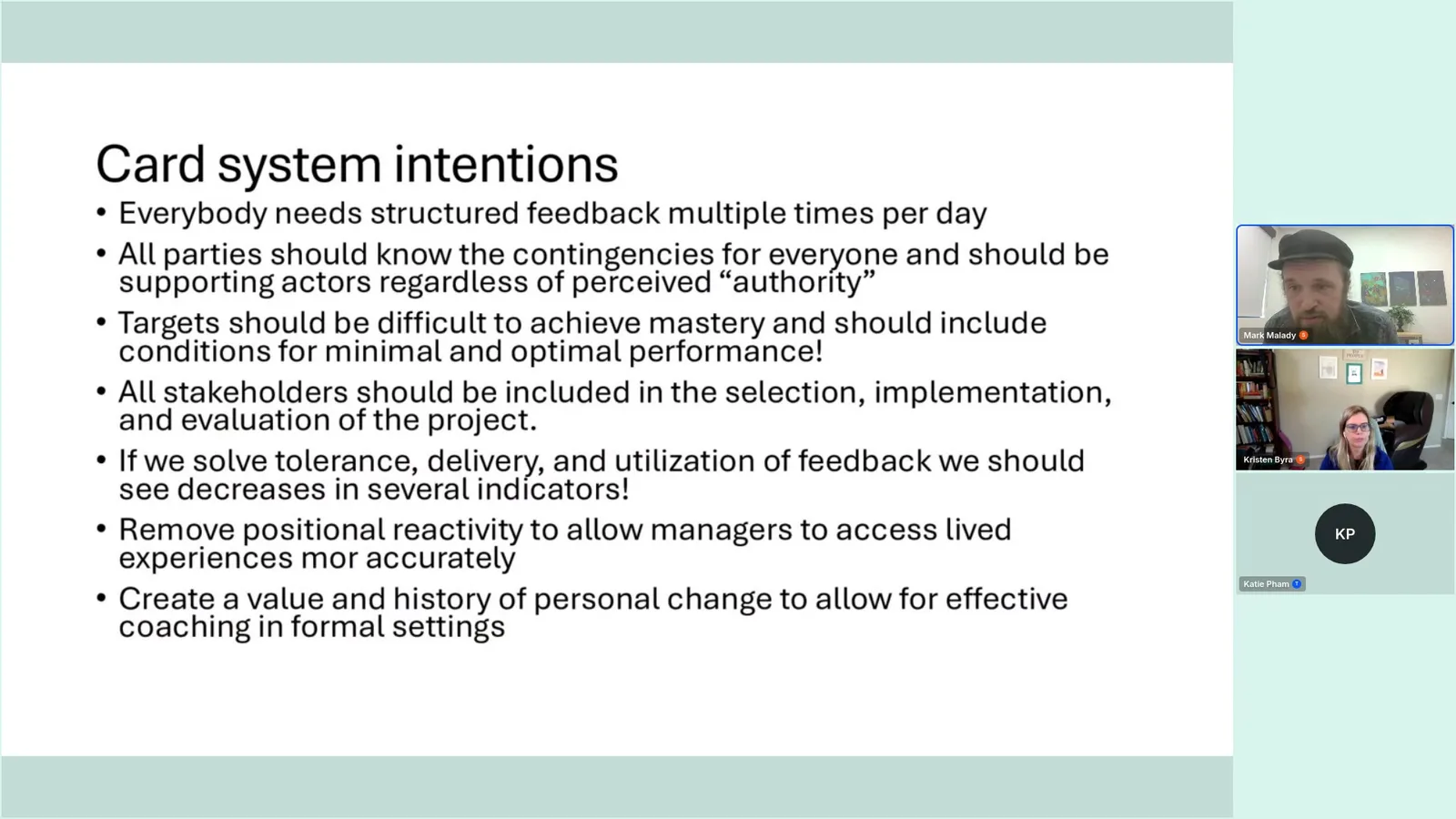
The team built a card based system. Everyone got structured feedback many times a day. All parties knew every target in advance, no matter their rank. Targets were set to be hard to master, with both a minimum and an optimal level. That blocks the fake it for the visitor habit. Staff and service recipients helped pick, run, and judge the project. A group of ten people served sat on the review, plus a staff representative chosen by the staff.
Delivery was fast and quiet. A card was handed over in the moment, and that was not the time to debate it. Staff turned in all their cards at the end of the day to the main manager. So the hard talk happened later, with a different person. That split diffuses the sting. The cards used humor and local culture. One card named after a famous ball hog meant you were carrying the work alone instead of using your team. A huddle card meant you collaborated in real time. Each card listed targets as fair pairs (an error paired with its better match). Small boxes on the card pointed to help. Rewards included an early out, a shadowing block, no chore for the day, and picking your spot.
To build one, start with three to five critical targets. Name your observers and set a daily observation schedule. Review it with everyone and pick short card names that make your people laugh. Choose the rewards as a group. Run a facilitated talk until you reach consensus, with a review date if you are not at full agreement. Set when data gets shared and what goal each review carries. Then train both the givers and the receivers before day one.
Malady compared data before 2016 with 2019 to keep the pandemic out of it. Preventable 911 calls went from seven to zero. Plan changes moved from every three years to every three months. Annual assessments went from 10 people a year to 100. Annual turnover dropped from 65 percent to 32 percent. Staff interaction with people served went from one every eight minutes to a floor of five per minute. His closing advice was plain. Say which kind of feedback you are giving. Keep delivery short. Give people a real channel for conflict afterward.
daily feedback is the only answer when a learner needs daily changes
From the talk — Mark Malady, M.S., BCBA
Common questions
What is a card based feedback system?▾
It is a set of short, pre named cards that cover three to five critical staff targets. A manager or BCBA hands a card over in the moment with no discussion. Staff turn in all their cards later, often to a different person, and the real conversation happens then. Because every target is known in advance, the card carries information rather than surprise or blame.
Does the feedback sandwich work?▾
Malady said the research cannot answer that yet. It helps under some conditions and backfires under others, which fits a literature with no shared definition of feedback. He personally refuses to use it. He also noted it may matter more in workplaces where supportive feedback almost never happens.
How often should performance feedback be delivered?▾
His answer ties feedback to the learner's pace. If a learner needs daily changes, the staff need daily feedback. Quarterly or monthly cycles move too slowly to protect progress. Frequent presence also removes reactivity (acting differently because you are being watched). Staff can no longer tell when to put on a show.
How do you handle pushback and counter control from staff?▾
He does not try to suppress it. He tries to shape where it goes. The card system blocks debate during the session. It routes complaints to the end of day handoff and to the company level. The key is giving people a channel where they can actually act on the complaint.
What outcomes did the day program report?▾
Comparing data before 2016 with 2019, preventable 911 calls fell from seven to zero. Skill plan changes moved from once every three years to once every three months. Annual assessments rose from 10 people a year to 100. Annual turnover fell from 65 percent to 32 percent. Staff interaction with people served rose from one every eight minutes to a minimum of five per minute.
About the speaker
Mark Malady, M.S., BCBA, is a board certified behavior analyst with 18 years of clinical and management experience, and he is also autistic. He has worked directly with more than 1,500 learners, supported staff across nearly every human service sector, and helped train over 500 special educators. He has authored five peer reviewed articles and book chapters and is a co author of Generate, a skill based assessment project.
This summary was generated from the recording’s transcript. Quotes are taken word for word from the talk.
What you'll learn
- 11) Participants will be able to describe current best practices for delivery of performance feedback within complex human service settings. 2) Participants will be able to describe features that promote resistance to deterioration for systems level interventions. 3) Participants will be able to describe benefits for removing social censure and other common punitive components from feedback by using diffusion based strategies on a systems level.
Related talks
Talks that cover the same concepts
When You’re Everyone’s Support: Building Sustainable Leadership.
Behavioral Wellness Coaching, LLC

Crash Course in Behavior Analytic Toilet Training: Translating Research to Practice
Copper Consulting Group

Beyond Competence: Using ACT to Cultivate Psychological Flexibility in Behavior Analytic Supervision
Rooted Consultation, LLC

A New Era of Fieldwork: Navigating the 2027 BACB Supervision Requirements
Rooted Consultation, LLC

Providing Fieldwork Supervision in a School Setting
Rooted Consultation, LLC

Eight Hours Get You the Mug: Building Supervisors Who Can Actually Fill It
Rooted Consultation, LLC
More from Upskill ABA
A Panel on Collaboration in Practice: SLP, OT & ABA Services
Upskill ABA
From Peer to Professional: Becoming & Supporting Early Career Behavior Analysts
Upskill ABA
From Idea to IRB: Conducting Research in Your ABA Practice
Upskill ABA
OpenCEU is supported by advertising from third-party sponsors. Sponsors are clearly labeled, have no influence over course content, instructors, or CEU decisions, and never appear on certificates. The BACB does not sponsor, approve, or endorse OpenCEU sponsors or their products.