Dunder Mifflin’s Guide to BCBA Ethics: Lessons from The Office
Presented by Mellanie Page
This CEU session transforms ethical learning into an interactive and enjoyable experience by analyzing scenarios from The Office and applying them to the practice of behavior analysis. Participants explore ethical issues related to confidentiality, competence, cultural responsiveness, stakeholder engagement, and gift giving through humor, group dialogue, and guided reflection. Using clips from the show as a jumping-off point, the presenter connects ethical missteps to specific BACB codes, offering practical solutions and emphasizing person-centered care. This course is ideal for BCBAs, BCaBAs, and RBT supervisors who want to build fluency with the ethics code while laughing—and learning—from the world’s most awkward regional manager.
Register free & watch nowCancel any time. Cert delivered to your inbox the moment you pass the quiz.
Learner ratings
from 112 learners
98% would recommend this CEU to other professionals in their field (85 responses)
“Well informative”
— Sapna M.“First and foremost, this is a brilliant idea. The office is FULL of ethically questionable scenes, and it makes me so happy you used this for a CEU. Thank you for creating this as a free CEU as well. I had fun, and will be keeping an eye out for more opportunities to learn from you in the future.”
— Shelby F.“5/5 stars ⭐⭐⭐⭐⭐ She has mastered the art of making standard topics interesting!”
— Reagan P.
About this CEU
This CEU session transforms ethical learning into an interactive and enjoyable experience by analyzing scenarios from The Office and applying them to the practice of behavior analysis. Participants explore ethical issues related to confidentiality, competence, cultural responsiveness, stakeholder engagement, and gift giving through humor, group dialogue, and guided reflection. Using clips from the show as a jumping-off point, the presenter connects ethical missteps to specific BACB codes, offering practical solutions and emphasizing person-centered care. This course is ideal for BCBAs, BCaBAs, and RBT supervisors who want to build fluency with the ethics code while laughing—and learning—from the world’s most awkward regional manager.
From the talk
What was covered
Ethics lessons from The Office: expectations, confidentiality, gifts, hard stakeholders, and growing your scope, with Mellanie Page.
- Plan goals to match the hours you actually have, so families are not promised progress the schedule cannot support.
- Before you share client information you think would help, de-identify it, limit it, and get consent first.
- Treat cultural responsiveness as a skill to practice and model, not a video to click through.
- Sit side by side with a hard stakeholder and name the shared goal before you argue about any single target.
- Swap gifts for notes, crafts, photos, feedback surveys, and a year-end progress summary written for the family.
- When a supervisor asks for something off-code, open with a question about their reasoning, then say plainly what you see.
Code 2.08 and the Promise You Cannot Keep
The talk opens with one of the show's most cringeworthy scenes. Michael Scott tells a room of kids he will pay for college. Then he takes it back. The speaker ties that to code 2.08, communicating about services (what we tell families about care). The promise felt generous. The follow-through was never there.
Her read on why this happens in ABA (applied behavior analysis) is simple. We believe in the science. We can picture what a child might gain. So we talk about the big future and drop the guardrails. The room agreed. Their answers were honest talks up front, clear timelines, and a plan built around one child. Not a general pitch.
Two fixes stood out. First, aim at socially significant behaviors (skills that change daily life). You may not hit a hundred goals. You can still change the one thing that matters most at home. Second, plan within the prescription (the treatment hours a family is authorized for). Ten hours a week does not support a hundred targets. Build a roadmap that names the goals and the review points.
My other suggestion is to be a guide, not a hero.
From the talk — Mellanie Page
Code 2.03 When Sharing Would Actually Help the Client
The next scene is Michael leaking a secret and then talking in fake code by the vending machine. Code 2.03 covers protecting confidential information. The chat answered fast. Use initials. Get a release of information (a signed form allowing sharing). Work only with consent and assent (the client's own okay). As the speaker put it, the field tends to do this part well.
The sticky case is different. It is the day you believe sharing would help the child. Her steps are worth writing down. Know your legal and ethical duties, since risk of harm changes the answer. Limit the disclosure to what the other person needs. De-identify the details when you can.
She gave a clean example. Say you want a speech provider's view on a child who uses an AAC device (a tool that helps someone communicate). The child is starting to use vocal words. You can ask that question without naming anyone. If you are still unsure, take it to a supervisor or a peer and weigh it out with them.
So, they can also help you advocate and be more persuasive when you're trying to obtain consent to collaborate.
From the talk — Mellanie Page
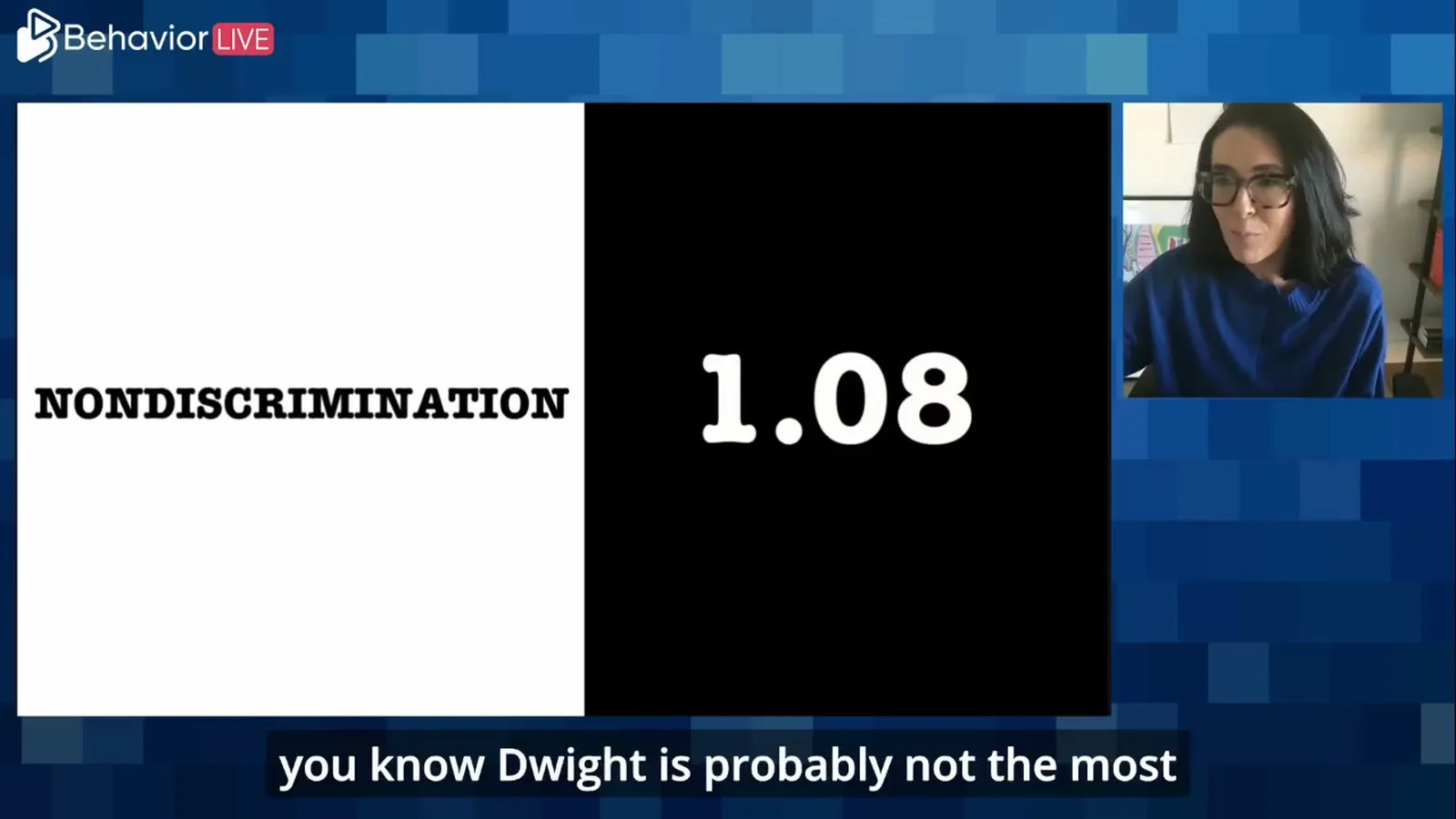
Code 1.08 Non-Discrimination on a Spread-Out Team
The clip here is Dwight practicing a sales call. He cannot accept that the woman across from him is the boss. He plans to tell her what her needs are and then fill them. It is a joke, but the pattern is real: deciding what someone needs before you ask.
The speaker pointed at a hard fact of our work. Teams are spread out across homes and centers, serving very different families. The chat offered whole-person conversations, asking about language and family traditions before treatment starts, and modeling instead of lecturing. Several people named cultural humility and curiosity over judgment.
Her own answer was to run it through the core principles. Benefit others. Treat people with compassion, dignity, and respect. Act with integrity. Ensure competence. Cultural competence sits inside that last one. That may mean going past the recorded training into behavior skills training (teach, model, practice, give feedback). One chat idea she highlighted: ask stakeholders (parents, caregivers, and other providers) what values and traditions matter to them.
We don't know everything about everyone or their differences.
From the talk — Mellanie Page
Working With a Difficult Stakeholder Without Keeping Score
The longest clip is a coached sales call that goes off the rails. The customer stalls, yells, and demands the salesman be fired. Before showing it, the speaker asked the room if the client is always right. The answer was no. Her point was that treatment is not a game of right and wrong. Everyone at the table wants the child to do well.
She also flipped the question. Sometimes we are the difficult one. Some families carry a real and valid history with ABA. That history rides along in every meeting. Her fixes: remember that opinion is not fact, listen for real, and define the mutual goal. Aim at the family's big vision, not the target list.
One chat idea got extra time. Ask families what they want, and also watch for what they do not say. A signature on a plan is not buy-in. Look for low involvement, flat energy, and no questions. If the back and forth has stopped, something is unspoken. Give families credit when progress holds after you leave. That means they are doing the work too.
I prefer to look at it like two partners are side by side.
From the talk — Mellanie Page
Code 1.12 Gifts: What to Do Instead
The speaker called gift giving the least important and most talked about item in the code. She moved straight to the better question. If a family shows love through gifts, what else can we offer each other?
Going from clinician to family, the room landed on notes, cards, and words of gratitude. Her own list added audio messages, including short ones from the client. She also suggested joining a family tradition in a way that stays professional. One idea she loved: a detailed year-end progress report that lays out everything the child gained. That takes time to write, and families keep it.
Going the other way, the room had just as much. Photos and short progress videos. A note to the supervisor or the boss saying the team member is doing well. A good review of the company. A satisfaction survey, even one with some honest criticism in it, since that is how people improve.
And I'll be honest, like the gifts, quote unquote, that I've received that I hold most special and that I actually still have to this day from clients are those like kid-made crafts.
From the talk — Mellanie Page
Code 1.06: Treat Your Scope as Something That Grows
Michael visits a business school and gets asked how a paper company survives in a paperless world. His answer is that real business is done on paper. The speaker used it to ask how each of us avoids getting stuck in the year we were certified.
The room said CEUs (continuing education credits), trainings, peer review, and reading outside their comfort zone. Several people said they learn the most from speech therapists, occupational therapists, teachers, and aides. She added a resource many attendees did not know about. Log in to your BACB (the board that certifies behavior analysts) account, open the resources tab, and read major journal articles.
Then came her strongest opinion of the hour. Scope of competence (the work you are trained and ready to do) is real, and she agrees with it. But she does not think it is a wall. Passing a case along is fine. Passing it along and never learning the skill is the miss. Go get the mentor, the supervision, and the literature, so you are ready for the next child with that need. One chat comment she endorsed fully: take care of yourself, because a better mood produces better service.
So part of how to continuously develop your competence is making sure that scope is getting broader and broader every year you're in practice.
From the talk — Mellanie Page
When a Supervisor Asks for Something Off the Code
An attendee asked how to handle a supervisor who requests something against the code. The speaker's first move is to check the story you are telling yourself. We often jump to the idea that the request is intentional or mean. Start with curiosity instead. Ask what benefit they see. Then say plainly how you read the code on it.
She calls herself a person-first practitioner. Nobody wants an audit or compliance notice for something they did not know was a problem. So talk to the person first. If you hit a wall, go to other resources. An attendee mentioned the ABA ethics hotline as a help in exactly that spot, and she agreed.
A second question raised caseloads that stretch BCBAs (board certified behavior analysts) past capacity. Her approach again was two-sided. Bring your actual schedule. Point to where supervision is thin. Stay open to the answer that training could expand what you can do in less time. Decide together what caseload is workable. If the values never line up, you can leave. Truly egregious cases should be reported.
This is where I would jump in or enter that situation with curiosity and try to really understand what value or benefit they see.
From the talk — Mellanie Page
Guidelines, Not Law: Leading With the Core Principles
The last question came from someone who works with very rigid colleagues. How do you argue that the code is a set of guidelines? Her answer was direct. She reads it that way herself. That is why she anchors on the core principles instead of debating each line item.
She gave a usable script for that conversation. Name the gap in how the two of you read the code. Then ask about principles. Is what we are doing benefiting others? Are we treating people with dignity and respect? Are we acting with integrity and building competence? If you both say yes, you are practicing inside the code.
She also drew a clear line at the end. The code does not set your caseload or your supervision hours. State licensure has its own rules, and funders have theirs. If a payer denies the hours you requested, tell the family who denied it. That way nothing gets blamed on the wrong party. And when a colleague simply does not know a rule, share what you know.
But I think that the person is much more important than the process.
From the talk — Mellanie Page
Common questions
How do I set realistic expectations with parents without sounding negative?▾
Tie the plan to the hours you actually have. If you deliver ten hours a week, do not write a hundred goals. Focus on the few behaviors that change daily life. Name in advance how you will check whether something is working. Saying you may pivot is not negative, it is the roadmap.
Can I share client information if I think it will help the client?▾
Not on your own read alone. Get consent and a release of information first, and limit what you share to what the other provider needs. You can ask a general, de-identified question to get early input before you take that step. If someone is at risk, your legal and ethical duties change the answer, so know those rules in advance.
What can families give clinicians instead of a gift?▾
Cards, notes, and handmade crafts came up most in this session. Photos and short videos of progress work well too. Many attendees suggested writing to the clinician's supervisor or leaving a good review of the company. A satisfaction survey is also a real gift, even when part of it is critical.
What does it mean to expand your scope of competence?▾
The speaker's view is that scope is a duty to grow, not a permanent boundary. If a skill is outside your training, refer the case, then go learn it. Use a mentor, supervision, and the literature so you are ready next time. She noted that BACB account holders can read major journal articles through the resources tab.
How do I bring up an ethics concern with my own supervisor?▾
Lead with a question, not an accusation. Ask what value or benefit they see in the request, then explain how you read the code on it. Talk to the person before you file anything, since most people do not know they crossed a line. If you hit a wall, an ethics hotline or another resource is the next step.
About the speaker
Mellanie Page presents CEU sessions that pair clips from The Office with BACB ethics codes and live audience discussion. She has given many serious clinical presentations, and told this audience that the humor-based format drew her largest turnout by far. She is building the format into a series, with a session on supervision planned next.
This summary was generated from the recording’s transcript. Quotes are taken word for word from the talk.
What you'll learn
- 1Learning Objectives
- 2By the end of this CEU, participants will be able to:
- 3Identify key BACB ethical code components through analysis of fictional workplace scenarios and apply them to real-world behavior analytic practice.
- 4Recognize the importance of managing client and caregiver expectations while maintaining treatment integrity and avoiding overpromising outcomes.
- 5Describe appropriate strategies for maintaining confidentiality and explain when and how information can be shared within ethical and legal bounds.
- 6Apply principles of cultural responsiveness and non-discrimination by adapting behavior analytic practices to honor family values, identities, and traditions.
- 7Develop effective collaboration strategies with difficult stakeholders, using empathy, curiosity, and shared values to guide ethical decision-making and conflict resolution.
- 8Demonstrate understanding of the gift-giving policy within the ethics code and propose alternative ways for clients and clinicians to show mutual appreciation.
- 9Explain the ethical importance of ongoing professional development, self-assessment, and collaboration with peers to maintain and expand competence in practice.
Concepts in this CEU
Related talks
Talks that cover the same concepts

Supervising Beyond Technical Skills: Professionalism, Communication, and Clinical Judgment
The Behaviorist Bookclub
Stronger Together: Care Collab
The Behaviorist Bookclub
New Year, New Care Collab Goals
The Behaviorist Bookclub

Scaling Influence- Coaches
The Behaviorist Bookclub
Is It Technical or Relational? A Framework for Pinpointing Caregiver Collaboration Breakdowns
Parenting with ABA
Shaping Behavior Change when ADHD is in the Picture
The Behaviorist Bookclub
More from The Behaviorist Bookclub
OpenCEU is supported by advertising from third-party sponsors. Sponsors are clearly labeled, have no influence over course content, instructors, or CEU decisions, and never appear on certificates. The BACB does not sponsor, approve, or endorse OpenCEU sponsors or their products.