Child Development Deep Dive: Early Childhood (2-5 year olds)
Presented by Kelly Brzak
What You’ll Learn & How It Applies to Your Practice Identify early childhood milestones, common problem behaviors, social, emotional and motor skill development and programming strategies (including tips for caregiver pairing and BST) for 2-5 year olds
Cancel any time. Cert delivered to your inbox the moment you pass the quiz.
Learner ratings
from 122 learners
95% would recommend this CEU to other professionals in their field (60 responses)
“The presentation had important takeaways such as tailoring trials based teaching and NET. Also liked that she mentioned delay responding should not be overlooked.”
— Rosario P.“The first half of the presentation was all no brainer information. I was looking forward to learning something. I think it would be good to show what level the presentations are. Like, for new BCBA's, advanced etc. The information was so very basic and I didn't need the awkward 2 minute break. Sorry, my honest opinion.”
— Gail B.
About this CEU
What You’ll Learn & How It Applies to Your Practice Identify early childhood milestones, common problem behaviors, social, emotional and motor skill development and programming strategies (including tips for caregiver pairing and BST) for 2-5 year olds
From the talk
What was covered
What Kelly Brzak told behavior analysts about milestones, safe goal writing, and caregiver pairing for 2 to 5 year olds.
- Shrink your trials to criterion: three of three items beats eight of ten for a 2 to 5 year old.
- Open the barriers and transitions parts of the VB-MAPP, not just the milestones grid.
- Drop zero-tantrum goals and target self soothing or accepting redirection within 30 seconds.
- Wait 10 seconds or more of silence before prompting again, not the usual three to five.
- Cut your questions down to single repeated words like car, beep beep, so the child has fewer chances to avoid you.
- Plan for generalization (using a skill everywhere) by running trials with parents, siblings, and preschool staff.
Why the First Years Are a Race Against the Clock
Kelly Brzak opened with a clock. If you get to serve a child of three or younger, you are racing it. The whole child grows faster in these years than at any later point in life. She also named a real access problem. Some states will not honor a diagnosis or fund services before age four. That access gap means some BCBAs (board certified behavior analysts) may never work with a child this young. Brzak has worked with two-year-olds herself.
Little kids depend on adults for food, shelter, clothing, and nearly everything else. What happens now tends to echo for years. She pointed to research on children raised in Eastern European orphanages. The earlier an infant leaves a deprived setting, the more ground that child makes up. So she asks teams to weigh four things at once. Emotional safety, physical safety, thinking skills, and the right dose of stimulation all matter together.
The classic window runs from birth to four. Brzak stretched hers to five. After COVID, she said, many people agree that milestones look a bit different now. Bodies are working hard in this stretch too. She cited Burke: small children need about twice the calories per body mass that adults need. Growth this fast is why every session carries weight.
Every single minute that you're with a kid this age is an opportunity to connect and share.
From the talk — Kelly Brzak
Safety Is a Clinical Decision, Not a Side Note
Two to five year olds move. They climb, run, spin, jump, crawl, and dance. They also see far less of the room than you do. Depth perception and object permanence (knowing things exist when hidden) are still coming in. So hand holding, close proximity, and help in and out of the car are part of the job.
Brzak means safety in three ways: physical, psychological, and emotional. She also draws clear lines around touch. A side hug works. A child parked in your lap or your technician's lap does not. She says no thank you when a child tries to kiss her. The point is not coldness. The point is that we should not teach young kids to be very friendly with strangers.
Two more safety habits came up. You are a mandated reporter (required by law to report concerns), and small children cannot advocate for themselves. Make the call and let others sort out whether it holds. Refer out when the need sits outside your training. Severe feeding problems were her example. ABA can support feeding work, but not every analyst has that depth. She added one warning from experience: scarves, necklaces, and glasses get grabbed, so leave them home.
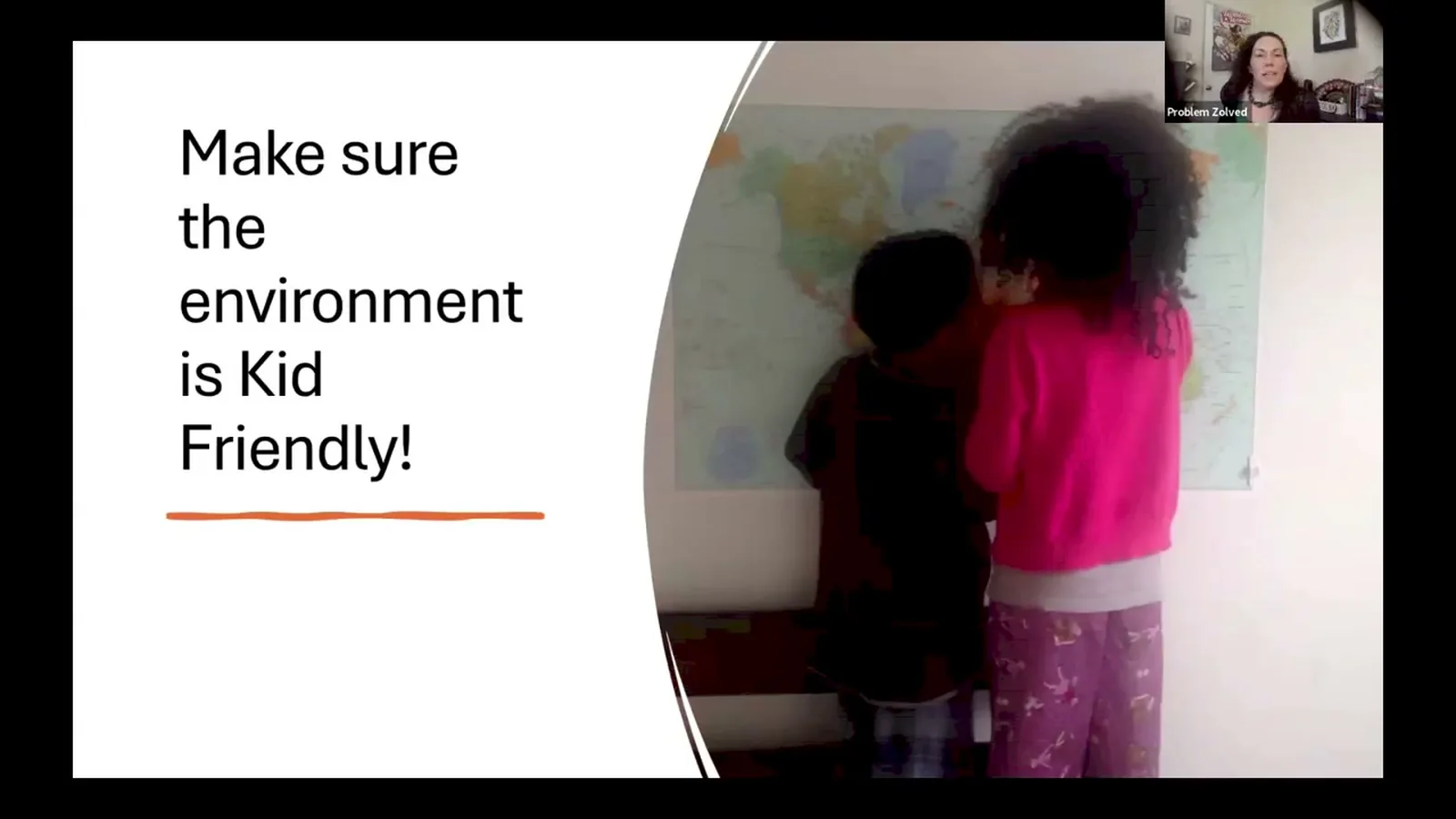
The environment needs to be safe.
From the talk — Kelly Brzak
What 2 to 5 Development Actually Looks Like
Emotional signs show up early: smiling, orienting toward a caregiver, hugging, touching, laughing, and crying when something is wrong. Frustration shows up too, and so do the first attempts to solve a problem. Brzak wants teams to watch the whole child, not only the boxes on the protocol.
Language grows on adult responses and adult examples. Even tiny babies pause and orient when someone speaks to them. A babbling baby will take turns with you if you stay quiet long enough. That pause is the lesson. Speaker and responder roles get practiced long before real words arrive.
Social play in this range is often parallel play (playing beside, not with). Imitation repertoires (copying what adults do) start here too, and that cuts both ways. Brzak's own toddler repeated a swear word she let slip. Children also imprint on a favored caregiver and check in constantly. Younger kids follow older kids, so a sibling in the room can pull more responding out of your client.
These little people can go through the whole gamut of emotions.
From the talk — Kelly Brzak
Get More Out of the VB-MAPP Than the Milestones Page
The VB-MAPP (a language milestones assessment) is loved or hated. It maps typical milestones for birth to four: vocal, social, and visual perceptual skills, with pre academic skills at level three. Brzak reads the milestones grid as a brick wall. Every rectangle you fill before age five strengthens the child's communication foundation. Even if you dislike the tool, she asks you to run it once for a young child. Scan for gaps.
The tool has three parts, and two of them get skipped. The barriers assessment (a scan for learning roadblocks) can be walked through with a caregiver. It shows you which barriers to attack first for this one child. The transitions assessment (the third part of that tool) is worth opening before you move on to other tools.
She also uses the Essential 8 booklet from Essentials for Living with every child on her caseload. It has a running record style (an ongoing log across targets). That covers leisure activities, requests, and tolerating a denied or delayed request. Some insurers accept it as an assessment tool. Her bigger push: stop reassessing only every six months. Keep the tool in your bag and look at it often.
Really, our assessment tools are supposed to help us scaffold the learning for the child.
From the talk — Kelly Brzak
The Word Gap Is a Reason to Talk More
Brzak walked through data from Meaningful Differences in the Everyday Experience of Young American Children. The study followed 42 families across income groups: 13 professional, 10 middle, 13 lower, and 3 welfare families. SES here means family income and education level.
The kids started talking at about the same age no matter the group. The size of their vocabulary was another story. By age three, children in professional families had about 1,100 words. Children in welfare families had about 500. By that same age, one group had heard about 30 million words and the other about 10 million. The work reported a strong link between vocabulary and IQ.
Her takeaway is practical. If you serve a young child in a home with spare resources, bring the extra. Bring extra language, extra playtime, and extra energy into that room. You are one of the adults who can close part of that gap.
If you look at the bottom, the children started talking at approximately the same time, despite their SES considerations.
From the talk — Kelly Brzak
Write Goals That Let a Small Child Win
Brzak spends real time on trials to criterion (how many correct tries equal mastery). Her goals for this age look small on purpose. A child expressively identifies three of three items per session across six sessions. A child imitates two of two actions. She admits she was trained to think eight of ten sounded stronger. What she got when she pushed past two or three was task refusal and elopement (running off from the session).
Do the math on a common goal. Eight of ten colors across five sessions asks a child to tact (name something they see) 50 times. Unless you brought an artist's set of markers, the same colors come around again and again. That is hoop jumping. Rewrite it as two of two colors across eight total colors. Two and three year olds may also not be ready to sort colors at all, so play beats trials there.
Two more rewrites came up. She crosses the word seated out of goals and asks why it was there in the first place. Shape attention through 15, 30, 45, then 60 seconds, and celebrate five seconds if that is what you get. Then drop zero instances of maladaptive behavior (behavior that gets in the way) as a target. Her small caregiver survey said daily crying and tantrums are the norm. Try self soothing or accepting redirection within 30 seconds instead.
These are all age appropriate and common behaviors.
From the talk — Kelly Brzak
Play, Repetition, and a Longer Wait
Her teaching rules are short. Bring play. Use repetition. Watch how much language you pile on. She codes technician language on a sheet so the team can see its own habits. Every extra question is one more chance for a child to avoid you or say no. Say car, beep beep. Skip the stack of who, what, and where questions.
Wait longer than feels normal. Instead of a three to five second window, she gives a long silence before prompting again. That longer latency (the pause before you prompt) is where many kids answer on their own. She also reframed the old fight over teaching format. Good NET (teaching inside natural play) is DTT (short structured teaching trials) embedded in the natural environment. Each trial keeps the same parts intact.
Materials matter more than people expect. Bring a variety of play items, sized so nothing is a choking risk and small hands can still manage. Ask the family what they already own. Pack sanitizer, wipes, tissues, band aids, and gloves for the team. Kid sized chairs, tables, and step stools help a child act on their own. Tiny board books with one word and one animal per page let a parent feel successful reading aloud.
One more thing to expect. A child with neurological differences may not smile back or look up at you. That missing feedback can quietly punish your own playing. Notice it happening in yourself, then keep playing anyway.
Reduce demands does not mean reduce learning.
From the talk — Kelly Brzak
Pairing With Caregivers Without Adding Stress
Pairing (building fun before asking for work) starts with your own head. Brzak asks teams to suspend judgment of the family. Clinical expertise is not permission to look down on anyone. Ask how the parent is doing and mean it. Remember who was sick last week and ask about them. Do not take it personally when a family ghosts you, and keep offering times.
Her pairing answer for the child is blunt: bring a bag of stuff. Puzzles, books, stickers, shapes. Something in there will land. Then watch the child's eyes and hands, and narrate what they are already looking at. Be goofy. Imitate favorite characters. A colleague she consulted added that purposeful touch, matched to the child's preferences, matters at this age.
With caregivers, showing beats handing over a printout to sign. Model the skill. Pick one goal area per session and let the parent choose from a few. Include parents in running trials. That means short echoic trials (having the child repeat sounds) and FCT practice (teaching the child to ask). Invite siblings in. Loop in teachers or preschool staff, and offer to come along on an outing.
Set your technicians up the same way. They need to know how to play, spot incidental teaching moments (teaching that happens through everyday activity), and bring energy. Ask directly whether they are comfortable with toileting and other messes. You will find out either way, so it is better to know first.
There is a difference between showing and telling.
From the talk — Kelly Brzak
Common questions
How many trials should I require for a 2 to 5 year old?▾
Brzak writes goals at two of two or three of three items, across five or six consecutive sessions. Her reason is math and motivation. Eight of ten colors across five sessions asks a small child to name colors 50 times. That turns into hoop jumping. When she pushed past two or three, she got task refusal and kids running off.
Is it normal for a preschooler to tantrum every day?▾
Yes. She surveyed caregivers and the answers were yes or sometimes, so daily crying or tantrums are common at this age. Crying, whining, throwing items, and avoiding tasks are age appropriate reactions, not proof of a problem. That is why a zero instances goal is a bad goal. Target self soothing or accepting redirection within 30 seconds instead.
What does the VB-MAPP cover, and is it worth using if I dislike it?▾
It maps typical milestones from birth to four. It covers vocal, social, and visual perceptual skills, with pre academic skills at level three. Brzak says run the milestones once for any young child, even if you hate the tool, just to find skill gaps. She also pushes people to open the two parts most owners skip: the barriers assessment and the transitions assessment.
How should I coach caregivers instead of just handing them a goal sheet?▾
Brzak says there is a difference between showing and telling. Model the skill for the parent instead of handing over a page to sign. Pick one goal area per session and let the parent choose from a few options. Then move the parent into running real trials with the child, including echoic trials and FCT practice.
How long should I wait before prompting a young child again?▾
Longer than the standard three to five seconds. Brzak has found many children respond independently after 10 seconds or more of silence. Letting the silence sit gives the child room to answer without a prompt. That is exactly what you want to count.
About the speaker
Kelly Brzak is a BCBA with a master's degree in child development rather than in ABA. She has worked with and around children for most of her life as a teacher, coach, nanny, and house parent, and she is the mom of four kids ages 2 to 18. She runs her own company, and this talk was part one of a three part series on early, middle, and late child development for behavior analysts.
This summary was generated from the recording’s transcript. Quotes are taken word for word from the talk.
What you'll learn
- 1Learning Objectives
- 2Participants will identify key developmental milestones across social, emotional, language, and motor domains for children ages 2–5.
- 3Participants will recognize common problem behaviors observed during early childhood and the developmental factors that may influence them.
- 4Participants will describe evidence based programming strategies for young children, including caregiver pairing and the use of Behavioral Skills Training (BST).
Concepts in this CEU
Related talks
Talks that cover the same concepts

Shaping Behavior Change when ADHD is in the Picture
The Behaviorist Bookclub

Child Development for BCBAs- Age 9-11
The Behaviorist Bookclub
PDA Caregivers, Complex Profiles, Replacement Behaviors, and Being Trauma Informed
The Behaviorist Bookclub

Teaching RBTs to Think Clinically: Training In-the-Moment Decision Making
Copper Consulting Group

Delegating with Confidence: Training and Supervising RBTs to Support Assessments
Copper Consulting Group

It’s Complicated: Teaching Relationship Safety That Reflects Real Life
The Behaviorist Bookclub
More from The Behaviorist Bookclub
Supervising Beyond Technical Skills: Professionalism, Communication, and Clinical Judgment
The Behaviorist Bookclub
Reflective Supervision and Client Outcomes
The Behaviorist Bookclub
When the Foundations Are Right: Unlocking Advanced Verbal Repertoires
The Behaviorist Bookclub
OpenCEU is supported by advertising from third-party sponsors. Sponsors are clearly labeled, have no influence over course content, instructors, or CEU decisions, and never appear on certificates. The BACB does not sponsor, approve, or endorse OpenCEU sponsors or their products.