Cultural Responsiveness in ABA: A BCBA's Guide
Cultural responsiveness is a BACB ethics duty under Code 1.07. Learn to check your bias, respect family values, and deliver care that fits each family.
Key takeaway
Cultural responsiveness means shaping your care to fit each family's values and background. It is not a bonus skill. For behavior analysts, it is written into the ethics code.

Cultural Considerations Across Teams, Systems & Practice
Experts who cover this
4 recordings on openceu cover cultural responsiveness aba.
- Featured talk1 Ethics CEU
Cultural Considerations Across Teams, Systems & Practice
Makenzie SandlerThe Behaviorist Bookclub
Ties BACB ethics code 1.07 to organizational contexts, arguing behavior analysts must actively identify their own cultural biases and recognize that identical…
- 1 Ethics CEU
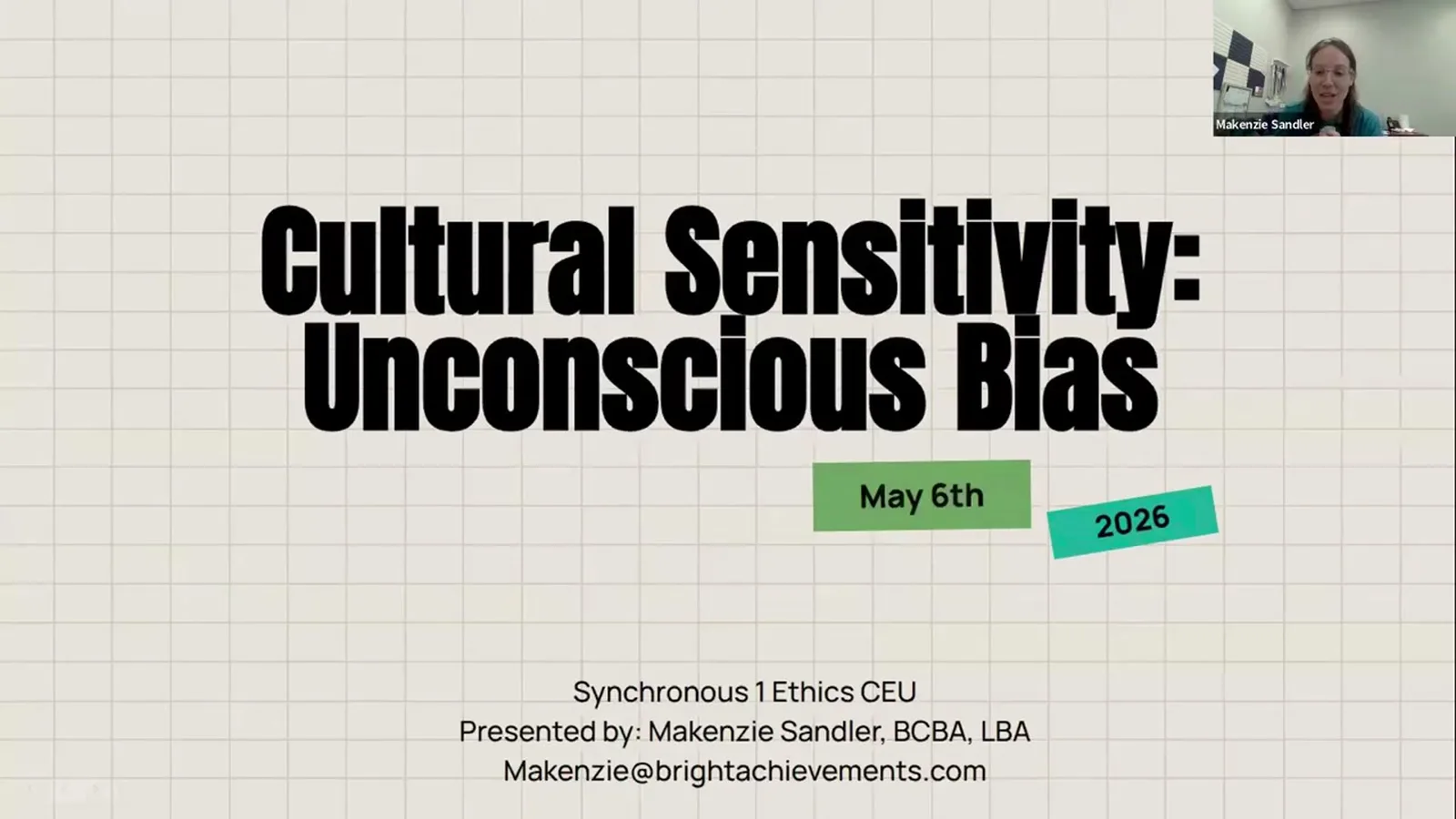
Cultural Sensitivity: Unconscious Bias
Mackenzie SandlerThe Behaviorist Bookclub
Sandler grounds the whole talk in BACB code 1.07, noting that evaluating your own biases, and your supervisees' biases, toward cultural responsiveness and…
- 1 Ethics CEU
Cultural Considerations in ABA Clinical Practice
Mackenzie SandlerThe Behaviorist Bookclub
Distinguished from cultural humility as the active, ongoing behavior of acquiring cultural knowledge: attending trainings, reading, and learning directly from…
- 1 CEU
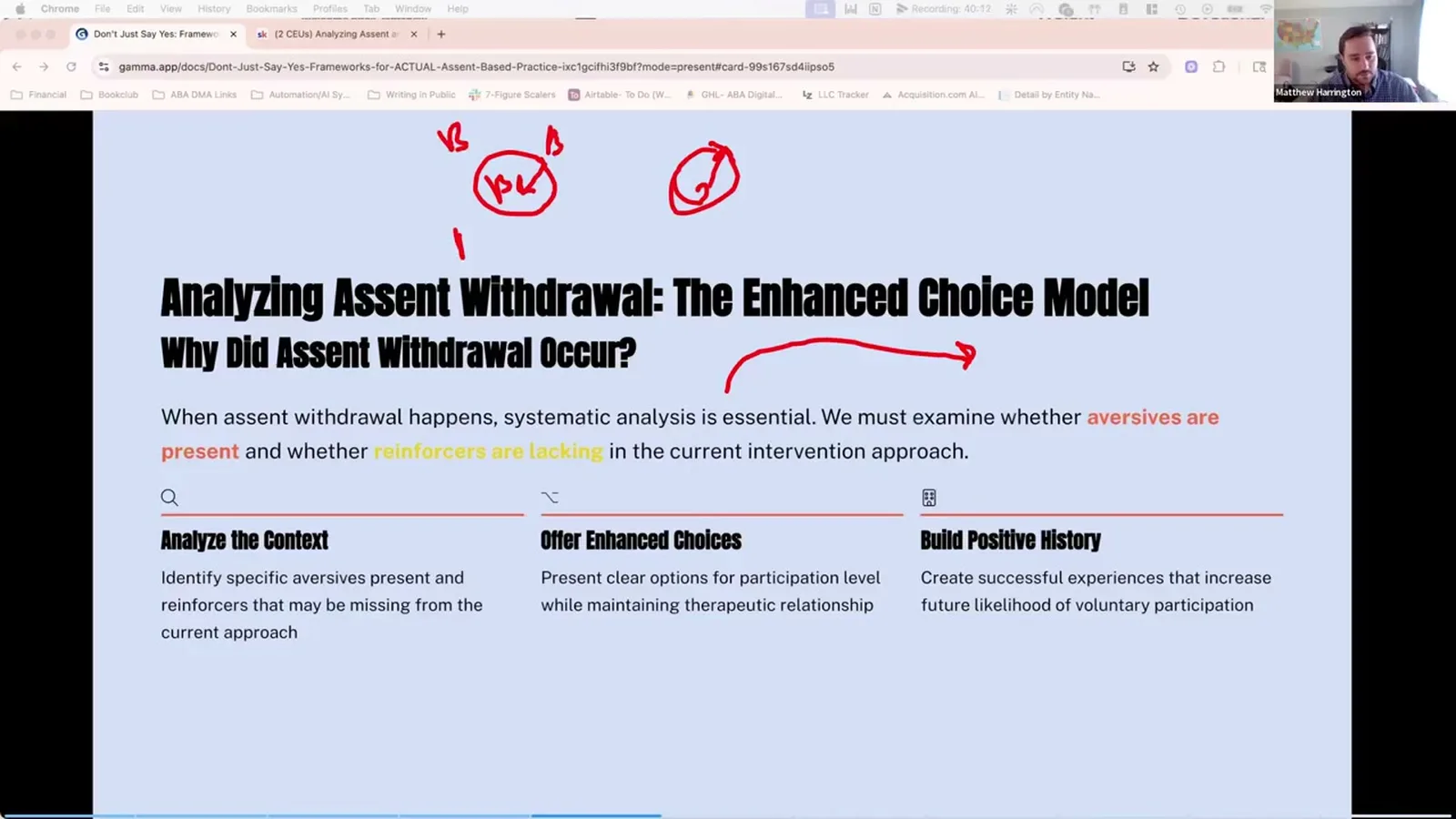
Assent: Don't just say Yes!-
Matt HarringtonThe Behaviorist Bookclub
Addressed in Q&A: assent-based care can still be applied when a family's culture places decision-making firmly with adults, by keeping adults as decision…


On this page · 8 sections▾
Cultural responsiveness means shaping your care to fit each family's values and background. It is not a bonus skill. For behavior analysts, it is written into the ethics code. The same idea is sometimes called cultural diversity in practice.
This matters because your clients come from many cultures. What feels normal to you may feel strange to a family. What a family expects at home may surprise you. Good care starts by noticing that gap and respecting it.
It is in the ethics code#
Cultural responsiveness is a duty, not a preference. The BACB ethics code names it directly under Code 1.07. That means you are required to look at your own biases.
Mackenzie Sandler grounds her whole talk in this rule.
1.07 is specifically cultural responsiveness and diversity. So as a BCBA, we are tasked with evaluating our own biases. It is built into our code. From the talk — Mackenzie Sandler
The code goes further than you alone. It also asks you to help your supervisees look at their biases. So responsiveness is part of how you train your team, not just how you serve clients.
Start by checking your own bias#
You cannot respond to culture if you cannot see your own lens. Every person carries a set of default views. Those views quietly shape how you read a family's choices.
The first move is honest self-review. You pause and ask what you are assuming and why. A bias can be small and quiet. It can show up as a snap judgment about a family's home or choices. Naming it is how you keep it from steering your plan.
Behavior analysts are asked to spot and address their own bias on purpose. Sandler points back to ethics code 1.07 here. She says behavior analysts must actively find and address their own cultural biases. Then they must practice in ways that respect diverse groups. This is active work, not a one-time checkbox.
Same behavior, different meaning#
One action can carry two very different meanings. Direct eye contact may read as confident in one culture. It may read as rude in another. Culture sits behind these readings.
The goal is not to judge one view as correct. It is to understand where a family is coming from.
Neither perspective is unethical. Neither one is wrong, right? We just are trying to identify people's perspective on cultural... respect of what their outlook is on the behavior and the expectation. From the talk — Makenzie Sandler
When you hold this stance, you ask more and assume less. You learn the family's meaning before you set a goal. That habit keeps your plans respectful and useful.
What counts as effective is not universal#
 Advertisement
You may prove a method works with data. That does not make it acceptable to every family. Social validity, which means how acceptable a goal or method feels to a family, changes across cultures.
Dr. Shane Spiker is blunt about this point.
What we deem effective and what we deem appropriate is not going to be socially valid across every culture. From the talk — Dr. Shane Spiker
Spiker gives sharp examples of how far this can range. In some cultures, medication or physical restraint may be taboo. In others, punishment may be seen as an acceptable option instead.
Some families may view certain methods as off-limits. Others may expect methods you would never suggest. You cannot pick a plan the family will not use. So you weigh both the evidence and the family's values.
Responsiveness is an active, ongoing skill#
Cultural responsiveness is a verb, not a badge you earn once. It grows through steady effort. You read, attend trainings, and learn from families and coworkers.
Sandler frames this as never-ending growth.
we have to acquire those knowledge and skills and continue to grow, continue to pause and ask ourselves questions. From the talk — Mackenzie Sandler
So treat it like any skill you build over years. Keep asking questions. Keep learning from the people you serve. You can go deeper in Cultural Sensitivity: Unconscious Bias.
Staying responsive inside assent-based care#
Sometimes values seem to clash with your approach. A family may believe adults make the choices and children follow. Assent-based care can still fit here.
Matt Harrington describes a gentler route to the same family goal.
if Ascent-based care long term is a strategy we're using, that still means that adults are decision makers. It just means that there's more flexibility and we get there in a different route than an alternative way that's more disciplinarian. From the talk — Matt Harrington
The family keeps its role. You keep your ethics. Both can hold at once with care and creativity.
What the research says#
The field is building a real base for this work. Studies point to training and self-review as key steps.
The updated ethics code requires training in culturally responsive service. Yet the field still has limited research on best practices (Jimenez-Gomez & Beaulieu, 2022). Self-assessment of your own values and biases is a critical first step (Beaulieu & Jimenez-Gomez, 2022).
Training does move the needle. Behavioral skills training taught graduate students cultural responsiveness, interviewing, and compassionate care. The skills held over time (Gatzunis et al., 2023). Still, many providers report little training for diverse families. That is true even when families rate their providers fairly well (O'Neill et al., 2023). The takeaway is clear. Responsiveness can be taught, and most of us have room to grow.
FAQ#
What is BACB Code 1.07? It is the ethics standard on cultural responsiveness and diversity. It asks behavior analysts to evaluate and address their own biases. It also asks you to support your supervisees in doing the same. It makes responsive care a professional duty.
What is the difference between cultural responsiveness and cultural humility? Cultural humility is the open, curious mindset you hold. Cultural responsiveness is the active work you do with it. That work includes learning, self-review, and changing your practice. You need both to serve families well.
How do I make my ABA plans more culturally responsive? Start by asking families about their values and goals. Check your own assumptions before you set targets. Choose methods the family finds acceptable, not just effective on paper. Keep learning and adjust as the relationship grows.
 Advertisement
Turn this topic into a CEU
You just studied this. Now get credit for it.
Watch Cultural Considerations Across Teams, Systems & Practice with Makenzie Sandler, BCBA and earn 1 free BCBA CEU. Detailed certificate, delivered the moment you finish.