The Single-Session IISCA: When It Works and When It Blows Up
How a single-session IISCA actually works in practice, when to use one in telehealth, and the interview prep that has to come first from a BCBA-led CEU.
Key takeaway
Run a single-session IISCA (interview-informed synthesized contingency analysis) when you only have one hour, the caregiver interview already told you the answer, and you can say out loud that you are 99 percent sure of the function before the test starts.
12 days of PFA & SBT
On this page · 9 sections▾
Run a single-session IISCA (interview-informed synthesized contingency analysis) when you only have one hour, the caregiver interview already told you the answer, and you can say out loud that you are 99 percent sure of the function before the test starts. Jessel and colleagues introduced this short-format option in 2019 as a way to confirm a hypothesis you have already built, not as a way to discover one. The first time I tried one on Zoom, I rushed the interview, walked in half sure, and spent the next 30 minutes watching the test fail. The fix was simple. I gave the next interview almost the full hour and ran the test in three minutes. This page is for the BCBA (board certified behavior analyst) who already knows what a PFA (practical functional assessment) and an IISCA are, and wants a clear rule on when the short format is the right call. PFA and IISCA are part of the same family of assessments. The PFA is the broader process Hanley, Jin, Vanselow, and Hanratty laid out in 2014. The IISCA is the specific functional analysis inside it.
What a Single-Session IISCA Actually Is (Jessel 2019 in Plain English)#
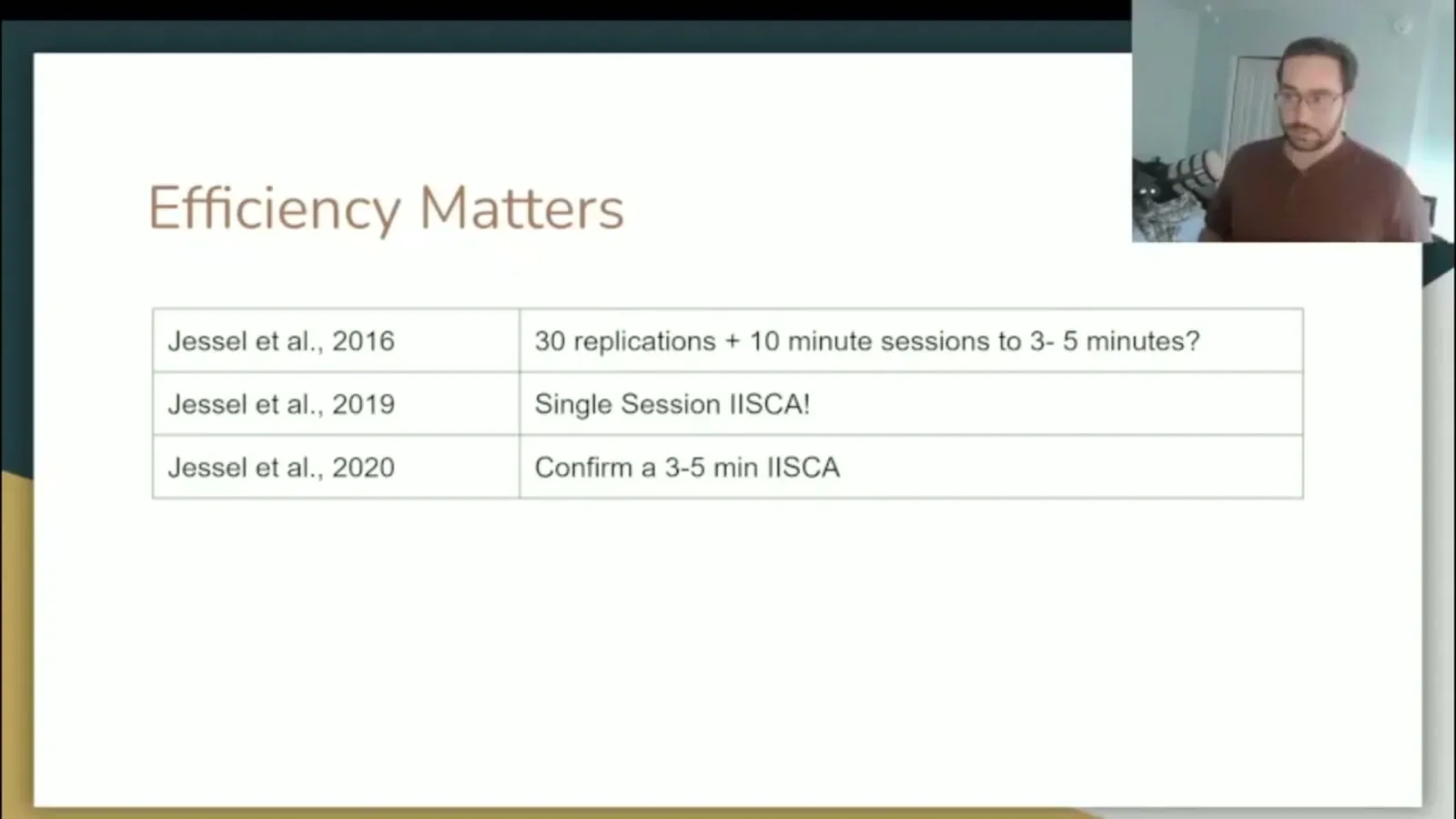
A regular IISCA gives you several pairs of intervals. You have a reinforcer-present condition. You have a reinforcer-absent condition. You go back and forth. You stop when the data is clean. The test usually takes 20 to 30 minutes once everything is set up. The single-session version, described by Jessel and colleagues in 2019, collapses that down to one test interval and zero control intervals. That is not a typo. You get one chance to confirm what you already think is true.
The trade is simple. You save time. You lose the safety net. There is no second pass. There is no control to compare. If you guessed wrong, you walked out of the test with nothing usable. The format only works when the homework before the test is so strong that the test is essentially a check, not a search. That homework is the caregiver interview. Jessel 2019 leans hard on the interview the same way Hanley 2014 did. The interview is not a warm-up. It is the experiment. The three-minute test on the back end is just the seal on the envelope.
That is why the single-session IISCA is a clinical decision-making tool, not a default. You pick it when the interview is already that strong, not when the schedule is tight.
The 'Reinforcer Present, Reinforcer Absent' Logic, Explained on Paper#
Strip the jargon and the logic is almost too simple. You bring the kid in with everything they like already present. Tablet. Attention from a caregiver. Whatever the interview told you was the synthesized reinforcer. While those things are present, you do not expect any challenging behavior. The kid is getting what the function chases. The system is at rest.
Then you remove the reinforcer. You take the tablet away. You turn your back. You start the demand. If you are right about the function, challenging behavior should appear within seconds to a minute or two. The moment it does, you put the reinforcer back. The test is over. You have your answer.
That is what people mean when they say "reinforcer present" and "reinforcer absent" intervals. Present is the baseline where the kid has access. Absent is the brief moment where you remove it. The contrast between those two short intervals is the entire signal. It is not a long curve. It is a switch.
Once you can draw that on a napkin for a parent, you can run it without an app, without a stopwatch app, and without research-grade software. Pen and paper works.
When a Single-Session IISCA Is the Right Call (Telehealth, Time Caps, Strong Interview)#
There are three situations where this format earns its keep.
The first is telehealth. You only have the parent and the kid on a video call. The parent is the one delivering the test conditions. You are coaching through a screen. A full back-and-forth IISCA over Zoom is hard to keep clean. Cameras shift. Kids walk off. The parent loses the script. A single test interval is much easier to coach in real time.
The second is a hard time cap. You have one hour because that is what the family could carve out. You have one hour because the school will only release the student for that long. You have one hour because the insurance authorization is short. A standard IISCA inside a single hour is doable, but the interview gets sacrificed, and that is the part you cannot afford to lose.
The third is when the interview is already overwhelming. You have done a 45 to 60 minute interview. The parent has given you specific examples, specific stimuli, specific recovery patterns. You can already write the synthesized contingency from memory. At that point the longer test is just a formality. Confirming with one clean interval is the right move.
In each of those cases, the win is the same. You move the time out of the test and into the interview. The test stops being the experiment. The interview becomes the experiment.
When It Is Not (The 99-Percent-Sure Sniff Test)#
Here is the rule I use before I commit to a single session. I ask myself out loud, before I touch the test conditions, "Am I 99 percent sure of the function?" If the honest answer is no, I do not run the single session. I run the longer version, or I go back and do another interview, or I rebook.
The reason is built into the format. The single-session IISCA has no control. You do not get to compare. If the test interval blows up and you were wrong about the function, you do not learn what the function actually was. You learn that the one you guessed at was probably not it. That is not the same thing.
In order to do a single session ISCA you have one chance to get it right... you don't even get a control but really get one instance to nail down and confirm that your hypothesis is correct... if your hypothesis isn't correct you're just going to... go back to the drawing board. From the talk — Matt Harrington
So the sniff test is not about confidence in the abstract. It is about whether the interview gave you a specific, testable picture. A specific reinforcer. A specific way to remove it. A specific way to expect challenging behavior to look. If any of those three is fuzzy, the answer is not 99 percent. The answer is closer to 70. And 70 is not enough to spend a kid's only test interval on.
Matt's Telehealth Failure Story and the Fix That Worked#
The first time I tried this, I did it backward. I had the time pressure. I had the telehealth setup. I had a parent on Zoom who was patient and ready. I had read Jessel 2019 the night before and was excited to try the short format. I rushed the interview because I thought of the test as the real part of the assessment.
The first time I did it I came in really confident... I rushed through it because I figured hey I'm going to be doing the ISCA after this so I don't need as strong of a caregiver interview... I spent about 30 minutes... just banging my head against into a wall. From the talk — Matt Harrington
The test did not produce clean data. The parent was confused about when to take the tablet away. My hypothesis about the reinforcer was wrong in a way I did not catch until we were in the middle of it. By the time I figured out what was actually going on, we were past the hour. I had nothing usable to write up.
The next time I had the same setup, I flipped the time. I gave the interview almost the entire hour.
I knew I had one hour to come out with a differentiated functional analysis this was my first time that I decided that I was going to do a single session ISCA because of the time restraints and I spent the first 57 minutes of my hour talking to the caregivers I actually started to listen. From the talk — Matt Harrington
57 minutes of interview. Three minutes of test. The test worked the first time. I did not need a second round. The interview had already done all the work. The test was just the confirmation. That is the format the way Jessel 2019 actually intended it. The short part is the test. The long part is still the interview.
Data Collection Without an App: Pen and Paper Works#
A common stall I hear from BCBAs trying this for the first time is that they think they need software. They have heard of BDataPro. They have seen demos of an IISCA app. They worry that doing it on paper will look unprofessional or fail an audit. None of that holds up.
The actual process of separating out reinforcer absent and reinforcer present intervals typically is done via some type of computer program... like a b data pro... or maybe an ISCA app... this actually isn't that hard of a process to do if you're just doing it on a piece of paper. From the talk — Matt Harrington
What you actually need is a stopwatch, a sheet that lets you write the start time of the reinforcer-present interval and the start time of the reinforcer-absent interval, and a column to tally instances of challenging behavior in each. That is it. If you are running a single session, your sheet is even simpler. You have one row for present, one row for absent, and a tally box.
Software is fine for studies. Pen and paper is fine for one test, one kid, one hour, on a Tuesday.
What to Document So the Insurance Reviewer Buys It#
The note you write afterward should not say "single-session IISCA confirmed function" and stop. That gets kicked back. Write down the interview length. Write down the specific reinforcer you tested. Write down the procedure for the present and absent intervals, how long each ran, and the dependent variable, like instances of vocal protest, dropping, and attempts to leave. Then write the function statement.
A clean version reads: "Caregiver interview, 57 minutes. Hypothesized synthesized reinforcer of tablet plus caregiver attention plus tangible. Test ran as single-session IISCA (Jessel et al., 2019). Reinforcer-present interval, 90 seconds, zero instances of challenging behavior. Reinforcer-absent interval, 60 seconds, three instances of vocal protest and one attempt to leave. Reinforcer reinstated, behavior immediately ceased."
Cite Jessel 2019 in the assessment plan. The format is published and peer-reviewed. The single-session IISCA is not a corner cut. It is a published method. Treat the note that way.
Frequently asked questions#
Can I bill a single-session IISCA as a full functional behavior assessment?
The format does not change what kind of assessment it is. An FBA (functional behavior assessment) is the broader document. The IISCA, single-session or not, is the functional analysis piece inside it. Bill the FBA the way you normally would. The fact that the test took three minutes instead of thirty is a methodology detail in the report. If a funder questions it, cite Jessel 2019. The format is published and defensible.
How long should the interview be before a single-session IISCA?
Plan for 45 to 60 minutes minimum. The interview has to give you a specific synthesized reinforcer, a specific way to deliver it, a specific way to remove it, and a specific description of what challenging behavior will look like when you remove it. Vague answers like "she just gets upset" mean you are not done interviewing. The minutes you spend in the interview are the minutes you are saving in the test.
Is a latency-based IISCA the same as a single-session IISCA?
No. A latency-based IISCA, often associated with Coffey and colleagues, measures how long it takes for challenging behavior to appear after the reinforcer is removed. A single-session IISCA, in the Jessel 2019 sense, is about how many test intervals you run. The two ideas can overlap. You can run a single session where the dependent measure is latency. If you are reading a paper, look at whether the author means the time format or the dependent measure. They answer different questions.
Watch the full talk#
The full talk walks through the interview prompts I use, the way I script the present and absent intervals over telehealth, the parent-coaching language that keeps a Zoom session clean, and the way I write the result up for an insurance reviewer. If you only have time for one viewing, the section that starts with the 57-minute interview story is the one to watch. Watch the full talk →
Turn this topic into a CEU
You just studied this. Now get credit for it.
Watch 12 days of PFA & SBT with Matt Harrington and earn 3 free BCBA CEUs. Detailed certificate, delivered the moment you finish.