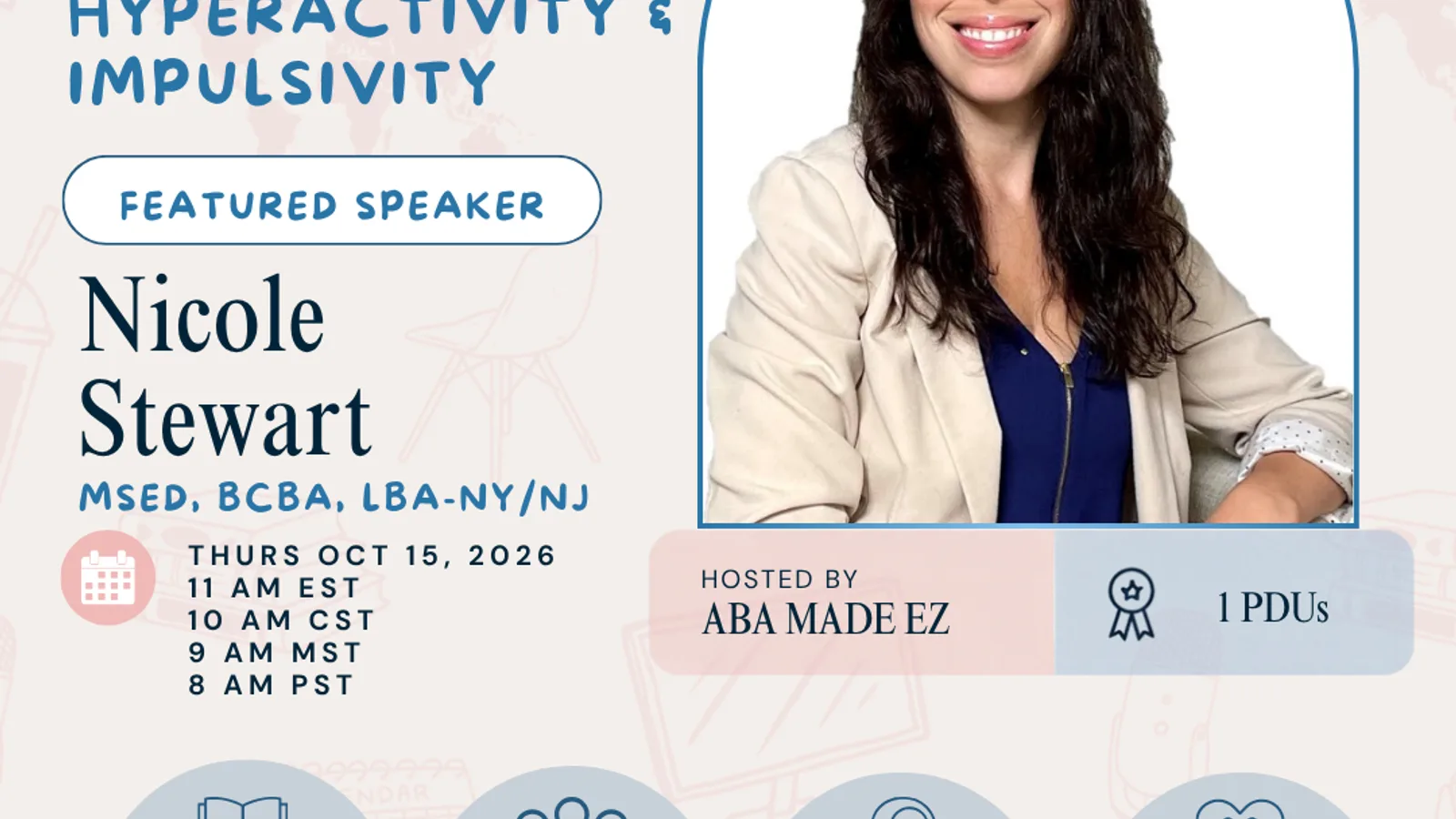
Understanding ADHD: An RBT PDU Series 1 | ADHD 101: Inattention, Hyperactivity & Impulsivity
$5 · 1 PDU · 4.8★ from 5 attendees
One-time purchase, permanent access. Claim your BACB PD form as soon as you pass the quiz.
4.8★ from 5 attendees · 100% would recommend
Presented by Nicole Stewart and Christina Torres
About this course
**Understanding ADHD: An RBT PDU Series** Following the success of our **ADHD Exchange CEU Series**, we wanted to create that same opportunity for RBTs through a dedicated PDU series. **Understanding ADHD** is designed to provide RBTs with practical, accessible education and support around understanding ADHD and applying that knowledge in their everyday practice. Across six cumulative PDUs, RBTs will explore ADHD characteristics, rapport building, attention and motivation, executive functioning and skill development, behavior support, and collaboration. Each session builds on the last, helping RBTs move from understanding ADHD to confidently supporting the learners they serve.
Abstract
Start your journey with the foundations of ADHD! In this introductory PDU, we’ll explore what ADHD is, the different presentations, and how characteristics such as inattention, hyperactivity, and impulsivity may show up in everyday behavior. RBTs will also explore common misconceptions about ADHD and begin to understand how ADHD can impact learning, engagement, communication, and skill development. This session sets the foundation for the rest of the series by helping RBTs better understand the learners they support and approach behavior with greater awareness, compassion, and curiosity.
Credits
1 PDU · 50 min
From the talk
What was covered
Up to 70% of autistic clients also meet ADHD criteria. Nicole Stewart on presentations, dopamine, and what inattention really looks like.
- Assume ADHD is in the room, because up to 70 percent of autistic clients also meet criteria for it.
- Before you call inattention a skill gap, check whether the learner shows that same skill when the task is interesting.
- Make the start smaller: fold the worksheet so only three problems show, then build back up.
- Keep activities new, because the same reward goes stale fast for these learners.
- Say the next step out loud instead of asking an open question like what should you be doing.
- Watch one learner across two or three sessions, write down what you see, and bring it to your BCBA.
Why ADHD Belongs in Every ABA Caseload
Most ABA training is built around autism. ADHD (a brain based attention condition) gets far less time. Nicole Stewart opened this PDU by naming that gap. Up to 70 percent of autistic people also meet criteria for ADHD. That is a comorbid diagnosis (two conditions in one person). Seven of every ten clients, in plain terms.
She put this knowledge on the same shelf as the four functions of behavior. If you work in autism treatment, ADHD is not a side topic. It is a medical need that shapes how a client responds to your programs. Ignoring it, she said, is ignoring the elephant in the room.
School settings raise the odds even more. Nicole said the kids she sees with the biggest behaviors in public schools are often the ADHD kids. That holds more than it does for autistic kids. RBTs in classrooms already work with these learners daily. The real question is whether anyone has named it yet. Naming it changes the plan, because treatment stops being one script for autism.
that means if you're working and autism treatment seven out of every 10 clients has ADHD.
From the talk — Nicole Stewart
The Three ADHD Presentations and What the Criteria Require
ADHD shows up in three presentations. The first is predominantly inattentive (trouble holding focus on tasks). The second is predominantly hyperactive and impulsive (always moving, acting before thinking). The third is combined type, which many children have.
The criteria are tighter than most people assume. The pattern has to interfere with functioning or development. Symptoms must be present before age 12. They must show up in at least two settings. And they must interfere with school, social, or work life. Nicole said she would probably qualify herself. But it does not interfere with her functioning now, so she never sought it.
Age matters for RBTs. Most doctors wait until about six or seven. Four and five year olds are impulsive anyway, and some of that fades. Third grade is the common turning point. Demands climb, play time shrinks, and teachers get stricter. Nicole called that mix a pressure cooker for symptoms. A young client with no diagnosis can still show every characteristic on the list.
It doesn't mean that we might not still see those symptoms.
From the talk — Nicole Stewart
Dopamine, the Prefrontal Cortex, and Why Treatment Lands Differently
ADHD is not only a mental health label. There are measurable differences in how the brain works. Dopamine (a brain chemical tied to motivation) sits at the center of it. Nicole said researchers still do not know whether ADHD brains make less dopamine or take it in poorly. Either way, dopamine is not doing its job.
A brain low on dopamine gets hungry for it. That hunger drives behavior. Nicole compared it to Cookie Monster. He will get the cookie any way he can. Dopamine seeking can look like impulsivity. It can look like bids for negative attention. It can look like a body that will not stop moving. If poking a sibling delivers dopamine, the poking continues.
Dopamine also shapes how the brain grows. In ADHD, the prefrontal cortex (the brain's planning and control center) is underdeveloped. There are also differences in the basal ganglia (a deeper motor and reward hub). That area handles movement, sensory input, and reward. So emotion control, higher level thinking, and reward response all shift at once. We are still behavior analysts. But a brain that works differently responds to treatment differently.
But however it is, dopamine is not working.
From the talk — Nicole Stewart
The Quieter Symptoms: Hyperfocus, Time Blindness, and Rejection Sensitivity
Several ADHD features never make the diagnostic checklist. Sensory issues are common: clothing, food, light, and loud chaotic rooms. Nicole finds them usually less severe than in autism. A new or busy place can still push symptoms up for the rest of the day.
Hyperfocus (locking onto one thing for hours) confuses a lot of teams. A client builds Legos for six hours but cannot do two minutes of trials. That is not proof the skill is there. Time blindness (no real sense of time passing) runs alongside it. Boring tasks feel endless. Fun tasks vanish. Kids think a job takes two minutes when it takes twenty. It shows up more in older students.
Then there is rejection sensitive dysphoria (deep pain from perceived criticism). Error corrections sting. A missed reinforcer (a reward that keeps a behavior going) stings. One correction can trigger a full shame spiral and emotional dysregulation (big feelings that spill over fast). Working memory (holding information in your head) is another one. Ask how school was and you get good. The answer is in there. They cannot pull it up on demand.
I can work on a PowerPoint for 12 hours.
From the talk — Nicole Stewart
Inattention That Gets Mislabeled as a Skill Deficit
Picture a sorting or receptive ID program (pointing to the right picture). The learner throws cards in boxes without looking. The easy read is a skill deficit (a skill the learner never learned). Maybe they cannot tell a vehicle from a vegetable. The other read is that noticing those details takes attention and stamina. So they rush to be done.
Out of seat behavior gets the same treatment. We code it as escape from the demand. Sometimes sitting still is the hard part, not the worksheet. Multi-step directions are another trap. Nicole said she cannot follow multi-step directions, like several turns to find a bathroom. Some learners need visuals and built in routines instead of more repetitions.
Trouble organizing a task looks like prompt dependence (needing help to keep going). Think about getting dressed or packing a bag. Both are long chains with many choices. A learner who cannot organize the sequence needs a prompt at every step. One 17 year old in the talk took 30 minutes to get dressed and wandered off mid chain. A checklist can ground a learner in what comes next. In a math example, a 10 year old retreated into daydreams and then could not start her work. The daydream was simply the better reinforcer.
But it's not that you can't do it. it's that we haven't designed it for your brain.
From the talk — Nicole Stewart
When Hyperactivity and Impulsivity Get Coded as Behavior
Inattention gets missed. Hyperactivity and impulsivity get targeted. That is the pattern Nicole sees most. A child grabs from a passing cart, blurts answers, or takes a risk with no warning. The team writes attention seeking. Nicole described a child who popped a yoga ball with a pencil just to see what would happen. He was embarrassed after. Nobody was meant to see it at all.
Interrupting is a good test case. You can reinforce quiet all day and the motor keeps running. The symptom is acting as if driven by a motor. So impulse control has to be taught directly. Model the skill. Prime it before the moment. Practice waiting in small doses. Saying it again nicely is not teaching.
The social cost is real and often ignored. Kids talk over peers, miss cues, and steer every topic back to their own interests. A 14 year old in the talk looked typical on the surface but alienated friends this way. He also quit games when they stopped going his way. A 7 year old with ADHD and autism could not sit still for two minutes. He would elope (leave the area without permission) and grab at materials. His team kept losing reinforcers within days. Containing the body with furniture is the wrong fix. The hosts admitted trying it themselves, then regretting it.
I think impulsivity gets coded as attention seeking.
From the talk — Nicole Stewart
Strategies That Worked: Response Effort, Novelty, and Interests
Start by cutting response effort (how hard a task feels). Fold a ten problem worksheet in half. Then tell the learner to circle three. Once those three are done, many learners finish the page. Getting started is often the real barrier, not the math. Flexible seating belongs in the same bucket: standing, the floor, a rocking chair, fidgets. These are accommodations, not rewards.
Novelty does heavy work with these learners. One child who sat 12 seconds at a table stayed eight minutes when the blocks were stacked a new way. Nicole brought a brand new game to a session and a child played it for 45 minutes. His parent had never seen him sit that long for anything. Attending is a prerequisite skill, so building it is worth the effort.
Push interests into the teaching, not just the reward at the end. Let the race car drive to the strawberry during receptive ID. Build routines so the brain does not have to decide. Toothbrush right after the bath. Keys by the coffee maker. Every item needs a home. Replace open questions with direct statements about the next step. Use priming (telling them what comes next) and timers before transitions. And balance the heavy redirection these kids hear with real positive feedback.
He needs novelty. His brain, his little dopamine seeking. Brain needs novelty.
From the talk — Nicole Stewart
An Observation Exercise RBTs Can Run This Week
Nicole closed with a concrete assignment. Pick one learner on your caseload. Watch across two or three sessions. Write down what you saw and what was happening around it. Then match each behavior to a possible ADHD characteristic. Keep it descriptive, not diagnostic.
Add one more column: does this skill show up anywhere else? A learner may complete a long toothbrushing chain because clean teeth matter to them. The same learner may not make a snack, because food is not motivating. That is useful data. It tells you long chains are possible. Three questions help sort it. Could this be a visible ADHD symptom? Is the symptom more reinforcing than the activity I am offering? Can the learner do this under other conditions? If yes to the last one, you may be looking at a performance deficit (can do it, not doing it).
Then ask the environment question. Have we set this up so the learner can succeed? If they cannot sit still, are we programming for that? Bring the notes to your BCBA supervision and start the conversation. You know the client best, so say what you see. Nicole said this kind of observation can also count toward unrestricted hours (fieldwork hours outside direct therapy) for trainees.
ADHD is often a performance issue, not a skill deficit.
From the talk — Nicole Stewart
Common questions
What percentage of autistic people also have ADHD?▾
Nicole Stewart cited up to 70 percent. That works out to about seven of every ten clients in autism treatment. She uses the number to argue that ADHD knowledge is a core ABA skill, not a specialty topic.
At what age is ADHD usually diagnosed?▾
Most doctors wait until about six or seven, though some diagnose earlier. Symptoms must appear before age 12 and show up in at least two settings. They also have to interfere with school, social, or work functioning. Third grade is a common point where symptoms become hard to miss.
Is inattention in a session a skill deficit or something else?▾
Often it is a performance problem, not a missing skill. Check whether the learner shows the same skill when the task is interesting or the stakes are different. If they can do it under some conditions, the issue is motivation and attention. That changes the intervention completely.
Why does a reinforcer stop working after a day or two?▾
A brain seeking dopamine needs novelty to stay engaged. Once a reward stops being new, it stops delivering. Rotate items, change how an activity is played, and bring in something unfamiliar. In the talk, a simple change to how blocks were stacked bought eight minutes of attending.
What can an RBT do about ADHD without a diagnosis in the file?▾
You can describe what you see and bring it to your BCBA. Log behaviors across two or three sessions and note what was happening around them. Ask whether accommodations like movement breaks, visuals, or lower response effort would help. You are not diagnosing, you are advocating.
About the speaker
Nicole Stewart is a BCBA and special education teacher with 20 years in the field, and an ADHD certified clinical service provider. She previously taught a 10 part ADHD series for BCBAs that drew thousands of registrations, and she is also raising children with ADHD. Her focus is the neurobiology behind behavior: how a differently wired brain changes a learner's response to standard ABA treatment.
This summary was generated from the recording’s transcript. Quotes are taken word for word from the talk.
Concepts in this course
Course materials
Sign in and register for this course to download these files.
More from ABA Made Ez
OpenCEU is supported by advertising from third-party sponsors. Sponsors are clearly labeled, have no influence over course content, instructors, or CEU decisions, and never appear on certificates. The BACB does not sponsor, approve, or endorse OpenCEU sponsors or their products.