Functional Analysis for Anxiety: What a BCBA Can Pull From an FA
A clean FA will tell you escape is the reinforcer. It will not tell you the kid is anxious. Here is how a BCBA closes the gap, from a BCBA-led CEU.
Key takeaway
A functional analysis (FA) can tell you that escape from a transition is the reinforcer. It cannot tell you that the kid was anxious about it.
Hey, Chillax Man! Understanding the Logic of Anxiety
On this page · 8 sections▾
A functional analysis (FA) can tell you that escape from a transition is the reinforcer. It cannot tell you that the kid was anxious about it. I (a Board Certified Behavior Analyst, or BCBA) learned that the hard way on a client I will call M. I ran an interview-informed synthesized contingency analysis (ISCA, a kind of FA that tests blended contingencies in one condition) and got a clean result. Escape from aversive transitions, plus access to preferred activities. Tight data. Defensible writeup. And it still missed the whole story, which was a 2,000-kid high school nobody had walked through with him yet.
This page is for the BCBA who has a clean FA in hand and a nagging feeling the function statement is not the whole picture. It is built on a CEU talk from Dr. Clelia Sigaud called "Hey, Chillax Man! Understanding the Logic of Anxiety," plus the M case I have been chewing on for years.
What an FA is built to tell you, and what it is not#
An FA tests reinforcement contingencies. You set up conditions, you watch the rate of the target behavior across them, and you draw a line from the behavior to the consequence that maintains it. That is the job. It is a very good job. When you run an FA cleanly, you can say with confidence: this behavior is maintained by escape, or by access, or by attention, or by automatic reinforcement.
What an FA is not built to do is tell you what the person was feeling on the way to the behavior. It does not measure heart rate. It does not ask about the bus ride that morning. It does not know about the fluorescent lights or the substitute teacher or the fact that a parent got sick last week. An FA gives you the contingency. It does not give you the context that loaded the contingency.
This matters most on avoidance-shaped cases. If a kid is escaping a transition because the transition is genuinely aversive in the moment, that is one thing. If the kid is escaping a transition because the transition is the first link in a chain that ends in a panic response, that is a different problem with a different treatment plan. The FA cannot tell those two stories apart on its own.
M's FA result: a clean ISCA that still missed the point#
Here is what I had on M before he started high school. He was a teenager on the spectrum. He had a long history of behavior plans. The referral question was the same one I get on a lot of kids: he is doing this thing, what is it for, what do we do about it.
I ran the assessment carefully.
I ran a functional analysis. I ended up doing an ISCA and we saw a really clear synthesized reinforcement contingency for access to preferred activities, as well as escape from an aversive transition. So essentially, just like the initial assessment said, when he transitioned, he didn't like it. From the talk — Dr. Clelia Sigaud
That is exactly what I wrote up. Escape plus access, on a synthesized contingency. If you handed that report to ten BCBAs, nine would build the same BIP. Antecedent strategies for transitions. Functional communication for "break." Reinforcement for tolerating the transition. Clean.
Then he started high school and shut down on day one. None of the FA-driven supports touched it. The plan we built off the FA was technically correct and operationally useless, because the FA had answered the wrong question. The question was not what reinforced his transition refusal in the clinic. The question was what made the transition aversive in the first place once the setting changed.
Where the synthesized contingency hides the anxiety#
Synthesized contingencies are a real tool. They were built because reinforcement in the natural environment is rarely pure, and trying to isolate a single function in an analog setting can produce false negatives. So you test the blend the way it shows up in real life. Escape plus access. Attention plus tangible. Whatever the interview points you at.
The catch is that "escape from an aversive transition" is a category big enough to hide a lot. A transition can be aversive because the next activity is boring. It can be aversive because the next activity is hard. It can be aversive because the transition itself produces a private response (a feeling, a thought, a body sensation) the kid is trying to get away from. The FA result reads the same in all three. The treatment plans should not.
When the driver is a private response, you are looking at something that walks and talks like anxiety. The behavior is escape-maintained on the data sheet. The function, in the lived sense, is avoidance of a feeling. If you only have the FA in front of you, you cannot tell which version you are looking at. You need a second pass.
Sometimes we're problem solving behavior analytically with someone and we get to this place where we've determined for through whatever means that this person is experiencing anxiety and we just kind of stop. And we don't problem solve from there. From the talk — Dr. Clelia Sigaud
Sigaud is naming the failure mode I fell into on M. The FA result was the start of the analysis, not the end of it. I treated it like the end.
Three questions to ask after every FA on an avoidance case#
After you run an FA and the result points at escape, sit with the report for ten minutes before you write the behavior intervention plan (BIP). Walk through these three.
One. Does the behavior happen at a stable rate across days, or does it cluster around specific settings, people, or windows? Stable rates suggest the contingency is doing most of the work. Clustered rates suggest a setting event is loading the contingency.
Two. Is there a delay between the antecedent and the behavior, or is the response immediate? Immediate responses look more like operant escape. Delayed responses, where the kid seems to wind up first, are a tell that something is building inside the kid before the behavior shows up.
Three. When the behavior is blocked, what do you see? If the kid drops to a quieter version of the same escape (covering ears, asking to leave, going still), you are probably looking at the same operant function in a smaller package. If the kid escalates into a different topography (crying, trembling, full shutdown), the private event probably has more weight than the FA captured.
None of these replace the FA. They sit next to it. They are the questions that decide whether you write the BIP today or run a second assessment first.
Setting events: the 2,000-kid school nobody assessed#
The piece I had on M that I never plugged into the analysis was the setting event. Setting events are the conditions in the background that make a contingency hit harder. Bad sleep. A fight with a sibling. A new building. They do not cause the behavior on their own. They turn the volume up on whatever the contingency was already going to do.
It seemed like our big fear of a new high school causing a lot of problems came to pass. We started to look at the actual variables and you started to see a pattern. The previous school was small, a hundred students. It was a self-contained center school. The new high school had 2,000 students. From the talk — Dr. Clelia Sigaud
A hundred kids to two thousand kids. Self-contained to general population. Quiet halls to loud halls. None of that was in the FA, because the FA ran in the clinic and the school change had not happened yet. The contingency I measured was real. The setting event that would later overwhelm every coping skill we had taught was not on the page.
For anxiety-shaped cases, setting-event analysis is not a nice-to-have. It is the second half of the assessment. The questions are straightforward. What changed in the last month? What is different about the days the behavior spikes? Who is present, who is absent? What does the kid do for the hour before the trigger? You are building a map of conditions, not a function statement. The function statement comes from the FA. The conditions come from the setting-event work.
When to add a secondary assessment instead of writing the BIP#
This is the call I wish I had made on M. After the FA, before the BIP. Pause and decide if you have enough.
You probably have enough if the rates are stable across settings, the topography is consistent, the kid can describe the trigger in any kind of words, and the FA result lines up with what the family and school have been seeing all along. Write the BIP.
You probably do not have enough if the rates cluster, the topography shifts, the kid cannot or will not describe what is happening before the behavior, or the case has an avoidance shape with private-event signals (trembling, freezing, somatic complaints, sleep changes). Add a secondary assessment. That usually means a school psychologist or a clinical psychologist who can do the part of the work BCBAs are not trained for, which is naming and measuring the private event. It can also mean a functional behavior assessment (FBA) extension that includes structured caregiver interviews on setting events, antecedent chains across the full day, and a mood or anxiety screener appropriate to the kid.
The cost of skipping this step is not just a weaker plan. It can be a worse outcome for the client.
Another example might be treating attention maintained elopement with extinctions, not realizing the potential risks to the individual based on their overall profile. Another example would be assuming that suicidal statements from a client are just to get out of work demands. From the talk — Dr. Clelia Sigaud
That is the hard version of the same point. A BIP built off an incomplete picture can hurt the kid you are trying to help. The FA is necessary. It is not always sufficient.
Frequently asked questions#
Should I run an FA at all on a kid I already suspect has anxiety?
Yes, in most cases. The FA still tells you what is reinforcing the behavior in the moment, which you need for the operant side of the BIP. It just is not the whole assessment. Run the FA, then run the secondary work. Treat the FA result as one input.
Can a synthesized contingency mask an anxiety driver?
It can, because the synthesized condition is designed to produce the behavior efficiently, and an escape-plus-access blend will produce avoidance behavior whether or not the underlying driver is anxiety. The synthesized result tells you the behavior is escape and access maintained. It does not tell you why the transition was aversive. That is where the secondary assessment goes.
What does a school psychologist add that an FA does not?
Standardized measures for private events. Norm-referenced anxiety screeners. Cognitive and emotional assessments that name the construct the FA is not built to name. On cases with clear anxiety signals, a school psychologist or clinical psychologist gives you the part of the picture BCBAs are not credentialed to provide on our own.
Closing the loop#
The version of this case I wish I had run on M went like this. Run the FA. Get the function statement. Pause. Score the avoidance-case checklist. Bring in a secondary assessment. Map the setting events. Build the BIP off the full picture, not the function statement alone. We got there eventually with M. It would have been a faster, kinder path if I had asked the second set of questions before writing the first plan.
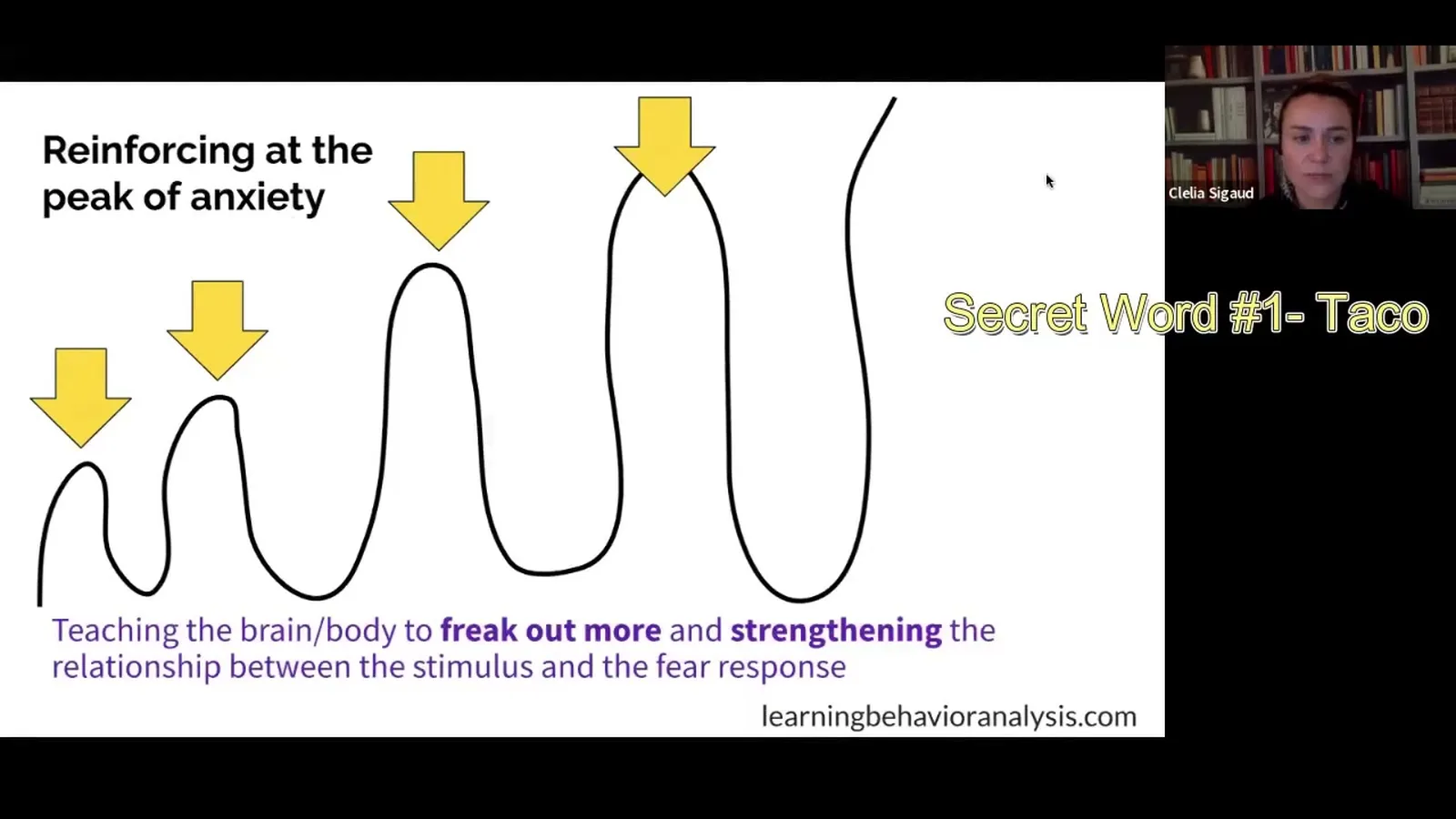
If you want the full version of Sigaud's framing, including the wave shape of anxiety and where reinforcement lands on it, the CEU talk is the place to go.
Turn this topic into a CEU
You just studied this. Now get credit for it.
Watch Hey, Chillax Man! Understanding the Logic of Anxiety with Dr. Clelia Sigaud & Matt Harrington and earn 1.5 free BCBA CEUs. Detailed certificate, delivered the moment you finish.