5 KPIs That Catch Clinical Quality Slipping Before It Hurts a Client
Turnover, cancellation rate, satisfaction scores, skill acquisition, and Vineland catch growth-related quality drops early. Track these monthly, from a BCBA-led CEU.
Key takeaway
The five numbers an ABA owner should pull up before hiring the next BCBA (Board Certified Behavior Analyst, the clinician who designs and oversees treatment) are staff turnover rate, client cancellation rate, a one-question satisfaction score, monthly skill acquisition per client, and a standardized assessment score like the Vineland (a parent-report test of daily-life skills, called adaptive behavior).
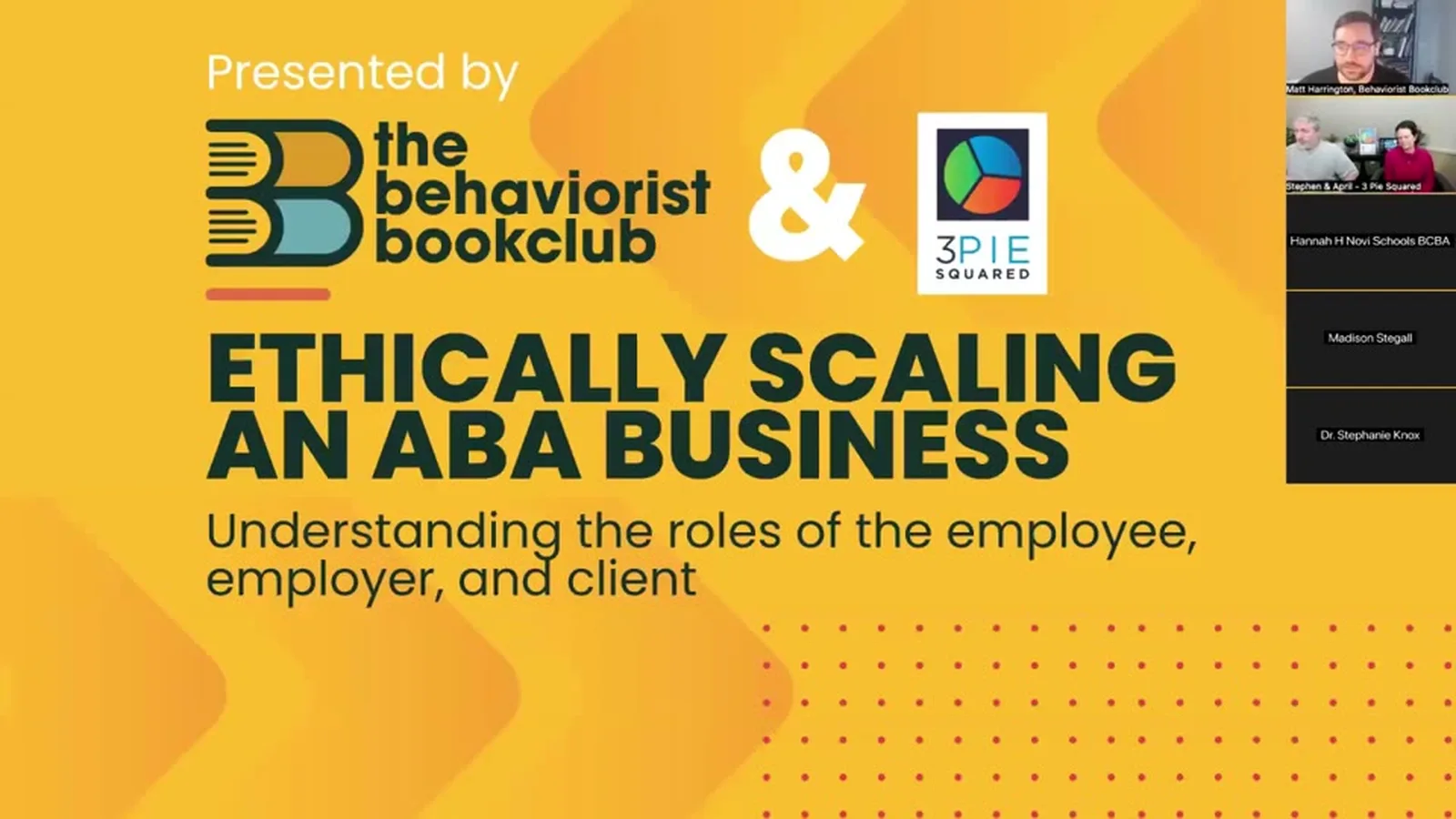
Ethically Scaling an ABA Company
Free learning path on this topic
Your 4 Ethics CEUs, Done
Four ethics CEUs in three courses, all free. Start with Matt Harrington's assent and data course, then ethical guardrails in behavior reduction, then cultural considerations in clinical practice. Every course carries ethics credit, so this path covers the BACB requirement with nothing to buy.
On this page · 9 sections▾
The five numbers an ABA owner should pull up before hiring the next BCBA (Board Certified Behavior Analyst, the clinician who designs and oversees treatment) are staff turnover rate, client cancellation rate, a one-question satisfaction score, monthly skill acquisition per client, and a standardized assessment score like the Vineland (a parent-report test of daily-life skills, called adaptive behavior). Each one is a leading indicator. Each one is cheap to collect. And together they tell you, in plain numbers, whether your last growth step made care better, worse, or about the same. This page is the how-to. It walks through what each KPI (key performance indicator, just a number you track on purpose) is, how often to pull it, what a healthy reading looks like, and how to use the five together to decide if you can scale again without hurting a client.
Why scaling hides quality drops until it is too late#
When you start an ABA company, you know every kid's name. You know every parent's cell number. You probably do the billing yourself. When something slips, you feel it the same day, because it lands in your inbox or on your schedule.
Then you hire one BCBA. Then two. Then three. Each hire pulls you one step away from the kid. You are now managing instead of treating. The work day grows from 45 hours to 60 to 80. And the signal that quality is slipping shows up later, because no one person is holding the whole picture in their head anymore.
This is the trap. Growth feels like progress while care is quietly getting worse. You will not catch it by feel. You catch it with five small numbers that you check every month, the same way you check your bank account. If the numbers move the wrong way, you fix the problem before it reaches the family. If they hold steady, you have earned the right to hire one more person.
KPI 1: staff turnover rate#
Turnover is the share of your staff who leave in a given period. Track it monthly and as a rolling 12-month figure. If you start the year with 20 staff and 5 leave during the year, that is 25% annual turnover.
Why this is the first KPI: every time a tech leaves, the BCBA stops working on the client's progression and starts working on training the new tech. The kid pays for that in lost therapy time.
"If your turnover rate is 75%, this is obviously going to impact quality of service. That's just going to be a problem if your BCBAs are constantly having to train staff. They're not working on a progression of the kids. They're working on training staff." From the talk — Matt Harrington
A healthy reading for direct-care staff in ABA is roughly 30 to 40% annual turnover. Above 50% is a flashing red light. Above 75%, your BCBAs are training, not treating, and your skill-acquisition number (KPI 4) will confirm that within two months.
How to measure: count separations divided by average headcount over the same period. Break it out by role. BCBA turnover and tech turnover tell different stories. A BCBA leaving usually means a caseload gets shuffled across three other BCBAs, which is its own quality hit.
KPI 2: client cancellation rate#
Cancellation rate is the share of scheduled hours that did not happen. If a client is authorized for 20 hours a week and only got 14 hours last week, the cancellation rate for that client that week was 30%.
This one matters because it is a direct measure of dose. You can have a perfect treatment plan and a great team, but if half the sessions cancel, the kid does not get the help. Track it per client per month, then roll it up to the company level.
A reasonable target is under 15% across the company. Anything over 25% on a single client for two months in a row means you need a conversation with the family, the tech team, or both.
There are two flavors of cancellation worth separating: family-side cancellations (sick days, schedule conflicts, no-shows) and provider-side cancellations (tech called out, no coverage available). The fix is different for each. Family-side cancellations usually need a caregiver-engagement conversation. Provider-side cancellations are usually a staffing or scheduling problem, often a sign that one client has too many techs cycling through the case.
KPI 3: monthly staff and family satisfaction (the 1-question version)#
You do not need a 30-question survey. You need one question, asked every month, to staff and to families.
The question: "On a scale of 0 to 10, how likely are you to recommend us to a colleague (or friend)?" This is the NPS (Net Promoter Score) question, and it is the fastest way to take the temperature of the building.
"Something I highly recommend now is doing some really quick satisfaction surveys, weekly or monthly, for both staff and clients. How happy are you with our services? Would you recommend us to a colleague?" From the talk — Matt Harrington
Send it the same week every month so the rhythm becomes invisible. Look for trends, not single readings. A single bad score is information. A three-month decline is an alarm.
Pair the score with one open text box: "What is the one thing we could do better?" That single line will tell you which of the other four KPIs to dig into first.
A healthy reading: average score above 8 on both staff and family surveys, with at least 60% response rate. If response rate drops, that is itself a signal. People who feel ignored stop filling out surveys before they stop showing up.
KPI 4: skill acquisition rate per client per month#
This is the closest thing ABA has to a real-time progress dial. Skill acquisition is the count of program targets a client mastered in a given month. Mastery means the client hit your defined criterion (for example, 80% correct across three sessions in a row with two different techs).
The point is not the exact number. The point is the trend per client. If a kid is mastering 4 to 6 targets per month and that drops to 1 to 2 for two months running, something changed. The team may have turned over. The tech may not be running the program with fidelity. The family may have started canceling more. Skill acquisition is the symptom. The other four KPIs help you find the cause.
How to collect without a fancy platform: ask each BCBA to report, once a month, a single number per client: targets mastered this month. That is it. You are not auditing every program. You are watching for direction of travel.
"You can put a measure in place, even if it's a monthly thing, just to ask all of your BCBAs for a couple data points, just very high level, just quick and dirty, just to see if clients are making the progress." From the talk — Matt Harrington
A trending-down number on three or more clients at the same time is usually a company-level problem, not a clinician-level problem. That distinction matters because the fix lives at a different layer.
KPI 5: standardized assessment scores (Vineland, QOL, family validity)#
Skill acquisition tells you about month-to-month motion. Standardized assessments tell you whether the whole arc of treatment is actually changing the kid's life.
Pick three assessments and give them at intake, every reassessment, and exit. A reasonable starting set:
- The Vineland (Vineland Adaptive Behavior Scales). A parent-report tool that scores how a child is doing at daily-living skills, communication, socialization, and motor skills compared to same-age peers.
- A quality-of-life or social-validity questionnaire for the family. Pick one that fits your clients and use it consistently.
- A family-validity or treatment-satisfaction measure that asks whether the family feels the treatment is actually improving daily life at home.
These are not perfect. They will not capture every ABA-specific gain. But they give you a baseline that you can read across clients and across BCBAs. If your average Vineland gain per six-month interval was running at +X points, and after your last expansion it drops, you have a comparable, defensible number to act on.
Run these every six months at minimum. Roll the results up by BCBA, by site, and by company so you can see where the slip is happening if there is one.
How to use these to decide if you can hire the next BCBA#
The five KPIs work as a single dashboard. Use them as a go/no-go for the next scaling step.
Before you bring on a new BCBA, write down the current company-wide numbers:
- Turnover rate (rolling 12-month)
- Cancellation rate (last month)
- Staff NPS and family NPS (last month)
- Average skill acquisition per client (last month)
- Average Vineland gain per six-month interval (last reassessment cycle)
Make the hire. Wait 90 days. Pull the same five numbers. If three or more moved in the wrong direction, pause. You are not ready to add the next one. Fix the slip first. Then earn the next hire.
"I expanded to three new BCBAs. Now my qualities, my scores, my progress, my acquisition rate, whatever the metric is, is now dipping. How can I pull that up before taking the next scaling step?" From the talk — Matt Harrington
That sentence is the whole spine of this page. You will scale, something will break, you will scale again, something will break. The owners who hold quality through growth are the ones who measure the break early enough to fix it before it lands on a family.
Frequently asked questions#
How often should an ABA company measure clinical quality?
Monthly for the four fast KPIs (turnover, cancellation, satisfaction, skill acquisition) and at every reassessment, usually every six months, for standardized assessments. Monthly is frequent enough to catch a slip inside one billing cycle. Less often than that and a problem can run for a quarter before you see it in the data.
What is a healthy BCBA turnover rate?
Direct-care tech turnover in ABA tends to run 30 to 40% annually in healthy companies. BCBA turnover should sit lower, in the 15 to 25% range. If your BCBA turnover climbs over 40%, the cause is almost always caseload size, supervision support, or pay, in that order. Fix the cause before adding the next BCBA, because the new hire will leave for the same reason.
Do I need a fancy outcomes platform to track quality?
No. The first version of this dashboard fits in a single spreadsheet. One row per client, one column per KPI, one tab per month. The point is the rhythm, not the tool. Add a platform later if it saves time. The owners who run this discipline on a spreadsheet for a year usually know exactly what they want a platform to do by the time they pay for one.
Pull the numbers up before the next hire#
You do not need 20 metrics. You need 5, checked monthly, with one clear rule: if three move the wrong way, pause the next hire and fix the slip first. That single rule keeps growth and quality on the same line instead of in a tug of war.
The full CEU walks through how Matt, Stephen, and April use these in real ABA companies, with examples from the 1,500 BCBA businesses they advise.
Watch the full CEU on openceu.com
Turn this topic into a CEU
You just studied this. Now get credit for it.
Watch Ethically Scaling an ABA Company with Matt Harrington and 3 Pie Squared and earn 1 free BCBA CEU. Detailed certificate, delivered the moment you finish.
Keep going with a free learning path
Your 4 Ethics CEUs, Done
Four ethics CEUs in three courses, all free. Start with Matt Harrington's assent and data course, then ethical guardrails in behavior reduction, then cultural considerations in clinical practice. Every course carries ethics credit, so this path covers the BACB requirement with nothing to buy.