How to Scale an ABA Company Ethically Without Wrecking Care
Scaling pulls you away from clients. Define your why, your end goal, and your quality bar first, then grow on purpose, from a BCBA-led CEU.
Key takeaway
The central tension Stephen named on the panel is the one most ABA company owners do not say out loud: he was scaling for scaling's sake, with no picture of the end goal, while his partner April wanted a small in-home practice where she could know every client by name and visit each one every quarter.
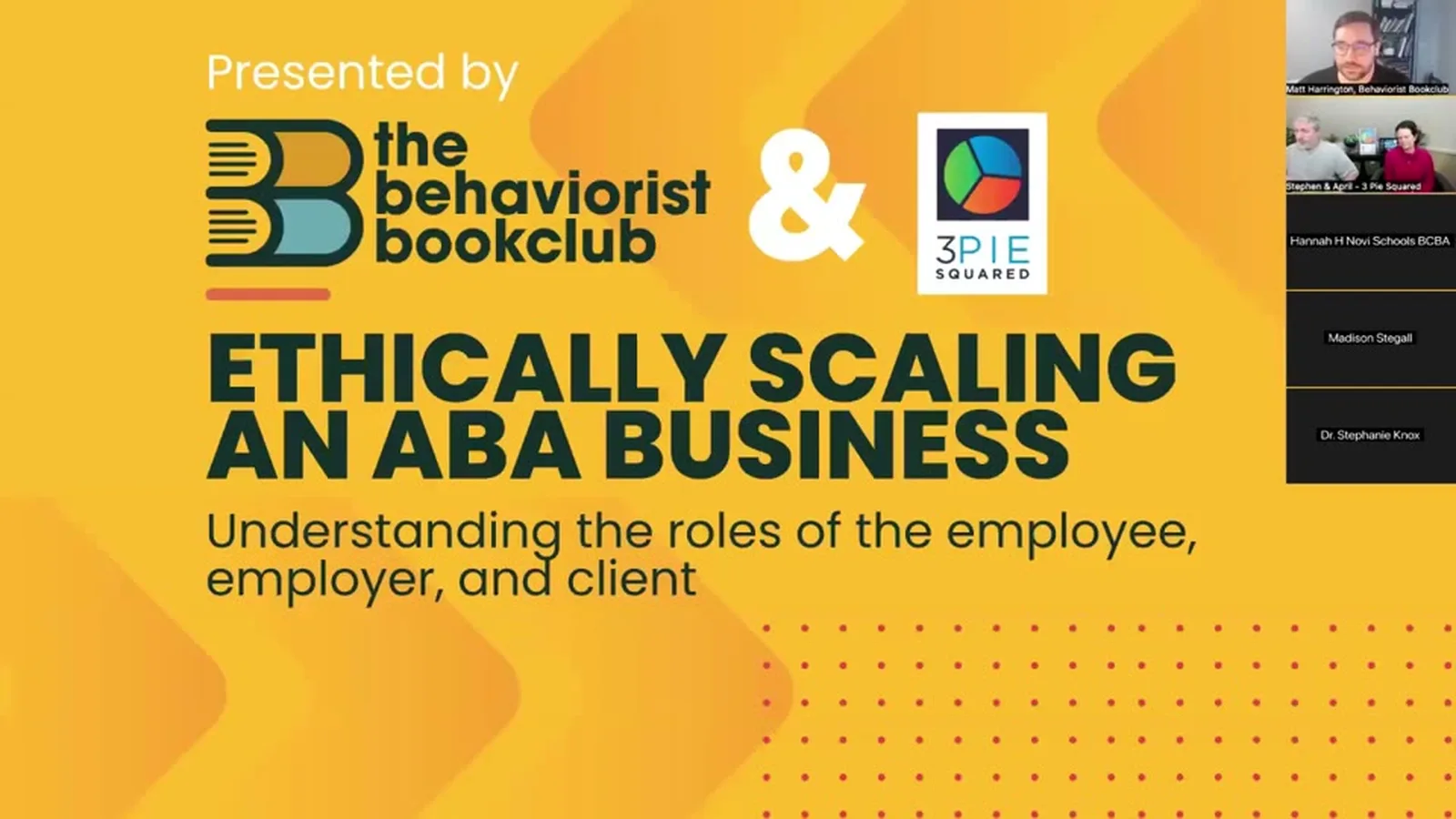
Ethically Scaling an ABA Company
Free learning path on this topic
Your 4 Ethics CEUs, Done
Four ethics CEUs in three courses, all free. Start with Matt Harrington's assent and data course, then ethical guardrails in behavior reduction, then cultural considerations in clinical practice. Every course carries ethics credit, so this path covers the BACB requirement with nothing to buy.
On this page · 8 sections▾
The central tension Stephen named on the panel is the one most ABA company owners do not say out loud: he was scaling for scaling's sake, with no picture of the end goal, while his partner April wanted a small in-home practice where she could know every client by name and visit each one every quarter. Same company. Two different finish lines. They had not talked about it. That gap is where ethical scaling lives or dies, and it is the reason most "how to scale your ABA company" advice goes sideways. You are not failing at growth. You are growing without a destination, and the people paying for that are your clients.
What ethical scaling actually means in ABA#
Scaling is not the villain. Every company has to grow a little just to keep up with payroll and inflation. The problem is what scaling tends to do to clinical quality when nobody slows down to define what quality even means in this company. A Board Certified Behavior Analyst (BCBA) starts a small practice. Ten clients. They know every parent's name. Then they hire a second BCBA. Then a third. Their weeks go from 45 hours to 60 to 80, and they spend most of that time supervising other people instead of looking at their own clients' data. That is not greed. That is drift.
Ethical scaling means three things working at once. You know why you are growing. You can describe what quality looks like at your company in numbers, not vibes. And you have a plan for what breaks next, because something will break every time you add a team.
If you cannot answer those three, you are not scaling ethically yet. You are just hiring.
Step 1: write down your why and your end goal#
This is the step Stephen wishes he had taken before the second BCBA hire. Not after the fifth. Before the second.
I had no vision of what the end goal was going to be. It was just I'm scaling for scaling's sake. We have three BCBAs and now we need a fourth. And of course, once we have four, we would need five. So what is the end goal? Why am I building this out? From the talk — Matt Harrington
You need to write this down. Not in your head. On paper, or in a doc your business partner can see. Answer these:
- What does your company look like the day you stop growing? Two BCBAs and 30 in-home clients? Five clinics across two states? National?
- How many hours a week do you want to work in year three?
- What part of the job do you actually want to keep doing yourself? Direct clinical supervision? Hiring? Billing? None of it?
- What does this do for your retirement? Are you building something to sell, or something to run for 20 years?
If you have a co-owner, you each do this alone first. Then you compare. You will be surprised. April wanted to walk into every client's home once a quarter. Stephen wanted to be national. Both are valid. But you cannot run one company toward both. Find the gap before you sign the lease on a second location.
Step 2: define quality in numbers, not vibes#
April brought this question to the California Association for Behavior Analysis (CalABA) conference and asked it of every ABA business owner she could find. The answers were vague. Most owners could not say, in plain terms, what quality meant at their own company.
What is quality to you? And a lot of people struggled answering that. So I would highly recommend anyone listening to this, what is quality to you? From the talk — Matt Harrington
If you cannot define it, you cannot hold a baseline as you grow. Here is a starter pack that does not require a research department:
- Minimum BCBA supervision percent per client per month. Pick a number you will not be embarrassed to defend. Write it down.
- Minimum caregiver training hours per month. Same rule. Pick the floor.
- Two or three standard assessments every client gets at intake, mid-year, and exit. Vineland. A social skills measure. A family quality-of-life check-in. Run the same ones every time so you can compare year over year.
- A short monthly satisfaction survey to staff and families. One question. "Would you recommend us to a colleague or another family?" Track the trend.
- Mastery rate and skill acquisition data, rolled up per BCBA. Even rough numbers tell you when something has slipped.
These are not perfect. They are better than 99 percent of what most small ABA companies are tracking. The point is the baseline. When you hire your fourth BCBA and the numbers dip, you can see it. Before a family files a complaint. Before a tech quits.
This is also the place where the Behavior Analyst Certification Board (BACB) ethics code starts to matter operationally. Practicing within your defined role. Continuity of services. Honest recruiting. Those are not posters on the wall. They show up in whether your monthly numbers hold.
Step 3: align with your partner before you hire BCBA number two#
This is the conversation April and Stephen did not have early enough. If you have a co-owner, schedule a real meeting. Not in the car. Not after a long day. Bring your end-goal answers from Step 1 and compare them side by side.
Ask:
- What is the maximum number of clinicians you each want to manage personally?
- Who owns hiring? Who owns firing? Who owns billing? Who owns the clinical floor?
- What is the trigger that says we stop growing for six months and stabilize?
- If we hit a number where one of us has to pull back from clinical work, who pulls back and what does that look like?
April had to get to a burnout low before she told Stephen she could not keep carrying a full caseload and manage staff. Do not wait that long. The cost of the awkward conversation now is much smaller than the cost of a partnership crisis at year four with 30 clients depending on you both.
If you are a solo owner, this is the same conversation, just with yourself and a trusted advisor. You still need someone who will tell you when you are drowning.
Step 4: expect something to break every time you grow#
This is the framing that helped a lot of owners watching the panel relax. Scaling is not a smooth ramp. It is a series of break-and-rebuild cycles. You add a BCBA. Scheduling breaks. You fix scheduling. You add three more clients. Billing breaks. You fix billing. You open a second location. Supervision quality dips. You fix supervision.
Ultimately you're going to scale, something's going to break, and then you're going to scale again, and then something's going to break, and then you're going to move up. And having that baseline is really important. From the talk — Matt Harrington
The baseline is what makes the breaks survivable. If you know your numbers from Step 2, you can tell which thing broke and how badly. If you do not, you will only notice when a family leaves or a tech writes a hard review.
Plan for it. Before each scaling step, ask which system is most likely to break first. Pre-build the fix. Or pre-budget for the ops hire who will own it. The owners who do this are the ones running practices five years in. The ones who do not are the ones whose name is on the window of the same kind of practice they left a job to escape.
What ethical scaling does NOT look like#
A few patterns from the panel that are signals to slow down or stop, not push harder:
- Six different techs covering 20 hours of services for one client in a month. That is not staffing. That is chaos. Tighter teams first, more clients later.
- An RBT writing treatment plans because they are cheaper than a BCBA. This is a BACB ethics code violation, full stop. It is also one of the most common shortcuts at companies trying to scale through margin.
- Hiring a BCBA you would not be proud to have on your case as a parent. If you are lowering the bar to fill seats, you are growing your reputation downward.
- Promising a family a new location near their home that is actually a year or two out, just to start services. That is the dishonest-recruiting trap, and it shows up in cancellations and complaints later.
- Scaling because the agency down the street is scaling. Mighty Mouse Syndrome. You are addicted to the rescue, not the plan.
If three of these are happening at once, you are not scaling ethically. You are extracting from your clinical team and your clients to fund growth. The fix is not a new sales hire. The fix is to pause, recheck your end goal, and rebuild the baseline.
Frequently asked questions#
Is it unethical to grow an ABA company at all?
No. Growth is normal and often necessary. What makes it ethical is whether you have defined your end goal, defined quality in numbers, and have a baseline you can hold as you add staff. The BACB ethics code does not prohibit growth. It expects you to practice within your role, recruit honestly, and protect continuity of care while you do it.
How fast is too fast to add new BCBAs?
The honest answer is faster than your supervision system can absorb. If your quality numbers slip after the next hire and stay slipped for two months, you grew too fast. Most small practices do better adding one BCBA, stabilizing for a quarter, then adding the next. Three BCBA hires in three months is almost always too fast unless you already have an operations partner running hiring, training, and scheduling.
Do I have to take private equity money to scale?
No. The panel was clear on this. Most of the 1,500 BCBA-owned practices 3 Pie Squared works with grow through cash flow, careful hiring, and tight ops. Private equity is one path with one set of trade-offs. It is not the only path. Define your end goal first, then decide whether outside capital actually serves that goal or just changes who you work for.
Watch the full talk#
If this resonated, watch the full CEU recording with Matt Harrington and 3 Pie Squared. Stephen and April walk through their own scaling story in detail, including the early-warning signs, the partner conversation they wish they had earlier, and the policies they recommend before you hire BCBA number two.
Turn this topic into a CEU
You just studied this. Now get credit for it.
Watch Ethically Scaling an ABA Company with Matt Harrington and 3 Pie Squared and earn 1 free BCBA CEU. Detailed certificate, delivered the moment you finish.
Keep going with a free learning path
Your 4 Ethics CEUs, Done
Four ethics CEUs in three courses, all free. Start with Matt Harrington's assent and data course, then ethical guardrails in behavior reduction, then cultural considerations in clinical practice. Every course carries ethics credit, so this path covers the BACB requirement with nothing to buy.