Hiring BCBAs Ethically as You Grow: Roles, Hats, and Honest Job Posts
Define quality, name every hat, write honest job ads, and never push an RBT into BCBA work. Hiring ethics for scaling agencies, from a BCBA-led CEU.
Key takeaway
The hiring decision that quietly breaks ethics codes in a growing ABA (Applied Behavior Analysis) company is the one where a Registered Behavior Technician (RBT), the staff member who runs direct therapy sessions, ends up writing treatment plans because a Board Certified Behavior Analyst (BCBA), the master's-level clinician licensed by the Behavior Analyst Certification Board (BACB), costs more.
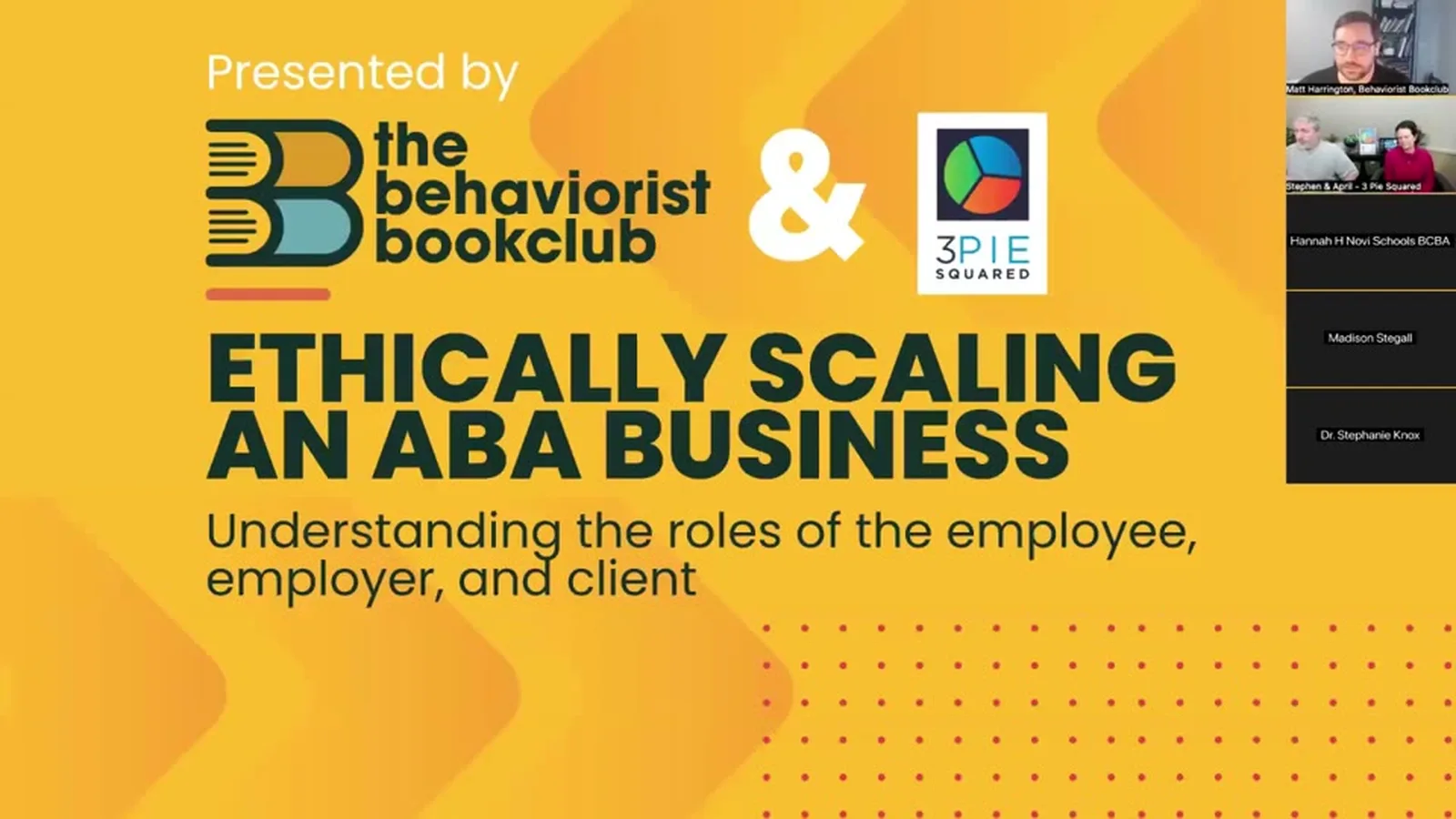
Ethically Scaling an ABA Company
Free learning path on this topic
Your 4 Ethics CEUs, Done
Four ethics CEUs in three courses, all free. Start with Matt Harrington's assent and data course, then ethical guardrails in behavior reduction, then cultural considerations in clinical practice. Every course carries ethics credit, so this path covers the BACB requirement with nothing to buy.
On this page · 8 sections▾
The hiring decision that quietly breaks ethics codes in a growing ABA (Applied Behavior Analysis) company is the one where a Registered Behavior Technician (RBT), the staff member who runs direct therapy sessions, ends up writing treatment plans because a Board Certified Behavior Analyst (BCBA), the master's-level clinician licensed by the Behavior Analyst Certification Board (BACB), costs more. Right next to that decision is the one April from 3 Pie Squared names out loud in the talk: the moment one owner is wearing six hats at once. Safety officer. HIPAA (Health Insurance Portability and Accountability Act) security officer. Clinical director. Operations director. Ethics officer. And quiet admin. None of those hats fit a person who is also carrying a full clinical caseload, and none of them get taken off just because the org chart is small.
This page is the hiring playbook from the CEU. It is for the BCBA owner who is about to hire their second clinician, or their fifth, and wants to do it without breaking the BACB code or the people they bring on.
The hiring decisions that quietly break ethics codes#
Most "how to hire" advice for ABA owners is about pay bands and sourcing. The CEU goes the other way. It treats hiring as an ethics decision because most of the moments where care slips later start with a hiring choice made earlier.
A few of those moments come up again and again. An RBT gets pushed into clinical work because the BCBA is too busy. A new BCBA is hired with a promise the company cannot keep, like a new clinic location near their house, and then they leave a year in. A second BCBA is hired before a second admin person, which means the owner is still answering every scheduling question at ten at night.
Each of those is a normal-looking choice on a normal-looking day. Each of them maps to a code in the BACB Ethics Code for Behavior Analysts. The point of writing this page is not to scare you. It is to give you the same checklist Matt and 3 Pie Squared use when they coach the roughly 1,500 BCBA-owned ABA businesses they advise.
Never push an RBT into BCBA-level work to save money#
Start here because this is the one Matt names first in the talk. Hiring an RBT is good. Asking an RBT to do work that only a BCBA is allowed to do is not. That includes writing the treatment plan, picking the program goals, and making changes to a behavior plan after a session goes sideways.
It is tempting to drift into it. An RBT who is sharp and experienced can sound like they are ready. Their pay rate is a fraction of a BCBA's. The math on the spreadsheet looks great. The math on the BACB code does not. Practicing inside your defined role is not a vibe. It is a written rule.
Practicing within your defined role and not aggressively hiring perhaps an RBT to write treatment plans because they're a little bit cheaper.From the talk — Matt Harrington
Two checks before you let an RBT do anything that lives in the BCBA lane:
- Read the task back out loud. If it ends in "and the BCBA signs it," that is a flag, not a fix. A signature does not move the task into the RBT scope.
- Price the real cost. If your spreadsheet only works when an RBT does a BCBA's job, the business is not ready to take that client. Say no, or hire the BCBA.
The 6 hats every ABA agency has to fill (and when each starts mattering)#
April walks through the org chart that already exists inside every solo owner, even if no one has named it yet. You are wearing all of these hats whether you want to be or not. The question is when each one starts taking real hours.
You're going to be the safety officer, you're going to be the security officer for HIPAA, you're going to be the clinical director, you're going to be the ops director, you're going to be the ethics officer. So, like, it's just knowing that these roles exist and maybe your ethics officer is only a half hour a month right now.From the talk — Matt Harrington
Here is when each hat starts to need a real owner, based on what 3 Pie Squared sees across their client base.
- Clinical director. First. The second you hire another BCBA you are supervising clinical quality, not just doing it.
- Operations director. When you cross about 15 to 20 hours per team per week of admin work. That is one BCBA plus six or seven techs.
- Safety officer. First day a tech gets bitten, or the first time a 150-pound family dog jumps on staff. Pretend that day is day one.
- HIPAA security officer. The day you accept your first insurance contract. You are a healthcare company now, whether you wanted to be one or not.
- Ethics officer. Half an hour a month at the start. Grows fast when you add caregivers, funders, and more BCBAs to supervise.
- Admin and scheduling. Sooner than you think. Scheduling was the last hat April let go of, and it is the one she says cost her the most clinical hours.
If you cannot picture who is wearing each hat next quarter, do not hire the next clinician yet. Hire the hat first.
Write the job ad you would want to receive#
The most common reason BCBAs leave a new job inside a year is that the role they were promised is not the role they got. Matt names the same pattern that shows up with caregivers, where a clinic location "near home" is one or two years away when the family signs up, and points out it happens to staff too.
Typically, it's the caregiver who was promised a new location right near their home when in reality that was one year, two years away and they were just trying to get services started, get that kid started because they were a high hour child and they wanted those hours in the pursuit of quality.From the talk — Matt Harrington
A clean BCBA job ad has four things in it that most ads skip.
- The real caseload size and supervision percentage. Not "competitive caseload." The number.
- The real hours. If your current BCBAs are working 60-hour weeks, do not put 40 in the ad. Say what the busiest month looks like and what the slowest month looks like.
- The real growth plan and the timeline. If you want a second clinic in three years, say three years. Do not say "soon."
- The hat you actually need help with. If you need someone who can also run intake, say so. A BCBA who wants pure clinical will self-select out, and you will save both of you six months.
That is the same standard Matt names in the talk for recruiting in general.
Being truthful as a scaling business about what the priorities are and how you're recruiting staff and those practices.From the talk — Matt Harrington
What to tell a new BCBA in their first week#
New hires walk in with one giant question: what is going to make me successful here. Answer it on day one with three numbers and one promise.
- Your minimum supervision percentage per client. This is the BACB requirement plus whatever your company adds on top. Write it down.
- Your minimum caregiver guidance contact per month. Same thing. Pick a number and stand behind it.
- Your minimum data review cadence. Weekly is fine. Pick one.
The promise is the whistleblower path. If they see something that does not feel right, they need to know exactly where it goes. April and Steven both flag this in the talk. Without an anonymous path, the people closest to the client end up the quietest, and the canary in the coal mine dies before you hear the song.
How to hire your second ops person (not just your fifth BCBA)#
This is the move most BCBA owners skip. They keep hiring the role they know how to hire, which is more BCBAs, and they wonder why the week keeps growing. The talk names it as Mighty Mouse Syndrome, where the owner gets a small dopamine hit every time they save the day, and the system never gets fixed.
Steven's rule of thumb is straight from running 3 Pie Squared. A BCBA plus six or seven techs generates roughly 15 to 20 hours of admin work a week, before you bring billing in-house. If your owner-hours have been north of 60 for three months in a row, the next hire is almost never another BCBA. It is an ops person who can take scheduling, intake calls, and credentialing off your plate.
The cleanest tell that you waited too long is the one April describes from her own scaling. The fires take all your attention, the policies live in your head, and your staff cannot read your mind. The fix is not working harder. The fix is hiring the second seat.
Frequently asked questions#
Can an RBT write a treatment plan if a BCBA signs it? No. A signature does not move the task into the RBT scope. Treatment planning is BCBA-level work under both the BACB code and the RBT task list. If the only way the math on a client works is to push that work down a level, the answer is to price the work correctly or to not take the client yet.
What should I disclose about company growth during a BCBA interview? The real caseload, the real hours in your busiest month, the real supervision percentage, and the real timeline for any growth promise like a new clinic. Matt names the same dynamic with caregivers. The promise "near your home" turns into one or two years, and trust never recovers. Staff feel it the same way.
When should an ABA company hire a dedicated HR person? Most 3 Pie Squared owner-operators bring HR work in-house somewhere around two to three million in revenue. Before that point, the work is usually split between the owner, an ops lead, and a fractional or outsourced HR partner. The trigger is rarely revenue alone. It is the moment hiring, firing, and policy work are eating more than a day a week.
Where to go next#
Hiring ethically is one piece of a larger scaling decision. The other pieces, like productivity quotas, picking quality metrics that catch problems early, and knowing when not to grow at all, sit on the sibling pages below.
Ready to earn the ethics CEU that goes with this talk? Watch "Ethically Scaling an ABA Company" with Matt Harrington and 3 Pie Squared, and pass the quiz to claim your credit.
Turn this topic into a CEU
You just studied this. Now get credit for it.
Watch Ethically Scaling an ABA Company with Matt Harrington and 3 Pie Squared and earn 1 free BCBA CEU. Detailed certificate, delivered the moment you finish.
Keep going with a free learning path
Your 4 Ethics CEUs, Done
Four ethics CEUs in three courses, all free. Start with Matt Harrington's assent and data course, then ethical guardrails in behavior reduction, then cultural considerations in clinical practice. Every course carries ethics credit, so this path covers the BACB requirement with nothing to buy.