Self-Advocacy in ABA: Helping Learners Speak Up
Self-advocacy in ABA means helping learners notice, name, and act on their own needs. See how clinicians teach it and why RBTs need it too.
Key takeaway
Self-advocacy in ABA means a person notices their own needs and limits, then speaks up or acts on them. For autistic clients, that can mean saying "I'm not ready" or "I need more time." It can also mean stepping away when their body feels unsafe.

Navigating Communication with Clinicians
Free learning path on this topic
ADHD for Behavior Analysts
Nicole Stewart's three-part series on ADHD for behavior analysts. Reframe what you are seeing, shape behavior change in a way that fits how ADHD learners learn, then hand over autonomy and self-management. Three hours, three CEUs.
Experts who cover this
3 recordings on openceu cover self-advocacy.
- Featured talk1 PDU
Navigating Communication with Clinicians
Anlara HoskinsCandid Contingencies, LLC
The speaker frames self-advocacy as the central tool RBTs need when navigating disagreements with a supervising BCBA, tying it to the RBT ethics code and to…
- 1 Ethics CEU
Article Club: A Child's Rights Approach to ABA
Pauli Catanese & Jasmine AbdelAchieve Behavior Partners
Clinicians describe deliberately teaching clients to advocate for their own choices and preferences, from choosing a marker color to verbal self-advocacy…
- 1 CEU
What Does Your Body Know? Teaching Individuals with IDD to Recognize Internal Warning Signs`
Tricia LundThe Behaviorist Bookclub
Both presenters frame the ultimate goal of interoceptive safety training as moving learners from rule-following compliance to self-advocacy, where the body's…


On this page · 9 sections▾
Self-advocacy in ABA means a person notices their own needs and limits, then speaks up or acts on them. For autistic clients, that can mean saying "I'm not ready" or "I need more time." It can also mean stepping away when their body feels unsafe.
Self-advocacy is not just a client skill. Staff need it too. Registered Behavior Technicians (RBTs, the front-line staff who run sessions) have to speak up for their own limits. When they do, they are better able to meet their clients' needs. This page covers both sides, drawn from real conference talks.
Self-advocacy starts inside the body#
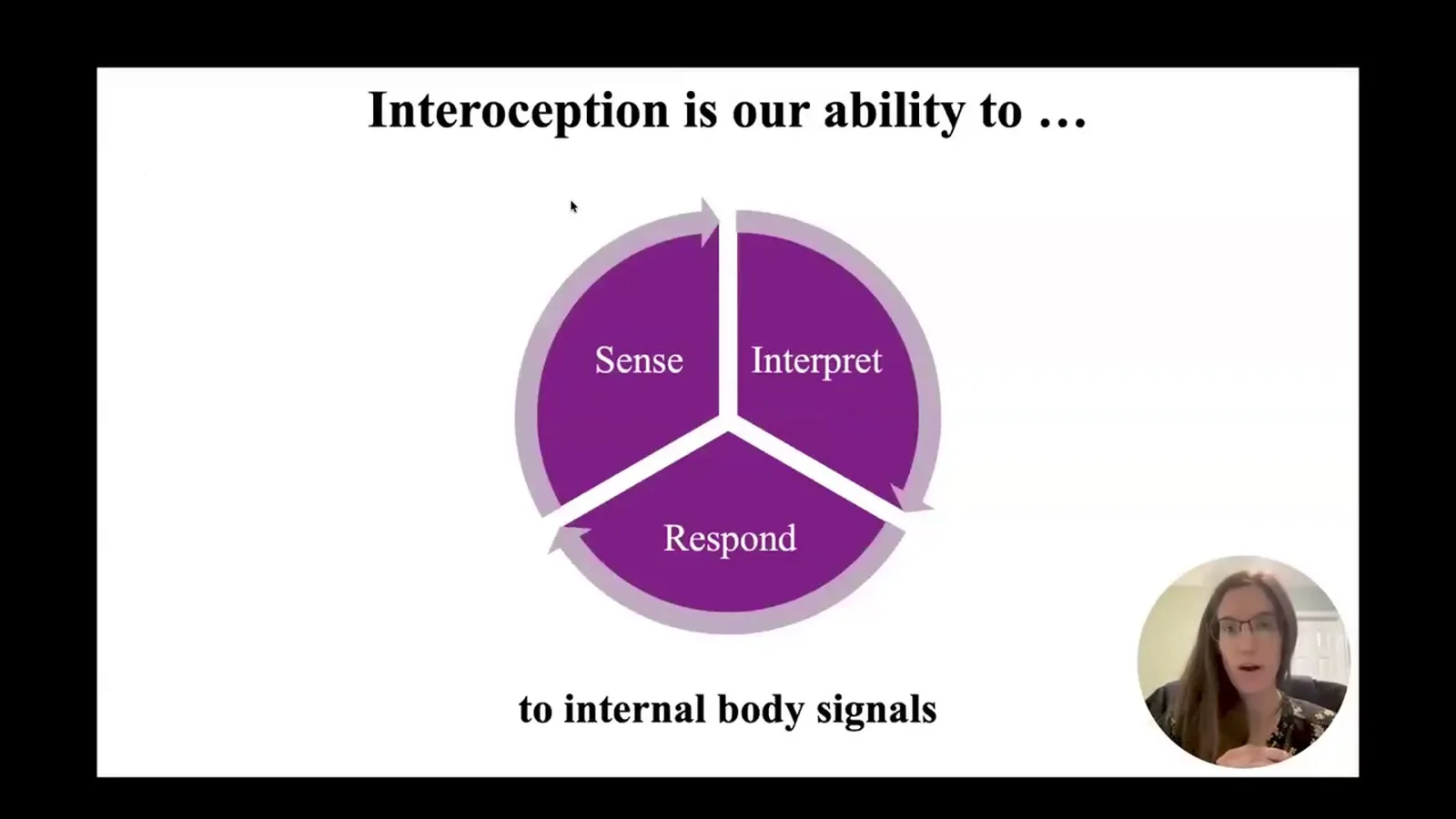
Carolyn, presenting with Tricia Lund on teaching people with intellectual and developmental disabilities (IDD), starts with a simple point. A learner can't speak up about a feeling they don't notice. She ties self-advocacy to interoceptive awareness. That means sensing what is happening inside your own body, like an internal warning sign that makes you want to pull away from someone or something.
If our goal is to move beyond compliance and towards self-advocacy, learners can't simply memorize what to say.
From the talk — Carolyn
Carolyn says learners have to notice, trust, and act on what their bodies tell them. She calls interoceptive awareness a "teachable repertoire." In plain words, it is a set of skills you can build with practice. Learners get repeated chances to spot a signal, give it a name, trust it, and respond.
She also uses the term "private events." These are internal states only the learner can feel. Carolyn says we should teach learners to detect and "tact" these events early. To tact means to label something out loud. Naming a feeling early gives the learner time to act before things get worse.
Why "non-compliance" might be a warning sign#
Many learners show small changes before they get upset. They might pull away, go quiet, or start fewer social interactions. Carolyn warns against reading these as defiance. She says these behaviors "should not automatically be interpreted as non-compliance, avoidance, or maladaptive behavior."
Instead, she frames them as early outside signs of something felt inside. From a behavior analytic view, they may show a shift in motivating operations. That term means a change in how much something matters to a person right now. When a learner feels unsafe, escape or a trusted adult suddenly matters a lot more.
This matters for clients who have spent years in compliance-focused teaching. Carolyn notes that for neurodivergent and trauma-exposed learners, body signals "may be present but not yet discriminated, trusted, or acted upon." If adults notice and validate these signs, they can step in early. They can also reinforce early boundary setting, so the learner learns that speaking up works.
The goal is not simply to teach learners how to say no. The goal is to help them know when their bodies are telling them that they need to do so.
From the talk — Carolyn
When a learner says yes but means no#
Pauli Catanese and Jasmine Abdel explore the same problem from a session-room angle. In their Article Club talk, one speaker describes kids who have been in ABA for a while. These kids may say "yes" to a task. But their body shows they are distracted or don't want to do it.
The speaker says you need to watch closely for that gap. Then you can teach the child how to say what they really mean. She teaches self-advocacy statements for this. One example she uses with a client is: "You're telling me yes, but you're showing me no."
From there, she offers the child simple scripts. The child can say "I'm not ready," "I need more time," or "I want to talk about something else." These short phrases give a learner real words for a real feeling. That links closely to Carolyn's point. A learner first notices the signal, then has a phrase ready to use.
Choice and consent in everyday sessions#
The Article Club speakers also tie self-advocacy to small choices. One speaker describes giving a client a say in what to work on and when. She might ask, "Do you wanna answer questions or do you wanna practice your reading comprehension?" The child gets to tell her what he is ready to do.
They also suggest simple check-in questions before work starts. Examples include "Are you ready to do learning?" and "Do you need more time?" Sometimes body language shows a child is not ready, even before they say so.
You're acknowledging that and helping them advocate for themselves.
From the talk — Pauli Catanese & Jasmine Abdel
The speakers connect this to how staff use physical contact. They ask whether a physical prompt is truly needed, and whether staff explain why they use it. One speaker notes that her own family culture is very physical. That makes it extra important to pause and check habits. Their full discussion is in Article Club: A Child's Rights Approach to ABA. It frames these ideas as part of a child's rights.
Self-advocacy for RBTs, too#
Anlara Hoskins brings the topic to the staff side. Her talk focuses on how RBTs can handle hard conversations with their supervising BCBA (Board Certified Behavior Analyst, the clinician who writes and oversees the treatment plan). She points to code 1.02 of the RBT Ethics Code, released in 2021. That code covers professional conduct, and it names self-advocacy directly.
Hoskins says some RBTs feel trapped in the BCBA and RBT relationship. They forget they have a powerful voice. She reminds them that their certification is on the line under the ethics code, just like a BCBA's is.
And the RBT ethics code encourages you to self-advocate to meet your needs so that you can meet your clients needs.
From the talk — Anlara Hoskins
She lists self-advocacy first among her key takeaways from the code. The others are open communication, staying professional, working under good supervision, and running procedures as written. Code 1.03 says RBTs should follow the treatment plan and not change it on their own. Hoskins explains that this protects the RBT. Changes outside the plan can skew the data and make a sound plan look like it fails.
To follow a plan well, an RBT has to understand it. That means they must feel safe asking their supervisor questions. So self-advocacy supports good treatment, not just staff comfort.
Knowing your limits before the hard talk#
Hoskins says self-advocacy starts with self-reflection. Before speaking up, you need to know where your own lines are.
It's really important that you know your limits, know your boundaries, know when you're just not in a position to be able to have a hard conversation right now.
From the talk — Anlara Hoskins
She suggests RBTs ask themselves two kinds of questions. Is this just not the right time for me to talk? Or is this a boundary I truly cannot cross? Knowing the answer helps you speak up in a clear, calm way.
Her next step is building rapport with your supervisor. Rapport means a working bond built on trust. Most staff already know to build rapport with a new client. Hoskins applies the same idea to the people you work with. Trust makes it easier to raise concerns later.
What ties client and staff self-advocacy together#
At first, these talks seem to cover two different groups. Carolyn and the Article Club speakers focus on learners. Hoskins focuses on RBTs. But the same pattern shows up in each one.
First, a person has to notice their own state. For a learner, that might be a body signal. For an RBT, it might be a limit or a boundary. Second, the person needs words or actions ready to use. Learners get scripts like "I need more time." RBTs get the ethics code as backing for their voice.
Third, someone else has to listen and respond. Carolyn asks clinicians to validate early signs and reinforce boundary setting. The Article Club speakers ask staff to watch for "yes" that means "no." Hoskins asks RBTs and BCBAs to keep communication open. In every case, self-advocacy only grows when it works for the person using it.
What the research says#
Research outside these talks supports a shift toward affirming practice in ABA. One paper calls on behavior analysts to affirm neurodiversity in their work (Mathur, Renz, & Tarbox, 2024). Neurodiversity is the idea that brain differences are natural, not defects. That view fits with teaching learners to voice their needs rather than just comply.
The full reference is: Mathur, S. K., Renz, E., & Tarbox, J. (2024). Affirming neurodiversity within applied behavior analysis. Behavior Analysis in Practice, 17, 471–485.
Self-advocacy is also studied well beyond ABA clinics. Researchers have looked at self-advocacy services for people with IDD across the country. Others have asked young adults with IDD how they practice self-advocacy during the move to adulthood. Still others have studied health self-advocacy training for people with intellectual disabilities. Together, these lines of work show self-advocacy as a skill people use across school, health care, and daily life.
FAQ#
What is self-advocacy in ABA? It is a person noticing their own needs or limits and then speaking up or acting on them. In ABA, it applies to both clients and staff.
How do you teach self-advocacy to autistic learners? Start by helping them notice body signals and name them. Then teach short phrases like "I'm not ready" or "I need more time." Offer real choices, and honor those choices when the learner uses them.
Why do RBTs need self-advocacy skills? The RBT Ethics Code encourages RBTs to self-advocate so they can meet their clients' needs. Speaking up helps RBTs understand plans, ask questions, and set clear boundaries with supervisors.
Turn this topic into a CEU
You just studied this. Now get credit for it.
Watch Navigating Communication with Clinicians with Anlara Hoskins, MA, BCBA, LBA and earn 1 free BCBA CEU. Detailed certificate, delivered the moment you finish.
Keep going with a free learning path
ADHD for Behavior Analysts
Nicole Stewart's three-part series on ADHD for behavior analysts. Reframe what you are seeing, shape behavior change in a way that fits how ADHD learners learn, then hand over autonomy and self-management. Three hours, three CEUs.