MTSS Coaching for School BCBAs: How to Read Tier 1 Before Touching Tier 3
School BCBAs: audit Tier 1 routines, expectations, and praise ratios before writing a BIP, from a BCBA-led CEU.
Key takeaway
If you are a school BCBA, this is the diagnostic workflow for sizing up Tier 1 health before you touch a Tier 3 plan: count whether 16 of 20 students meet the stated expectation, count the 5:1 praise to correction ratio, count opportunities to respond (OTRs) in a 15 minute observation, and translate it all through the PBIS Classroom Assistance Tool.
Practical Takeaways for School-Based Behavior Analysts
Free learning path on this topic
Supervision, Done Right
Four supervision CEUs that build on each other. What reflective supervision is, how to build a supervision system, how to assess supervisee competence instead of counting hours, and how supervision affects provider outcomes. The BACB asks supervisors for three supervision CEUs per cycle. This covers it.
On this page · 10 sections▾
If you are a school BCBA, this is the diagnostic workflow for sizing up Tier 1 health before you touch a Tier 3 plan: count whether 16 of 20 students meet the stated expectation, count the 5:1 praise to correction ratio, count opportunities to respond (OTRs) in a 15 minute observation, and translate it all through the PBIS Classroom Assistance Tool. That sequence is what separates an MTSS-aligned consult from a superhero rescue that fails inside two weeks. The rest of this guide is how to run that sequence, what to write down, and how to bring it back to admin without sounding like you are grading the teacher.
MTSS in plain language for the school BCBA#
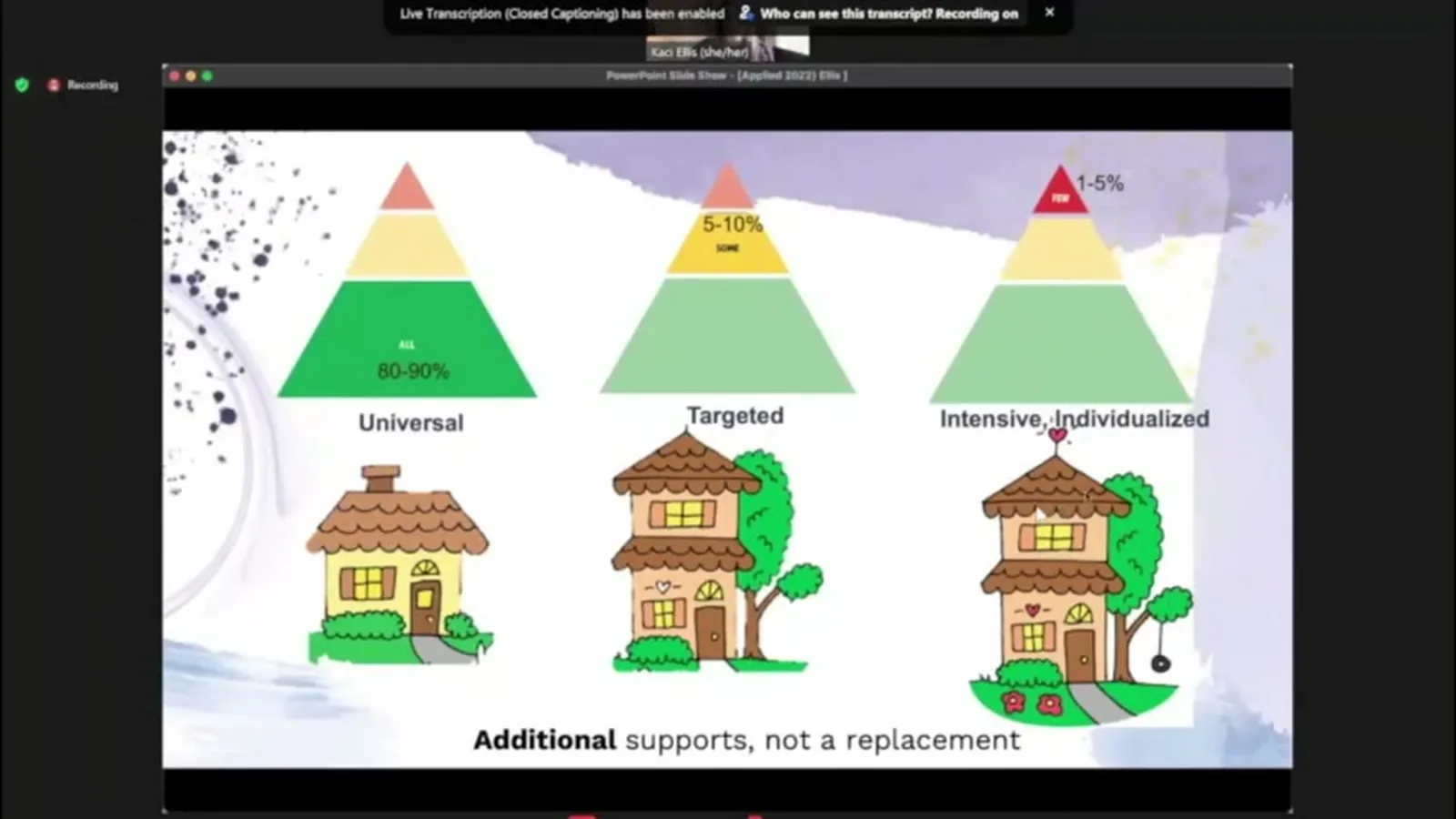
MTSS stands for Multi-Tiered System of Supports. It is the umbrella. PBIS, Positive Behavior Interventions and Supports, is the behavior framework that lives inside that umbrella. RTI, Response to Intervention, is the academic cousin. All three use the same shape: a universal Tier 1 layer for every kid, a targeted Tier 2 layer for the 5 to 10 percent who need a boost, and an intensive Tier 3 layer for the 1 to 5 percent who need individualized planning.
The job of the school BCBA inside MTSS is not to write a plan for every referral that lands on your desk. It is to figure out which tier is actually broken, because a Tier 3 BIP cannot fix a Tier 1 problem. As Dr. Ellis puts it:
If our foundation is broken, then we cannot adequately say that a student needs tier two or tier three supports.
That single sentence reorders your workflow. Before the BIP, before the FBA, before the team meeting, your first move is a Tier 1 audit.
The 16-of-20 rule: is Tier 1 actually working?#
The cleanest signal that Tier 1 is in place is whether the rest of the classroom is following the rule you want this one student to follow. Walk in, scan the room, and count.
If 16 or more students meet the expectation, that's an indicator that we believe tier one is effective.
That is 80 percent of a 20-student room. If only 12 of 20 are seated, only 10 of 20 are tracking the speaker, only 14 of 20 raise their hands before calling out, then Tier 1 is not stable. The referred student is not the outlier. The classroom is.
This matters for two reasons. First, it stops you from writing a token economy for one kid when the whole room needs the same prompt. Second, it gives you a concrete number to bring back to admin without grading anyone. "Sixteen of twenty" is data. "The classroom felt chaotic" is a vibe, and vibes do not survive an IEP meeting.
What to count in a 15-minute observation#
Fifteen minutes is enough if you know what you are counting. Walk in with a simple tally sheet and track five things at the classroom level:
- Expectations stated. How many times in 15 minutes did the teacher state, prompt, or re-teach a behavior expectation? "We are walking quietly to centers" counts. "Sit down" does not.
- Opportunities to respond (OTRs). Every choral response, every cold call, every turn-and-talk, every dry-erase board check. Count them.
- Behavior-specific praise statements. "Thank you for raising your hand, Marcus" counts. A generic "good job" does not.
- Negative or corrective statements. "No." "Stop." "Sit down." Count them honestly.
- Peer behavior. Of the 20 kids in the room, how many are doing what was asked at minute 5, minute 10, minute 15?
You do not write a single recommendation about the referred student yet. You bring back numbers. The narrative comes from the spread between praise and correction, and from the OTR count against the chaos count.
The 5:1 positive-to-negative ratio (and what real classrooms look like)#
The research-supported rule is five positive statements to every one negative statement at the classroom level. Real classrooms are nowhere near it. Dr. Ellis describes a kindergarten observation where she counted "35 on average, negative feedback statements, three behavior specific pre-statements" in 15 minutes. That is roughly 12 to 1 in the wrong direction. No BIP fixes a kindergartner whose adult is correcting them every 25 seconds.
When you write the observation note, put the ratio in plain text. "I counted 35 corrective statements and 3 behavior-specific praise statements during a 15-minute window" is something an administrator can read and act on. It does not blame the teacher. It does not need to. The number does the work.
If the ratio is upside down, that is your Tier 1 finding. Tier 1 is broken at the classroom level. You do not need an FBA to know what to do next, and you almost certainly do not need a Tier 3 plan for the referred student.
Opportunities to respond: the cheapest Tier 1 intervention#
OTRs are the highest leverage Tier 1 lever for a school BCBA because they cost nothing and the research is unambiguous.
Increased opportunities to respond decrease those inappropriate behaviors.
A student who is responding cannot also be off task. A teacher delivering 15 minutes of direct instruction with zero OTRs is functionally guaranteeing off-task behavior. When you write up the observation, count the OTRs and state the rate. "Zero opportunities to respond in 15 minutes of direct instruction" is a finding any admin will recognize.
OTRs scale across formats: choral response, response cards, dry-erase boards, partner talks, hand signals, thumbs up or thumbs down. They do not require new curriculum, new tokens, or new staff. They require the teacher to pause the monologue and ask. That is a coaching note, not a behavior plan.
Using the PBIS Classroom Assistance Tool to drive conversations#
Once you have the 15-minute count, you need a structure to bring it back. The PBIS Classroom Assistance Tool gives you that structure for free.
The classroom assistance tool... It's an Excel spreadsheet... breaks down across three factors and it asks questions.
The tool lives on pbis.org. It walks through routines, expectations, OTRs, praise, classwide reinforcement, and response to misbehavior. Each item is rated "in place," "somewhat in place," or "not in place." You do not have to score it for the teacher. You can share the tool, fill out the items you observed, and ask the teacher to self-rate the rest. That is the inquiry stance. You are giving the teacher the rubric, not grading them against it.
The Classroom Assistance Tool also gives you a defensible artifact for the IEP team. When admin says "this kid needs a Tier 3 plan," you can point to specific items on the tool that scored "not in place" at Tier 1 and say the foundation is the right place to start.
Bringing data back to admin without sounding evaluative#
The trap for new school BCBAs is showing up with a Tier 1 finding and accidentally indicting the teacher. The way out is to lead with the student, lead with curiosity, and lead with the number.
A script that works: "I sat in for 15 minutes. I counted 16 of 20 students following the stated expectation. For the referred student, I counted 4 opportunities to respond and 1 behavior-specific praise statement. Before I recommend Tier 3 supports, I want to bring back what I saw at the classroom level. I'm not sure Tier 1 is fully in place yet, and that changes what plan would actually stick."
That script does three things. It uses the 16-of-20 rule as the entry point. It quantifies the experience of the referred student. It names the tier mismatch without naming the teacher. The administrator can act on it because the data is countable.
If the room flips and admin pushes back, the question to ask is the one Dr. Ellis recommends: how many students in this classroom do you think are meeting expectations today? The answer either confirms Tier 1 is healthy and the referral makes sense, or it surfaces that nobody actually believes Tier 1 is in place. Either answer moves the conversation forward.
Putting the workflow together#
A clean MTSS consult for a school BCBA looks like this:
- Pre-meeting first. IEP status, consent, restraint policy, what the team has already tried.
- 15-minute observation second. Tally expectations stated, OTRs, praise, corrections, and peer behavior.
- Apply the 16-of-20 rule. If fewer than 16 of 20 students are meeting the expectation, your finding is Tier 1, not Tier 3.
- Check the 5:1 ratio. If praise to correction is inverted, your finding is Tier 1.
- Score the relevant PBIS Classroom Assistance Tool items. Bring the tool, not a verdict.
- Debrief admin with numbers, not adjectives. Recommend the lowest tier that the data supports.
That sequence keeps you out of the superhero seat and inside your scope. It also produces the only outcome that actually moves student behavior: interventions matched to the tier that is broken.
FAQ#
What is MTSS and how is it different from PBIS?
MTSS is the umbrella system that organizes academic and behavioral supports into three tiers. PBIS is the behavior framework that sits inside MTSS. RTI is the academic framework that sits inside MTSS. A school can implement PBIS as its Tier 1 behavior layer without using the MTSS label, but the structure is the same: universal, targeted, intensive.
How do I check if Tier 1 is in place during an observation?
Walk in for 15 minutes and count. Are 3 to 5 school-wide expectations posted and being taught? Did the teacher state at least one expectation during your window? Are 16 of 20 students following it? Did you hear behavior-specific praise? Did you count any opportunities to respond? If two or more of those answers are no, Tier 1 is not stable.
What's the 5 to 1 praise ratio rule?
The research-supported ratio is five positive statements to every one negative or corrective statement at the classroom level. Behavior-specific praise counts (it names the behavior). Generic praise like "good job" does not count as strongly. Track both sides for 15 minutes and the ratio surfaces quickly.
What should I count during a classroom observation?
Five things: expectations stated by the teacher, opportunities to respond, behavior-specific praise statements, negative or corrective statements, and the percentage of peers following the stated expectation. Bring a tally sheet. Numbers travel better than narratives.
What if admin says the kid needs Tier 3 but Tier 1 is broken?
Bring the numbers and the PBIS Classroom Assistance Tool. Ask how many of the 20 students in the room admin believes are meeting expectations. Recommend classroom-level Tier 1 supports first, with a follow-up observation in two to three weeks. A Tier 3 BIP written on top of a broken Tier 1 will not be implemented with fidelity, and the BCBA owns that outcome.
Watch the full session#
Dr. Kaci Ellis walks through the full MTSS workflow, the survey data on how teachers actually perceive BCBAs in schools, and the language she uses to keep conversations on the inquiry side instead of the evaluative side.
Turn this topic into a CEU
You just studied this. Now get credit for it.
Watch Practical Takeaways for School-Based Behavior Analysts with Dr. Kaci Ellis and earn 1 free BCBA CEU. Detailed certificate, delivered the moment you finish.
Keep going with a free learning path
Supervision, Done Right
Four supervision CEUs that build on each other. What reflective supervision is, how to build a supervision system, how to assess supervisee competence instead of counting hours, and how supervision affects provider outcomes. The BACB asks supervisors for three supervision CEUs per cycle. This covers it.