Prosocial Framework for ABA Workplaces: A BCBA Guide
Apply the Prosocial framework to your ABA team. Three sciences, eight design principles, real workplace shifts, from a BCBA-led CEU.
Key takeaway
The Prosocial framework comes from the 2019 book by David Sloan Wilson, Paul Atkins, and Steve Hayes, and it sits at the meeting point of three sciences: conscious (contextual behavioral science), cultural (Elinor Ostrom's group design work), and evolution (multilevel selection theory).
Prosocial in the Workplace
Free learning path on this topic
Supervision, Done Right
Four supervision CEUs that build on each other. What reflective supervision is, how to build a supervision system, how to assess supervisee competence instead of counting hours, and how supervision affects provider outcomes. The BACB asks supervisors for three supervision CEUs per cycle. This covers it.
On this page · 7 sections▾
The Prosocial framework comes from the 2019 book by David Sloan Wilson, Paul Atkins, and Steve Hayes, and it sits at the meeting point of three sciences: conscious (contextual behavioral science), cultural (Elinor Ostrom's group design work), and evolution (multilevel selection theory). For a BCBA who runs a team, that mix matters. It gives you a way to look at supervision, staff meetings, and clinic culture that goes deeper than "have an agenda and follow up." It treats your team as a group of groups, and it gives you tools to help that group cooperate on purpose.
Jason Stauffer, a BCBA practicing in Hawaii, walked through this in a free CEU hosted by the Behaviorist Book Club. The talk is dense in the best way. This page pulls out the core ideas so a busy BCBA can decide if Prosocial is worth a deeper look. If it is, the watch link below is the whole talk, in his words.
What Prosocial Actually Is (Beyond the Buzzword)#
Prosocial is a framework for helping groups work together better. It is not a single technique. It is a synthesis of behavior science, group design rules, and evolutionary theory, applied to the everyday problem of "why is my team not clicking?"
Stauffer is clear that he is the messenger, not the author of the ideas. He points listeners to the book.
All of the material in this presentation comes from this book, Prosocial, by David Sloan Wilson, Paul Atkins, and Steve Hayes, published in 2019. From the talk — Jason Stauffer
The short version of the framework is three words.
One way to sum up the idea of Prosocial is three words, conscious, cultural, evolution. From the talk — Jason Stauffer
That phrase sounds vague until you unpack it. Each word points to a real body of research. Together they tell you why groups break down and how to design them so they don't.
For an ABA workplace, the goal is simple. You want a clinic where BCBAs, RBTs, families, and admin pull in the same direction. Prosocial gives you a map for getting there that is built on the same selection-by-consequences logic you already use with clients.
The Three Sciences That Built It: Conscious, Cultural, Evolution#
The "conscious" part is contextual behavioral science. This is the work of Steve Hayes, Kelly Wilson, and others starting in the 1980s. It gave us relational frame theory and acceptance and commitment training (ACT). The big idea for teams is psychological flexibility. People can notice the thoughts and feelings they have at work, and still act in line with what they care about.
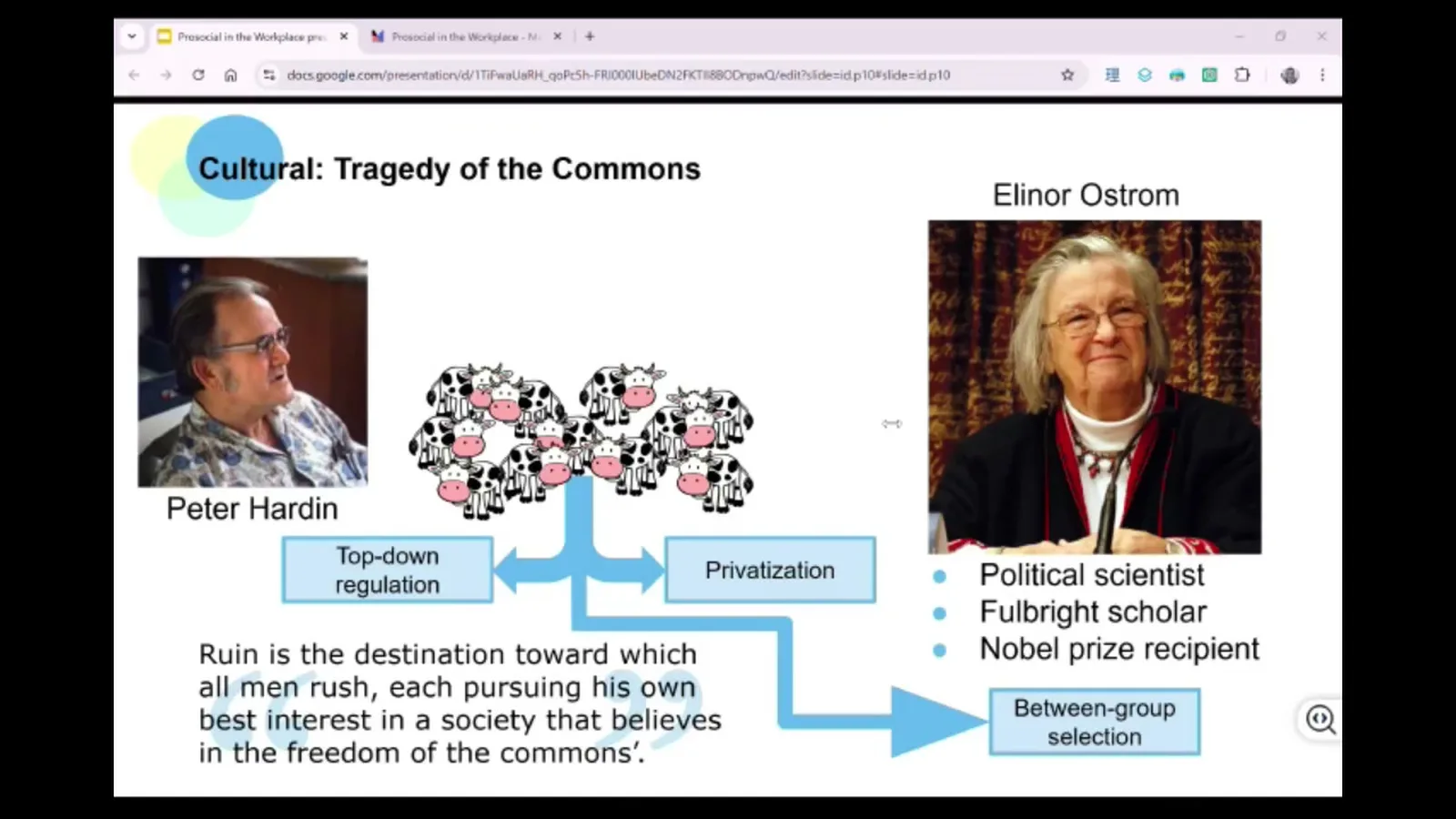
The "cultural" part is the work of Elinor Ostrom, a political scientist who won the Nobel Prize in 2009. She studied how real communities, like fishing villages in Turkey and farmers in Nepal, manage shared resources without falling apart. She found eight core design principles that successful groups use over and over. Prosocial adapts those eight principles for any group, not just ones sharing a pasture.
The "evolution" part is multilevel selection theory, from biologist David Sloan Wilson. The short form is that selection happens at more than one level at once. Selfish behavior can win inside a group while group-versus-group selection rewards cooperation. Stauffer uses the famous "super chicken" study to make this stick. When you breed the most productive individual hens, productivity drops, because the top layers were bullies. When you breed the most productive groups of hens, productivity climbs.
The Prosocial project sits at the intersection of these three lines of scientific research. From the talk — Jason Stauffer
Put the three together and you get a working theory of why teams thrive or fall apart.
This combination creates a powerful synthesis leading to increased collaboration productivity and equity in groups. From the talk — Jason Stauffer
Why ABA Workplaces Are a Perfect Fit for This Framework#
ABA leans on selection by consequences for client work. Prosocial extends the same logic to staff. That is a natural fit for any BCBA running supervision, a clinic, or a school team.
A few reasons it lands well in our field.
We already think in terms of behavior, antecedents, and consequences. Prosocial adds rules, stories, and group identity on top, but the base is familiar. Operant selection is in the foundation of the model.
We supervise in groups. RBTs report to BCBAs. BCBAs report to clinical directors. Clinical directors talk to owners, funders, and licensing boards. That is a stack of nested groups. Multilevel selection theory is built for that exact picture.
We care about ethics and long-term sustainability. The eight design principles speak directly to fair contributions, fair decision making, and conflict resolution. Those are the same issues that show up in BACB ethics consults every week.
We see burnout. Stauffer points to learned helplessness in supervisees who came from rough supervision before. Prosocial gives you a structured way to rebuild trust, shared purpose, and autonomy on a team that has been beat up.
If your team has the right values written on a wall and the wrong dynamics in the break room, the framework gives you names for what is going wrong and a path back.
How a BCBA Supervisor Can Start Using Prosocial This Week#
You do not have to overhaul your clinic to get value from this. Stauffer suggests starting with one group. Pick a team you supervise or sit inside. Write the name down. Then walk through the principles one at a time and ask honest questions.
A few starter moves that map to the eight core design principles.
Principle 1 is shared identity and purpose. In your next team meeting, ask the group, "What is this team actually for, in your own words?" Listen for overlap and gaps. If people answer five different things, you have your first project.
Principle 7 is the right to self-govern. Look at the decisions your team makes. Which ones do they actually own? Which ones get overridden by people who are not in the room? Stauffer flags this as a common pain point for supervisees who learned to wait for orders.
Principle 3 is fair and inclusive decision making. Run one small choice through a "nothing about us without us" filter. A schedule change, a new data sheet, a parent-training script. See what shifts.
You do not need ACT certification to do this. You do not need a curriculum. You need a clear group, an honest read on how it is functioning, and the willingness to keep showing up. Stauffer says it plainly. Read the book. Apply the principles to yourself first. Then bring them to the team.
If you want to go deeper on the eight principles, the Ostrom's 8 Core Design Principles for ABA Teams page breaks each one down for a clinic context. If you want to focus on the values side first, Values-Based Team Meetings for BCBA Supervisors gives you a meeting structure.
What Prosocial Is Not (Common Misreads to Avoid)#
A few myths about this framework come up fast, and they are worth heading off.
Prosocial is not a hive mind. Stauffer says so directly. The model uses ants and bees as examples of deep cooperation, but the goal is human teams with shared purpose, not loss of self. Autonomy is principle 7 for a reason.
Prosocial is not the same as performance feedback or behavior skills training. BST and OBM are great tools. They focus on building specific skills and clean contingencies. Prosocial sits one layer up. It asks how the group itself is designed, what stories it tells about its members, and how it handles conflict.
Prosocial is not soft. It includes graduated sanctions and conflict resolution as core principles. Cooperation does not mean avoiding hard conversations. It means having a system for them so they do not blow up the team.
Prosocial is not anti-research. It is built on decades of empirical work, from Ostrom's field studies to relational frame theory experiments. Mark Dixon and Jonathan Tarbox are bringing Prosocial assessments and curricula into ABA right now. The field is catching up.
If your team needs structure to cooperate, the framework gives you one. If your team already cooperates well, the framework gives you language to protect that.
FAQ#
What is the Prosocial framework in plain language? It is a way to design a group so the people in it cooperate on purpose. It pulls from behavior science, group design research, and evolution to give you eight principles and a set of skills (acceptance, values, awareness, action) for using them.
Who created the Prosocial model and where can I read it? David Sloan Wilson, Paul Atkins, and Steve Hayes wrote the 2019 book Prosocial: Using Evolutionary Science to Build Productive, Equitable, and Collaborative Groups. Stauffer also recommends Steve Hayes's A Liberated Mind for the ACT side.
How is Prosocial different from regular ABA team training? Standard ABA training, like BST, focuses on teaching specific skills with feedback. Prosocial sits at the group level. It asks how the team is designed, what shared values guide it, and how members handle conflict and decisions.
Do I need ACT experience to use Prosocial with my team? No. Stauffer recommends you start by reading the book and trying the ideas on your own life first. ACT principles support the framework but you can begin with the eight core design principles and a clear sense of group purpose.
Is Prosocial supported by behavior analytic research? Yes, and the support is growing. The framework draws on operant selection and relational frame theory. Mark Dixon's team is releasing a Prosocial assessment and curriculum, and Jonathan Tarbox is developing Prosocial resources for behavior analysts.
Watch the Full CEU#
Stauffer's talk goes much deeper than this page can. He works through the super chicken study, the tragedy of the commons, Ostrom's field work across four continents, and the six processes of psychological flexibility. He also takes audience questions on supervising staff who arrive feeling stuck.
If you supervise a team and want a framework that takes the work seriously, this CEU is a strong place to start. Watch it free on openceu.com and decide for yourself if Prosocial belongs in your practice.
Turn this topic into a CEU
You just studied this. Now get credit for it.
Watch Prosocial in the Workplace with Jason Stauffer and earn 1 free BCBA CEU. Detailed certificate, delivered the moment you finish.
Keep going with a free learning path
Supervision, Done Right
Four supervision CEUs that build on each other. What reflective supervision is, how to build a supervision system, how to assess supervisee competence instead of counting hours, and how supervision affects provider outcomes. The BACB asks supervisors for three supervision CEUs per cycle. This covers it.