Gagne's Nine Events of Instruction for ABA Staff Training
How Gagne's nine events of instruction map onto BST and make ABA staff training stick, from a BCBA-led CEU.
Key takeaway
Gagne's nine events of instruction map almost one-to-one onto the steps of BST, with one small recall-prompt tweak that makes the learning actually stick. If you already run behavioral skills training with your RBTs, you are most of the way there.
Design Smarter: Using Instructional Design to Improve Staff and Stakeholder Training
Free learning path on this topic
Supervision, Done Right
Four supervision CEUs that build on each other. What reflective supervision is, how to build a supervision system, how to assess supervisee competence instead of counting hours, and how supervision affects provider outcomes. The BACB asks supervisors for three supervision CEUs per cycle. This covers it.
On this page · 10 sections▾
Gagne's nine events of instruction map almost one-to-one onto the steps of BST, with one small recall-prompt tweak that makes the learning actually stick. If you already run behavioral skills training with your RBTs, you are most of the way there. You just need a few extra moves at the front and the back of the session, plus one swap in how you connect new content to old.
This page is the bridge between two worlds that already overlap. BCBAs know BST. Instructional designers know Gagne. Putting them side by side gives you a fuller checklist for any 45-minute staff training, and it gives you one concrete change you can make in tomorrow's team meeting.
What Gagne's nine events of instruction are#
Robert Gagne laid out nine moves a teacher should make, in order, to get a learner from "never heard of this" to "can do it back at work next week." The list goes: gain attention, share the objective, prompt recall of prior learning, present the content, provide learning guidance, elicit performance, give feedback, assess performance, and enhance retention and transfer.
It looks like a long checklist. In practice, it is closer to a sequence that any good supervisor already drifts through without naming it. The value of having the named list is that you can spot the events you skip on autopilot, and you can shore those up on purpose.
Why Gagne's pairs cleanly with BST#
BST is four steps: instruction, modeling, rehearsal, feedback. Gagne's is nine. The middle of Gagne's is BST. The front and the back of Gagne's are the parts BCBAs tend to skip because the four-step shorthand does not name them.
A lot of instructional design, even outside of the field of behavior analysis is very behavioral in nature. So whether it's Gagne's nine events or Merrill's first principles, there are a lot of different theories that you could pull from. It can help you to unpack and layer on to some of the processes you're already doing like BST.
Read that as a stack, not a swap. You keep BST. You add the attention grab, the objective, the recall prompt, and the transfer plan around it. The training gets longer by a few minutes and a lot stickier.
Events 1 to 3: attention, objectives, recall of prior learning#
The first three events run at the top of your meeting. They take maybe five minutes combined.
Event 1, gain attention, is anything that pulls eyes up. A bad session note on a slide. A short clip. A question. The point is to make the brain alert before content lands.
Event 2, share the objective, is not a formal learning objective slide. It is one sentence in plain language.
Gaining the learner's attention, informing the learners of the objectives. That doesn't need to look like the actual formal list. This can look more like today we're going to be talking about data collection, today you're going to learn how to collect accurate data, simulate recall of prior learning and drawing connections to their past experiences. So instruction is more meaningful and can stick better when you make connections to existing knowledge.
Event 3 is the one most BCBAs leave on the floor. Prompt recall of prior learning. Instead of re-teaching what you taught last month, ask the team to retrieve it. "Before we get into this, what do you remember about prompting?" Then wait.
That single swap is the instructional design move that pays back the most for the least effort. Retrieval beats re-presentation every time.
Events 4 to 5: presenting content and learning guidance#
Event 4 is where most BCBAs already live. You present the content. Slides, talk track, a job aid handout. Useful additions from the instructional design side: show information in more than one channel (visual plus spoken), and keep it tight enough that someone can actually act on it.
Event 5 is the one that gets misread. Learning guidance is not the same as presenting content. It is the part where you start staging the move from this room to a real session.
Providing learning guidance is a little bit different from presenting content. That is where you're starting to already think about generalization and bridging to how that person is going to use it. This can look like talking about examples or non-examples. It could look like talking through common pitfalls that someone might experience when they're doing this.
Translation: this is where you walk through worked examples, show non-examples ("here is what a bad version of this looks like"), and call out the spots people usually trip. If you skip this, your trainees can answer questions in the room and still freeze the next morning.
Events 6 to 7: eliciting performance and providing feedback#
Events 6 and 7 are pure BST. You ask the learner to do the skill, then you tell them what worked and what to fix.
In a 45-minute meeting, eliciting performance might be a quick role play, a worked-example audit, or having each RBT write one session note against the checklist. Feedback is the part you already know how to do.
The only quiet upgrade here is to build in time for it. Trainings that run out of clock at slide 30 of 32 skip events 6 and 7. That is where most of the actual learning sits.
Events 8 to 9: assessing performance and enhancing transfer#
Event 8 is performance assessment with a real measure, not a vibe check. Event 9 is the plan for what happens after the meeting ends. In ABA terms, event 9 is generalization.
Eliciting performance is just that role play or rehearsal piece of BST, providing feedback. We all know how to do that. And then we're actually assessing performance with feedback and follow-up. The very last piece is just enhancing retention and transfer. When you see transfer in instructional design, all that means is generalization.
Concretely, event 9 looks like a job aid the RBT carries into session, a self-check rubric for the next two weeks, and a plan for the supervisor to drop in and reinforce. Without it, the training behaves like an antecedent with no consequence in the natural environment, and the data drifts back to baseline.
The recall-prompt tweak: small swap, big payoff#
Here is the highest-leverage change from this CEU. It costs nothing. It changes what your team retains.
One of the most meaningful things that you can do is instead of repeating content, having someone recall content. A super, super simple tweak you can do is to replace that remember and you sharing that content to, okay, before we've talked about the ABCs of behavior, what are those?
That is event 3 in one move. Stop saying "remember, the ABCs are." Start asking "what are the ABCs?" and waiting through the pause. Retrieval practice is one of the most replicated findings in learning science. Your RBTs will hold the content longer, and you will spot the gaps in real time instead of finding them in session notes a month later.
Worked example: Gagne's applied to a 45-minute RBT meeting#
Topic: session notes are vague and missing required elements. Goal: every RBT can write a complete, objective note by the end of next week.
- Event 1 (attention): show a real note that says "client did great." Ask the team what they could tell from it. Wait.
- Event 2 (objective): "Today you will learn how to write objective, complete session notes."
- Event 3 (recall): "Before we get into this, what do you already include in your notes? What is the difference between objective and subjective language?"
- Event 4 (content): walk through the required elements and show examples and non-examples.
- Event 5 (guidance): point out the three places people usually slip (subjective labels, missing prompt level, no next step). Show a worked example fixing each one.
- Event 6 (performance): each RBT writes a note from a short scenario.
- Event 7 (feedback): peer swap and self-check against the rubric. You float and give two specific pieces of feedback per person.
- Event 8 (assessment): score the notes against the rubric on the spot, not a week later.
- Event 9 (transfer): everyone leaves with the checklist clipped to their data sheets, and supervisors review one note per RBT per week for the next two weeks.
That is one staff meeting. The structure is what makes it work.
FAQ#
How is Gagne's nine events different from BST in ABA?
BST is four steps focused on the middle of the training: instruction, modeling, rehearsal, feedback. Gagne's adds five more events around it. You get an explicit attention grab, a stated objective, a recall prompt for prior learning, and a transfer plan for what happens after the room empties. Same DNA, more coverage.
Do I have to use all nine events every training?
No. Use Gagne's as a checklist, not a script. For a 45-minute team meeting, the high-value adds over plain BST are events 1, 2, 3, and 9. Those are the ones BCBAs skip most often, and they are cheap to put back in.
What is enhancing retention and transfer in plain ABA terms?
It is generalization. Event 9 asks how the skill shows up outside the training room. In a staff training, that means job aids, self-check rubrics, supervisor follow-up in real sessions, and a measurement plan for the two or three weeks after the meeting.
Try this in your next staff meeting#
Pick your next training. Before you build the slides, write the nine events on a sheet of paper. Fill in one sentence under each. If you cannot fill in event 3 (recall) or event 9 (transfer), that is the part of the training to design first.
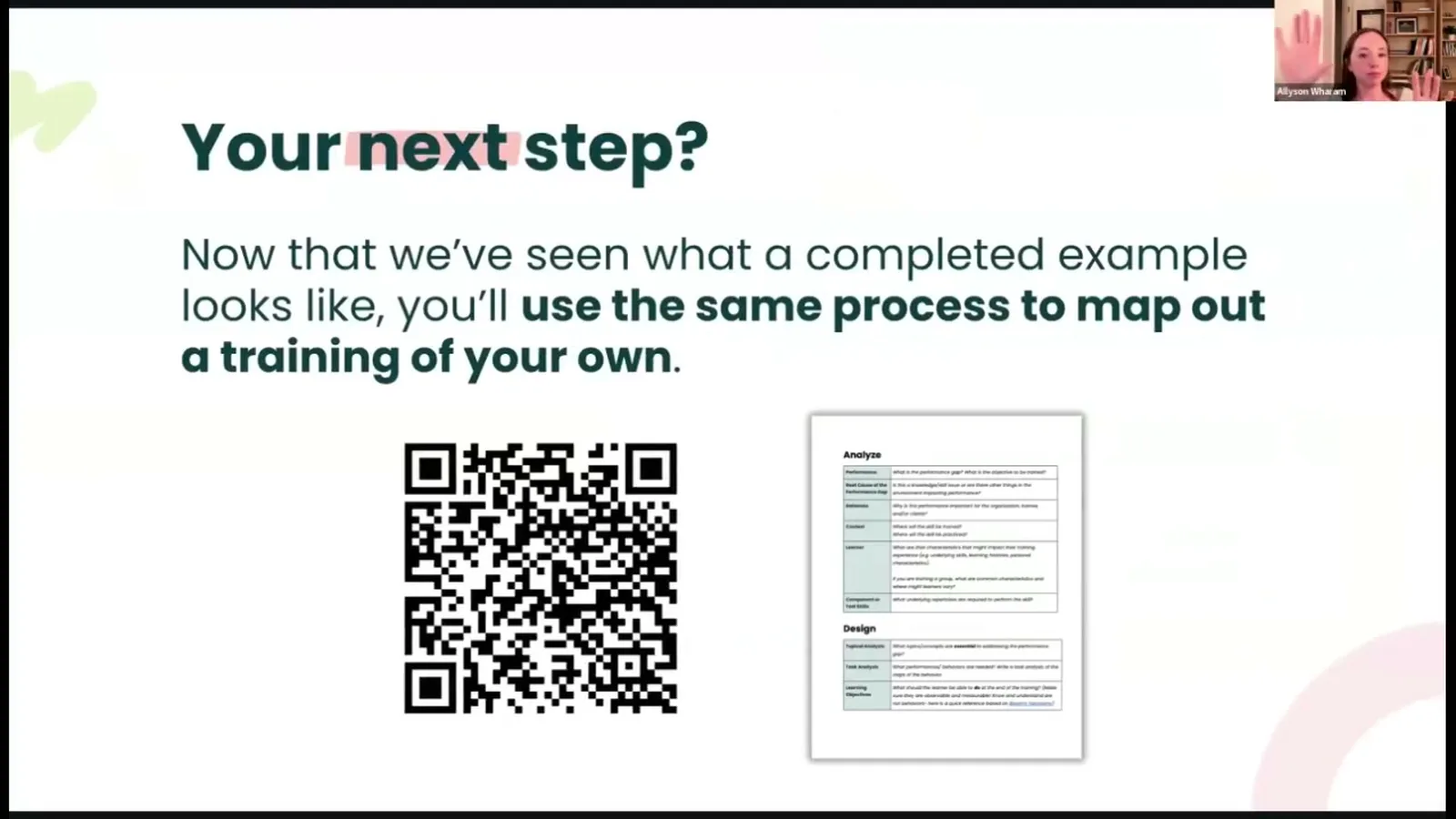
Then watch the full CEU below. Ally walks through ADDIE, the nine events, and a complete worked example for a session-note training.
Turn this topic into a CEU
You just studied this. Now get credit for it.
Watch Design Smarter: Using Instructional Design to Improve Staff and Stakeholder Training with Ally and earn 1 free BCBA CEU. Detailed certificate, delivered the moment you finish.
Keep going with a free learning path
Supervision, Done Right
Four supervision CEUs that build on each other. What reflective supervision is, how to build a supervision system, how to assess supervisee competence instead of counting hours, and how supervision affects provider outcomes. The BACB asks supervisors for three supervision CEUs per cycle. This covers it.