Interdisciplinary Collaboration in ABA: Working as a Team
How BCBAs work with OTs, speech therapists, PTs, and caregivers on shared clients, with lessons from real conference talks and ABA research.
Key takeaway
Interdisciplinary collaboration in ABA is when a BCBA works with speech, occupational, physical, and medical providers on the same client. A BCBA is a Board Certified Behavior Analyst.

The Interdisciplinary Case Conference
Free learning path on this topic
Caregiver Collaboration and Parent Training
Leanne Page on why caregivers disengage and how to tell a skill gap from a relationship problem. Then Matt Harrington's seven habits for parent training and a workflow for setting collaboration goals with schools, pediatricians and other partners. Four CEUs, all free.
Experts who cover this
3 recordings on openceu cover interdisciplinary collaboration in ABA.
- Featured talk1 CEU
The Interdisciplinary Case Conference
Michelle VencesThe Mindful Learner LLC
The core theme: a BCBA, physical therapist, and occupational therapist walk through fictional case referrals together, showing how each discipline flags…
- 2 Ethics CEUs
Rad N Bad: The Healthcare Fortress — Interdisciplinary Integration, Rational Therapeutics, and Ethics in ABA
Sean Yocum & Michael CarreroHickory Learning Group
Framed as a skill ABA hasn't earned: care of a complex child requires relinquishing some control, sharing accountability, and being present in the same…
- 1 CEU
What Does Your Body Know? Teaching Individuals with IDD to Recognize Internal Warning Signs`
Tricia LundThe Behaviorist Bookclub
Carolyn argues interoceptive safety programming is inherently interdisciplinary, mapping distinct roles for BCBAs doing functional assessment, OTs handling…


On this page · 9 sections▾
Interdisciplinary collaboration in ABA is when a BCBA works with speech, occupational, physical, and medical providers on the same client. A BCBA is a Board Certified Behavior Analyst. The team shares what each person sees, splits up the work, and refers out when a need falls outside one person's training.
This matters most for complex cases. A child may need help with behavior, speech, movement, feeding, and health all at once. No one provider can cover all of that alone. The speakers below show what good teamwork looks like in real clinics, and why it is harder than it sounds.
Why no single discipline owns the work#
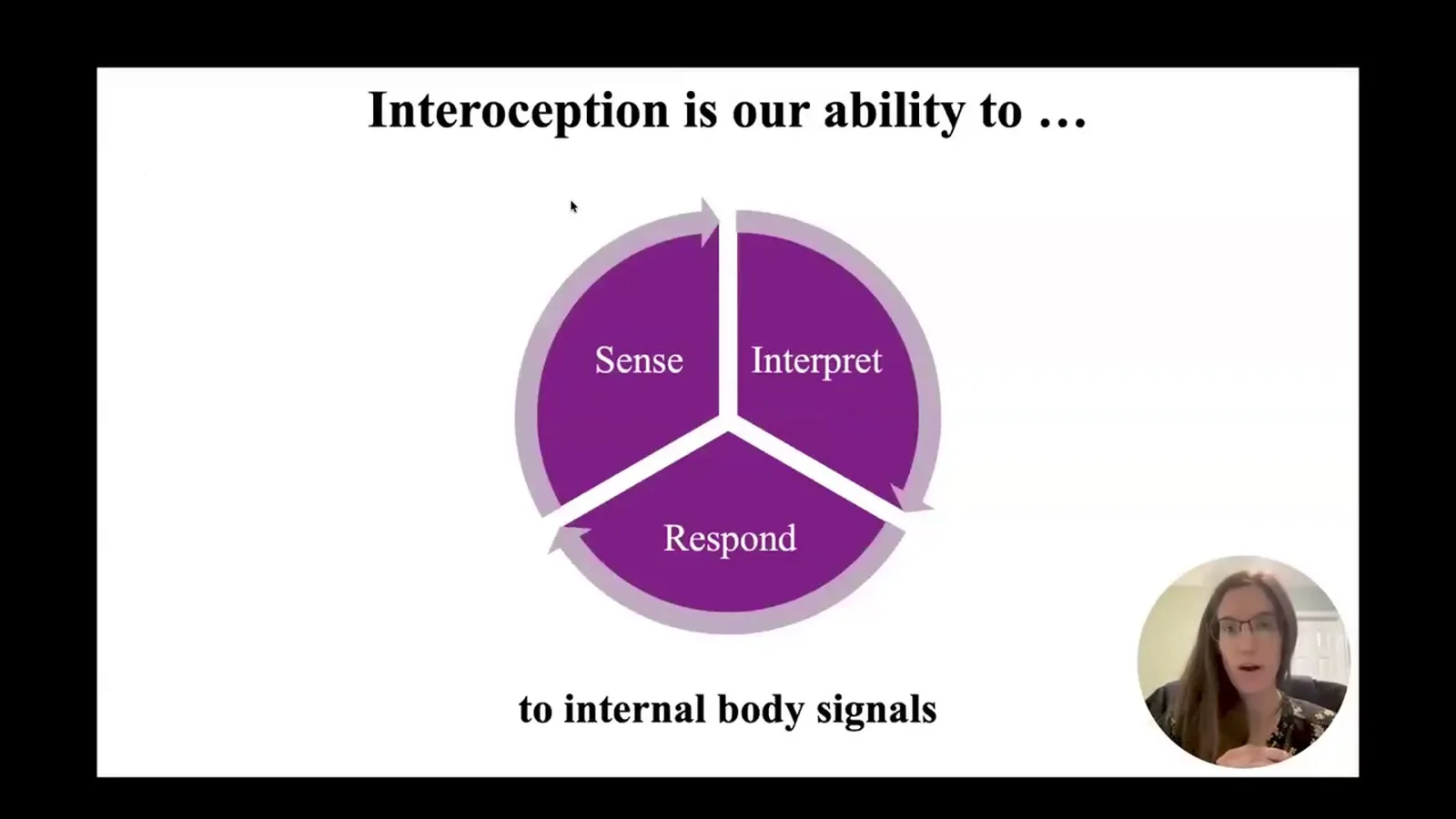
Carolyn makes this point in a talk about teaching learners to notice body signals. The skill is called interoception. That just means sensing what is going on inside your own body, like flushed skin or rapid breathing. Behavior analysts are trained to spot precursor behaviors, which are small early signs that a bigger behavior is coming. But Carolyn says that is only one piece.
interoception doesn't belong to any one discipline. If our goal is to help learners notice, trust, and act on internal warning signals, then safety programming becomes inherently interdisciplinary.
From the talk — Carolyn
She adds a key point about scope. Scope of practice is the set of tasks your license or credential covers. In her view, teamwork lets a BCBA extend the reach of a safety program without stepping outside that scope. The BCBA does not have to become an OT or a speech therapist. Instead, the BCBA partners with them. She also stresses that the adults around a learner need to speak the same language. Body awareness does not grow in a vacuum.
Who brings what to the team#
Carolyn maps out a clear role for each team member. The BCBA often starts with functional assessment. That is the process of finding out why a behavior happens. It includes looking at motivating operations, which are things that make a reward more or less wanted in the moment.
Occupational therapists, or OTs, answer a different question. In Carolyn's words, they ask what a feeling is like in the body. They bring skill in sensory processing and body mapping. Speech therapists help with labels. Many learners can feel a change inside before they can name it. So speech therapists build the words or the AAC system the learner needs. AAC means augmentative and alternative communication, the systems some learners use to communicate in place of speech.
Teachers and school teams see these signals in real social settings, often before the clinic does. Then there are caregivers and direct support staff. Carolyn says they often notice small shifts first. These include changes in breathing, posture, voice, or how close a person stands.
When ABA is the first door#
Michelle Vences led a case conference with a physical therapist named Lori and an OT. Each of them walked through a made up case. The goal was to show what happens when your discipline is the first one a family sees.
because there is times where we do get that referral and we're probably sometimes the first ones that they see
From the talk — Michelle Vences
Vences explains how this happens. A primary care provider, or PCP, may decide one need looks most urgent. So the child gets sent to ABA first, or to PT, or to OT. That first provider then carries extra weight. They may be the only one in a spot to notice other needs. If they miss something, the family may wait a long time to get help. Vences says this is why her panel keeps a growing list of resources. Lori in particular keeps adding to hers, so the team always knows where to send people.
Referring out takes knowing other fields#
Vences praises one habit of Lori's in particular. Lori does not just tell families to go back to their doctor and wait. She sends them straight to the right next provider.
She's not even saying, oh, go to your PCP and like let your PCP like tell you where to go. She's like, I already know this is who you can go see.
From the talk — Michelle Vences
Vences says Lori treats this as part of her own duty. If she is the first to see a child, she must find others to refer to. And Vences names the catch. The only way to do that is to understand what other disciplines actually do. She notes that not every physical therapist would spot what Lori spots. A PT who works only with adults sees very different problems. Years of working side by side gave this panel that shared knowledge. Vences says it has made a world of difference for their clients.
Seeing only part of the picture#
A panelist named Yadira gives a feeding example in the same talk. She describes a child with a lot of chewing and mechanical issues. She hopes the child has already seen a speech therapist. If not, she makes that referral. She also checks whether the child is at a healthy weight and looks to dietitians for help.
it takes a whole team for like complex cases and sometimes in you know you may only see a little bit of the picture in your referral
From the talk — Yadira
Her answer to that gap is practical. Gather a lot of information from caregivers. Keep up with progress notes. Assess and feel confident in your own areas. Yadira says feeding can get extreme quickly, so she wants to know her next steps early. Her closing advice is simple. Once you have a team, collaborate. Ask questions if you don't know. Do the research. And make the referral at the end of the day.
Sharing turf and giving up control#
Dr. Steve Marin frames teamwork as a skill the behavior field still has to earn. He uses a road trip picture. Everyone is in the same van. Who is driving? Who has the map? Who has the radio? He says who is doing what matters just as much as who is not doing what.
It is truly a collaborative effort, which means there's a level of sharing. Accountability and giving up. Some turf in the best interest of the child.
From the talk — Dr. Steve Marin
Marin's reason is direct. No one discipline can get the full view of what a child needs. So each one must let go of some sense of control. He also widens the lens past kids. He points to the millions of autistic adults who did not get the level of care they needed. Many could not go on to live on their own, join in socially, or hold steady jobs. For Marin, the cost of poor teamwork shows up across a whole lifetime.
Showing up in the same rooms#
Marin lists five things that the most successful disciplines do in shared care. He gives the first one in detail. They are present in the microenvironments of the people they share care with. A microenvironment is the small, day to day setting where care actually happens.
He then makes a pointed claim about the behavior field. He says behavior analysts share care with skilled, well trained professionals but often dismiss their opinions. His co-host Michael pushes back a little. Michael says he wants to respond from their own experience, not to attack the point. He calls it a "dual edge sword" that could fill a whole episode. Both agree the issue is real enough to talk through.
This links back to the other talks. Carolyn wants the adults around a learner to speak the same language. Vences says you can only refer well if you know other fields. Marin adds that you have to show up where the other providers work. Shared rooms build shared language.
What the research says#
Published work backs up much of what these speakers describe. A team may run more than one treatment at once. A medicine change is a common one. Medicine changes can shift behavior in many ways. So every team member should know about every treatment (Newhouse-Oisten et al., 2017). Those authors say BCBAs must still follow their ethics code on a team. Sometimes that means speaking up for the client. They offer a decision tree for this. It helps when another provider suggests a new treatment.
Training can build these skills early. One program puts BCBA trainees through rotations in other fields (Boivin et al., 2021). Trainees spend time with speech, occupational, and physical therapy. They also spend time with developmental pediatrics.
Another team describes how BCBAs fit into a medical clinic. The clinic treats sudden-onset behavior and psychiatric symptoms (Carr et al., 2026). Those cases need medical and behavior care at the same time.
Good teamwork also takes more than expertise. It takes respectful, kind communication and relationship skills (Donnelly et al., 2025).
FAQ#
What is interdisciplinary collaboration in ABA? It is when a BCBA works with speech, OT, PT, medical providers, teachers, and caregivers on the same client. Each person covers their own area and shares what they see.
Does collaboration mean a BCBA works outside their scope? No. Carolyn says teamwork lets a BCBA extend a program's reach without leaving their scope. Other providers handle the parts that belong to their training.
How can a BCBA make better referrals? Learn what other disciplines actually do. Michelle Vences says that knowledge lets you refer families straight to the right provider. For an example of team-based safety work, see What Does Your Body Know? Teaching Individuals with IDD to Recognize Internal Warning Signs.
Turn this topic into a CEU
You just studied this. Now get credit for it.
Watch The Interdisciplinary Case Conference with Michelle Vences and earn 1 free BCBA CEU. Detailed certificate, delivered the moment you finish.
Keep going with a free learning path
Caregiver Collaboration and Parent Training
Leanne Page on why caregivers disengage and how to tell a skill gap from a relationship problem. Then Matt Harrington's seven habits for parent training and a workflow for setting collaboration goals with schools, pediatricians and other partners. Four CEUs, all free.