BCBA and LPC Collaboration on Grief: How to Actually Make It Work
Why adding an LPC helps, what behavior data to share, and the four collaboration practices that prevent dual-relationship problems. From a BCBA-led CEU.
Key takeaway
The fastest way to mess up grief support for a client with a disability is to keep the team you already have and try to do it alone, because the people closest to the client are usually grieving the same loss, which is called a dual relationship (one person serving two roles that quietly conflict), and the cleanest fix is to add a Licensed Professional Counselor, or LPC (a master's-level mental health therapist who can diagnose and provide talk therapy), and run the team using the Interprofessional Education Collaborative (IPEC) four domains: values and ethics, roles and responsibilities, communication, and teams and teamwork.
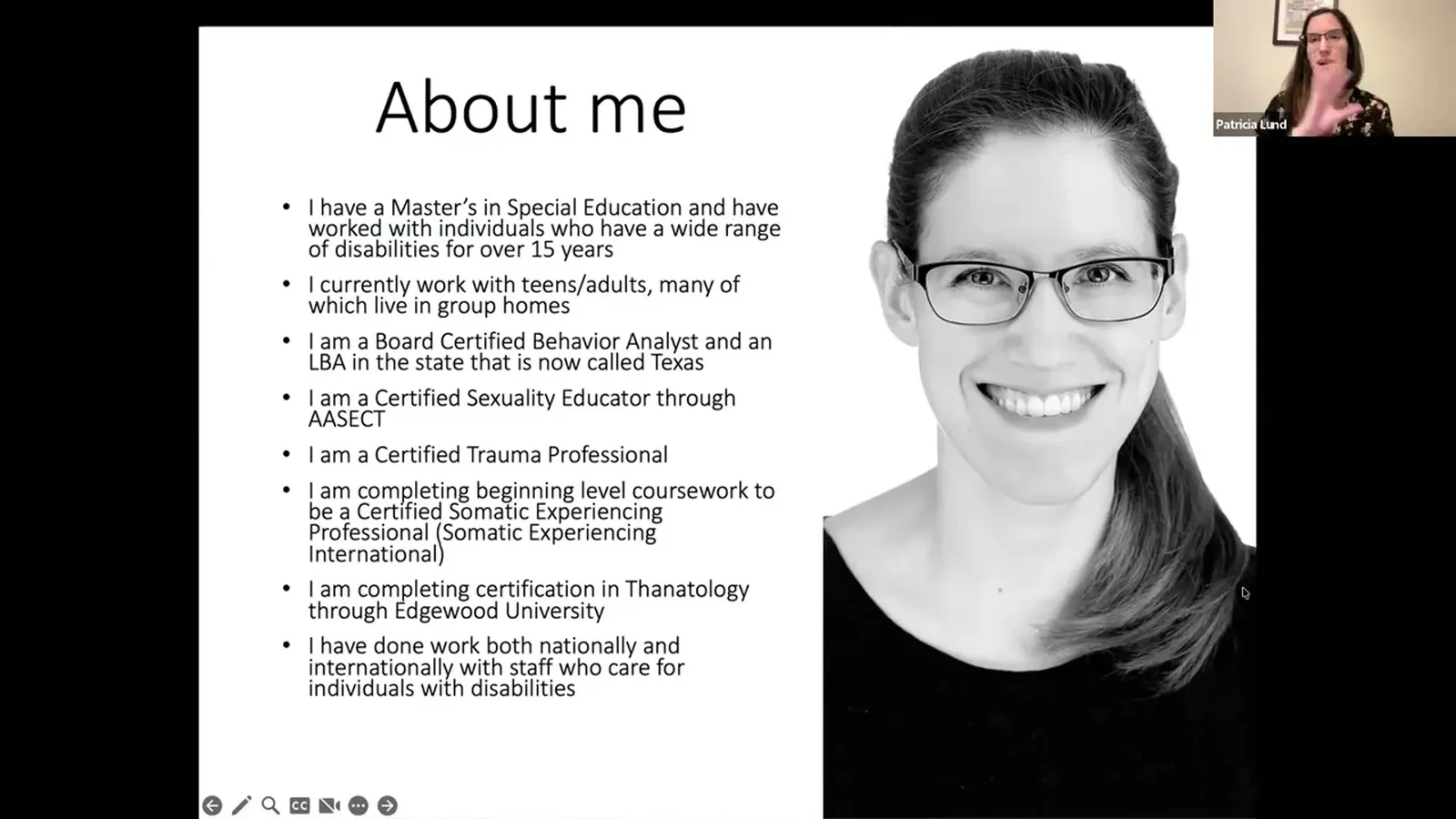
Interdisciplinary Grief Support for People with Disabilities: Enhancing Outcomes Through BCBA-LPC Collaboration
Free learning path on this topic
Your 4 Ethics CEUs, Done
Four ethics CEUs in three courses, all free. Start with Matt Harrington's assent and data course, then ethical guardrails in behavior reduction, then cultural considerations in clinical practice. Every course carries ethics credit, so this path covers the BACB requirement with nothing to buy.
On this page · 8 sections▾
The fastest way to mess up grief support for a client with a disability is to keep the team you already have and try to do it alone, because the people closest to the client are usually grieving the same loss, which is called a dual relationship (one person serving two roles that quietly conflict), and the cleanest fix is to add a Licensed Professional Counselor, or LPC (a master's-level mental health therapist who can diagnose and provide talk therapy), and run the team using the Interprofessional Education Collaborative (IPEC) four domains: values and ethics, roles and responsibilities, communication, and teams and teamwork. Before you refer, vet the LPC for real competence in Intellectual and Developmental Disabilities (IDD), trauma, grief, and Augmentative and Alternative Communication (AAC, the tools and systems people use to communicate when speech alone is not enough). And once they are on the team, drop the Board Certified Behavior Analyst (BCBA) jargon and use plain language everyone can follow.
Why the existing care team often can't hold grief alone#
Picture a group home where a long-time resident's mom just died. The direct support staff knew her. The house manager went to her birthdays. The BCBA has been on the case for three years. Everyone on that team is sad. And that is the problem.
Sometimes the existing carers have a tendency to shield people and protect them because they're really shielding and protecting themselves from the sad reality of loss, dying, and death. This is especially true for familial caregivers and caregivers that have suffered that same loss because it's within the same circle that they're serving. From the talk — Patricia Lund
Shielding looks like staff changing the subject when the client asks where mom is. It looks like a behavior plan that treats every cry as a target instead of grief. It is not bad people doing bad work. It is people who are hurting trying to keep more hurt out of the room.
An outside professional does not carry that weight. They can sit with the sad part because the sad part is not theirs.
What an LPC brings that a BCBA can't#
A BCBA has a defined scope. Per BACB ethics code 1.05, you practice inside your competence. You can do death education, help with funeral participation, and normalize feelings. You can not run weekly grief therapy or diagnose a mood disorder.
An LPC can. They can spot prolonged grief disorder, separation anxiety, or post-traumatic stress that is hiding under what the team has been calling "IDD behaviors." That last part matters. Mental health diagnoses are often missed in people with IDD because the symptoms get blamed on the disability itself, a habit called diagnostic overshadowing.
The LPC also brings something a BCBA can not: distance.
The mental health professional won't have a dual relationship with that client. So meaning that if they are not providing care to that client, as well as other people in the group home, or as well as services to the entire family, if they don't have that prior relationship, it's not complicated. From the talk — Patricia Lund
If you have ever felt guilty about "handing off" a client, read that quote again. You are not handing off. You are adding a seat to the table that does not have a conflict baked in.
How to find an LPC who actually works with IDD and AAC users#
Most counselor directories will return a list of therapists who say they "work with anxiety." That is not enough. A client who uses an AAC device to communicate, who has a seizure disorder, and who just lost the only parent they ever lived with needs someone who has done this work before.
Use this shortlist when you vet a referral:
- Grief and loss as a named focus. Not a footnote on their profile. A specialty.
- Trauma training. Loss often shows up tangled with trauma, especially after sudden or violent deaths.
- Comfort with IDD and medical complexity. Ask outright. "Have you carried clients with profound IDD and behavior support plans on your caseload? How many?"
- Familiarity with AAC. If the client uses a device, the LPC needs to know how to wait, how to model, and how to read what a single tile can mean.
- A real intake process for non-speaking clients. Ask how they build rapport without a back-and-forth interview.
If a counselor can not answer those questions with examples, keep looking. A referral that does not stick wastes the client's time and the family's hope.
The IPEC four domains of interprofessional practice#
Once you have the right person, the team has to actually work. The Interprofessional Education Collaborative (IPEC) is a national group that publishes the standard playbook for cross-discipline care. There are four domains.
Successful collaboration is going to, we have some best practices here from the Interprofessional Education Collaborative... values and ethics... roles and responsibilities... communication to communicate in a responsive, responsible, respectful and compassionate manner... teams and teamwork. From the talk — Patricia Lund
Here is what each one looks like in a real case meeting.
Values and ethics. The team agrees out loud that the client and family are at the center. The BCBA and LPC say what their codes allow and forbid. Nobody is surprised later.
Roles and responsibilities. The BCBA owns behavior data, skill teaching, and environmental support during the funeral. The LPC owns therapy sessions, diagnosis, and emotional processing. Nobody steps on the other's lane.
Communication. Notes get shared. Concerns get raised early. When the LPC sees the client weekly and the BCBA sees the home twice a month, you set up a 15-minute call every two weeks. Not "as needed." On the calendar.
Teams and teamwork. You treat the LPC as a peer, not a vendor. The LPC treats the BCBA the same. Shared leadership means whichever person sees the next red flag first speaks up first.
What behavior data to hand off (and how to hand it off)#
This is where a BCBA is irreplaceable. You have months or years of data the LPC does not. They need it.
Hand off these specific things:
- Baseline rates of target behaviors. What was happening before the loss. Pull the last 90 days.
- Topography changes. Self-injurious behavior (SIB) that used to be hand-biting and is now head-banging. Aggression that used to be pushing and is now throwing. Note exactly what is different.
- Duration and recovery. Before the loss, dysregulation lasted 12 minutes on average. After the loss, episodes are running 45 minutes and the client is not bouncing back the same way. That is real data.
- Antecedent shifts. Same activity, same staff, new response. That tells the LPC the trigger may not be in the environment.
- What used to work. If a certain calming routine helped for two years and stopped working after the funeral, the LPC needs to know.
Send it as a one-page summary. Skip the graphs and the BCBA-only abbreviations. Plain numbers, plain language, one paragraph per behavior. Save the full data set as an attachment if the LPC wants it.
Dropping jargon: speaking a common language across disciplines#
This is the easiest one to fix and the one BCBAs flunk the most.
Avoiding discipline specific terminology. So in a collaboration like this where we can get different types of professionals on the team to talk together and share, make sure that you have kind of a common language that you're using. From the talk — Patricia Lund
If you say "we saw an extinction burst after we removed the SD and the MO shifted," the LPC and the family hear nothing useful. Try this instead: "When we stopped giving him attention for screaming, the screaming got worse for about a week, then dropped off."
Same data. One sentence the whole team can act on.
Make a small list of terms you keep using and write a plain-English version next to each one. Bring that list to your first joint meeting. The LPC will love you for it. The family will trust you faster.
Frequently asked questions#
Does insurance cover an LPC for a client with IDD?
Often yes, with a qualifying mental health diagnosis. This is one of the practical reasons to refer to an LPC who can diagnose. A grief diagnosis like prolonged grief disorder, or a co-occurring condition like depression or PTSD, can open the door to covered sessions. Coverage varies by state and plan, so have the family check their behavioral health benefits before the first session.
Who owns the treatment plan when a BCBA and LPC both work with the same client?
Each clinician owns their own plan inside their own scope. The BCBA owns the behavior support plan. The LPC owns the counseling treatment plan. What you share is a goal sheet at the team level so everyone is rowing in the same direction. If the goals on the two plans ever contradict each other, that is a team meeting, not a tug-of-war.
What's the difference between an LPC, LMFT, and psychologist for grief work?
An LPC and a Licensed Marriage and Family Therapist (LMFT) are both master's-level therapists who can diagnose and provide talk therapy. LMFTs tend to lean into family systems work, which can be a fit when the whole family is grieving. A psychologist holds a doctoral degree, can do formal testing, and may carry a higher hourly rate. For most grief cases on a BCBA's caseload, any of the three can work if they have the IDD and AAC competence. Vet for skills before vetting for letters.
Watch the full talk#
If this is the part of your job you have been quiet about, watch the recording. Patricia Lund covers the BCBA-side scope. Lisa Trelevin covers the LPC side and walks through exactly when to bring her in. It is one hour, free, and BACB approved for one ethics CEU.
Turn this topic into a CEU
You just studied this. Now get credit for it.
Watch Interdisciplinary Grief Support for People with Disabilities: Enhancing Outcomes Through BCBA-LPC Collaboration with Patricia Lund and earn 1 free BCBA CEU. Detailed certificate, delivered the moment you finish.
Keep going with a free learning path
Your 4 Ethics CEUs, Done
Four ethics CEUs in three courses, all free. Start with Matt Harrington's assent and data course, then ethical guardrails in behavior reduction, then cultural considerations in clinical practice. Every course carries ethics credit, so this path covers the BACB requirement with nothing to buy.