How to Explain Death to a Client With Autism or IDD
Five concepts a client needs to grasp death, plus the dead plant lesson and aging timeline activity that actually work. From a BCBA-led CEU.
Key takeaway
Here is the lesson plan: teach your client the five concepts of a mature death understanding (permanence, universality, nonfunctionality, causality, inevitability), run the dead plant lesson with a live plant next to a dead one, build an aging timeline from baby to older adult so changes in ability feel neutral instead of scary, and audit the client's AAC vocabulary for the words "dead," "died," "gone," "where," and "how long." A BCBA (Board Certified Behavior Analyst) named Patricia Lund teaches all four of these in a single CEU on grief support for clients with autism and IDD (intellectual and developmental disability).
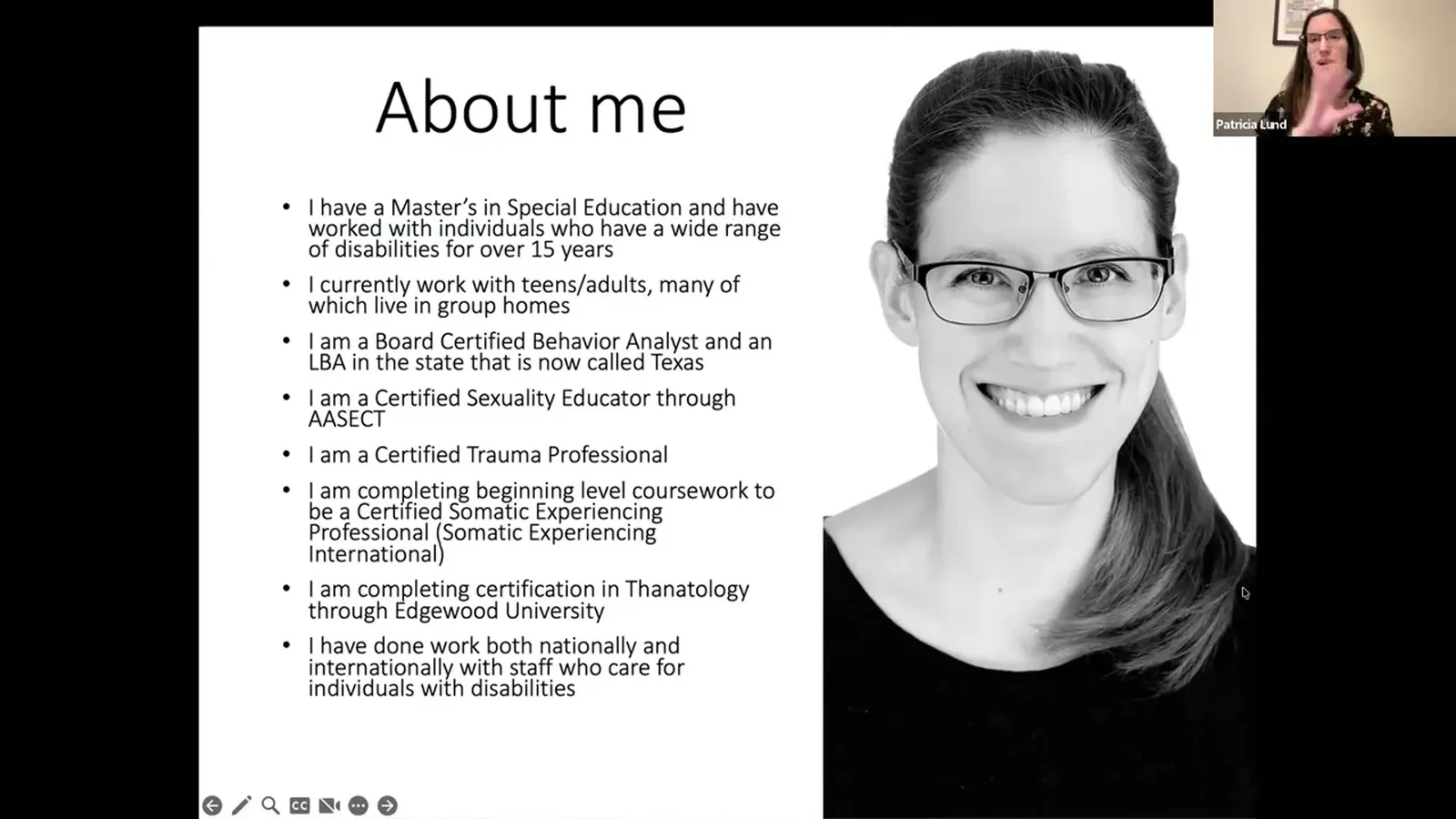
Interdisciplinary Grief Support for People with Disabilities: Enhancing Outcomes Through BCBA-LPC Collaboration
Free learning path on this topic
Your 4 Ethics CEUs, Done
Four ethics CEUs in three courses, all free. Start with Matt Harrington's assent and data course, then ethical guardrails in behavior reduction, then cultural considerations in clinical practice. Every course carries ethics credit, so this path covers the BACB requirement with nothing to buy.
On this page · 8 sections▾
Here is the lesson plan: teach your client the five concepts of a mature death understanding (permanence, universality, nonfunctionality, causality, inevitability), run the dead plant lesson with a live plant next to a dead one, build an aging timeline from baby to older adult so changes in ability feel neutral instead of scary, and audit the client's AAC vocabulary for the words "dead," "died," "gone," "where," and "how long." A BCBA (Board Certified Behavior Analyst) named Patricia Lund teaches all four of these in a single CEU on grief support for clients with autism and IDD (intellectual and developmental disability). This page pulls them out so you can run them on Monday morning.
The Five Concepts a Person Needs to Understand Death#
Patricia walks through a developmental framework that is probably new to most BCBAs, and it changes how you talk with caregivers about what your client can hold onto.
Neurotypical children can have a basic understanding of death between the ages seven and nine. And that means that they understand that death is permanent. When someone is dead, they're not going to come back. They understand that everything and everyone will die, that only living things die. From the talk — Patricia Lund
The five concepts are:
- Permanence. Dead means not coming back.
- Universality. Everything that is alive will die. Stuffed animals will not.
- Nonfunctionality. A dead body does not work anymore. The heart stops. The lungs stop.
- Causality. Death happens because something in the body broke. It is not caused by forgetting to say "I love you" or by being bad.
- Inevitability. Death is part of being alive.
Neurotypical kids tend to hold all five by age 7 to 9. A client with autism or IDD may hold one or two and never reach all five. That is not a failure. It is information. If your client keeps asking "where is Grandpa," that is a permanence gap, not defiance. If they think the death was their fault, that is causality (and magical thinking) showing up, and it deserves a calm, factual answer, not frustration.
Map your client against the five concepts before the next family meeting. You will know what to teach, what to leave alone, and where to ask the licensed professional counselor (LPC) for backup.
Why You Teach Before the Loss, Not After#
The instinct is to start grief work after a death happens. Patricia's whole approach pushes the opposite way.
It's going to benefit your child later because we're teaching death in a context that feels safer and is neutral. We don't want to provide death education right after a caregiver has died. That's already traumatic. That's not the time to teach. From the talk — Patricia Lund
Right after a death, the client is dysregulated. The family is dysregulated. Working memory is shot. New learning will not stick, and any teaching attempt risks pairing the concept of death with the worst day of their life.
Front-loading is the move. Pick neutral examples. A dead bug on the sidewalk. A dead plant on the windowsill. A character in a movie. Teach in plain language using the actual word "dead," not "passed away" or "in a better place." Western culture is death-avoidant by default. Euphemisms feel kind but they leave the client guessing, and confusion increases anxiety.
Three quick rules:
- Start the conversation when nothing has happened yet.
- Use the words "dead" and "died" out loud.
- Treat the topic like any other tact target. Brief. Factual. Repeated.
The Dead Plant Lesson (Step by Step)#
This is Patricia's signature activity, and it is as simple as it sounds.
What you need: one healthy plant, one clearly dead plant from the same species if possible.
Step 1. Put them on the table side by side. Let the client look at both for a minute.
Step 2. Ask what is different. Color, leaves, smell, the way it feels when you touch it. Take whatever they give you. Write it down or draw it.
Step 3. Name the difference out loud. "This plant is alive. This plant is dead." Use the word.
Step 4. Pull out the five concepts one at a time. Will the dead plant grow new leaves? No. Why? Because it is dead and dead things do not come back (permanence). Do all plants die eventually? Yes (universality). Is the dead plant still doing plant things, like drinking water? No (nonfunctionality). Why did it die? Because something in it broke and stopped working (causality). Will the live plant die one day too? Yes (inevitability).
Step 5. Generalize. Over the next few weeks, point at a dead bug on the porch. A dead leaf. A character in a show. Same language each time. Same five concepts each time.
Why a plant? Because no one in the client's life loved that plant. There is no grief to manage while the learning happens. By the time a caregiver gets sick, the client already has a framework. The teaching is done. What is left is the feelings, and feelings are where you facilitate and the LPC may intervene.
The Aging Timeline Activity#
Aging is the other piece clients almost never get taught explicitly. Patricia builds it into the same neutral, factual register as the dead plant lesson.
We're normalizing the concept of aging. And we're normalizing the concept of changes in abilities. And so here, you write like we have a baby, child, adult, older person, and we write down what are some things that you could do as a baby? And then we continue down to someone who's older. From the talk — Patricia Lund
How to run it. Draw four columns on a page or whiteboard: Baby, Child, Adult, Older Person.
For each column, ask two questions:
- What can this person do on their own?
- What do they need help with?
Babies can suck on a bottle. They cannot walk. Kids can run. They cannot drive. Adults can drive. They may need help reading small print. Older people can tell stories about a whole life. They may need help with stairs, with chores, with getting dressed.
The point is fluidity. Abilities change across a lifetime. That is normal, not scary. When Patricia ran this with a client whose parents were aging and could not play soccer with him anymore, the timeline gave them shared language for what was happening. The dad was not broken. The dad was older. And the client's role in the family was allowed to shift too. He could help dad with things now.
This activity also lays groundwork for the inevitability concept without ever saying the word death. A client who understands that bodies change with time is closer to understanding that bodies eventually stop working.
Programming Death Vocabulary on an AAC Device#
This is the gap that almost no generic grief resource talks about, and it is squarely in BCBA scope of practice.
If you are working with clients that have AAC devices, or maybe use sign language or alternate ways of communication, how do they know the words dead, death, died? Do they know other words like where? How long? Gone? And if they don't yet, do we have a plan to get them there? From the talk — Patricia Lund
Pull up your client's AAC (augmentative and alternative communication) device or sign vocabulary list. Run an audit. Look for:
- Core death words: dead, died, death, dying
- Location and time words a grieving person needs: where, gone, missing, how long, when, return, come back
- Feeling words tied to grief: sad, mad, scared, lonely, miss, jealous, relief
- Ritual words: funeral, grave, cemetery, casket, ashes, remember
For any word that is missing, write a teaching plan. Tact training, mand training, modeling during the dead plant lesson. Whatever your normal vocabulary acquisition workflow looks like, run it here.
A client who cannot say "where did Grandma go" or "I miss her" does not stop having those experiences. They just have no way to share them. The behavior you see instead, the dysregulation, the questions that look like perseveration, the new SIB (self-injurious behavior), is often the only channel they have left. Build the channel first.
Using Movies and Books to Correct Magical Thinking#
Most kids' media gets death wrong. Snow White dies and a kiss brings her back. A cartoon character falls off a cliff and walks away in the next scene. For neurotypical kids, this is background noise. For a client working on the five concepts, it is bad data.
You do not need to ban the media. You need to teach around it. While you are watching together, pause and ask a few guiding questions in a curious, non-shamey tone:
- "What just happened to her?"
- "Do you think that really happens in real life?"
- "What would happen if a person really died?"
Patricia's reminder: the goal is not to make Disney the villain. The goal is to surface the contradiction so the client can sort fact from story. You are correcting the data, not the show.
This also works with books. Pick picture books that show death in a factual, age-appropriate way. Read them like you would any other story. Let the client ask questions. Answer in plain language.
Frequently asked questions#
At what age can a child with autism understand that death is permanent?
There is no fixed age. Patricia notes that neurotypical kids usually grasp permanence between ages 7 and 9. For a client with autism or IDD, permanence may come later, may come partially (they get it for animals but not people), or may never fully land. Map the five concepts (permanence, universality, nonfunctionality, causality, inevitability) against your client and teach what is reachable. Treat partial understanding as a real win.
Should I use the word "died" or say "passed away" with my client?
Use "died" and "dead." Euphemisms like "passed away," "lost him," or "in a better place" are confusing for a client who takes language literally. "Where did we lose him?" is not a question you want to answer. Plain words are kinder long-term, even if they feel harder in the moment.
What if my client keeps asking where the person who died is?
The repeated question is usually a permanence gap, not perseveration. Answer the same way every time, in plain language: "Grandpa died. He is not coming back. His body stopped working." If the client has an AAC device, make sure the words they need to ask and process this are programmed. If the questions continue for weeks alongside new behaviors (SIB, sleep disruption, withdrawal), that is a signal to bring in the LPC.
Take this to Monday#
You have a lesson plan now. Pick a neutral object this week. Run the dead plant lesson. Build an aging timeline with one client. Open their AAC device and audit the vocabulary. None of this requires a new credential. It requires a few hours and the decision to teach death the same way you teach any other concept: clearly, calmly, before the crisis.
Patricia's full CEU walks through where BCBA scope ends and LPC scope begins, plus the Reed and Elliott continuum that maps which clients need education, participation, facilitation, or focused intervention. If you want the rest of that picture, watch the recording.
Turn this topic into a CEU
You just studied this. Now get credit for it.
Watch Interdisciplinary Grief Support for People with Disabilities: Enhancing Outcomes Through BCBA-LPC Collaboration with Patricia Lund and earn 1 free BCBA CEU. Detailed certificate, delivered the moment you finish.
Keep going with a free learning path
Your 4 Ethics CEUs, Done
Four ethics CEUs in three courses, all free. Start with Matt Harrington's assent and data course, then ethical guardrails in behavior reduction, then cultural considerations in clinical practice. Every course carries ethics credit, so this path covers the BACB requirement with nothing to buy.