Supporting Clients With Disabilities Through Grief: A BCBA Guide
Three layers of grief support BCBAs can run under scope: death education, funeral participation, and feeling facilitation. From a BCBA-led CEU.
Key takeaway
Reed and Elliott lay out a three-tier continuum (education, participation, facilitation) that maps cleanly onto the Board Certified Behavior Analyst (BCBA) scope spelled out in Behavior Analyst Certification Board (BACB) Ethics Code 1.05, which is the real answer to the question every BCBA asks first: do I belong in grief work at all?
Interdisciplinary Grief Support for People with Disabilities: Enhancing Outcomes Through BCBA-LPC Collaboration
Free learning path on this topic
Your 4 Ethics CEUs, Done
Four ethics CEUs in three courses, all free. Start with Matt Harrington's assent and data course, then ethical guardrails in behavior reduction, then cultural considerations in clinical practice. Every course carries ethics credit, so this path covers the BACB requirement with nothing to buy.
On this page · 9 sections▾
Reed and Elliott lay out a three-tier continuum (education, participation, facilitation) that maps cleanly onto the Board Certified Behavior Analyst (BCBA) scope spelled out in Behavior Analyst Certification Board (BACB) Ethics Code 1.05, which is the real answer to the question every BCBA asks first: do I belong in grief work at all? Most of us were trained to treat anything that smells like feelings as someone else's job. That instinct is fair, and it is also wrong often enough that clients with intellectual and developmental disabilities (IDD) end up with no one running the parts a BCBA can actually run.
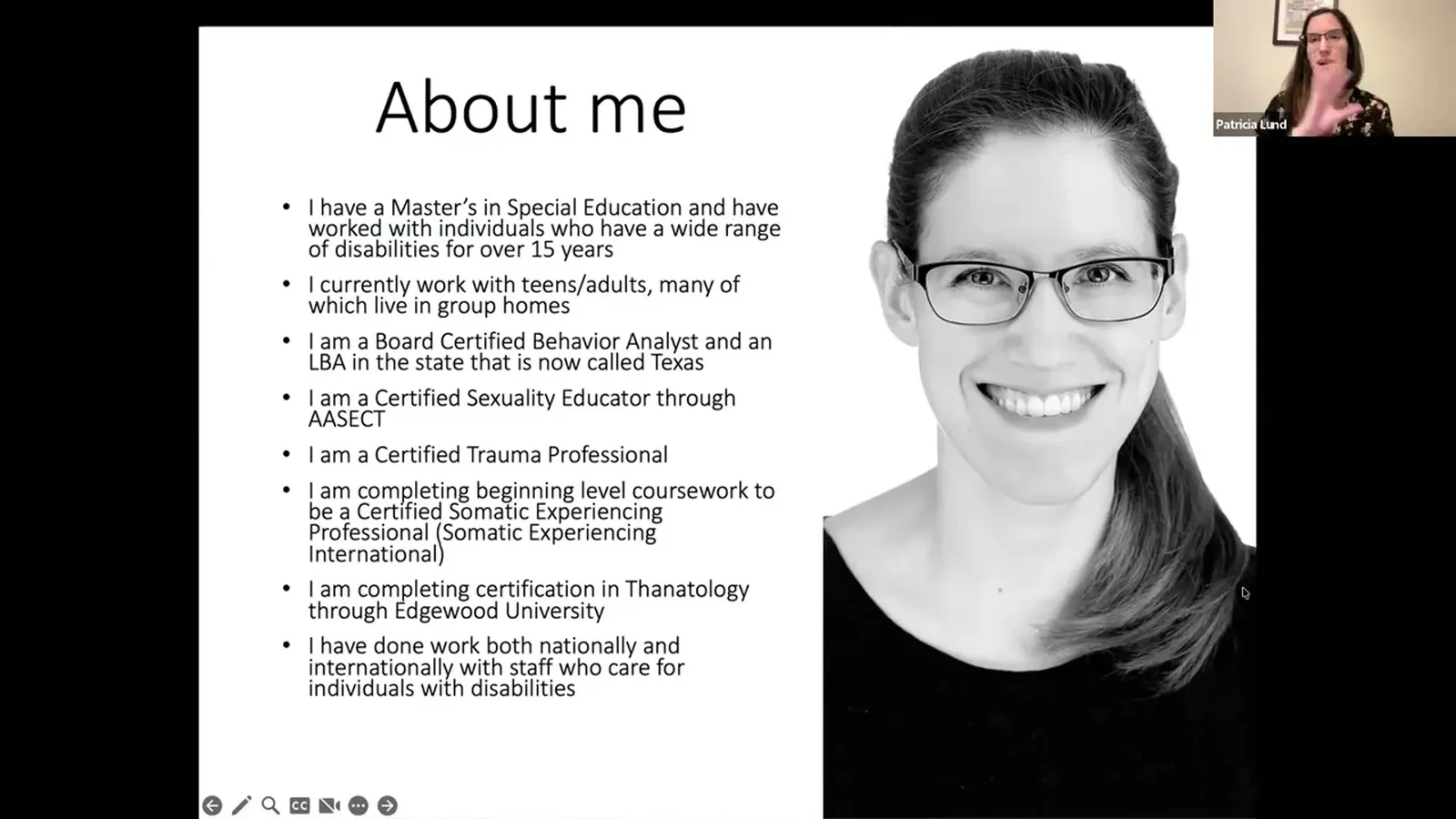
This guide pulls directly from a CEU led by Patricia Lund, a Texas BCBA who works mostly in group homes with adults. The whole frame here is hers. She did the reading, found the model, and tested it against real cases. The job below is to make her three layers concrete enough that you can decide, by the end of the page, whether to start with a dead-plant lesson tomorrow or to call a licensed professional counselor (LPC) first.
Why BCBAs avoid grief work (and why that hurts clients)#
The avoidance is honest. Grief looks like mental health. We were not trained as mental health practitioners. So we step back, and the client, often an adult with IDD, ends up with no death education, no prep for the funeral, and no safe person to talk to. Research shows people with IDD experience more death losses than the general population, and until the 1980s almost no one studied how they grieve. The field is young. The avoidance is not neutral.
When I first started studying grief, I was trying to figure out where BCBAs fit because it seemed very emotional, very, you know, mental health. And I found a really cool way to outline where BCBAs fit in this and how to then collaborate with mental health practitioners. From the talk — Patricia Lund
That "really cool way" is the Reed and Elliott continuum. It is the rest of this page.
The Reed and Elliott continuum: where BCBAs actually fit#
Sue Reed and David Elliott are UK researchers who published in the Journal of Intellectual Disabilities. They are not BCBAs. They drew a triangle. The wide base is education. The next layer up is participation. Above that is facilitation. The narrow top is focused intervention (one-on-one therapy with someone who has the credentials for it).
Most clients do not need the top. Most clients need the bottom three layers done well. That is where a BCBA can practice safely. There is some overlap between facilitation and the LPC's lane, and the very top is not yours unless you hold those extra credentials.
So in the first tier, we have education. So that's death education. It's normalizing what's going on. It's giving factual information about what death is. Participation, helping individuals with disabilities participate in death-related rituals like funerals, memorials, wakes. And then facilitation. And that's where you're going to help normalize the feelings that the client is having. From the talk — Patricia Lund
Layer 1: Death education you can run right now#
Death education is factual information about what death is, delivered in a context that does not feel scary. The Western world tends to be death avoidant. We use euphemisms ("passed on," "lost him"), we whisk bodies away, and the research is clear that this avoidance raises anxiety, not lowers it. So part of your job is to use the words. Dead. Died. Heart stops. Lungs stop.
You do not need to sit a client down with picture cards and announce a lesson on corpses. Use what is already in the room. A few of Patricia's examples:
- A dead plant next to a live plant. Look at the differences. What changed? Living things die. Stuffed animals do not.
- Roadkill on the side of the road on the way to the grocery store. Brief, factual, neutral.
- Snow White waking up. Ask, gently, "do you think that really happens in real life?" Not to shame Disney. Just to check what the client believes.
- An aging timeline. Baby, kid, adult, older person. What could you do at each age? What did you need help with? This normalizes that abilities change across a life. Patricia used this with a client whose parents were aging and could not play soccer with him anymore. It worked because the lesson was not about death yet. It was about change.
The other big one is vocabulary. If your client uses an augmentative and alternative communication (AAC) device or sign, do they have the word "dead" programmed? "Died"? "Gone"? "Where"? "How long"? If not, that is an immediate plan item.
Run this work before a loss, not after. Patricia is firm on this: the time to teach is when the experience is neutral. After a caregiver dies is the worst time to introduce the concept of death for the first time.
Layer 2: Helping clients participate in funerals and rituals#
Adults and kids with IDD are often left out of funerals. Sometimes the family is worried about behavior. Sometimes the family is too overwhelmed to plan around someone else's needs. Sometimes the assumption is that the client will not "get it" anyway. The research says participation helps the grieving process. Exclusion does not.
A BCBA can run almost all of the prep. This is squarely behavioral work:
- Front-load with social stories about what will happen step by step.
- Drive the client past the funeral home or graveside a few days before so the setting is not new.
- Build a visual schedule for the day.
- Offer real choices. Sit through the eulogy or step out. Place flowers here or there. Pick a song. Program a short message into the AAC device.
- Plan environmental modifications. An alternate room to regroup in. A seat near the door. A transition object.
- Float a smaller private service before the larger one, if the family is open to it.
- Limit time at the event. Maybe only the outdoor portion, not the indoor one.
None of this is therapy. All of it is the work BCBAs already do for any novel high-arousal environment, applied to a funeral.
Layer 3: Facilitating feelings without crossing into therapy#
This layer is where the lane gets narrow. Facilitation means helping the client know that what they are feeling is a normal response to a death. Laughing at the wake. Insisting grandpa is not really dead. Withdrawing. Anger. Relief. Jealousy. All of it is normal grief, even when it looks wrong.
Your job is not to process the feeling with them. Your job is to be a person who does not flinch when the feeling shows up.
We're not there to therapize. We're not there to help them process their feelings unless that is where we have additional degrees. But we can be there to listen and we can be there as a safe person. From the talk — Patricia Lund
That is the cleanest scope line in the whole talk. Print it out. Tape it somewhere.
When to bring an LPC onto the team#
Patricia does not love the phrase "refer out." It makes it sound like you hand the client off and walk away. Better frame: you are adding a mental health professional to the team that already exists around the client.
Signals it is time to add an LPC:
- The loss was a primary caregiver, especially for an adult client who lived with that caregiver.
- The death involved suicide, violence, or the client witnessed something traumatic.
- Self-injurious behavior (SIB) has increased in severity, duration, or topography since the loss.
- Dysregulation episodes are lasting noticeably longer than before.
- The client is months or years out and you are still seeing behavioral deterioration. Bonnell and Pascal followed up with bereaved adults with IDD five to eight years after a parent's death and found further deterioration in behavioral measures, not recovery.
- You do not feel comfortable. That is enough.
When you bring an LPC in, your behavior data becomes their starting point. You can tell them exactly what changed and when. That is real value, and it is the part of collaboration that BCBAs are uniquely good at.
What Code 1.05 lets you do, and what it doesn't#
Code 1.05 is the scope-of-competence rule. The short version: practice inside what you are trained for, keep that training current, and consult or refer when a case sits outside it.
Ethical code 1.05, you want to make sure that you're practicing within your scope of competence. If you're not a mental health practitioner, then we're not going to do mental health practitioner things. If you're not a psychologist, we're not doing psychologist things. From the talk — Patricia Lund
Mapped to the three layers:
- Death education: yes. This is teaching. You do this every day.
- Participation prep: yes. This is antecedent management for a novel setting. You do this every day too.
- Facilitation: yes, as long as you are listening and normalizing, not processing or diagnosing.
- Focused intervention: no. That is the LPC or the psychologist. Hand it over (and stay on the team).
Code 1.05 is not a wall keeping you out of grief. It is a fence around the part of grief work that needs different credentials. Inside the fence, there is a lot of room.
Frequently asked questions#
Is grief support inside the BCBA scope of practice?
Parts of it, yes. Death education, funeral participation prep, and listening through normal grief responses are all inside scope. Processing trauma, diagnosing prolonged grief disorder, or running grief counseling are not. The Reed and Elliott three-tier model gives you a clear split.
Do I need extra certification to do death education with clients?
No. Death education is teaching factual information about what death is and what happens to a body. It is the same instructional work BCBAs already do for any concept, just applied to a topic Western culture trained us to avoid. Stay current on the research and consult when a case is unusual. That is what Code 1.05 asks.
What do I say if a parent asks me to "fix" their child's grief behaviors?
Reframe first: most of what looks like a behavior problem after a loss is a normal grief response, even when it is loud or messy. Then offer what you can actually do: prep the child for the funeral, build death-related vocabulary into the communication system, run aging-timeline or dead-plant lessons in the neutral period before any new loss, and track behavior changes carefully. If the behaviors are severe, lasting, or after the loss of a primary caregiver, that is when you bring in an LPC.
Where to go next#
Grief work splits into a few pieces a BCBA can run, and a few that need a counselor. Pick the next page based on the case in front of you.
Turn this topic into a CEU
You just studied this. Now get credit for it.
Watch Interdisciplinary Grief Support for People with Disabilities: Enhancing Outcomes Through BCBA-LPC Collaboration with Patricia Lund and earn 1 free BCBA CEU. Detailed certificate, delivered the moment you finish.
Keep going with a free learning path
Your 4 Ethics CEUs, Done
Four ethics CEUs in three courses, all free. Start with Matt Harrington's assent and data course, then ethical guardrails in behavior reduction, then cultural considerations in clinical practice. Every course carries ethics credit, so this path covers the BACB requirement with nothing to buy.