Prosocial in the Workplace
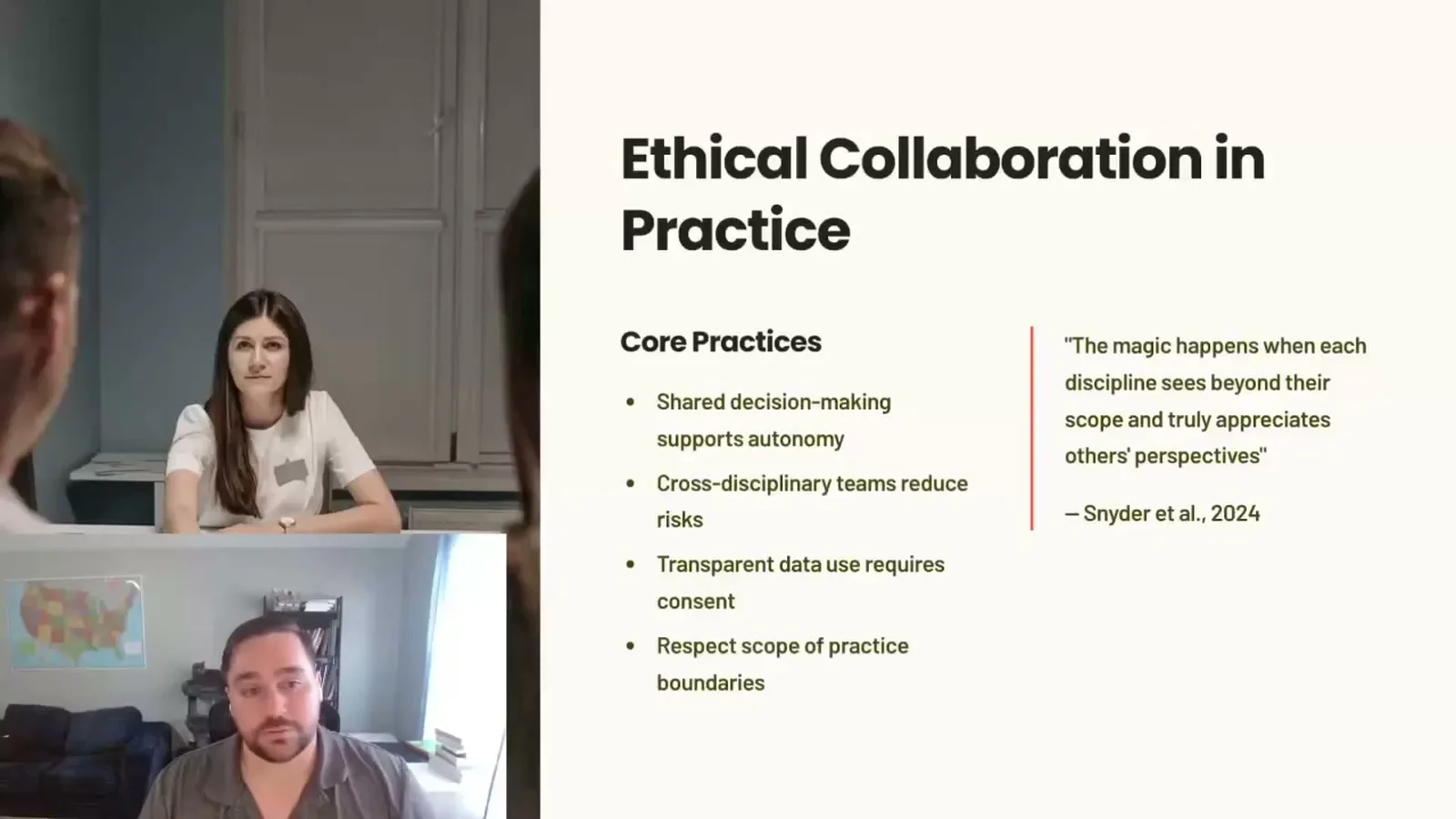
Presented by Jason Stauffer
This presentation introduces the Prosocial model, a framework that combines contextual behavioral science, evolutionary theory, and group-level design principles to improve cooperation, inclusion, and effectiveness in workplace and supervisory settings. Using engaging metaphors, historical examples, and foundational behavioral science, the speaker explains why groups fail to collaborate and how intentional design rooted in shared values can shift workplace dynamics. Participants will explore the eight core design principles adapted from Ostrom’s work and learn how ACT and relational frame theory can support behavior change at both individual and group levels. Designed for behavior analysts in supervisory or leadership roles, this session offers a compelling case for reimagining supervision and team dynamics through the lens of psychological flexibility and prosocial behavior.
Register free & watch nowCancel any time. Cert delivered to your inbox the moment you pass the quiz.
Learner ratings
from 59 learners
90% would recommend this CEU to other professionals in their field (40 responses)
“very informative”
— Farwah A.“very good”
— Ana S.“Very informative”
— Nawal M.“I found it really interesting. Some of the information was a bit challenging to grasp initially but it was interesting!”
— Julia C.
About this CEU
This presentation introduces the Prosocial model, a framework that combines contextual behavioral science, evolutionary theory, and group-level design principles to improve cooperation, inclusion, and effectiveness in workplace and supervisory settings. Using engaging metaphors, historical examples, and foundational behavioral science, the speaker explains why groups fail to collaborate and how intentional design rooted in shared values can shift workplace dynamics. Participants will explore the eight core design principles adapted from Ostrom’s work and learn how ACT and relational frame theory can support behavior change at both individual and group levels. Designed for behavior analysts in supervisory or leadership roles, this session offers a compelling case for reimagining supervision and team dynamics through the lens of psychological flexibility and prosocial behavior.
From the talk
What was covered
A behavior analyst's guide to the Prosocial model: multilevel selection, Ostrom's eight design principles, and ACT for stronger teams.
- Check what your reward system actually selects, because your top producer may be winning by taking from teammates.
- Start any group repair with principle one and name the shared purpose before you touch process or paperwork.
- Score your team on all eight design principles to see where to focus first.
- Ask whether the smaller groups inside your group have real authority, not just the team as a whole.
- Notice the story you tell yourself about your staff, since that story sets how you treat them.
- Read the source book if you want the step by step methods, because this session covers what and why.
What the Prosocial Model Is, in Plain Terms
Prosocial is a model for making groups work better. The talk pulls almost all of its content from one book. The speaker named it up front: Prosocial, by David Sloan Wilson, Paul Atkins, and Steve Hayes, from 2019. He was clear that the ideas are not his own. He called himself the messenger.
The name breaks into three words: conscious, cultural, evolution. Each word stands for a real line of research. Conscious points to contextual behavioral science (a science of language and action). Steve Hayes, Kelly Wilson, and others built it in the 1980s. Cultural points to Elinor Ostrom and Tony Biglan. They studied what happens when many people share one resource. Evolution points to David Sloan Wilson. He studied how traits get picked at many levels at once.
Prosocial sits where those three lines cross. The claim is simple. Put them together and groups get more fair, more productive, and more willing to work as one unit.
The talk sets one more boundary, and it matters. It covers what Prosocial is and why it works. It does not cover how to run it in a supervision session. The speaker said a part two would carry the tools.
This presentation today, it's going to be about the what and the why, but not so much about the how.
From the talk — Jason Stauffer
Evolution Runs in More Than One Stream
Behavior analysts hear the word evolution and think of genes. Prosocial asks for a wider view. The basic loop has three steps: variation, selection, and retention. Traits differ. Some traits work better. Those get passed on. In plain biology, that takes many generations.
Genes are not the only stream. Since the 1970s, the idea of inheritance has grown. Epigenetics (how the world turns genes on and off) is one example. Diet and stress can switch a gene on or off. Those marks can pass to the next generation. Then there is operant selection (behavior shaped by what follows it). Skinner landed on this in the 1950s. An organism varies its behavior. Some acts get more reinforcement. Those acts stick around. The loop matches the gene loop.
Culture is a stream too. We learn from other people, not just from our own hits and misses. Other species do this as well: insects, primates, marine mammals. Humans add one more trick. We write things down. A person can read a book written in Greece two thousand years ago and copy what worked. The speaker cited Yuval Noah Harari's 2011 book Sapiens on this point.
Speed is what matters here. Operant selection can happen inside one session with a client. Culture can spread a good practice across a whole field in a year. We do not have to sit and wait for slow, random change.
we don't have to wait eons thousands of years hundreds of generations anymore for evolution to happen we can do it on purpose
From the talk — Jason Stauffer
The Super Chicken Study and Why Top Performers Can Sink a Team
The clearest story in the talk came from a chicken farm. In the 1970s, a genetics researcher named William Muir worked at Purdue. He wanted more eggs. So he picked the hens that laid the most eggs and bred them. Egg counts went down. The top layers were not better hens. They were bullies. They laid more because they pushed other hens off the food. Breeding the best layers bred the best bullies, and the flock suffered.
Then he changed the unit he was picking. He bred the most productive groups, not the most productive birds. Output climbed. He was now selecting for birds that worked well together.
Those two rounds have names. Picking traits that win inside a group is within-group selection (traits that beat your own teammates). Picking traits that help the whole unit is between-group selection (traits that help groups win). Both forces run at once. It is a tug of war, and neither side stays ahead for good.
This should land hard for anyone who runs a team. Ask what your bonus plan or your praise actually picks. If you reward the loudest producer, look at what that person does to the people nearby. Muir needed six generations of breeding. A supervisor can shift a contingency far faster, without waiting on genetics.
selfishness beats altruism within groups altruistic groups beat selfish groups everything else is commentary
From the talk — Jason Stauffer
You Are a Group of Groups: Multilevel Selection
Next the talk pulls the word individual apart. You are one person. You are also a group of organs that cooperate. Your body works because no single organ hogs the supply. When the stomach grabs resources for its own growth, you get cancer. The selfish part wins for a while. Then the whole unit dies, and the part dies with it.
Go down another level. A stomach is a group of cells. A cell is a group of smaller parts. Mitochondria (tiny energy making parts of a cell) even carry their own DNA (a code kept apart from the rest). In some plants, too many changes in that DNA leave the plant unable to reproduce. The selfish part wins again. The plant dies out. So does the part. The same logic runs all the way down.
Now go up. A person sits inside a neighborhood. Neighborhoods sit inside a town. Towns sit inside a state, then a nation. The same tug of war runs at every step. Fixing it at one level just moves the fight up one floor, and the stakes get higher as you climb.
The group you supervise works the same way. Your staff are not just bodies in a room. Each one carries their own ideas, fears, stories, and learning history. Those count as members too. Within-group selection runs inside a single person's head, not only across a staff roster.
what defines a group is not its boundaries but the shared purpose and values of its members
From the talk — Jason Stauffer
From the Tragedy of the Commons to Ostrom's Field Work
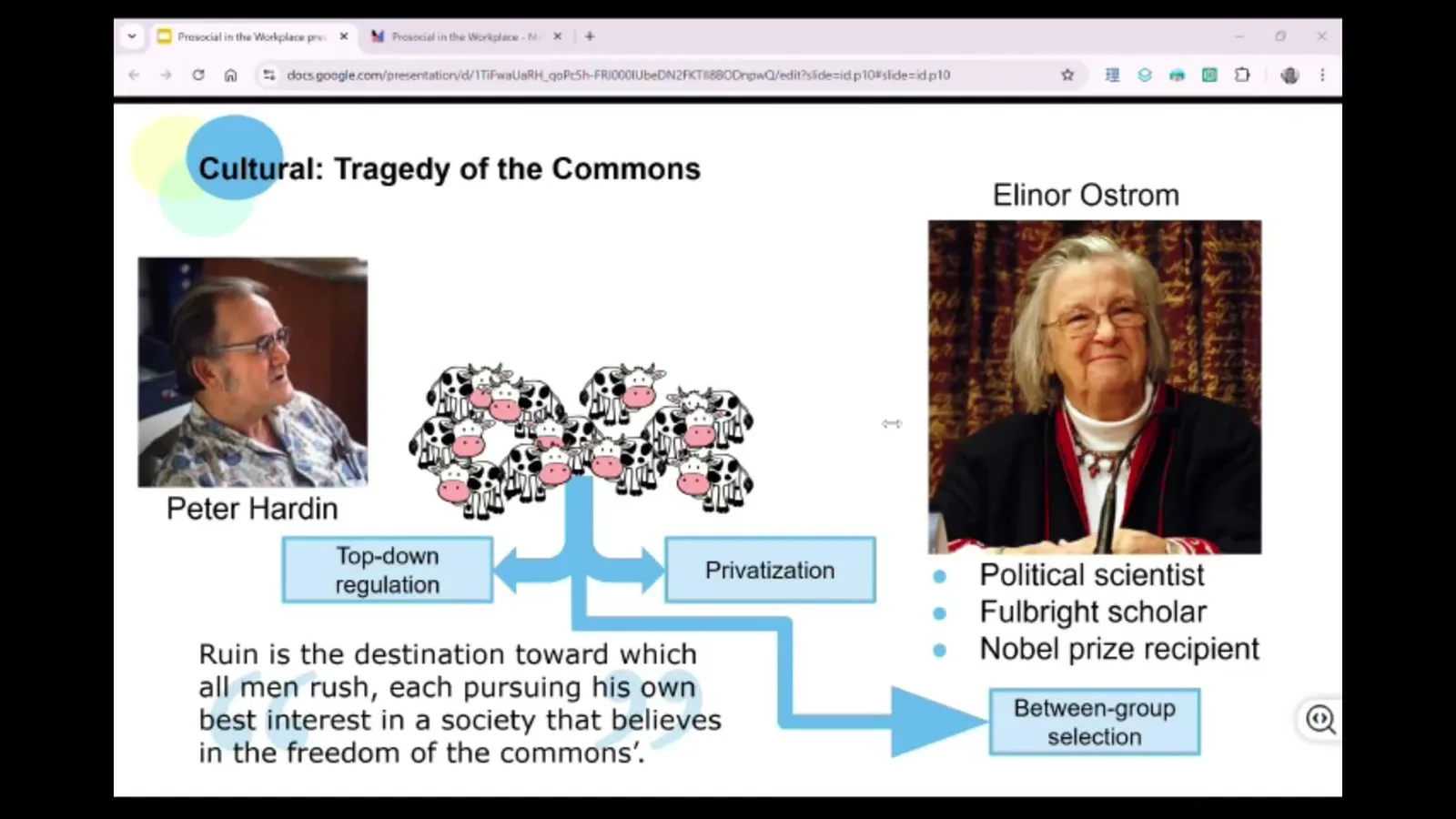
In 1968, Garrett Hardin wrote an essay called The Tragedy of the Commons. He imagined a shared pasture and a group of shepherds. Each one grazes as much as he can before the others do. The grass runs out. Everyone loses. Hardin saw no way out. He offered two fixes: rules from the top, or private ownership.
The talk pushed back on both. People at the top cannot see the ground. They lack real feedback from the people using the resource. So they enforce with more and more force. Private ownership brings its own trap. Money motives pull hard, and they shut down cooperation between groups. Some resources cannot be owned at all. Nobody can buy the air.
Elinor Ostrom answered with data instead of theory. She was a political scientist and a Fulbright scholar. She won the Nobel Prize in economics in 2009 for work she began in the 1960s. She started with groundwater basins in Southern California. Pump too hard and salt water seeps in and ruins the basin for all. Users from rival jurisdictions found ways to settle it without a boss and without a sale. So she looked around the world. Fishers in the Alanya region of Turkey built a rotation for fishing spots. Farmers in Nepal ran irrigation by local rules. Alpine farmers in Switzerland managed shared pasture through community meetings and small, stepped penalties. Lobster fishers in Maine set territory rights and policed themselves.
The same features kept showing up. Clear boundaries, rules made by the users, peer monitoring, and a way to settle fights, every time. That body of work became known as Ostrom's law. If an arrangement works in practice, it can work in theory. The speaker tied this to our own field. Clinicians on the ground often know what works long before the research catches up.
she saw what was happening on the ground and then she worked backwards from there to find out these principles
From the talk — Jason Stauffer
The Eight Core Design Principles for Groups
Ostrom found eight core design principles, or CDPs (eight rules for group design). The Prosocial project adapted them for teams that share a goal instead of a pasture. They sort into three jobs. Two of them coordinate action. Principle one is shared identity and purpose. You know who is in the group and what the group is about. Principle three is fair and inclusive decision making. The speaker summed that one up as: nothing about us without us.
Four principles hold selfishness in check. Principle two is fair share. What you get out matches what you put in, and you can expect the same for everyone else. Principle four is monitoring. Did members do what they said they would do? Principle five is graduated sanctions (small responses before big ones). Principle six is a way to resolve conflict fast and fairly.
Two principles handle the edges. Principle seven asks if your group can decide its own business without outside meddling. Then it asks the same question one level down. Can your classrooms decide classroom things? Principle eight looks up instead. When your group deals with funders, boards, or lawmakers, is there shared identity and purpose there too? The same questions run up the ladder and down it.
The Prosocial project maps all eight onto a web chart. Rate each one twice: how important it is, and how well you do it. Strong scores sit on the outer ring. Weak scores sit near the center. The shape tells you where to work first. One caution came up again and again. These are functional, not topographical (about effect, not appearance). They point to contingencies (what follows what, and why). Adapt them to your group, and add your own if you need to.
The CDPs aren't just what successful groups do. They are descriptions of how social environments can be arranged to reinforce cooperation, flexibility, and mutual accountability.
From the talk — Jason Stauffer
Why Teams Skip Principles They Already Believe In
If these principles feel obvious, why are they so rare? The talk gives several answers. Some of it is plain skill. Grabbing a slice of pie and baking the pie take different repertoires. Some of it is our usual toolkit doing its usual job. Motivating operations (things that make a reward matter more), antecedents, and consequences shape behavior well in tidy settings. Groups are not tidy. People think, worry, and tell stories, and those count as behavior too.
The bigger blocks are verbal. One is experiential avoidance (escaping a feeling you do not want). We can picture a bad outcome that has not happened, then act to dodge it anyway. Another is rule following. Some rules we keep because a boss cares, not because they work. Some are zombie rules that helped once and do not help now. Some never worked at all. Following a rule can feel as good as the real payoff. So we keep doing what is right, not what works.
Then there are the stories we tell. The loudest one is homo economicus (the tale that people are selfish). In 1993, Robert Frank surveyed two sets of undergrads: economics majors and anthropology majors. He measured their beliefs about altruism at the start of the year and again after two terms. Exposure to the self-interest model moved the economics majors toward self-interest. The anthropology majors did not shift. He also pointed to a survey in the UK. Seventy-four percent of people said they held altruistic values. Those same people guessed that most others did not.
The speaker called these stories verbal SDs (cues that signal what will pay off). Your story about a coworker tells you what to expect before you walk into the room. It also shapes what you do in there. If you decide people are out for themselves, you are left with two moves: force them, or use them.
The problem with homo economicus is it can become a self-fulfilling prophecy.
From the talk — Jason Stauffer
Relational Frames, ACT, and Where a Supervisor Starts
Language does this work through relational frame theory, or RFT (how we link words and ideas). Start simple. Teach that A goes with B, and that A goes with C. A learner then derives that B and C go together, both ways, with no extra teaching. Teach two links and get four free. Equivalence is only one frame. There are frames for opposite, for more and less, and for time and place. There is also the deictic frame (I and you, here and there). Because frames are open ended, almost anything can be linked to anything. The speaker took two random words from the audience, banana and power, and tied them together in seconds.
These links are not just talk. He gave an example. One symbol was taught as less than another, and the lesser one got paired with a shock. People later reacted to the untaught greater symbol as if it carried a bigger shock. He offered a useful metaphor for this. Genes give you a genotype (your genetic code), and that shows up as a phenotype (how that code appears in your body). Your web of word links is a symbotype (your learned network of meanings), and it shows up in what you say and do. A new metaphor can change behavior the way a mutation changes a body.
That is where acceptance and commitment therapy, or ACT (a therapy built on values based action), comes in. ACT builds psychological flexibility (acting on values, not on fear). It has six processes in three pillars. Openness holds acceptance and defusion (seeing a thought as just words). Awareness holds present moment attention and self as context (noticing you are the observer). Engagement holds values and committed action (doing what matters even when it is hard). Flexibility helps groups in three ways. It builds trust, since people can sit with hard feelings and stay open. It stretches the time frame, so a team picks the larger later payoff over the quick one. It grows perspective taking, so people care about outcomes that are not their own.
Asked about a supervisee who would not take the wheel, the speaker went straight to principle one. Do not open with the how or the what. Open with why this space exists and what matters to the person sitting in it. That answer costs nothing and you can use it right away.
I am here now accepting the way I feel and noticing my thoughts while doing what I care most about.
From the talk — Jason Stauffer
Common questions
What is the Prosocial model?▾
Prosocial is a framework for helping groups cooperate and get more done. It joins three lines of research: contextual behavioral science, work on shared resources, and work on selection across levels. The talk draws on the 2019 book Prosocial by David Sloan Wilson, Paul Atkins, and Steve Hayes.
What are the eight core design principles?▾
They are shared identity and purpose, fair share of costs and benefits, and fair and inclusive decision making. They also include monitoring, graduated sanctions, and fast conflict resolution. The last two are authority to self-govern and good relations with other groups. Elinor Ostrom found them in communities around the world. The Prosocial project adapted them for teams that share a goal rather than a physical resource.
What is the difference between within-group and between-group selection?▾
Within-group selection favors traits that beat your own teammates. Between-group selection favors traits that help the whole unit beat other units. The chicken study in the talk shows the split. Breeding top individual layers produced bullies, while breeding top flocks raised output.
How do ACT and RFT fit into a model about groups?▾
RFT explains how words and rules gain power over behavior, including the stories people carry into a team. ACT gives six processes that build psychological flexibility, which is the ability to act on values instead of fear. The talk argues that flexibility is what lets people follow the design principles when it is hard.
Did this session cover how to run Prosocial in supervision?▾
No. The speaker was direct about it. This session covers what Prosocial is and why it works, not the step by step tools. He said the how would be a part two, along with results from teams that have used it.
Where can a behavior analyst learn more?▾
The speaker pointed people to the Association for Contextual Behavioral Science at contextualscience.org. It has local chapters and special interest groups. For reading, he recommended A Liberated Mind by Steve Hayes, from 2020, and The Happiness Trap by Russ Harris. He also noted that Mark Dixon and colleagues were building a Prosocial assessment and curriculum. He said Jonathan Tarbox was working on Prosocial resources for behavior analysts.
About the speaker
Jason Stauffer is a board certified behavior analyst who has practiced since 2018 and lives in Hawaii. He serves as vice president of the Hawaii chapter of the Association for Contextual Behavioral Science. In this session he brings the Prosocial model to supervisors, drawing on the 2019 book by David Sloan Wilson, Paul Atkins, and Steve Hayes.
This summary was generated from the recording’s transcript. Quotes are taken word for word from the talk.
What you'll learn
- 1Learning Objectives
- 2By the end of this session, participants will be able to:
- 3Describe the foundational components of the Prosocial framework, including multilevel selection theory, ACT principles, and the eight core design principles for group cooperation.
- 4Explain how symbolic language processes and relational frames (from RFT) can either support or inhibit effective collaboration within workplace settings.
- 5Identify the impact of within-group versus between-group selection on team dynamics, ethical decision-making, and long-term organizational sustainability.
- 6Recognize common barriers to psychological flexibility in supervision and how narrative-based behavior influences cooperation and conflict.
- 7Assess the role of group identity, autonomy, and shared purpose in structuring ethically sound and self-sustaining teams using the CDP framework.
Concepts in this CEU
Related talks
Talks that cover the same concepts
Leadership Alignment in Supervision
Behavioral Wellness Coaching, LLC
ABA Beyond Autism
The Behaviorist Bookclub

Multiple Exemplar Instruction (MEI): Training for Generalization
Copper Consulting Group

genArete: To Teach or not to Teach!
The Behaviorist Bookclub
Supervision Articles Deep Dive
The Behaviorist Bookclub
New Year, New Care Collab Goals
The Behaviorist Bookclub
More from The Behaviorist Bookclub
Harm Reduction Within ABA Practice
The Behaviorist Bookclub
Supervising Beyond Technical Skills: Professionalism, Communication, and Clinical Judgment
The Behaviorist Bookclub
Reflective Supervision and Client Outcomes
The Behaviorist Bookclub
OpenCEU is supported by advertising from third-party sponsors. Sponsors are clearly labeled, have no influence over course content, instructors, or CEU decisions, and never appear on certificates. The BACB does not sponsor, approve, or endorse OpenCEU sponsors or their products.