Language Changes the Game (Part 2)
Presented by Stu Law, Ph.D.
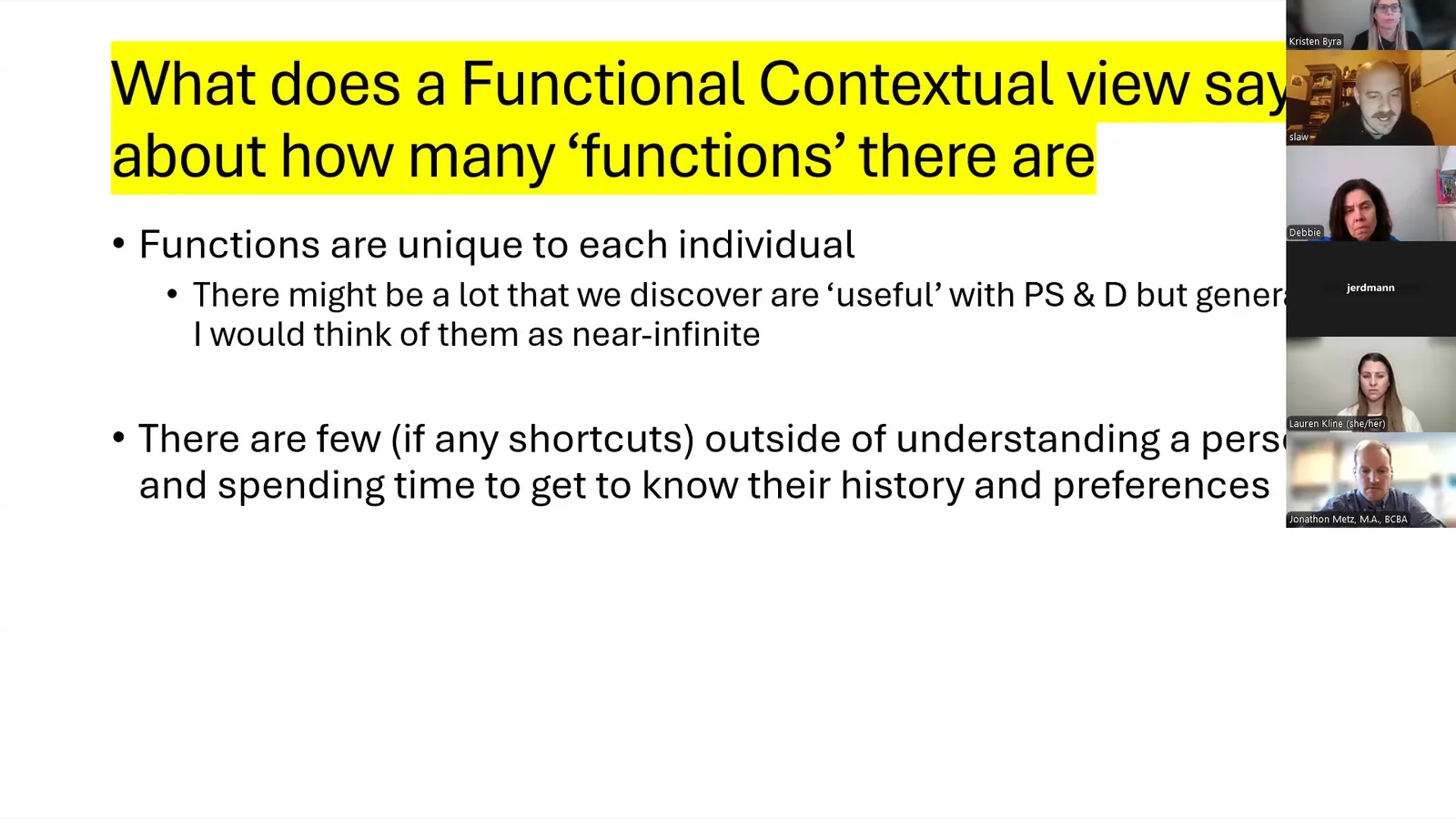
In Part 1, we introduced Functional Contextualism as a way of approaching scientific subject matter without treating our constructs as things that exist “out there,” and instead evaluating them by a pragmatic truth criterion: do they help us predict-and-influence behavior in context? We also reviewed the historical path that led to what we’re calling the Four Function Paradigm in ABA—and why that framework, while sometimes useful, becomes imprecise fast once verbal behavior enters the picture (as early as combinatorial entailment begins to emerge!). In Part 2, we’ll briefly reorient to these ideas using new examples, then move into how verbal operants alter consequential control. We’ll spend time on derived relational responding and transformation of stimulus function, with an emphasis on what this means for assessment, case formulation, and treatment decisions. We’ll close with audience participation, including Q&A and space to workshop case examples though the speaker will be ready with some varied examples just in case no one is ready to share just yet!
Register free & watch nowCancel any time. Cert delivered to your inbox the moment you pass the quiz.
About this CEU
In Part 1, we introduced Functional Contextualism as a way of approaching scientific subject matter without treating our constructs as things that exist “out there,” and instead evaluating them by a pragmatic truth criterion: do they help us predict-and-influence behavior in context? We also reviewed the historical path that led to what we’re calling the Four Function Paradigm in ABA—and why that framework, while sometimes useful, becomes imprecise fast once verbal behavior enters the picture (as early as combinatorial entailment begins to emerge!). In Part 2, we’ll briefly reorient to these ideas using new examples, then move into how verbal operants alter consequential control. We’ll spend time on derived relational responding and transformation of stimulus function, with an emphasis on what this means for assessment, case formulation, and treatment decisions. We’ll close with audience participation, including Q&A and space to workshop case examples though the speaker will be ready with some varied examples just in case no one is ready to share just yet!
Credits
1.5 CEUs · 97 min
From the talk
What was covered
Stu Law explains how language changes functional analysis and treatment planning. He covers derived relations and transformation of stimulus function (meaning spreads to a new stimulus).
- Before you run a four-function analysis, ask if the learner has enough language to catch on.
- Score your own concepts on precision, scope, and depth. Drop ones that stop helping you predict and influence behavior.
- Check whether a learner shows transformation of stimulus function (meaning spreads to a new stimulus). The answer can change rapport plans, staffing calls, and goals.
- Mutual entailment (when a relation implies its reverse) can work against positive affirmations. Try defusion (stepping back from a thought) instead.
- Treat signs of damage (reinforcement from someone else's upset) as real. The same goes for coherence, order, control, novelty, and familiarity.
- In reports, name the function readers expect first. Then add your verbal analysis next to it, not instead of it.
Where the Four Function Paradigm Runs Out of Room
Part 1 built the philosophy. Part 2 puts it to work in the clinic. Stu Law does not throw out the four-function model (attention, escape, tangible, and automatic reasons for behavior). He still uses these words with families every day. He tells parents that long explanations can feed yelling. He calls that wrestling with a pig in the mud.
Law's real point is about limits, not about tossing the tools out. He points to the Iwata style functional analysis, a direct test of what keeps behavior going. It fits a narrow set of cases. Three things need to line up. The learner has little or no language. You are honestly unsure of the function. No simple rule would fix the problem on its own.
He gave an early intervention example. One program he knew never ran a single analysis. Staff worked from one rule instead: keep the environment as steady as you can, and keep everyone safe. Law thinks that rule often beats a strict protocol. Picture a child who pinches you from behind while you read a data sheet. Nobody expects you to turn around and start handing out demands. The demand was never there in the first place. So the moment right before the behavior already told you something useful.
And you don't have to have a functional analysis if the behavior of interest doesn't lead to a change in the environment that is like detectable.
From the talk — Stu Law, Ph.D.
Precision, Scope, and Depth: A Test You Can Run on Any Construct
Law keeps coming back to one test. Functional contextualism (a view where useful counts as true) does not ask if a word names something real. It asks if the word helps you predict and change behavior in context. He grades ideas on three things: precision, scope, and depth.
Take gravity as an example. A mechanist, someone who treats nature like a machine, says we discovered a real force out in the world. Law tells it differently. Someone coined a word, and the word turned out to be very handy. It is precise enough to land us on the moon. It is broad enough to cover skydiving, physics, and microchips. It has depth, because other fields use it the same way. Reinforcement passes the same test. It applies to humans, animals, and even single-celled organisms.
Then he runs the test on the four-function analysis. Precision holds up well. It can dial you in on one clear function. Scope is where he gets doubtful, because the method needs a learner with very limited language skills. Depth is thinner still, since other fields have not picked up the method. He pointed to an article by Sasso and colleagues. They wrote about behavior analysts walking into classrooms without understanding students with social, emotional, and behavioral needs. He also noted that our field still celebrates ideas from the 1950s. He called that bittersweet.
what functional contextualists tend to believe is what's true is what is useful
From the talk — Stu Law, Ph.D.
Relational Framing Is Behavior, Not Storage in the Head
Relational frame theory, a behavior-based account of language, rests on one main claim. People can relate things by agreement, not just by how they look. RFT calls this arbitrarily applicable relational responding. Law treats it as an operant, a learned behavior shaped by its results. It is much like opening a door or waving hello. It is part of a person's repertoire, the set of behaviors they can do. You can test it and teach it.
He listed the features of a frame fast. These include mutual entailment, combinatorial entailment (when two trained relations create a free third one), and transformation of stimulus function. He covered each one loosely on purpose. His goal was to be approachable, not to give a textbook definition.
One warning matters here. Talk about relational networks can start to sound like talk about files stored in a brain. Law rejects that idea flatly. Frames are behavior that happens in context. That keeps the whole analysis in the room with you, not hidden inside someone's head.
They're not stored in my brain any more than a kick or a thumbs up is stored in my hands.
From the talk — Stu Law, Ph.D.
Transformation of Stimulus Function, Shown With a Dial and a Shock
The clearest part of the talk comes from a study by Dewar and colleagues from 1994. A person sits with a dial and three symbols on a screen. Nobody gives any instructions. Turning the dial slowly pays off when one symbol appears. A medium pace pays off with a second symbol. A fast pace pays off with a third symbol. Nothing about the symbols means slow or fast on its own. The link gets built through trial and reward.
Then the setup changes. Researchers pair the medium symbol with a shock. The slow symbol, never paired with shock, now brings a milder stress response. That part makes sense. A stimulus generalization gradient, the idea that similar things cause similar reactions, predicts it. The surprise is the fast symbol. It was never paired with shock at all. Yet people react to it as the scariest of the three. Heart rate and sweat both back this up.
This spread of meaning is called transformation of stimulus function (meaning spreads to a new stimulus). Law thinks this belongs in everyday clinical thinking, including trauma-informed care, treatment that accounts for a person's past hard experiences. He described a friend who had a startling fender bender as a teen. Nobody was hurt. The friend would not call it traumatic. Years later, he still avoids freeways and fast roads. The event entered a web of related ideas that includes faster than. His behavior changed because of it.
It's crazy that you are more scared of something that has never been directly paired with shock than the thing that was directly paired with shock.
From the talk — Stu Law, Ph.D.
Mutual and Combinatorial Entailment Inside a Session
Mutual entailment, when a relation implies its reverse, is the first feature Law unpacked. Say your sister is more of a free spirit than your brother. Most people can say the reverse without being taught it: your brother is less of a free spirit. They can also tell you who they would rather travel with. Both sides of the relation show up at the same time. That is the part with real clinical weight.
This is why Law is cold on affirmations said in the mirror. Saying "I am handsome" also brings up the opposite thought. You may end up strengthening both sides at once. He sees defusion, stepping back from a thought instead of fighting it, as the better answer. Telling someone to stop a thought often makes the thought stronger instead. He noted the same pattern in painful moments. A man cooks a favorite meal and cries, because the meal also brings up someone no longer there. A sunset after a breakup can feel beautiful and crushing at the same time. He also described a radio story about a man who could not hold a knife near his partner. He did not want to hurt her. The thought itself felt unbearable.
Combinatorial entailment looks tamer by comparison. Teach that A relates to B, and B relates to C. The link between C and A comes for free, with no extra teaching. Law says this matters because learners infer a lot without being told directly. That shapes what you can expect from vague instructions. It also shapes how much classrooms can leave unsaid.
I don't like positive affirmations as an intervention.
From the talk — Stu Law, Ph.D.
Verbally Mediated Reinforcers You Will Not Find on a Preference Assessment
Once language enters the picture, the list of possible reinforcers, things that make a behavior more likely, gets long. Law named a few classes worth knowing. Pliance, following a rule because people have rewarded it before, is one. Tracking, following a rule because it actually works, is another. His tracking examples were simple. A pottery teacher moves your hands, and the pot comes together. A coach tells you to turn your wrist, and the bat stops stinging in cold weather. Augmentals, words that change how much something is worth, matter too. A card means little until someone tells you it is rare.
Other classes need language but get less study. Coherence is one: we work hard for things to fit together and resolve. Law used a season finale as the example. A show that resolves nothing can sour the whole run. Sensed order is another. A child who loves tea parties may work hard to fill one empty place at the table. Frames of coordination, linking yourself to someone you admire, show up constantly with parents. A common example: "You used the potty just like your big sister."
Law also pushed on pairs that most of us treat as one-sided. Choice is a well-known reinforcer. But the absence of choice can be reinforcing too. Having dinner decided for you can feel like a kindness after a long day. Control is reinforcing too. He described a program where being the boss gets traded back and forth as a reward. Novelty and familiarity both work. That is why someone buys a candy they have never tried, and also rewatches the same show at bedtime. His favorite example was sending his wife a photo of butter. It was funny only because of their shared history with their dog.
I would tend to say that a functional contextual view says that functions are unique to the individual and their history of reinforcement.
From the talk — Stu Law, Ph.D.
Signs of Damage and How to Give It a Pro-Social Outlet
Signs of damage, reinforcement that comes from seeing someone else upset, got its own section. It does not need language at all. Pigeons under harsh conditions will work a lever all day to reach another pigeon they can hurt. Law thinks a human version shows up often. Ask a learner what they want to earn. "I want you in a trash can" is not a crazy answer. Some of what we call attention-maintained behavior (kept going by someone's reaction) may be about liking the upset we caused.
An audience member asked if this depends on the motivating operation, what makes a reward matter right now. Law said yes, in part. Some cases tie closely to one trigger. Others are fun at almost any time. Getting to shave the principal's head does not need the principal to have wronged anyone first.
His advice for reports and parent meetings is simple. Pair the function with a safe outlet. Play board games, and act truly sad when you get sent back to the start. Let people trash-talk inside a fantasy football league. Let a class earn the right to make a rule the teacher must follow. He described a rule that cost a teacher extra time grading papers, and the class loved earning it. Siblings who tease each other into chaos can get the same itch scratched inside a game. The game has built-in rules, so you can shape the boundaries.
And also it's important to note that that one doesn't work if the teacher doesn't like ham it up, right?
From the talk — Stu Law, Ph.D.
What to Change in Your Practice Next
The clearest example was a staffing call. A supervisor asks if a therapist can move to another case. Law would first ask if the learner shows transformation of stimulus function (meaning spreads to a new stimulus). If a new adult can quickly take on the features of a fun adult, the switch costs little. All it really needs is a proper goodbye. If not, the new person is a different stimulus, and rapport-building starts over. Law later corrected his own framing after a question. This is not an on-or-off switch. It is a skill that grows by degrees. A partial skill calls for a partial pairing plan.
He wants the same thinking inside assent work, getting real buy-in from the person you serve. He is not satisfied with accounts of assent that skip complex language. Frames of coordination, reinforcement history, and transformation of stimulus function give you one path forward. That path leads to what others call intrinsic motivation (wanting to do something for its own sake). Deictic frames, frames built from I, you, here, and there, stretch this further. He has used perspective-taking to build empathy, rather than targeting a problem behavior head-on. He pointed to an early Hayes paper called Making Sense of Spirituality as an example of this kind of thinking.
For writing and systems, his advice is gradual. Give readers the word they expect first. Then add the fuller analysis right next to it. Build reward systems out of local culture instead of gift cards. Rare, collectible items with real scarcity work well. Learn interview skills from clinical work, since uncovering motivation through talk differs from running a preference assessment. He also pointed outside the clinic, to marketing and to online disinformation. Content that fits a person's existing beliefs keeps its pull even after they agree it is fake.
I would advise you to also think of process-based therapy because it's functional analysis for therapy, kind of.
From the talk — Stu Law, Ph.D.
Common questions
What is transformation of stimulus function in plain language?▾
It means the function of one thing can spread to a related thing you never trained that way. In a 1994 study by Dewar and colleagues, people got shocked when they saw one symbol. Later, they reacted most to a different symbol, one only linked to going fast. A generalization gradient alone cannot explain that. Language-based relations can.
Is Stu Law saying we should stop running functional analyses?▾
No. He said the four-function analysis is precise where it fits. He still uses words like attention and escape with parents. His real point is about scope. Once a learner can relate events through language, they can often spot your test. This pushes you toward a different kind of analysis built around language.
What is an example of a verbally mediated reinforcer?▾
Telling someone a card is rare and valuable changes how hard they work for it. Law calls this an augmental, a word that changes a thing's value. Earning the right to make a rule the teacher must follow is another example. His personal example was sending his wife a photo of butter. It only worked as a reward because of their shared history with their dog.
How should I write a non-standard function in a report?▾
Give readers the term they expect first. Then expand next to it. Write "attention," then discuss signs of damage or frames of coordination in the same section. That keeps the report readable for the team. It also slowly widens the range of functions people will accept.
Why might positive affirmations backfire?▾
Because of mutual entailment, saying "I am handsome" also brings up the opposite idea. You can end up strengthening both sides at once. Law said you can still try affirmations with one person and check if they work. But keep other tools ready, including defusion-style strategies.
How do I tell if a learner has the verbal skills this talk needs?▾
Start with mutual entailment. Say your uncle is cooler than your aunt. Can the learner tell you your aunt is less cool than your uncle? Law noted that learners without this skill are a small share of the people most of us serve. He also said transformation of stimulus function comes in degrees, not all at once.
About the speaker
Stu Law, Ph.D., earned his doctorate at the University of Nevada, Reno, where he studied under Steve Hayes. He has worked in and around academics for about 18 years. He has written roughly 20 peer-reviewed articles and book chapters. Most of his work covers ACT (Acceptance and Commitment Therapy) and RFT (Relational Frame Theory) assessment. He also covers behavioral assessment and the theory and philosophy of science. He has also taken a behavioral approach to psychedelic-assisted therapy, therapy that uses psychedelic drugs alongside talk therapy. He is co-creator of Generate, a skill-based assessment that has been seven to ten years in the making.
This summary was generated from the recording’s transcript. Quotes are taken word for word from the talk.
What you'll learn
- 11) Speak to the impact of Transformation of Stimulus Function on functional analysis 2) Give examples of verbally-mediated reinforcers 3) Recognize the need for verbally-mediated analyses in their work and seek appropriate resources
Related talks
Talks that cover the same concepts
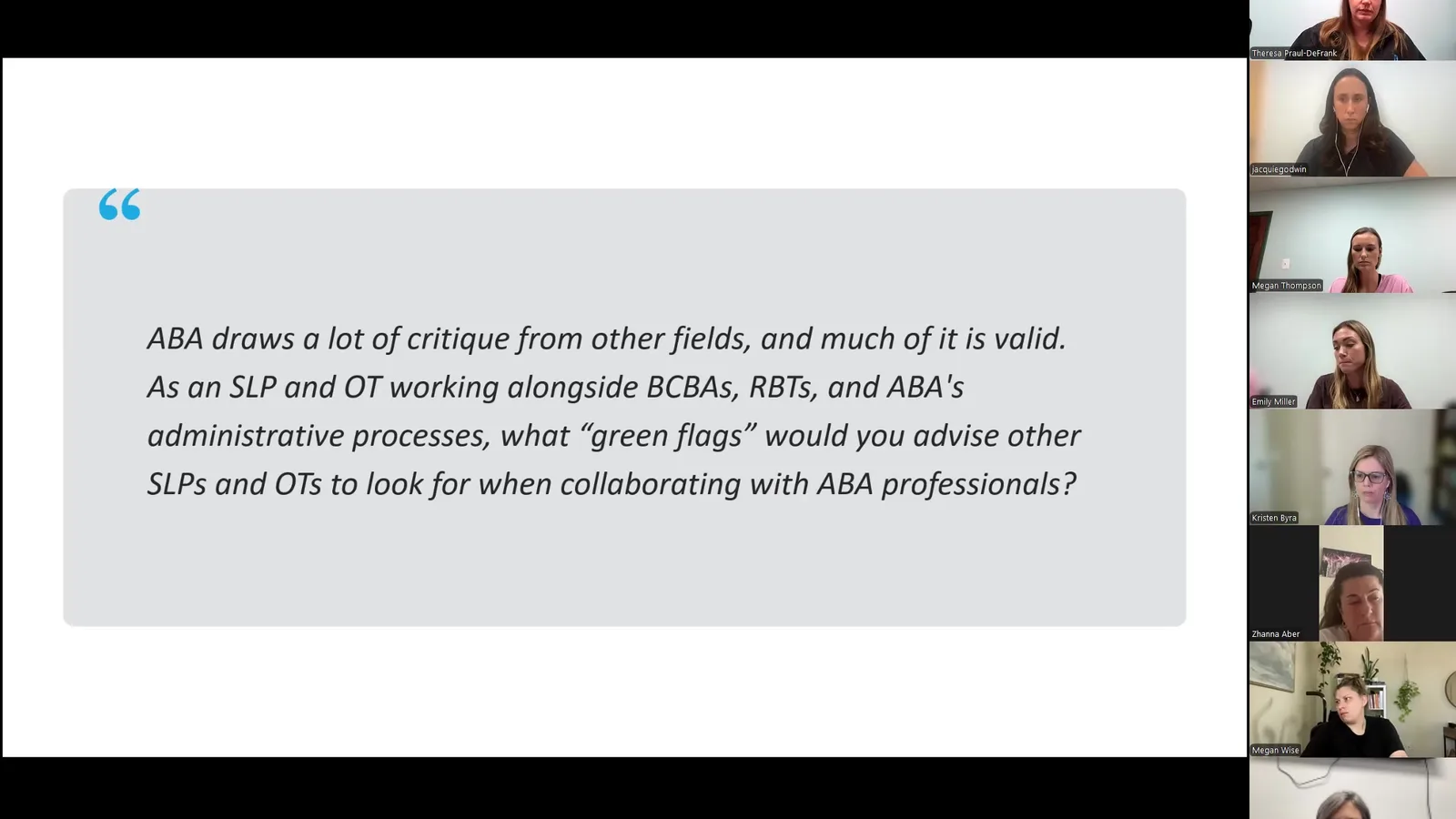
A Panel on Collaboration in Practice: SLP, OT & ABA Services
Upskill ABA
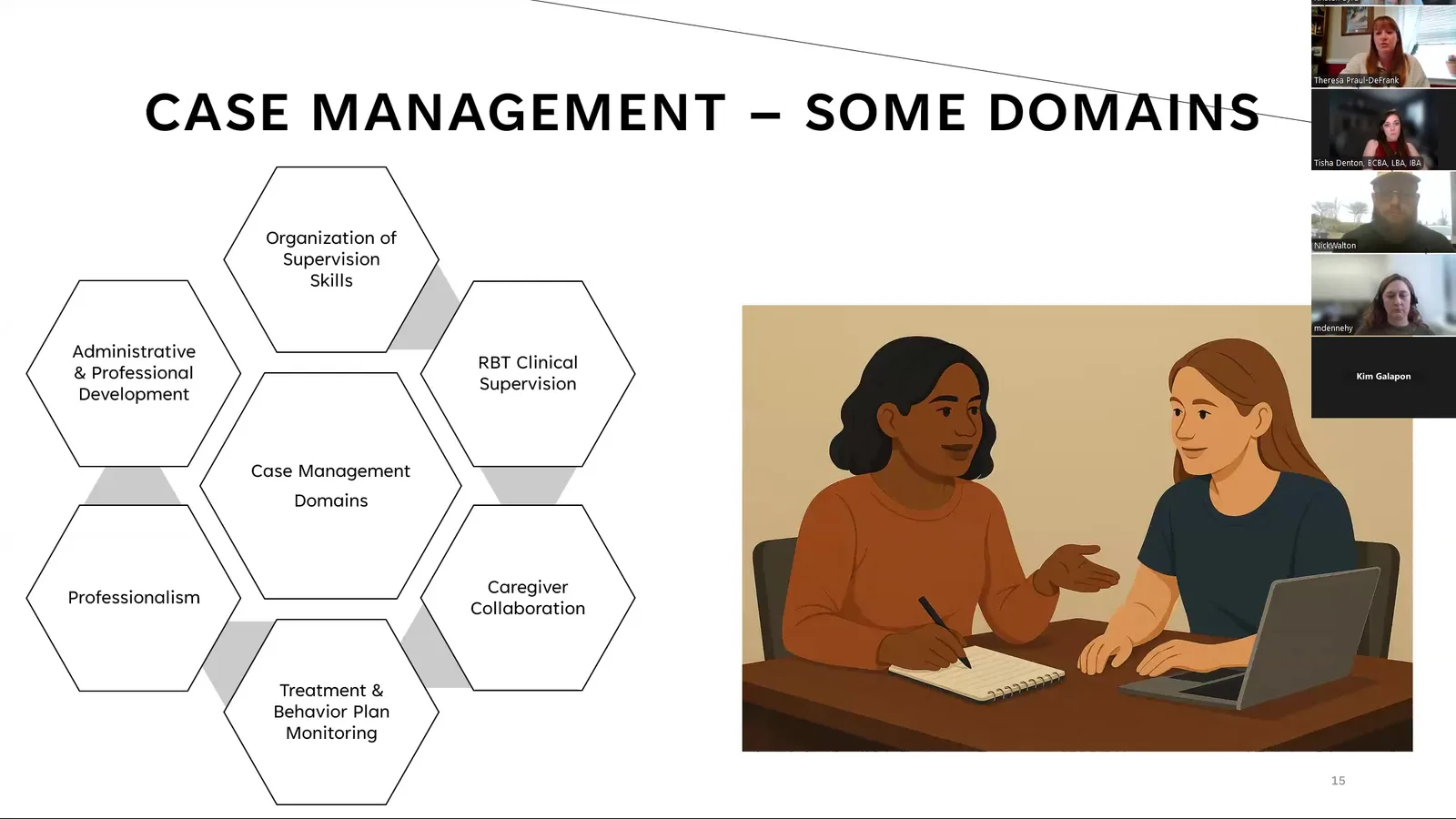
From Peer to Professional: Becoming & Supporting Early Career Behavior Analysts
Upskill ABA
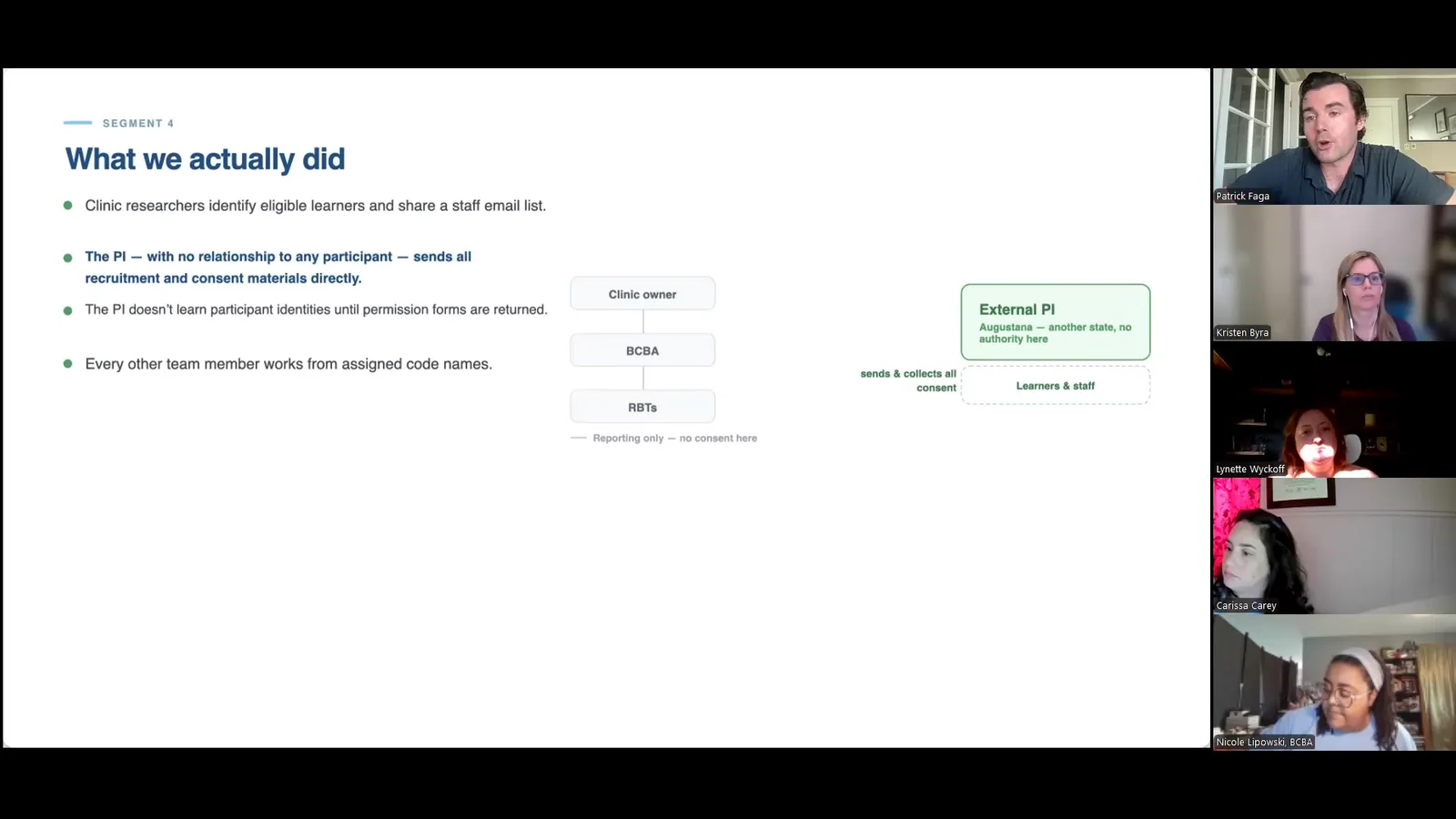
From Idea to IRB: Conducting Research in Your ABA Practice
Upskill ABA
Quality Without Measurement is Just Marketing: A Critical Analysis of Quality Service Delivery
Upskill ABA
Practical RFT
Upskill ABA
Assent and Compassionate Care: Ethical Issues and Considerations for Practice
Upskill ABA
More from Upskill ABA
OpenCEU is supported by advertising from third-party sponsors. Sponsors are clearly labeled, have no influence over course content, instructors, or CEU decisions, and never appear on certificates. The BACB does not sponsor, approve, or endorse OpenCEU sponsors or their products.