When You’re Everyone’s Support: Building Sustainable Leadership.
Presented by Allyson Mullins
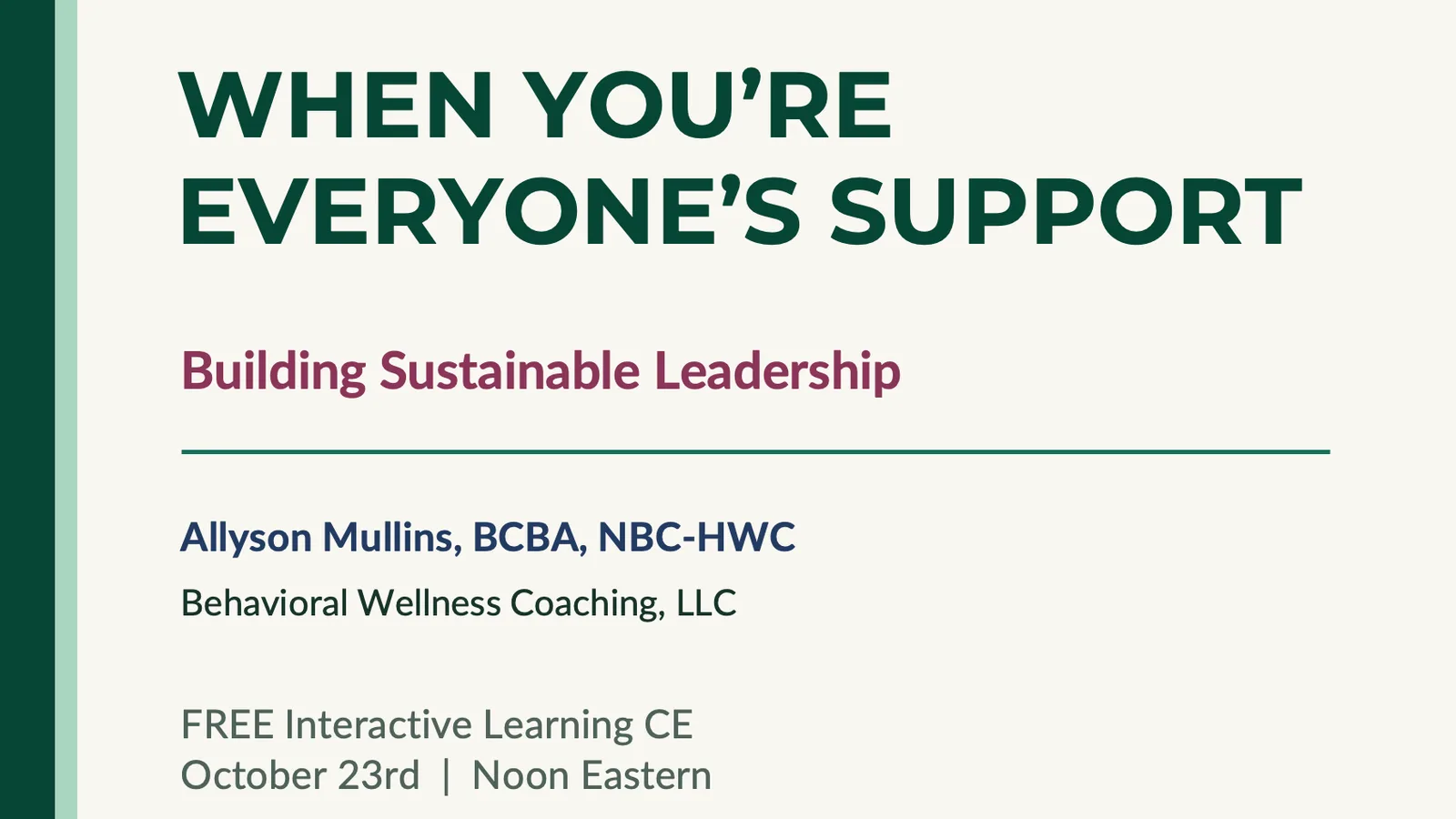
ABA leaders often become the person everyone turns to for answers, decisions, and support. Over time, this pattern can create competing demands, limit opportunities to develop others’ skills, and make it difficult to follow through on their own leadership priorities. This interactive session explores how reinforcement contingencies, unclear expectations, and environmental barriers can maintain patterns of overextension in supervisory roles. Participants will examine a recurring leadership situation, distinguish actions that require their involvement from opportunities to teach or clarify expectations, and identify changes that support more sustainable supervisory practices. Through guided reflection and applied examples, participants will complete a Leadership Support Plan that includes an observable leadership action, an environmental support, and a simple measure of follow-through (PDF found in the course materials). The session emphasizes practical changes that help leaders support their teams while preserving capacity for effective supervision. Disclosure: Allyson is the Founder and Owner of Behavioral Wellness Coaching, LLC.
Register free & watch nowCancel any time. Cert delivered to your inbox the moment you pass the quiz.
Learner ratings
from 46 learners
89% would recommend this CEU to other professionals in their field (46 responses)
“Thank you.”
— Marsha S.“Thank you”
— Christie S.“NICE”
— Mahmoud A.“Excellente training”
— Dora M.“Excellent presenter! Informative presentation and helpful slides.”
— Ashley W.
About this CEU
When everyone turns to you for answers, decisions, and support, it can be difficult to make room for your own leadership priorities. You want to support your team, but being constantly available can leave you stretched thin and keep others relying on you. In this interactive CE session, we’ll explore how reinforcement patterns, unclear expectations, and environmental barriers can contribute to overextension in ABA leadership. Through practical examples and guided reflection, you’ll examine a recurring challenge and identify changes that support both your leadership capacity and your team’s independence. You’ll complete a fillable Leadership Support Plan and leave with one observable action to try, an environmental change to support it, and a simple way to track your follow-through. The first 50 minutes are the CE portion. After, I’ll spend 10 optional minutes sharing ways to continue this work through Behavioral Wellness Coaching. **Attend live for the full interactive experience. The session includes dedicated time to complete your worksheet, respond to prompts, and ask questions. Bring a current leadership challenge you’d like to work through, keeping identifying information confidential. Replay viewers can complete the same activities independently (the Leadership Support Plan fillable PDF is found in the course materials). The recording will include pauses for reflection and live audience responses (these will not be edited down), so you are encouraged to participate and reflect during these pauses and even pause if you need more time.
Abstract
ABA leaders often become the person everyone turns to for answers, decisions, and support. Over time, this pattern can create competing demands, limit opportunities to develop others’ skills, and make it difficult to follow through on their own leadership priorities. This interactive session explores how reinforcement contingencies, unclear expectations, and environmental barriers can maintain patterns of overextension in supervisory roles. Participants will examine a recurring leadership situation, distinguish actions that require their involvement from opportunities to teach or clarify expectations, and identify changes that support more sustainable supervisory practices. Through guided reflection and applied examples, participants will complete a Leadership Support Plan that includes an observable leadership action, an environmental support, and a simple measure of follow-through (PDF found in the course materials). The session emphasizes practical changes that help leaders support their teams while preserving capacity for effective supervision. Disclosure: Allyson is the Founder and Owner of Behavioral Wellness Coaching, LLC.
Credits
1 CEU · 60 min
From the talk
What was covered
How ABA (applied behavior analysis) leaders can stop absorbing every problem. Spot the pattern, pick the right fix, and plan one change.
- Notice the requests that keep coming back to you, then write one of them down in plain, observable terms.
- Before you step in, ask what the person gets to practice and what they can do next time.
- Check what happens right after you take over, for you and for them, because quick relief keeps the pattern going.
- Sort the problem into a skill gap, unclear expectations, or an environment barrier, since each one needs a different fix.
- Build support earlier in the process with checklists, earlier internal deadlines, and protected work time.
- Pick one observable action, one environmental change, and one simple measure of follow through.
Why Capable Leaders End Up Doing Everyone Else's Work
Allyson Mullins opened with her own leadership story. She wanted a team that felt safe bringing her questions. She came from a clinical background. She knew the pressure her BCBAs (Board Certified Behavior Analysts) carried. So she helped the way many leaders help. She took the hard caregiver call. She edited the late treatment plan so the authorization would not lapse.
None of that came from doubt about her team. It came from care about families, deadlines, and staff. The hard part showed up later. She could solve the problem today and meet the same one next week. That work sat on top of everything she already owned. For her, it often became after-hours work at home.
She frames leadership here as a BCBA supervisor supporting other BCBAs. She is also clear that the job title matters less than the role. Every BCBA leads someone. You can use the same frame with technicians or other team members.
Mullins asked her audience a direct question. If this pattern sounds familiar, she wanted to know. Many said yes in the chat, and she said she was not surprised. You can care deeply about your team and still want a different way to support them.
I was not stepping in because I thought my BCBAs were are incapable.
From the talk — Allyson Mullins
Resolve Today's Problem or Prepare for the Next One
Mullins kept one question at the center of the hour. Does your support today resolve the problem and prepare the person for the next one? Both halves matter. Clinical questions are often time sensitive. Caregiver concerns and team conflict can be urgent. Sometimes the leader really should handle it.
She asked the live audience which half was easier. The chat said the same thing most of us would say: resolve it today. Urgency pulls hard. Closing the loop feels good. That is a fair starting place for analysis, not a flaw.
The second half asks what happens after the fire is out. Is there information the BCBA needs access to? Is there a skill to teach? Does the chain of command need to be clear? Could you arrange practice before the next time?
She also asked what you would need to know before you take over, model, or coach. Attendees named the time pressure, how severe the issue is, and the history between the BCBA and the family. They named rapport, the staff member's current skill, and whether the person even wants help. There is no blanket rule. The answer depends on context.
but this should be a deliberate decision rather than an automatic pattern.
From the talk — Allyson Mullins
What Reinforces Overextension in Supervision
Look at the sequence from both sides. A BCBA asks the leader to take the hard conversation. The leader takes it. The difficult task is now gone for that BCBA. The leader's worry about accuracy and tone is gone too, instantly. That is a setup for negative reinforcement (behavior repeats because something unpleasant goes away).
Mullins was careful here. This is not a judgment, and nothing about it is malicious. It is a hypothesis about a possible function. It only becomes worth testing when it turns into a pattern. Then it is worth asking why you keep jumping in.
There is also positive reinforcement (behavior repeats because something good follows). Attendees named it in the chat. You get thanked. Your help is seen and appreciated. The problem goes away and someone recognizes your work. That feels good, and it should.
Two realities can be true at once. The family gets accurate information fast, and the issue gets resolved. At the same time, the BCBA gets no practice with that conversation. The next identical request lands on you again.
the issue was not that I provided support.
From the talk — Allyson Mullins
Three Barriers That Call for Three Different Fixes
Mullins sorted recurring problems into three buckets. The first is a skill gap. The person does not yet do the task accurately under real conditions. That can happen to very experienced staff. She used the idea of splinter skills (strong in some areas, weak in others). A new payer rule, a new documentation format, or a hard conversation can all expose one. Policies change, and old skills do not always carry over.
The second bucket is unclear expectations or authority. The person does not know what finished work looks like. Or they do not know which decisions are theirs. More practice will not fix that. They need a clear description of the final product. They also need clear limits and a clear escalation point (who they go to next).
The third bucket is an environmental barrier. Think competing demands, missing information, thin resources, or not enough time. If someone can write the plan but has no realistic writing time, training is the wrong tool. More training just adds response effort (more work to get the task done) without touching the real constraint. These buckets can also overlap.
She pushed for evidence over assumption. Asking a team if they have questions in a meeting proves nothing. You only learn the truth when the work comes in. She pointed to the Performance Diagnostic Checklist Human Services (a tool for finding performance barriers). It examines training, task clarification, resources, and process. It also looks at performance consequences, response effort, and competing demands.
we may need teaching, not just a checklist.
From the talk — Allyson Mullins
Worked Example: The Hard Caregiver Conversation
Start with baseline data (how someone performs before you help). When you can, sit in on a caregiver session. Watch what the BCBA actually does. Then match the support to the real barrier. Mullins admits this is not always possible. Things move fast. When you can build it into your regular cadence, it works like prevention.
From there, she used behavior skills training (instruct, model, rehearse, then give feedback). She shared a simple four-part scaffold for the conversation. First, acknowledge the concern out loud, so the family feels heard. Second, share only the information you can confirm today. Third, name the next step and who owns it. Fourth, check that the family understands their role and yours. Swap in your own policies and wording.
Then rehearse it. You play the caregiver. The BCBA leads. Feedback stays tied to observable behavior. Was the concern acknowledged? Was the information accurate, and was it too much or too little? Were the next steps and the owner clear? Did they check for understanding?
Teach the escape hatches too. It is completely valid for a BCBA to say they will check with their supervisor and follow up tomorrow. For escalated situations, you can offer a call from the supervisor. You can also fade (slowly remove your help) across visits. Sit in while they lead. Step in only if needed. Then debrief what worked and why you stepped in.
What did the clinician practice?
From the talk — Allyson Mullins
Worked Example: The Late Treatment Plan
A plan lands near the authorization deadline with pieces missing. You edit it and submit it, so service continues. Then you review your edits with the clinician. Then it happens again next month. For Mullins, that review often became after-hours work, because people filled her day.
She reframes both sides fairly. The deadline pressure is real, and submitting the plan is not proof that you lack boundaries. An incomplete draft is not proof that the clinician does not care. Still, walking someone through your edits does not show they can do the task next time under the same conditions.
So look at data. Are the same errors repeating? Is performance improving over time? Could the clinician complete the missing sections accurately? Were clinical duties competing for the same hours? Were they waiting on caregiver input to finish a section? Those answers separate a skill issue from a time issue from a workload issue.
Then move support earlier in the process. Build a completion checklist that makes the criteria visible, with examples and non-examples that work as models. Set an earlier internal draft deadline so there is room for feedback and revision. Help them block and protect writing time on the calendar. Create a way to report barriers before the deadline, so you problem solve together instead of rewriting at night.
She showed three versions of the same late plan. In one, the clinician needs modeling, rehearsal, and specific feedback. In another, caregiver input is late because the conversation is hard, so you rehearse that conversation. In the third, the skill is solid but the workload leaves no prep time, so you adjust demands. In all three, repeating the deadline and the policy changes nothing. Taking over every time changes nothing either.
Curious Questions and Team Psychological Safety
You cannot sort the barrier without good information. Mullins contrasts two questions. One is broad and backward looking. One is specific and useful. Asking why something is not done can feel like an accusation. People then defend themselves instead of solving the problem.
She suggests opening with a line like this: Walk me through where you get stuck. Then follow with questions that test each bucket. Is information missing? Is time the constraint? Is ownership unclear? Are they worried about how their feedback will land with someone else?
She connects this to psychological safety (feeling safe to speak up at work). She cited a 1999 study by Edmondson across 51 work teams. Psychological safety was associated with team learning behavior. People disclose uncertainty and barriers when leaders respond with curiosity and real support.
This is not softness, and she said so directly. The context simply lets someone raise a concern or admit an error without shame. They stay in problem solving mode with you.
There are still standards, there are still consequences.
From the talk — Allyson Mullins
Building a Leadership Support Plan You Will Actually Use
The session is built around a fillable Leadership Support Plan in the course materials. It is a reflection and implementation tool, not a test or a score. A notebook works just as well if you prefer paper.
Step one is to pick one recurring situation and describe it objectively. Name when it happens, where, and how often. Step two is the sequence. What happens right before the request, including timing, instructions, available information, and workload? What do you actually do, in observable words? What happens right after, for you and for the other person? Step three is the barrier check. Can they demonstrate the task? Are expectations and the chain of command clear? What makes finishing hard under current conditions?
Then commit to three things. One observable leadership action. One environmental change that supports it. One measure that tells you whether you followed through. She offered a commitment frame for the next seven days. Name the situation. State the action you will take. Name the environmental change that supports it. Then say how you will track it.
Choose the measure with care. Did the draft arrive by the internal date? Did the caregiver conversation include all the agreed steps? Avoid using requests for help as your only measure. If you do track them, pair that with task quality, timeliness, and appropriate escalation. The goal is never that your supervisees stop coming to you. The goal is accurate performance and good judgment about when to ask. Then your support stays available where it is really needed.
It is not a validated assessment.
From the talk — Allyson Mullins
Common questions
How do I know when to step in versus coach my BCBA?▾
There is no blanket rule, and the session says so plainly. Weigh how urgent and severe the issue is. Also weigh the rapport between the BCBA and the family, and the person's current skill. Also consider whether the matter sits inside their role and authority. The point is to make it a deliberate choice, not an automatic one.
Will setting these limits make my team stop asking for help?▾
That is the overcorrection the session warns about. Sensitive clinical issues, risk situations, and policy questions should still come to you. Keep escalation points clear and say out loud that asking is appropriate. You want accurate performance and good use of support, not silence.
What is on the Leadership Support Plan worksheet?▾
It walks you through one recurring situation in observable terms. Then you map what happens before your action, what you do, and what happens right after. Next you check whether the barrier is a skill gap, unclear expectations, or the environment. You finish with one action, one environmental support, and one measure of follow through.
What data should I look at for chronically late treatment plans?▾
Start with whether the same errors repeat and whether performance improves over time. Check if the clinician can complete the missing sections accurately at all. Look at competing clinical duties and real writing time. Also check whether they are waiting on caregiver input.
Can I do the activities if I watch the recording?▾
Yes. The recorded session includes the same pauses for reflection and writing. The fillable Leadership Support Plan and the slide deck are in the course materials. Download the plan first, then pause the video whenever you need more writing time.
About the speaker
Allyson Mullins is a BCBA (Board Certified Behavior Analyst) and a national board certified health and wellness coach. She says she has spent several years in the ABA field, with much of that time in clinical and operational roles. She draws on her own experience of overextension as a supervisor. In this session she walks leaders through reinforcement patterns, barrier analysis, and a fillable Leadership Support Plan. Disclosure: Allyson is the founder of Behavioral Wellness and the Behavioral Wellness Leadership Collective featured in this talk.
This summary was generated from the recording’s transcript. Quotes are taken word for word from the talk.
What you'll learn
- 1By the end of the presentation, participants will be able to Identify reinforcement contingencies and environmental variables that can maintain overextension in supervisory relationships. Differentiate situations requiring direct supervisor involvement from opportunities for skill development, delegation, or clarification of expectations. Develop a plan that specifies one observable supervisory action, one environmental support, and one measure for evaluating implementation.
Concepts in this CEU
Course materials
Related talks
Talks that cover the same concepts
Building a Supervision System That Actually Works
The Behaviorist Bookclub

The Supervision Breakthrough: Bringing Empathy to BCBA Supervision Through Behavior Science
Rooted Consultation, LLC

Supervision by Design: Applying Instructional Technology to Fieldwork Training
Rooted Consultation, LLC
Why Your Feedback Isn't Changing Behavior
Upskill ABA
Leadership Alignment in Supervision
Behavioral Wellness Coaching, LLC
Reflective Supervision and Provider Outcomes in ABA
The Behaviorist Bookclub
OpenCEU is supported by advertising from third-party sponsors. Sponsors are clearly labeled, have no influence over course content, instructors, or CEU decisions, and never appear on certificates. The BACB does not sponsor, approve, or endorse OpenCEU sponsors or their products.