Why Your Feedback Isn't Changing Behavior
Presented by Kristen Daneker, BCBA
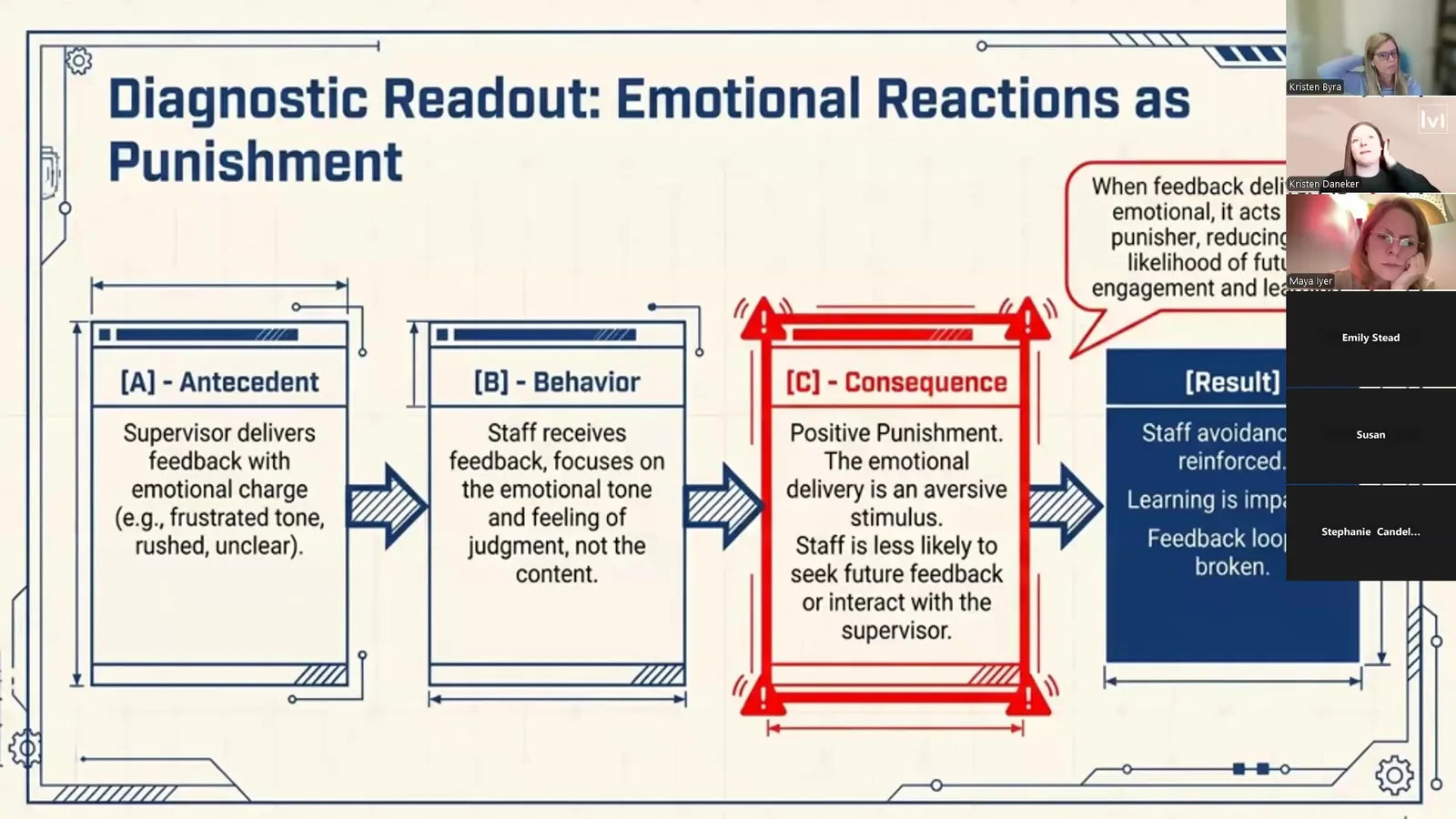
Let’s start with the obvious. If your feedback worked, your staff’s behavior would have changed already. But instead, you’re repeating yourself, softening your message, waiting for supervision… and somehow expecting a different outcome. Meanwhile, the behavior you’re trying to fix is being reinforced in real time. This CEU pulls back the curtain on why feedback fails, and no, it’s not because your staff are “difficult.” It’s because most leaders were never taught how to give feedback and definitely not how to use it as a behavior-change procedure. We’ll break down the five system failures that quietly sabotage your feedback (think: vague expectations, delayed timing, reinforcement gaps, sugarcoating, and zero follow-through) and use the ABC framework to analyze how your own behavior as a supervisor may be maintaining the problem. Then we fix it. You’ll learn how to diagnose whether you’re dealing with a skill or performance issue, apply Behavior Skills Training (BST) instead of “broadcasting into the void,” and use real-time, objective data to make feedback land without defensiveness. At the end of the day, if nothing changed, it’s not a communication issue, it’s a system failure. And this training shows you exactly how to fix it.
Register free & watch nowCancel any time. Cert delivered to your inbox the moment you pass the quiz.
About this CEU
Let’s start with the obvious. If your feedback worked, your staff’s behavior would have changed already. But instead, you’re repeating yourself, softening your message, waiting for supervision… and somehow expecting a different outcome. Meanwhile, the behavior you’re trying to fix is being reinforced in real time. This CEU pulls back the curtain on why feedback fails, and no, it’s not because your staff are “difficult.” It’s because most leaders were never taught how to give feedback and definitely not how to use it as a behavior-change procedure. We’ll break down the five system failures that quietly sabotage your feedback (think: vague expectations, delayed timing, reinforcement gaps, sugarcoating, and zero follow-through) and use the ABC framework to analyze how your own behavior as a supervisor may be maintaining the problem. Then we fix it. You’ll learn how to diagnose whether you’re dealing with a skill or performance issue, apply Behavior Skills Training (BST) instead of “broadcasting into the void,” and use real-time, objective data to make feedback land without defensiveness. At the end of the day, if nothing changed, it’s not a communication issue, it’s a system failure. And this training shows you exactly how to fix it.
Credits
1 supervision CEU · 61 min
From the talk
What was covered
A board certified behavior analyst (BCBA) breaks down five system failures behind feedback that doesn't change staff behavior. She also shows how to fix each one.
- Before you repeat yourself again, ask what is missing in your system instead of what is wrong with the person.
- Rewrite every expectation until it names the action, the standard, and the deadline.
- Attach a reinforcement plan (a reward that follows the behavior) to expected behavior. Otherwise natural consequences will beat your feedback every time.
- Coach the person through the task once. If they can do it with you there, it is a performance problem, not a skill problem.
- Replace telling with BST (behavior skills training): explain, model, let them try, then rehearse with feedback until they are competent.
- Ground follow up in a score or checklist so the talk is about data instead of personality.
Why Saying It Again Does Not Change Staff Behavior
If your feedback worked, the behavior would already look different. Instead you repeat yourself, soften the message, and wait for the next supervision meeting. The behavior you want to fix keeps getting reinforced (made stronger by what follows it). That happens in real time, while you wait.
Three lines show up again and again in this field. I already told them. It is part of their job description. I just gave them feedback last week. Saying a thing out loud feels like communication, but the two are not the same.
We are trained to analyze client behavior. We run the ABC sequence: what comes right before a behavior, and what comes right after. We look at the data, change the setup, and adjust the consequences. Then we supervise staff and drop all of it. We use one approach for everyone, and we talk at people instead of teaching them.
Feedback is a precise behavior change procedure. It is not a poster in the break room, and it is not advice over coffee. Some hires really are a bad fit, and this field is not for everyone. But most of the time the person is working just fine inside a broken system.
So really I encourage everybody on this call to stop asking what's wrong with them and start asking what's missing in my system.
From the talk — Kristen Daneker, BCBA
System Failure 1: Vague Expectations You Cannot Measure
Daneker calls the first one the fog of unmeasurable expectations. The feedback is not specific, observable, or countable. Be more positive. Your attitude was unhelpful. Those sound like feedback, but they leave the whole thing open to guessing. Be more positive to whom? Smile more? Give more praise to the client?
The fix is to say what you can see and count. You need to meet your deadlines is vague, because most staff carry many deadlines at once. Submit the report by Thursday at 5pm gives the person something they can actually do.
She tested two phrases on the room. Run the plan with fidelity (run it the way it is written). Offer choices when possible. The chat called both of them vague. How many choices? Two or seventeen? Does being done for the day count as one? Attendees offered strong fixes. One suggested a written rubric. Another suggested a teach back check. A third suggested IOA (two people scoring the same thing), so definitions stay steady across staff.
Jargon is part of the trap. Daneker said she once used the word fidelity, and a listener thought she meant something else entirely. Our field uses words that feel exact to us. They can land as noise for the person doing the work.
The good news is the fix for this particular system failure is to make feedback more observable and measurable.
From the talk — Kristen Daneker, BCBA
System Failure 2: The Reinforcement Vacuum
The second failure is a reinforcement vacuum. A behavior happens and nothing follows it. Over time that behavior drifts toward extinction (it fades out without reinforcement). We do this most often with behavior we label as expected.
They should come to work on time. They signed the handbook, so they know the dress code. I already pay them, so why reinforce any of that? Expected behavior still needs a contingency (an if then link to a result). Without one, it will not hold for long.
Natural consequences rush in to fill the gap, and they usually win. Say the session note is due today. If nothing happens when it lands today, and nothing happens when it lands next week, why hurry? Or picture a tech asked to finish a toileting routine. If skipping it avoids a long escalation in the bathroom, that relief will beat your feedback every single time.
We know that behavior goes where reinforcement flows.
From the talk — Kristen Daneker, BCBA
System Failure 3: Skill Deficit or Will Deficit
Failure three is misreading the root problem. Daneker uses a simple grid, with skill on one side and will on the other.
Low skill and high will is the eager person who needs more training. They want to run the protocol well, but they cannot yet do it across settings and across people. Train them. High skill and low will is the person who clearly can do it. They did it before, and now it slips when nobody is watching. That one calls for reinforcement and an environment change, not another training.
Low skill and low will is the box leaders love to blame. She says that is rarely the real story. High skill and high will are your strongest staff. They still need reinforcement, or that high level of work will not last.
There is a fast test. Stand next to the person and coach them through the task. If they still cannot do it, you have a skill deficit (they do not know how yet). If they can do it with you right there, you have a performance problem. We would never call a client a bad client. We would ask how to set that client up to win.
And there is an overemphasis on this will idea when a lot of times it is a skill deficit issue.
From the talk — Kristen Daneker, BCBA
System Failure 4: Broadcasting Instead of Using BST
Telling is only about 25 percent of the job. Her example comes from the operations side of the house. A team is asked to hand count client cancellations for two weeks. They compare the count to the EHR (the electronic record system). Then: go. You will get six spreadsheets and six readings of the same task, and none of it will add up cleanly.
Behavior Skills Training, or BST (explain, model, practice, then give feedback), closes that gap. Walk through the problem and the three columns that matter. Model it: here is where this number comes from, and here is the cell that does the math. Then let them try while you sit with them. Then rehearse and give feedback until they are competent. There is no set number of trials, just like with our clients.
Two things go wrong here. Teams call their training BST when steps are missing. Or they run all four steps the exact same way for every single person.
BST feels easy with concrete tasks like a tracker. It gets hard with open ended skills. You cannot train every version of pretend play. Teach the thinking, model a range of examples, and ask staff to rehearse a new variation each time. For a team of six, or for adult services with thin supervision time, she had suggestions. Try group supervision, or record a model of the steps.
And one of the key takeaways here is that we do have to have individualization for our staff.
From the talk — Kristen Daneker, BCBA
System Failure 5: No Follow Up, No Data, No Accountability
The last system failure is what she calls the ghosting of accountability. The feedback was clear. The expectation was fair. Then nobody went back to it. No one tracked the work, so nobody can say if the trend is going the right way.
Grounding follow up in data closes that loop, and it changes how the message lands. You are inconsistent feels like a personal attack. You completed 50% of the trials correctly is a fact on a page. One starts a fight. The other starts a plan.
Useful tools here include IOA checks, fidelity checklists, audit tools, and performance monitoring. Build in a self score so staff rate their own work first.
One attendee supervises a very large team and gives detailed written feedback on behavior plans. The same issues keep coming back. Daneker's answer was an audit tool the writer uses before they submit. They score themselves, fix what they catch, then send it in. Now the talk is about moving from 65% to 100%, not about red pen all over the report.
So data removes the ego, it removes some of the defensiveness.
From the talk — Kristen Daneker, BCBA
Feedback Delivery Failures: Timing, Avoidance, and Sugarcoating
Good systems still break at delivery, and timing comes first. Feedback works best close to the behavior, much like reinforcement does. Picture a tech teaching handwashing steps in the wrong order. One method teaches the first step first (a forward chain). The other teaches the last step first (a backward chain). If the tech uses the wrong one, speak up right away. Otherwise the errors repeat and the client gets confused.
Some feedback should wait. If that same tech rolls their eyes at a colleague, you do not handle it in front of the client. You ask for a few minutes after session. That is a delay, and a delay is fine. Same day and in private is the target.
Avoiding is not delaying. Avoiding feels kind, and it works like negative reinforcement (relief that makes the behavior repeat) for the supervisor. You skip the hard talk and your own discomfort drops. The staff member hears nothing, so the error rolls on. Two things can be true at once. Someone can be strong clinically and still need feedback about six call outs in a month.
Sugarcoating is avoidance in a nicer outfit. A staff member wears sandals to session. The supervisor says they love the sandals and suggests sneakers next time. The staff member hears the compliment, and the sandals come back. Kim Scott calls this ruinous empathy (caring so much that you avoid telling the truth) in her book Radical Candor. The same thing happens in writing, with softening emojis and a row of exclamation points.
We are not taco carts. We are going to have to deliver messages in a kind, clear, direct way that people aren't going to like.
From the talk — Kristen Daneker, BCBA
When Frustration Turns Your Feedback Into a Punisher
The final delivery failure is frustration. You were vague, you never reinforced, you never trained, and nothing changed. So the tone sharpens. Now your feedback works like a punisher (something that makes behavior drop).
Staff stop hearing the content and start reading your face. They avoid you. They stop asking for your input at all. That is where the flinch comes from when a supervisor asks, can I give you feedback? Nobody is born hating feedback. People learn it from weak systems and rough delivery.
She was direct about what this means for supervisors. Most of us were never taught any of this. Noticing the gap is step one. Changing your own behavior is step two.
Delivery can also be shaped for each person. She asks in interviews, and again at onboarding, how someone wants to receive feedback. Some people hate social praise (praise and attention given by others). For some, do you have a few minutes to touch base sets off a spiral. Naming the topic helps: wanted to circle back to the handwashing protocol. Treat your staff the way you treat clients: get to know them and build trust.
So sometimes it is you. Sometimes it is the system. Sometimes it's both.
From the talk — Kristen Daneker, BCBA
Common questions
Why doesn't my feedback change staff behavior?▾
Most of the time the message was delivered but the system behind it was not built. The expectation may be vague, nothing reinforces the new behavior, no one modeled it, and nobody follows up. Feedback is a behavior change procedure, so it needs all of those parts to work.
How do I tell a skill deficit from a will deficit?▾
Stand next to the person and coach them through the task. If they cannot do it even with your help, it is a skill problem and they need training. If they can do it with you there but not alone, look at reinforcement and the environment instead.
Is it okay to delay feedback instead of giving it in the moment?▾
Yes, when the moment is wrong. You do not correct an eye roll in front of a client or a colleague. Ask for a few minutes after session, and keep it to the same day. Delaying is fine; avoiding is a different thing.
How can I use BST with a big team or with open ended skills?▾
For large teams, try group supervision or record a model of the steps so staff can watch the workflow. For open ended skills like pretend play, you cannot train every example. Teach the thinking, model several variations, and ask staff to rehearse a different version each time.
How do I give corrective feedback without staff getting defensive?▾
Swap the label for the number. You are inconsistent sounds personal, while you completed 50% of the trials correctly is just data. Use fidelity checklists, audit tools, and self scoring so the conversation is about the record, not about the person.
About the speaker
Kristen Daneker is a board certified behavior analyst with nearly 20 years in behavioral health and applied behavior analysis. She has held senior clinical and operational leadership roles. She is known for a direct, practical approach that closes the gap between strategy and reality. She founded Level Up Leadership. She also created Where is the Feedback, a 12 week leadership certification on giving, receiving, and applying feedback.
This summary was generated from the recording’s transcript. Quotes are taken word for word from the talk.
What you'll learn
- 11) State the five system failures that contribute to ineffective feedback in supervision 2) Identify breakdowns in feedback contingencies that prevent behavior change in staff 3) Analyze supervisory behavior using the Antecedent-Behavior-Consequence (ABC) framework 4) Differentiate between skill deficits and performance (will) deficits when evaluating staff behavior 5) Apply Behavior Skills Training (BST) to move from “talking at staff” to actually training them 6) Utilize real-time, objective data to reduce defensiveness and increase accountability in feedback conversations 7) Apply behavior-analytic strategies to improve feedback effectiveness
Related talks
Talks that cover the same concepts
When You’re Everyone’s Support: Building Sustainable Leadership.
Behavioral Wellness Coaching, LLC

Crash Course in Behavior Analytic Toilet Training: Translating Research to Practice
Copper Consulting Group

Beyond Competence: Using ACT to Cultivate Psychological Flexibility in Behavior Analytic Supervision
Rooted Consultation, LLC

A New Era of Fieldwork: Navigating the 2027 BACB Supervision Requirements
Rooted Consultation, LLC

Providing Fieldwork Supervision in a School Setting
Rooted Consultation, LLC

Eight Hours Get You the Mug: Building Supervisors Who Can Actually Fill It
Rooted Consultation, LLC
More from Upskill ABA
A Panel on Collaboration in Practice: SLP, OT & ABA Services
Upskill ABA
From Peer to Professional: Becoming & Supporting Early Career Behavior Analysts
Upskill ABA
From Idea to IRB: Conducting Research in Your ABA Practice
Upskill ABA
OpenCEU is supported by advertising from third-party sponsors. Sponsors are clearly labeled, have no influence over course content, instructors, or CEU decisions, and never appear on certificates. The BACB does not sponsor, approve, or endorse OpenCEU sponsors or their products.