Mastering Your Time: Preparing for Service Delivery
Free · 1 PDU · 4.8★ from 13 attendees
Effective time management is an essential component of quality ABA service delivery. RBTs are responsible for balancing multiple responsibilities during sessions, including implementing treatment programs, collecting data, preparing materials, supporting transitions, and maintaining meaningful engagement with learners. Without intentional preparation and organization, valuable instructional opportunities can be missed. This professional development session focuses on practical strategies RBTs can use to improve preparation, organization, and time management before and during service delivery. Participants will be introduced to the RPPC framework (Review, Plan, Prepare, Clarify), which provides a structured approach to preparing for successful sessions. The session will also explore strategies for organizing instructional materials, anticipating learner needs, managing transitions, reducing unnecessary downtime, and maximizing meaningful learning opportunities. Emphasis will be placed on balancing efficiency with quality care, including maintaining treatment integrity, building rapport, respecting learner assent, and remaining responsive to individual client needs. Through practical examples, real-world scenarios, and guided reflection, participants will consider how their daily preparation and decision-making influence the quality and effectiveness of ABA services. Participants will leave with actionable strategies they can incorporate into their daily routines to become more prepared, purposeful, and intentional in their approach to service delivery.
Register free & watch nowClaim your BACB PD form as soon as you pass the quiz.
Presented by Ashley Andrew
Learner ratings
from 13 learners
100% would recommend this PDU to other professionals in their field (13 responses)
“Great lesson!”
— Kelsey E.“was really good”
— Lisandra S.“Compared to the other presentation on a similar topic by the same presenter, quality of this particular PDU was significantly improved and had more meaningful information embedded throughout. Good job!”
— Trysta G.
About this course
Learn practical strategies to improve time management and preparation for ABA service delivery. This session introduces the RPPC framework (Review, Plan, Prepare, Clarify) and explores ways RBTs can maximize meaningful learning opportunities, minimize downtime, and make intentional use of session time while maintaining treatment integrity and learner engagement.
Abstract
Effective time management is an essential component of quality ABA service delivery. RBTs are responsible for balancing multiple responsibilities during sessions, including implementing treatment programs, collecting data, preparing materials, supporting transitions, and maintaining meaningful engagement with learners. Without intentional preparation and organization, valuable instructional opportunities can be missed. This professional development session focuses on practical strategies RBTs can use to improve preparation, organization, and time management before and during service delivery. Participants will be introduced to the RPPC framework (Review, Plan, Prepare, Clarify), which provides a structured approach to preparing for successful sessions. The session will also explore strategies for organizing instructional materials, anticipating learner needs, managing transitions, reducing unnecessary downtime, and maximizing meaningful learning opportunities. Emphasis will be placed on balancing efficiency with quality care, including maintaining treatment integrity, building rapport, respecting learner assent, and remaining responsive to individual client needs. Through practical examples, real-world scenarios, and guided reflection, participants will consider how their daily preparation and decision-making influence the quality and effectiveness of ABA services. Participants will leave with actionable strategies they can incorporate into their daily routines to become more prepared, purposeful, and intentional in their approach to service delivery.
Credits
1 PDU · 50 min
From the talk
What was covered
Ashley Andrew's RPPC framework for RBT session prep, plus in-session data tricks, smoother transitions, and honoring assent.
- Run RPPC before every session: review notes, prepare materials, plan around the learner's interests, and clarify questions with your BCBA.
- Pull only today's target materials, like cars in the two colors still being taught, instead of the whole bin.
- Treat transitions as teaching time: use warnings, timers, and visual schedules, and move from one preferred activity to another.
- Record data in the moment using note card piles or a clip-on counter so you can change course mid-session.
- Be ready at any second to say how the current activity supports a goal in the treatment plan.
- Ask for help when you fall behind, and pause on any protocol you don't understand until someone explains it.
Why Session Preparation Is a Quality Issue, Not a Scheduling One
Ashley Andrew opened with a clear point: how you use session time is a quality issue. RBTs (the techs who run daily sessions) spend more time with learners than supervisors do. The choices you make in the ten minutes before a session shape the whole hour. Preparation is not a topic you finish in the 40 hour RBT training and then leave behind.
She described preparation as four linked actions: planning, engaging, implementing, and documenting. Before introducing her system, she asked the audience to reflect first. What gets in the way of your prep right now? What are you already doing well? That honest look is what makes the next session different.
The cost of weak prep shows up fast in a treatment room. Poor preparation creates a time gap. That gap becomes a lull, and the lull becomes wait time for the learner. Kids fill wait time with something, usually problem behavior or quiet disconnection from you. When prep is strong, learners stay engaged, problem behavior drops, and practice opportunities go up.
So are you being intentional or are you just simply keeping kids busy?
From the talk — Ashley Andrew
The RPPC Framework: Review, Prepare, Plan, Clarify
RPPC is Andrew's own memory aid, and she said plainly that she made it up. She built the acronym by asking what she actually does to get ready for a session. The four parts are review, prepare, plan, and clarify. All four happen before the learner walks in.
Review means looking at current programming and treatment priorities. She starts in her clinic's data system. There she checks what the learner did last session and whether progress is happening. Then she reads the SOAP note (a short written session record) to see what went well and what did not. She also checks the reinforcers (things that motivate repeating). She looks for setting events (things like hunger or sleep) that a caregiver reported.
Prepare means setting up the room and the materials to match that review. Gather items tied to the learner's targets and put the visual supports in place. If you are teaching a new game, have the visual routine ready before you sit down. Keep the reinforcement system close. Keep the communication system within reach too. That might be a break card, a help card, or a my turn card.
Plan means planning with a purpose rather than following the learner around. If trains are the draw, use trains to pull communication, engagement, and play with a peer. Follow the learner's lead, but hold high expectations. Know the behavior intervention plan (the written plan for behavior) too. Clarify is where leftover questions go. Ask your BCBA (the supervising board certified analyst) or lead how to use the learner's interests. Maybe that means numbers for listener responding (following what someone says), or bubbles for peer engagement.
This isn't a time where we're just following our clients around.
From the talk — Ashley Andrew
Case Study: The Learner Who Only Wants Cars and Ramps
The first case was a five year old who loves cars, ramps, and sensory bins. You have ten minutes before the session starts. The targets are requesting with a device, one step directions, identifying colors, and tolerating brief delays to reinforcement. During the last session, the learner stayed with the cars and got very few chances to communicate.
Review starts with the real numbers, not your impression. Check the AAC device (a tool that speaks for the learner) data. How many requests happened, and which one step directions went well? Andrew's color example was specific: orange and pink are strong, but green and red still need work. For delays, check how long the learner actually waited, five seconds or ten. That tells you a fair starting point.
The plan puts the targets inside the play the learner already wants. Put the lid on the sensory bin. Now the learner has to request help opening it. Keep the small items in a bag you hold. Then the learner requests the dinosaur or the shovel instead of grabbing. For one step directions, set the car at the top of the ramp. Model revving the engine, then ask for it on the next trial.
Preparation follows directly from that plan. Pull only the target color cars and bin items. Keep preferred items and the device close. Add a wait signal too, such as red for wait and green for go. For clarify, Andrew would ask the previous RBT what they tried for the communication goal and what actually worked.
Because we want to replicate things that are going well and we don't necessarily want to keep trying the things that aren't going well.
From the talk — Ashley Andrew
Case Studies: A 15-Minute Transition and a Bored Learner
The second case was a seven year old who struggles to leave the sensory room. The last transition ate 15 minutes. Review asks what the learner is actually seeking in that room. Can you bring the same experience to the clinic room? Check the data, and ask the BCBA or the last RBT what was already tried during those 15 minutes.
The plan avoids moving from a high preferred activity straight to a low preferred one. Go high to high instead. Maybe the spinny chair in the clinic room is a hit. Put it on the visual schedule right after the sensory room. If peer time matters to the learner, walk together to a room with peers. Warnings, timers, and visual supports get prepared ahead of time. Clarify means asking your supervisor what to try next. Long bouts of problem behavior are not yours to carry alone.
The third case was an eight year old who likes puzzles, coloring, and building. Today he walks the room and pushes materials away. He ignores your attempts to engage, while acquisition targets (new skills being taught) pile up. Review whether the disengagement is new. Maybe the targets have gotten too easy. Or maybe he is satiated (bored with a once favorite thing) on one puzzle.
Prepare alternates before you need them. Tape a puzzle to the wall instead of using the table. Color on a whiteboard with dry erase markers, or switch to paint. Swap Duplo blocks for magnet tiles or Jenga. Andrew would also be ready to run a preference assessment (a quick check of favorites). Those three old activities may simply be done.
15 minutes of a delay to transition is 15 minutes of lost instructional time.
From the talk — Ashley Andrew
Case Study: Five Minutes to Prep When You Are Running Late
The last case was about the technician, not the learner. Andrew admitted she has been late before too, though not often. Here is the setup: the SOAP note is unread, and you do not know which target needs practice. The reinforcement materials are missing, and there is a protocol change you do not understand. You have five minutes.
Her order of operations is worth copying. Review the SOAP note first, since it tells you what worked last time. Then you can at least replicate what went well. Glance at the behavior protocol, but do not spend all five minutes on it. Then plan by asking for help. A lead, a BCBA, or a technician on break can help. They can review notes with you or hold your client for a few minutes.
Prepare by taking a breath. You have to stay regulated (calm and in control) to help your learner stay regulated too. Pull a few materials for practice, and protect the learner's routine. Ask a teammate to set up the train set, or grab the goldfish the learner expects at arrival. For clarify, find the person who knows that protocol. She would rather staff ask questions than guess and run something wrong.
One caveat came up twice: this cannot become a pattern. A team rescue plan is for the rare bad morning, not a weekly habit.
It's okay to pause on a protocol if you don't understand it, as long as you're seeking clarification on how to run it.
From the talk — Ashley Andrew
Televisability: Explaining What You Are Doing and Why
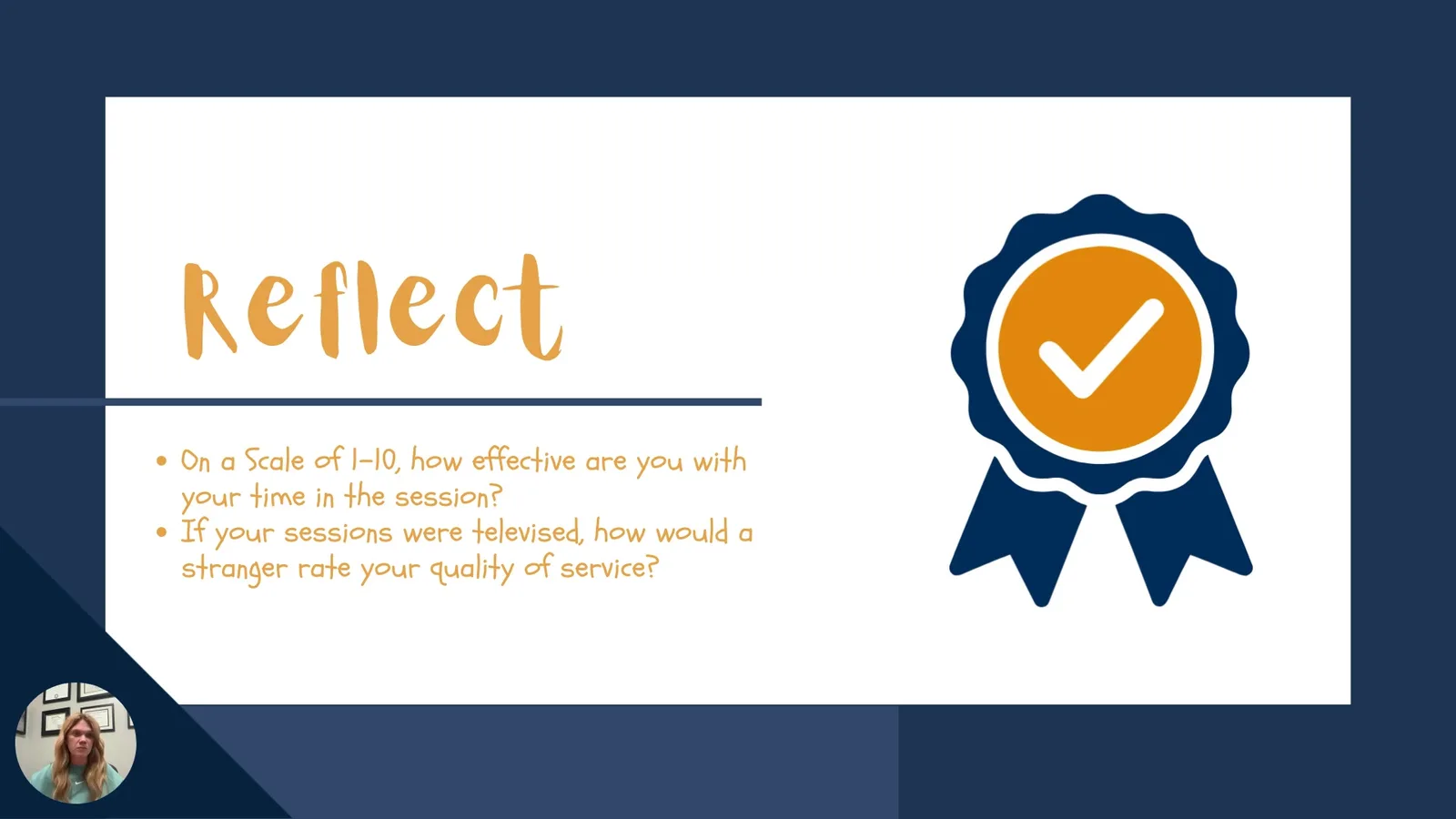
The second half of the talk moved from prep into session time itself. Andrew asked participants to rate their own time use from one to ten. Then she added a sharper question. If your session were broadcast in Times Square, how would a stranger rate the quality of care? She calls this televisability, an idea she credits to Greg Hanley's work.
The test is practical, not philosophical. At any moment, you should be able to explain how the current activity supports the learner's treatment goals. Andrew gave an example from her own clinic's hallway. She walks into a room, sees a barn and barn animals, and asks what they are working on. A strong answer names feature function class (naming traits, uses, and groups), or animal sounds for back and forth talk. A weak answer is that the learner just started playing with it.
Televisable does not mean nonstop demands, and Andrew said so directly. It means pairing (playing with the learner before asking for work) and real engagement with what the learner is doing. If you only approach a learner to deliver work, you become the person who brings demands. Leaning in means joining what they are already doing, as they tolerate it.
Assent (the learner's ongoing willing participation) is not a five minute warm up at the start. Look for it the whole session, and give the learner your full focus. Remove distractions, and watch your own patterns, whether that is a watch buzzing or a phone in your pocket. She banned phones from her clinic rooms a couple of years ago for exactly that reason.
My belief is that if you're not having fun, the kids probably aren't either.
From the talk — Ashley Andrew
Collecting Data as You Go Instead of Catching Up Later
Data collection drew some of her strongest language in the talk. Record responses and behaviors as they happen, rather than saving the last 10 or 15 minutes to catch up. She said research shows accuracy drops a lot when data is not taken in the moment. Memory is not a measurement system.
Her live example made the point concrete. She wanted at least ten trials of single gross motor imitation (copying a body movement) with one learner. Because she entered and graphed data as she went, she saw six wrong responses in a row. She shifted her approach during that same session. Behavior data carries the same risk. After an intense burst, was it five aggressions, seven, or ten?
Her tricks are low tech and easy to steal. For fast, mixed and varied DTT (fast structured teaching trials), use a note card for each target. Even a card that just says raise your hand works. Sort cards into piles as you go: face up for correct, face down for incorrect. Rubber band the piles and label them. Next session's prep is already half done. You know where to add prompting, or use errorless learning (teaching with help first). You also know where to fade prompts (give less help over time).
For counting communication attempts across a 30 minute block, she clips counters to her belt loops. She presses a button as opportunities happen. That beats reaching for an iPad every few seconds. If collecting data as you go feels impossible with your learner, treat that as a clarify question for your BCBA.
So data collection is the most essential part of service delivery when it comes to outcome measurement.
From the talk — Ashley Andrew
Making Transitions Work for You, and What to Do Tomorrow
Transitions can be teaching time instead of dead time. They are built in chances to practice communication, flexibility, and independence. Get the next activity out while the learner finishes the current one, not five minutes early, just ready and within reach. Asking a learner to clean up first fills the transition with a skill that matters at school and at home too.
If transitions are hard for your learner, look at the antecedent side (what happens right before the behavior) of the plan. Warnings, timers, and visual schedules belong in the prepare step, not in the moment of crisis. Her reasoning was blunt: kids who are having problem behavior are not learning. Happy, relaxed, and engaged learners give you more chances to teach.
Inside the session, implement protocols consistently and as written, since that is what makes the data mean something. If you run it as written and the data moves the wrong way, tell your supervisor. Know the reinforcement system and how often your learner needs access to it. Know what prompting the learner needs, and what the learner will tolerate. If a hand over hand prompt (guiding the learner's hands) is written in and tolerated, plan how you will fade it quickly.
Flexibility and treatment integrity (running the plan as written) are not opposites in her view. Swap toys when interest fades, and pivot to get the learner happy and engaged again. Then bring the problem back to your supervisor for other suggestions or a model. She closed with three questions. What will you do differently tomorrow? What will you discuss with your supervisor? What do you want to learn more about? Two tools support that work: a reflection and application sheet, and an RBT self monitoring log. You fill out the log across several days to spot your own patterns.
Transitions do not have to be lost time.
From the talk — Ashley Andrew
Common questions
What does RPPC stand for in ABA session preparation?▾
RPPC stands for review, prepare, plan, and clarify. Ashley Andrew created it as a memory aid for what an RBT does before a session starts. Review the data and session notes. Prepare the room and materials. Plan around the learner's interests and the behavior plan. Then clarify any leftover questions with your BCBA or lead.
How can an RBT create more meaningful learning opportunities in a session?▾
Build targets into the activities the learner already prefers. For example, have the learner request items from a bag you hold during sensory bin play. Model skills inside the play instead of pulling the learner to a table for every trial. Watch for satiation (losing interest from too much repetition), and have alternate materials ready so engagement does not stall.
How do you collect ABA session data without losing teaching time?▾
Record as responses occur rather than reconstructing at the end, since accuracy drops when you rely on memory. Andrew sorts note cards into correct and incorrect piles during fast trials, then bands and labels them for the next session. For frequency counts, she clips counters to her belt loops and presses as opportunities happen.
What reduces downtime during transitions?▾
Have the next activity out and within reach while the learner finishes the current one. Avoid moving from a high preferred activity straight to a low preferred one. Use a visual schedule, warnings, and timers instead. Filling the transition with a skill, like cleaning up, turns the gap into practice.
Does using time efficiently mean running more demands?▾
No. Andrew was clear that constant demands make sessions less effective, not more. Efficiency means every minute has a purpose. That includes pairing, relationship building, and honoring assent, while still connecting activities to the treatment plan.
About the speaker
Ashley Andrew is a board certified behavior analyst (BCBA) and owner of an ABA clinic in rural Iowa. She has more than 15 years of experience working with neurodiverse children. She earned her educational specialist degree in school psychology at the University of Northern Iowa. She has worked across educational and clinic settings, with some experience in residential settings as well. She later considered pursuing PK-12 principalship and special education director credentials, but returned to ABA work instead. She has taught at universities and community colleges and has led professional development for adult learners.
This summary was generated from the recording’s transcript. Quotes are taken word for word from the talk.
What you'll learn
- 11. Identify four components of effective preparation using the RPPC framework. 2. Describe at least three ways to increase meaningful learning opportunities during a session. 3. Identify strategies to reduce unnecessary downtime during transitions. 4. Apply time-management strategies to a simulated therapy session while maintaining treatment integrity and client assent.
Concepts in this course
Course materials
Sign in and register for this course to download these files.
Related talks
Talks that cover the same concepts

Mastering Your Time: Preparing for Service Delivery
Innovative Behavioral Therapy

Beyond Table Work
ABA Collective / Camber
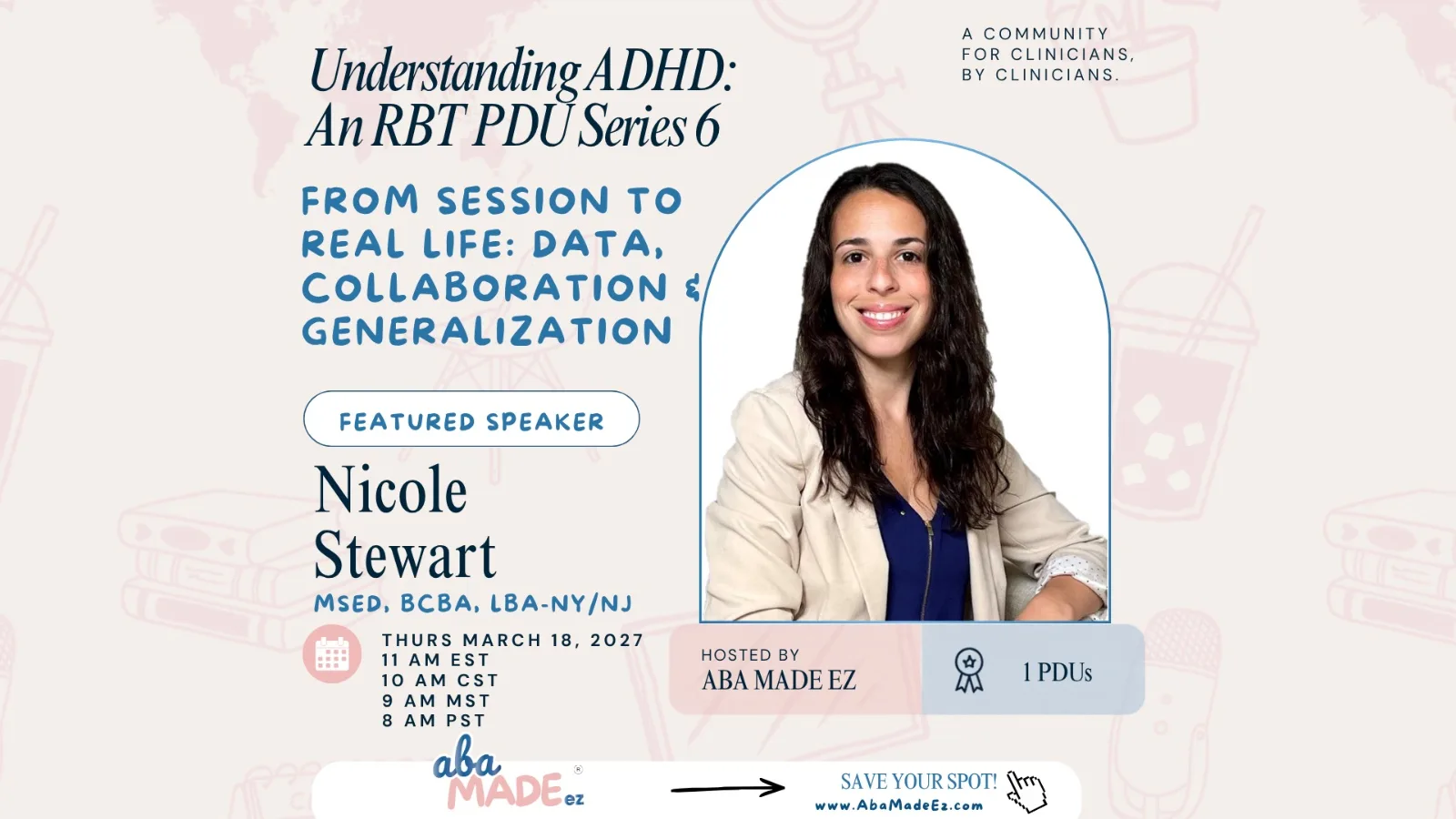
Understanding ADHD: An RBT PDU Series 6: From Session to Real Life: Data, Collaboration & Generalization
ABA Made Ez
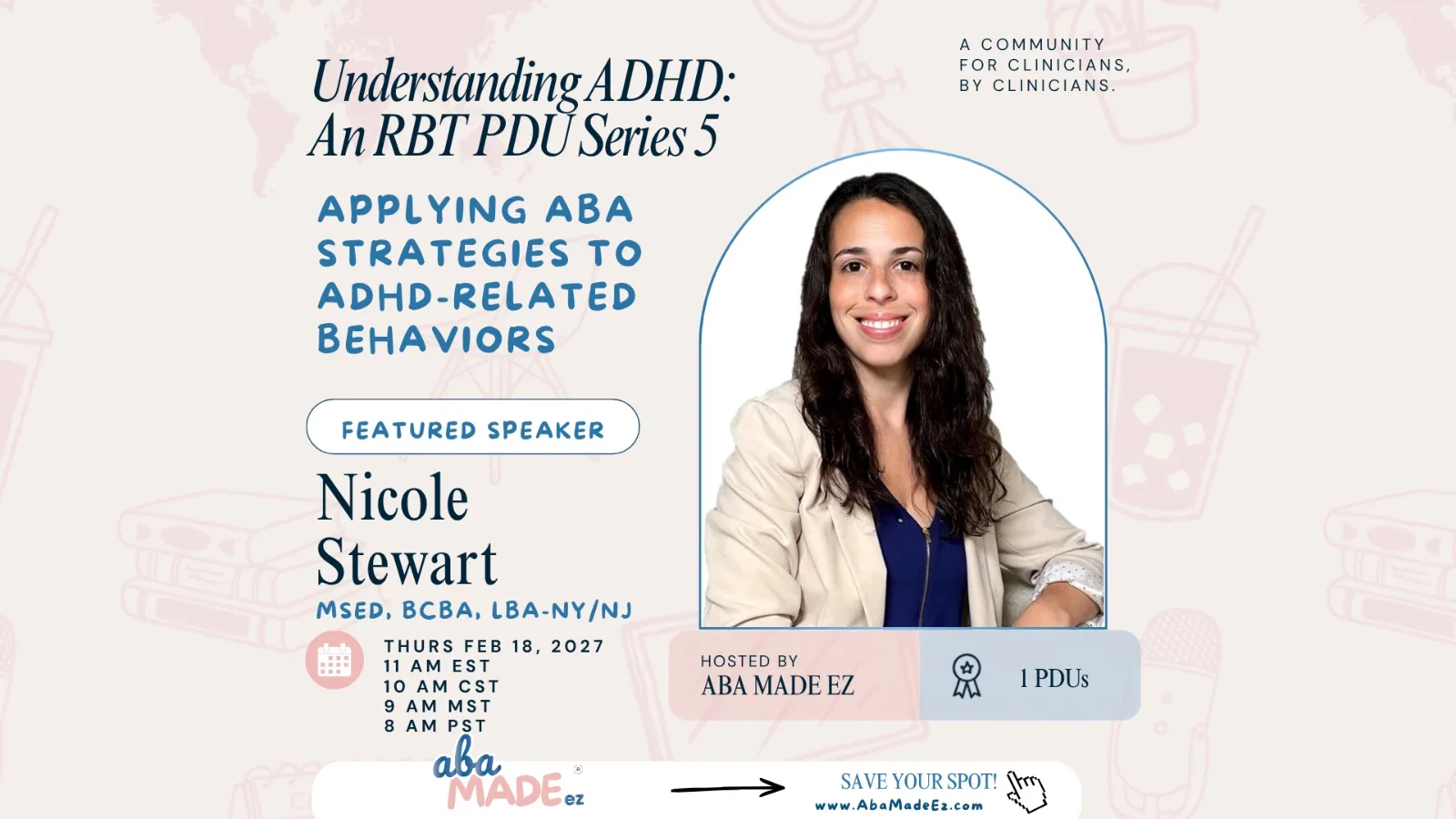
Understanding ADHD: An RBT PDU Series 5: Applying ABA Strategies to ADHD-Related Behaviors
ABA Made Ez
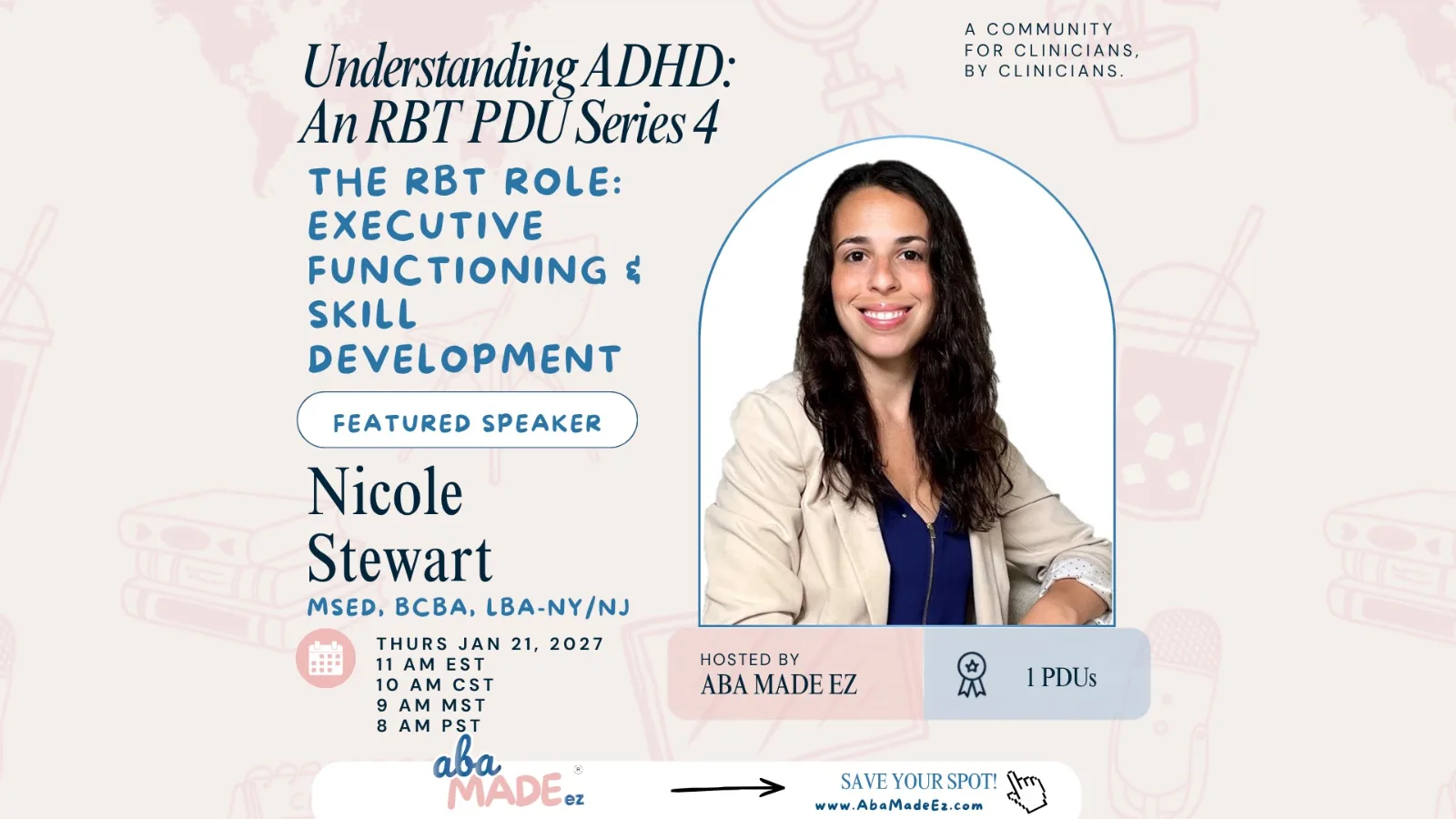
Understanding ADHD: An RBT PDU Series 4: The RBT Role: Executive Functioning & Skill Development
ABA Made Ez
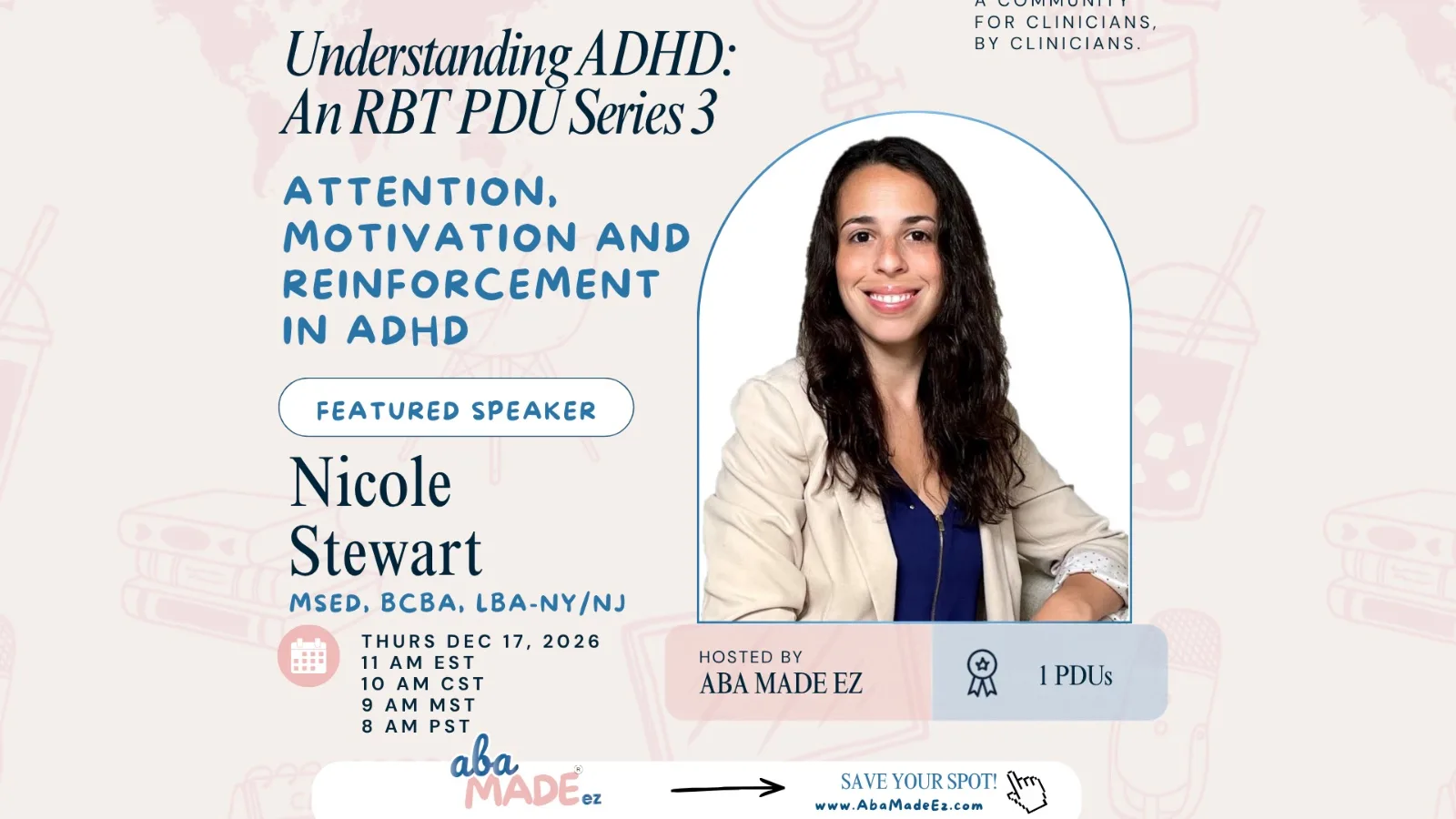
Understanding ADHD: An RBT PDU Series 3: Attention, Motivation and Reinforcement in ADHD
ABA Made Ez
OpenCEU is supported by advertising from third-party sponsors. Sponsors are clearly labeled, have no influence over course content, instructors, or CEU decisions, and never appear on certificates. The BACB does not sponsor, approve, or endorse OpenCEU sponsors or their products.