Dunder Mifflin’s Guide to BCBA Supervision: Lessons from The Office
Presented by Mellanie Page
This interactive CEU brings supervision to life through the lens of The Office, leveraging satirical workplace scenarios to examine evidence-based practices for supervising RBTs and behavior analytic staff. Participants explore how to build trust, nurture professional development, reduce burnout, and provide clear, effective feedback through humor, guided reflection, and practical examples. Topics include behavior-specific feedback, bias management, performance tracking, self-evaluation, and conflict resolution. Attendees leave with actionable tools to improve supervisory practices that are grounded in the ethics and science of Applied Behavior Analysis.
Register free & watch nowCancel any time. Cert delivered to your inbox the moment you pass the quiz.
Learner ratings
from 63 learners
100% would recommend this CEU to other professionals in their field (27 responses)
“Great information”
— Margaret A.“5/5 ⭐ ⭐ ⭐ ⭐ ⭐ Despite being sick! Super fun and super educational! 👏”
— Reagan P.“Well done”
— Rich W.“N/a”
— Kaitlyn S.“great”
— Matthew M.
About this CEU
This interactive CEU brings supervision to life through the lens of The Office, leveraging satirical workplace scenarios to examine evidence-based practices for supervising RBTs and behavior analytic staff. Participants explore how to build trust, nurture professional development, reduce burnout, and provide clear, effective feedback through humor, guided reflection, and practical examples. Topics include behavior-specific feedback, bias management, performance tracking, self-evaluation, and conflict resolution. Attendees leave with actionable tools to improve supervisory practices that are grounded in the ethics and science of Applied Behavior Analysis.
From the talk
What was covered
A recorded CEU (continuing education unit) that uses The Office to teach BCBA (board certified behavior analyst) supervision: behavior-first feedback, burnout signals, BST (behavior skills training), metrics, and conflict styles.
- Rewrite corrective feedback so it points at an observable behavior and invites the supervisee to solve the problem with you.
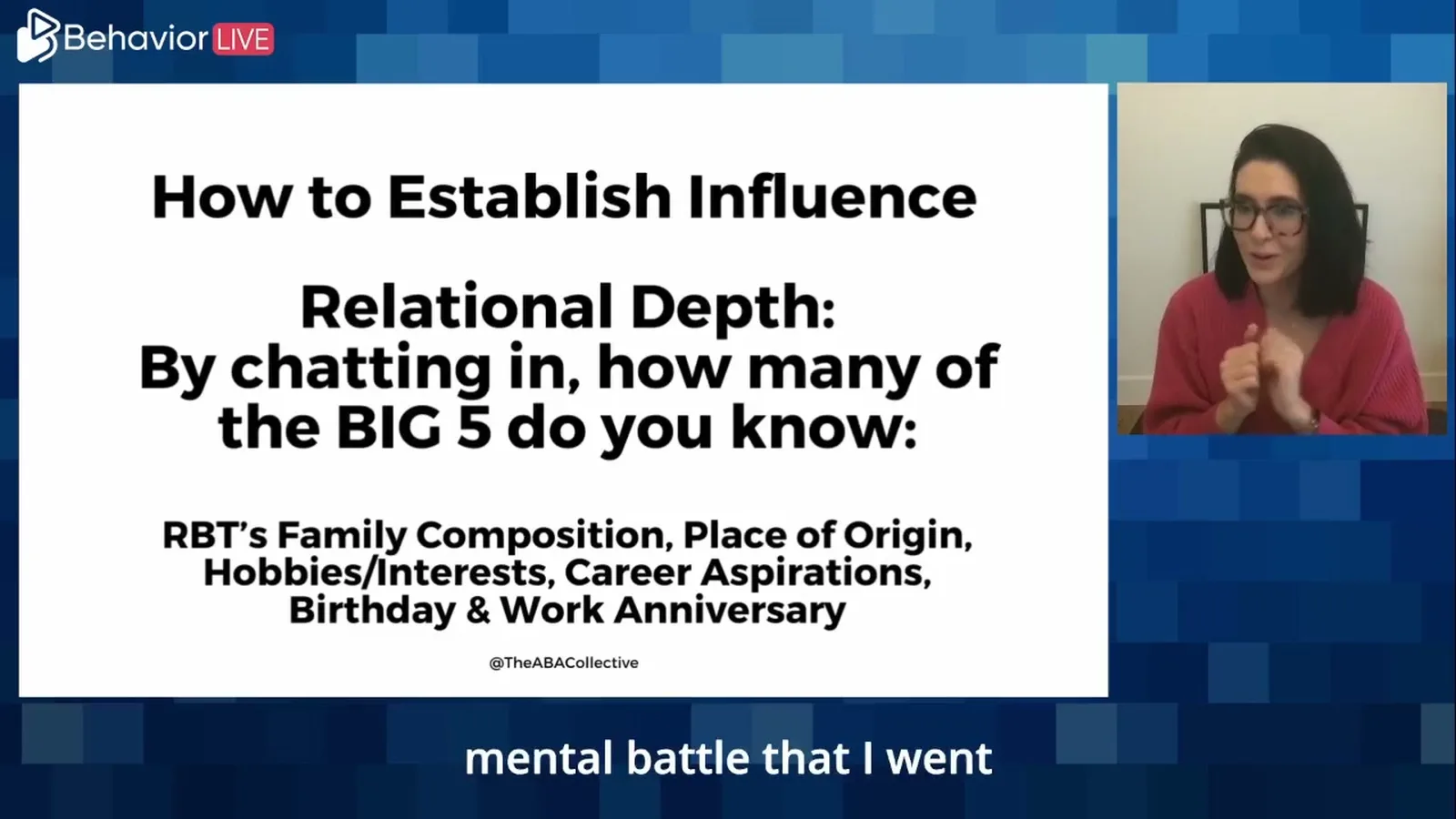
- Learn five basic facts about each person you supervise: family, where they are from, hobbies, career goals, and key dates.
- Give feedback continuously instead of saving it for a review. A surprised supervisee means you have not said it often or clearly enough.
- Train new skills with the four steps of BST: instruct, model, let them rehearse, then give specific feedback.
- When a supervisee gives you critical feedback, say thank you and skip the explanation. Otherwise you punish the next honest comment.
- Ask for a set number of items when you request feedback. For example, two things to start and two things to stop.
Why RBTs Treat the Job as a Stop on the Way Somewhere Else
The talk opens with a clip. Dwight has left Dunder Mifflin and is hunting for a new job. Page uses it to name a problem every clinic knows: turnover. Her framing question is blunt. How do you keep an RBT (the staff member who runs sessions) from passing through?
The answers she pulled from the room were not perks. They were relationship moves. Steady positive feedback. Check-ins on a set schedule, not whenever an hour opens up. Asking staff for their ideas about programming, then using them. Page noted that frequency itself sends a message. Checking in often shows you know the job is hard. Supervision can slide into pure critique, so she said to balance it with reinforcement (adding something that grows a behavior).
She pushed hardest on goal alignment. Supervisors often think their only job is the client's goals. Page argues you also have to learn what the RBT wants. Career plans. Skills they hope to build. Work they enjoy. Then link those to the client's goals and the agency's goals. That link is where buy-in starts. She also named a trap for new supervisors. You finally hold the expert seat, so you talk more and listen less.
And so finding those opportunities to pause and listen is so critical.
From the talk — Mellanie Page
Feedback That Points at Behavior Instead of the Person
This is the most concrete part of the talk. Page contrasts two versions of the same correction. The weak one: you are not keeping the client engaged during sessions, you need to be more playful. It is vague and it lands on the person. The strong one names what she saw. She says she has observed the client seeming less engaged during certain activities. Then she asks the RBT to brainstorm other activities with her.
She walks the same rewrite for session notes. The weak version says the notes are not detailed enough. The strong version points to the exact gap: the notes do not describe how the client responded to the intervention. She adds the payoff, that better detail raises the quality of the notes. Then she offers help and asks to run through one together.
Page's point is about where the supervisee is standing. In the first version they are the problem being pointed at. In the second they are beside you, looking at the same data. She did add one caveat about we language. If the issue is a specific behavior like being on time, say you. Saying we need to be punctual muddies the expectation when you are already there and they are late. Save partnership language for goals and planning.
So, again, one is a finger point and the other is a partnership.
From the talk — Mellanie Page
Supervising Someone You Do Not Click With
The Michael and Toby clip sets up a question most supervisors avoid. How do you handle your own bias toward a supervisee? Page kept it broad. It might be a mild personality mismatch. It might be something heavier. Either way the practice has to hold.
Two anchors came out of the discussion. First, the client. This relationship was not built to reinforce you. It exists to improve a client's quality of life. That purpose sets your expectations for what the relationship needs to be. Second, behavior. Focus on the skills a person needs to run the plan with fidelity (running the plan as written). That keeps the focus off the person and on the behavior. Page pointed out the irony that behavior analysts should find this easy.
She added three habits. Challenge your own assumptions before you assign blame. If a program is being run wrong, reread the program and ask whether you wrote it clearly. Take accountability out loud when you are wrong, using I language and a real apology. And hire for difference, because different personalities and opinions produce a more holistic approach to treatment. She also flagged negativity bias (our pull toward the worst read). It explains why a late arrival can turn into a character judgment.
And so if we can believe and give people the benefit of the doubt, then that's just a fantastic way to lead.
From the talk — Mellanie Page
Burnout: Moving Past the Buzzword to Actual Moves
Page said burnout has become a buzzword in the field. She wanted actionable strategies instead. Her first one reframes the supervisor's role. You cannot be the only support an RBT has. Build a social network around the team. Outings, team building, group dinners, time together that is not a session. If you are the single outlet, the arrangement may feel good to you and still be fragile.
Her second move is recognition at the right scale. Celebrate micro accomplishments in a big way. If tantrums went from eight to six, treat that as a win. Staff rarely feel the impact of their own work, and small wins are what keep people moving. She also models emotional identification (naming her own feelings out loud). After a hard session she says she is tired and going home to relax. She does not mention how much work is waiting.
The third move is clarity. Page tied unclear expectations directly to burnout. Ask a supervisee what they think you expect of them. If the answer is fuzzy, that is on you. People who cannot tell whether they are meeting the bar will assume they are not. Round this out with practical relief. Cover a client so someone gets five minutes to reset. Keep processes streamlined to lower response effort (how hard a task feels). And never guilt anyone for using time off. She also warned that a supervisee who feels helpless will burn out, so reinforce independent problem solving.
So if we're the sole solution for our RBTs, we may be reinforced by that relationship, but it's probably not the healthiest long term.
From the talk — Mellanie Page
Training Staff With BST and Self-Evaluation
The fire drill scene is the non-example of training. Page's answer is BST, or behavior skills training (teach, show, practice, then coach). She spells out the four parts: instruction, modeling, rehearsal, and feedback. Applied to a new behavior support plan (the written plan for behavior), it looks like this. Instruct on the plan details. Model the implementation during a real behavior or a role play. Let the RBT rehearse it. Then give behavior-specific feedback (feedback that names the exact action) on strengths and on gaps.
Her second tool is self-evaluation, and it is the sharper one. Some staff who seem to ignore feedback have blind spots they cannot see. So record the RBT running the plan. Before you watch, write out the objective criteria you are grading. Page was honest that this step costs effort. You have to answer what exactly the person is doing differently from the plan. Then watch the tape together and both score it. You can have them take IOA data (two people scoring the same thing). That way, agreement and gaps show up on paper.
She closed the section with a warning about how we motivate. The office clip ran on manufactured fear. Supervisors do a quieter version of this. We say the client will not make progress unless it is done our way. That is coercion wearing clinical clothes. Page asks you to trade it for mentorship and influence, which she says is built on trust.
Now, there is a difference between can't versus won't.
From the talk — Mellanie Page
The Big Five of Relational Depth With Your Team
Influence has to rest on something. Page credits a mentor for the idea of relational currency and depth. She turns it into a checklist of five things you should know about each person you supervise. Their family composition. Their place of origin. Their hobbies and interests. Their career aspirations. And important dates such as birthdays and work anniversaries.
She asked the room to score themselves from one to five, with no shame attached to a low number. The point is not the test. The point is noticing that relational depth is buildable. She acknowledged it gets harder with high turnover. She also acknowledged that not everyone wants to share. That reserve often softens over time if you keep showing up. One attendee offered a similar memory aid: family, occupation, recreation, dreams.
The most useful part was her confession about memory. She used to feel it was disingenuous to write down what staff told her about their lives. She now says that was a wasted mental battle. Keep a note per person. One participant keeps a page for each tech in a notes app. Writing it down is what lets you follow up later, and following up is the real ask.
It is totally okay if you have to develop systems to remember information about your team, as long as you care enough to do that, then you are a great supervisor.
From the talk — Mellanie Page
Continuous Feedback Beats the Annual Review
Page asked whether the room preferred continuous feedback or formal reviews. The vote was lopsided. The reasons were good ones. A year squeezed into one meeting invites bias, because one bad morning can color the whole rating. Live feedback lets a person fix the thing while it still matters. And nobody wants to learn after six months that they were missing a key expectation. Several people wanted both: continuous coaching plus a periodic sit down to celebrate highlights and plan for advancement.
She was direct about the cost of holding back. Withholding a critique does not protect anyone. If everyone around a person knows they need to improve in some area, silence damages that person. The discomfort is yours, so carry it. She quoted a leader she admires in workplace behavior science.
The metrics discussion was the practical payoff. Things worth tracking continuously include detail in session notes, active client engagement, and treatment fidelity. Add IOA, monthly integrity checks on learner plans, pairing and reinforcement, and the quality of caregiver conversations. Page called that last one underrated, since it becomes core work later in a career. Whatever you choose, hand the rubric to the staff member. Show them the checklist you grade with so they can see the gap themselves. And reinforce the act of taking feedback well, so they eventually catch their own errors without you.
And he said, the best job you'll ever have and no one will ever have it is the one that you know at the end of every day how you've done.
From the talk — Mellanie Page
Taking Feedback From Your Team and Handling Conflict
The Michael Scott roast sets up the role reversal. How do you know you are doing a good job as a supervisor? Page's answer starts with simply asking. The room described anonymous surveys, weekly evaluations, peer review, and a short feedback form after every observation. That last one matters. A supervisee who seems unwilling to critique you often just needs the offer repeated until it feels safe.
Then comes her sharpest rule: zero explanations. Suppose someone tells you that you spend too much time behind a laptop during their session. The urge is to explain the reauthorization (insurance approval renewal) deadline. Do not. Explanations read as excuses, and they punish the behavior of speaking up. If the reason was real, let your next session prove it instead.
She also shared a trick for the ask. Put a number on it. Request two things you could start and two things you could stop. An open ended request gives people an easy exit, because nothing comes to mind. A number nudges the brain to fill the slots. Add a real relationship as the base and the answers get honest. Depth here is not about time served. A week is enough if you did the work.
Conflict got the last few minutes. Page's frame is ownership: almost every conflict includes at least a small contribution from you, even when you feel blameless. Treat stress as a challenge rather than a threat, so conflict becomes a skill you develop. Prepare before the conversation, not during it, or you will not listen. And learn your own default style using the TKI (a quiz on conflict styles). The goal is to be a conflict chameleon, matching your style to the situation.
So even if you have the best explanation in the world, really try to reserve that, say thank you for the feedback, and just move on.
From the talk — Mellanie Page
Common questions
How do I give corrective feedback to an RBT without it feeling personal?▾
Describe an observable event instead of a trait. Rather than saying the RBT needs to be more playful, say what you noticed. The client seemed less engaged during certain activities. Then invite them to brainstorm alternatives with you. The goal is to stand beside the person and look at the same data, not to point at them.
What is the Big Five of relational depth in supervision?▾
It is a short list of things a supervisor should know about each team member. Family composition, place of origin, hobbies and interests, career aspirations, and important dates like birthdays or work anniversaries. Page presented it as a trust foundation, not a quiz. She also said writing these details down in a note for each person is fine and even recommended.
Should I use continuous feedback or formal performance reviews?▾
The session strongly favored continuous feedback. Live correction can be applied right away. It also avoids the bias that creeps in when a whole year gets judged in one meeting. Many participants still valued a periodic formal review as a celebration of highlights and a place to plan advancement. If someone is surprised by your feedback in that meeting, you were not giving it often or clearly enough.
What should I measure to track RBT performance?▾
Useful examples from the talk include detail in session notes, active client engagement, and treatment fidelity. Also track IOA, monthly integrity checks on learner plans, pairing and reinforcement, and the quality of caregiver conversations. Pick measures that are discrete and observable. Then share the actual checklist with your staff so they know what you are grading.
How do I get my supervisees to give me honest feedback?▾
Ask on a schedule rather than once. Anonymous surveys and a short feedback form after every observation both came up in the discussion. Put a number on the request, such as two things to start and two things to stop. An open ended ask lets people say nothing comes to mind. Most importantly, do not explain yourself when you hear something hard. Say thank you and act on it.
About the speaker
Mellanie Page led this discussion-based CEU on supervising RBTs and behavior analytic staff. She built the session around audience participation. She used scenes from The Office as non-examples and paired each one with her own supervision strategies. Her material covers behavior-specific feedback, bias, burnout, BST, relational depth, performance metrics, and conflict styles. She also noted a follow-up webinar focused on conflict resolution.
This summary was generated from the recording’s transcript. Quotes are taken word for word from the talk.
What you'll learn
- 1Learning Objectives
- 2By the end of this CEU, participants will be able to:
- 3Identify supervision best practices through analysis of fictional workplace behavior and contrast them with behavior-analytic standards.
- 4Apply behavior-specific feedback strategies such as Behavior Skills Training (BST), modeling, and reinforcement to improve supervisee performance.
- 5Develop supportive and personalized supervisory relationships by learning the “Big Five” of relational depth and creating reinforcement systems that prioritize staff well-being.
- 6Implement objective performance metrics and continuous feedback systems to improve staff accountability, treatment fidelity, and clinical quality.
- 7Recognize and address early signs of staff burnout, and apply practical strategies to support team resilience and satisfaction.
- 8Create an environment of psychological safety and reciprocal feedback, using tools such as anonymous surveys, open-ended prompts, and non-defensive communication strategies.
- 9Apply conflict resolution styles strategically by understanding and adapting one’s own conflict response using tools like the Thomas-Kilmann Conflict Mode Instrument (TKI).
Concepts in this CEU
Related talks
Talks that cover the same concepts
Toward an Evidence-based Supervision Model: Training Students in Independent Fieldwork
Willow Mentorship & Consulting, LLC
Building a Supervision System That Actually Works
The Behaviorist Bookclub

Reflective Supervision and Client Outcomes
The Behaviorist Bookclub
Reflective Supervision and Provider Outcomes in ABA
The Behaviorist Bookclub

Teaching RBTs to Think Clinically: Training In-the-Moment Decision Making
Copper Consulting Group

Child Development for BCBAs- Age 9-11
The Behaviorist Bookclub
More from The Behaviorist Bookclub
Supervising Beyond Technical Skills: Professionalism, Communication, and Clinical Judgment
The Behaviorist Bookclub
When the Foundations Are Right: Unlocking Advanced Verbal Repertoires
The Behaviorist Bookclub
Empowering Autonomy and Self-Management in ADHD Learners
The Behaviorist Bookclub
OpenCEU is supported by advertising from third-party sponsors. Sponsors are clearly labeled, have no influence over course content, instructors, or CEU decisions, and never appear on certificates. The BACB does not sponsor, approve, or endorse OpenCEU sponsors or their products.