Cultural Sensitivity: Unconscious Bias
Presented by Mackenzie Sandler
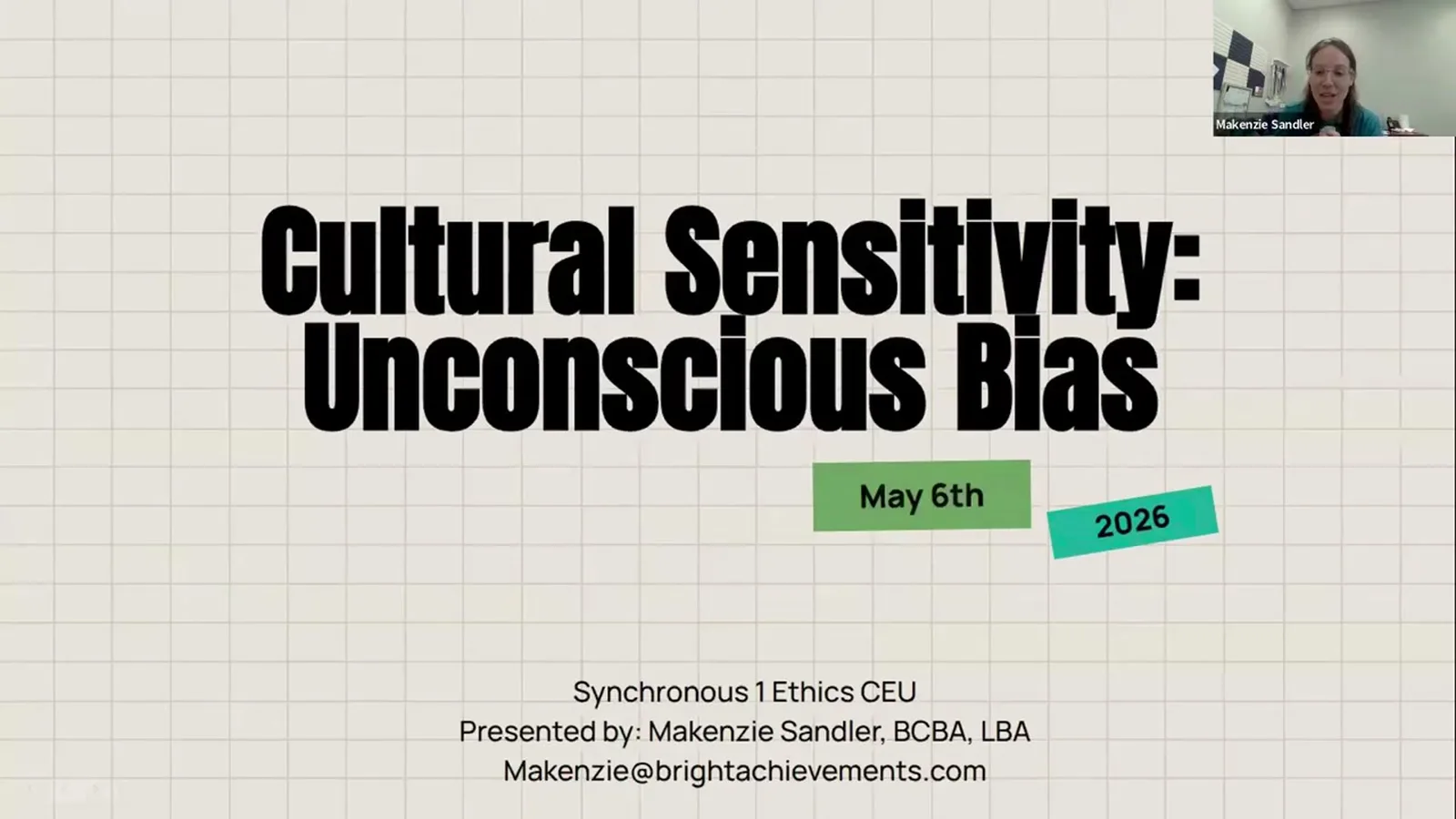
Unconscious bias can influence clinical judgment, communication, and decision-making in subtle but meaningful ways. This presentation explores how implicit biases develop and how they may affect interactions with clients, families, and colleagues in applied behavior analysis (ABA). Participants will review relevant BACB Ethics Code standards related to equity, cultural responsiveness, and professional conduct while learning strategies to recognize and mitigate personal bias. The session will also incorporate concepts from Acceptance and Commitment Therapy (ACT), guiding participants to identify their own professional and personal values and examine how behavior tends to be reinforced when it moves toward those values. Participants will learn to recognize situations in which their behavior and the behavior of others, may be moving in different directions toward individual values, and how increased awareness can support more thoughtful, ethical, and culturally responsive decision-making. Through reflection activities, practical examples, and discussion, attendees will gain tools to promote more equitable and values-consistent service delivery.
Cancel any time. Cert delivered to your inbox the moment you pass the quiz.
Learner ratings
from 152 learners
98% would recommend this CEU to other professionals in their field (81 responses)
“I hope we all recognize these factors in ourselves”
— Mateo M.“informative”
— Farwah A.
About this CEU
Unconscious bias can influence clinical judgment, communication, and decision-making in subtle but meaningful ways. This presentation explores how implicit biases develop and how they may affect interactions with clients, families, and colleagues in applied behavior analysis (ABA). Participants will review relevant BACB Ethics Code standards related to equity, cultural responsiveness, and professional conduct while learning strategies to recognize and mitigate personal bias. The session will also incorporate concepts from Acceptance and Commitment Therapy (ACT), guiding participants to identify their own professional and personal values and examine how behavior tends to be reinforced when it moves toward those values. Participants will learn to recognize situations in which their behavior and the behavior of others, may be moving in different directions toward individual values, and how increased awareness can support more thoughtful, ethical, and culturally responsive decision-making. Through reflection activities, practical examples, and discussion, attendees will gain tools to promote more equitable and values-consistent service delivery.
From the talk
What was covered
How unconscious bias shapes goals, labels, and clinical calls in behavior analysis, plus values-based tools and a four-step routine to catch your own.
- Treat bias like any other behavior: name it, define it, and take data on it.
- Ethics Code 1.07 asks you to evaluate your own biases and the biases of your trainees.
- Write values as a chain: the value, the behavior that moves toward it, and the payoff.
- Before you write a goal, ask whether the world of the learner will reward that skill.
- Swap labels that plant bias in a file, such as problem behavior for target behavior.
- When a goal from a family sounds biased, ask what safety or freedom sits under it.
What Unconscious Bias Is, and What It Is Not
Mackenzie Sandler opened with a clear definition of the term. Unconscious bias (views you hold without knowing it) shapes what you see and do. She used the terms implicit bias and unconscious bias to mean the same thing. Both point to attitudes and stereotypes that act fast and act on their own. They sit outside what you can report about yourself.
Explicit bias is the flip side, and it is much easier to handle. That is a view you know you hold and can name out loud. She used light ones, like coffee over tea and purple over blue. You may even feel proud of a few of them. You can see them, so you can plan around them.
Unconscious bias is harder to catch. The tell is one line: I do not even know I think this. Your news, your social media, and the patterns on your block all feed it. Bias also gets reinforced (rewarded, so it repeats) over time. The more a view pays off, the more it sticks. That is plain behavior analysis, not a moral flaw.
Being human means that we have unconscious biases.
From the talk — Mackenzie Sandler
Ethics Code 1.07 Puts Bias On Your Plate
The talk was built on the ethics code. The core rule is to treat others with compassion, dignity, and respect. To do that well, you have to know who you serve and who you are. Sandler also stressed personal choice. The choice of the client belongs inside the service, not next to it.
Code standard 1.07 covers cultural responsiveness and diversity. It asks you to evaluate your own biases. As she put it, that task is built into the code, not extra credit. The code also names ways to grow: training like this talk, articles, and mentorship. The point is to keep building skill in this area.
The standard has a second half that gets less airtime. You also evaluate the biases of the people you supervise. So the work runs two ways. You grow your own skill first, then you coach it out to your trainees. Sandler likes to make that work measurable with the tools you already own.
So as a BCBA, we are tasked with evaluating our own biases.
From the talk — Mackenzie Sandler
Values as Verbally Constructed Reinforcers
To find a bias, she said, you first have to name it. That is the same move as an operational definition (a clear, countable description). So she brought in ACT, or Acceptance and Commitment Therapy (a values based form of therapy). Values give you the words to work with.
Her behavioral take: values are verbally constructed reinforcers. In plain terms, they are stated ideas that pull your behavior. They guide long patterns of action, and they are not goals. You never get to check one off. They act more like motivating operations (states that make a payoff matter more).
She walked the room through a simple three part chain. The value is independence, and the behavior is showering on your own. The payoff is that it feels right, so the behavior goes up. Here is a second chain from her own life. The value is a healthy work and home balance. The behavior is turning off work alerts at five. The payoff is more time with family, which feels good.
She caught her own slip here, and it is worth stealing. Not checking email fails the dead man's test (a dead person could do it too). So she restated it as a real action: she turns off her alerts. Values can also be broad or concrete. One person values religion, and another values church. Match the level to the learner in front of you.
You don't get to finish a value.
From the talk — Mackenzie Sandler
What Happens When Values Pull in Different Directions
Behavior grows fast when two things line up. It pays off outside, with praise, a break, or access to things. It also fits your values inside, so you feel calm and steady. When both happen, the natural payoff keeps climbing.
The reverse is just as strong. When your behavior fights your values, you get rigid and start to avoid things. Burnout behavior goes up, and resentment shows up at work. Her example: you stay until six when the clinic closes at five. Then you lose the hour you wanted at home.
Families hit the same clash. A teen starts to name their own values, and friends may top the list. Parents may rank family time and respect first. Now the whole home is stuck in conflict. That is the moment to ask what a valid goal really is. Whose values is the behavior contract built on?
Teams clash too, and a value sort makes it visible. Rank your work values as a group, and the order will differ. Then watch the behavior that follows. One teammate tells a sick coworker to go home. Another asks them to stay one more hour. She showed several tools for this work. Card sorts, ranking grids for young kids, and icon cards all work. You can also run forced choice preference assessments (pick one of two, again and again).
You'll see that the ranking is different across different individuals.
From the talk — Mackenzie Sandler
Where Bias Enters Your Clinical Decisions
Sandler mapped the spots where bias gets into the work. It shows up in how you read an assessment and which goals you pick. It shows up in how you label behavior and how you coach your team. It shows up in what you ask a parent to change at home. It even shows up in which resources you share and which you skip.
She offered four contrasts to test a target against. The first two are independence or interdependence, and compliance or autonomy (choice and voice). The others are showing feelings or holding them back, and flexibility or structure. None of these is the right answer. The real question is what the world of the learner will reward.
So ask one blunt thing about each goal you write. Will this skill be praised at home, or will it cost the learner? A child taught to say no thank you may be praised in one home. In another home, that same line may get them in trouble. Her feeding example landed hard. Some families hand feed a child at eight or nine, because their community values it. She grew up where kids used forks on their own by age one or two.
The same test applies to the word success. Success for an insurance plan is not success for a parent. Neither one may match success for the learner. Mastering every box on an assessment may be your win, not theirs.
Values are not correct or incorrect.
From the talk — Mackenzie Sandler
Labels, and the Records That Outlive Them
Labels were the sharpest part of the hour. Sandler has asked IEP teams (school plan meetings) to strike the word violence from a report. The definition can stay the same. The label is what changes how the next reader sees a child.
Records outlive the moment, which is why this matters. She once read years of group home files on one adult. An old note flagged a safety risk from a single childhood incident, so a housing restriction stayed in place for years. The real story: it was harmless childhood play, not a real danger. It never happened again. The label kept working long after the behavior stopped.
A chat question pushed on this. One family raised the racial weight that the term physical aggression can carry. Her answer was practical. Physical aggression is a response class (a group of behaviors with one job). You can define each form on its own, then roll them into one count. You can also drop the label and just define the target. Write what happened: hands placed on the neck, with redness or pressure.
She also flagged the pressure that pushes us the other way. Many of us were taught to write the plan at its worst for insurance. Then we warn the parent that we wrote it harshly. Her fix is not to soften the data. Make the definition replicable, and stop asking the label to do extra work. Non-compliance is her clearest cut, since a dead person can do it. It also plants bias in the next person who reads the file.
Violence is very different than physical aggression.
From the talk — Mackenzie Sandler
SCAD: Self-Reflection, Consult, Action, Data
Her plan is an acronym she made up. She told the room to make it their own. SCAD stands for self-reflection, consult, action, and data. Self-reflection starts with a pause. Bias surfaces when you are rushed, overwhelmed, or moving too fast. It surfaces when norms differ and when feelings run high. Frustration, defensiveness, and plain discomfort are your cues. Then ask four questions of yourself. What am I labeling this as, and what am I assuming? What else could this mean, and what data do I actually have?
Consult means going to real sources, not just to your own head. That list includes mentors, other providers, the family, and the learner. She said to show learners their own data when it helps them. Want to understand a faith or a culture? Go to the source. Consult before a problem, during one, and after one. A good opener: how is this behavior viewed in your family and your community?
Action is where she wanted people to move within ten minutes. Pick one value, personal or professional, and pick one behavior that moves you toward it. Shift your words while you are at it. Attention-seeking becomes seeking connection, and problem behavior becomes target behavior. Then write one measurable goal for yourself.
Data review uses skills you already have. Define your own behavior, not just the behavior of the learner. Trade summaries for numbers: a parent is not inconsistent, a parent performs in 65 percent of chances. Compare across cases and look for real patterns, not one bad memory. Then pull up your stuck goals. If a goal has not moved in weeks, ask who it was ever valuable to.
Don't let your unconscious bias take over and make assumptions.
From the talk — Mackenzie Sandler
Hidden Values: When a Goal From a Family Sounds Biased
The best question of the day came from the chat. What do you do when the values of the family look biased? The case in point was a parent who wants harmless stimming (repeated self soothing movement) gone. The reason given was social norms.
Her first move was to check her own assumption out loud. She had assumed the parent wanted the signs of autism hidden. Maybe that is right, or maybe they fear bullying instead. Maybe they saw another child get hurt, or no one ever explained the behavior. So ask the question before you answer it.
Her second move is the hidden value. A parent may say they want their child to seem normal. Under that word there is often safety or freedom. Ask what is hard for them right now. Ask what one behavior they would change with a magic wand. Take the top three answers and look for the pattern. If the answers are running off, scratching, and hitting a sibling, the value is safety. Now you can build goals on the real value.
If the gap is still real, she said to name it. That is explicit bias on both sides, and it can be talked through. Have the open conversation in a professional way. Then know the last exit. If your bias is in the way, ask for mentorship or step off the case. You do not have to erase your bias. You have to see it, so it stops steering the work.
Those all sound like safety goals to me, right?
From the talk — Mackenzie Sandler
Common questions
What is the difference between unconscious bias and explicit bias?▾
Unconscious bias works outside your awareness and steers choices on its own. Explicit bias is a view you know you hold and can state plainly. Sandler said explicit bias is easier to handle, because you can see it and plan around it. With unconscious bias, the first job is naming it.
Which Ethics Code standard covers bias?▾
Standard 1.07 covers cultural responsiveness and diversity. It asks behavior analysts to evaluate their own biases and to keep building skill through training, articles, and mentorship. It also asks you to evaluate the biases of your supervisees and trainees. The core rule behind it is treating others with compassion, dignity, and respect.
How do ACT values relate to unconscious bias?▾
Values are verbally constructed reinforcers, so they pull your behavior toward some choices and away from others. That pull includes the goals you write and the behavior you call a problem. Naming your values makes the pull visible. It also shows you when your values and the values of a family point in different directions.
How do I label a behavior without planting bias in the record?▾
Keep the definition tight and replicable, and be careful with the category name. Sandler has asked teams to drop violence in favor of a clear account of what happened. You can also break a response class into single defined forms and count them together. Non-compliance is one to retire, since it fails the dead man's test.
What can I do this week to reduce the effect of my own bias?▾
Pick one value and one behavior that moves you toward it today. Pause when you feel rushed, frustrated, or defensive, and ask what you are assuming. Then run a data review on yourself: check which goals are stuck and who they are valuable to. Sandler also suggests one language swap, such as target behavior instead of problem behavior.
About the speaker
Mackenzie Sandler is a BCBA (board certified behavior analyst) who lives in North Carolina and has been certified for about 11 years. She has worked in family homes, group homes, public and private schools, boarding schools, and across many teams of providers. She says she is obsessed with ethics, and this talk is the second part of her series on cultural sensitivity.
This summary was generated from the recording’s transcript. Quotes are taken word for word from the talk.
What you'll learn
- 1OOBJ 1: Identify relevant BACB Ethics Code standards and describe how unconscious bias may influence clinical decision-making, behavior interpretation, and service delivery in ABA practice. OBJ 2: Describe how personal and cultural values influence behavior and decision-making, and explain how actions may be reinforced when they move toward personally held values. OBJ 3: Apply at least one practical strategy to recognize and reduce the influence of unconscious bias when working with clients, families, and team members from diverse backgrounds.
Concepts in this CEU
Related talks
Talks that cover the same concepts
Assent: Don't just say Yes!-
The Behaviorist Bookclub
Supervising Beyond Technical Skills: Professionalism, Communication, and Clinical Judgment
The Behaviorist Bookclub

Streamlining BIPs & Data Collection Systems for Schools
NRS Compassionate Behavior Services
Reflective Supervision and Provider Outcomes in ABA
The Behaviorist Bookclub

Cultural Considerations Across Teams, Systems & Practice
The Behaviorist Bookclub
PDA: Collaborating for Success
The Behaviorist Bookclub
More from The Behaviorist Bookclub
OpenCEU is supported by advertising from third-party sponsors. Sponsors are clearly labeled, have no influence over course content, instructors, or CEU decisions, and never appear on certificates. The BACB does not sponsor, approve, or endorse OpenCEU sponsors or their products.