The Dead Man Test in ABA: What Counts as Behavior
The dead man test is a simple rule: if a dead person can do it, it isn't behavior. See how BCBAs use it to write goals and cut bias.
Key takeaway
The dead man test is a simple rule in behavior analysis. If a dead person can do it, it is not behavior. A dead person can sit still, stay quiet, and not hit.
Explore free BCBA CEU courses
Free learning path on this topic
Child Development for Behavior Analysts
Typical development for behavior analysts. Kristen Byra's overview, then Kelly Brzak's deep dives on ages 2 to 5, 6 to 8, and 9 to 11, with milestones, common problem behaviors, and programming tips for each band.
Experts who cover this
The recording behind this guide covers dead man test.
- 1 Ethics CEU
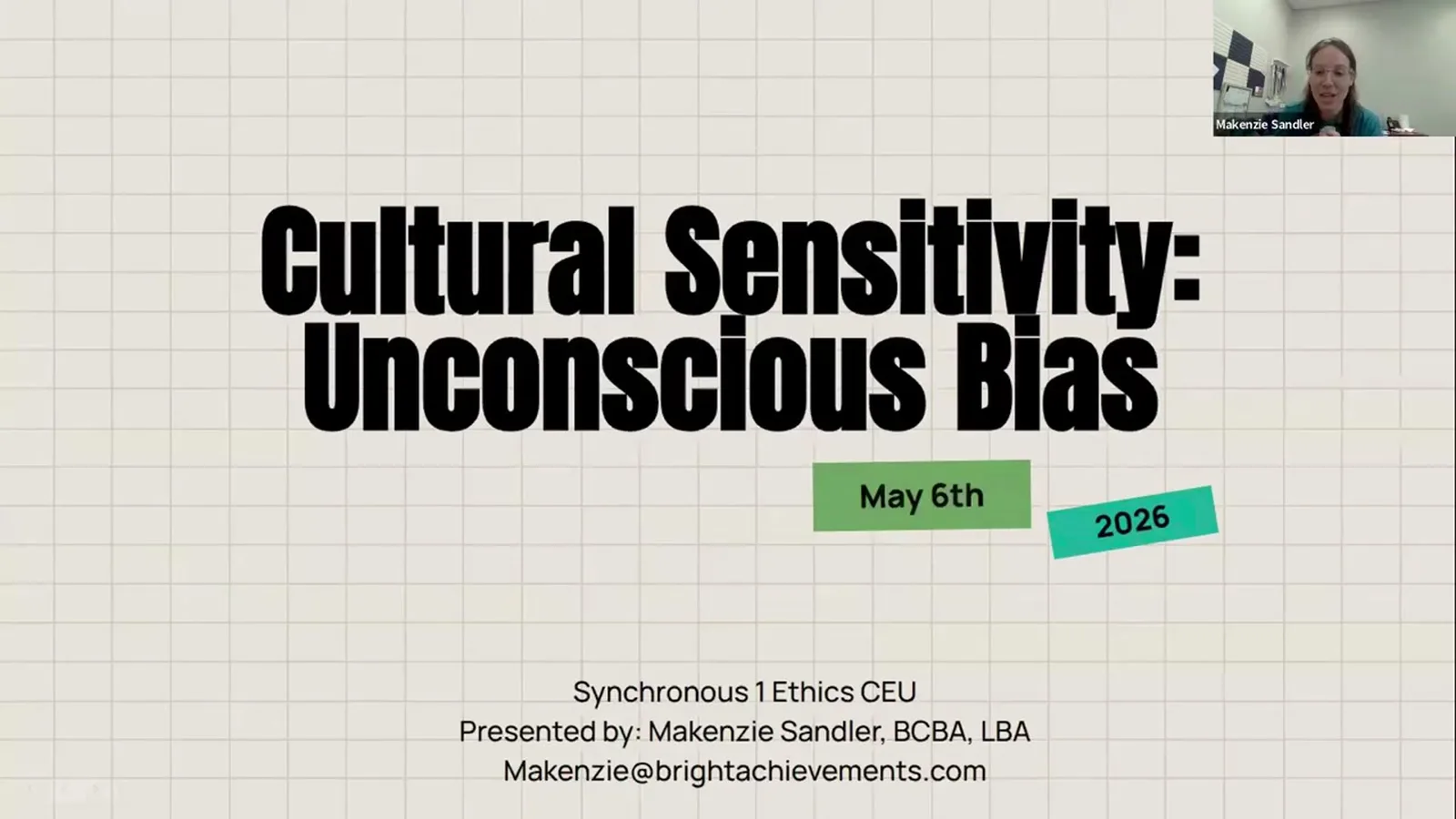
Cultural Sensitivity: Unconscious Bias
Mackenzie SandlerThe Behaviorist Bookclub
Sandler flags that labels like 'non-compliance' fail the dead man's test, arguing that using such non-behavioral labels feeds unconscious bias against the…
On this page · 8 sections▾
The dead man test is a simple rule in behavior analysis. If a dead person can do it, it is not behavior. A dead person can sit still, stay quiet, and not hit. So "sitting still" and "not hitting" are not real behavior goals.
This rule sounds odd, but it does real work. It keeps BCBAs, RBTs, teachers, and parents honest. It pushes us to name what a learner should do, not just what they should stop. That small shift makes goals clearer and plans stronger.
The name is meant to stick. A dead body is the extreme case of doing nothing. If your goal describes that state, you have not named a behavior at all. The test gives you a quick, memorable gut check for any goal.
Values have to pass it too#
Brian Middleton uses the test in a fresh way. He applies it to values, not just target behaviors. A value has to name something a living person does.
Values must pass the dead man test. From the talk — Brian Middleton
Many people describe what they want to escape. But escape goals often fail the test. Middleton gives clear examples.
I want to stop feeling tired. That's a dead man. That does not pass the dead man test. I don't want to feel depressed. That doesn't pass the dead man test. From the talk — Brian Middleton
A dead person also does not feel tired or depressed. So "stop feeling tired" is a dead man goal. The fix is to flip it. Ask what the person would do instead if they had energy. That answer points to the real value.
Labels that fail the test cause bias#
Mackenzie Sandler brings the test into everyday clinical language. She warns about a common word. "Non-compliance" describes the absence of an action, not an action.
Non-compliance doesn't pass the dead man's test and it creates unconscious bias toward that learner. From the talk — Mackenzie Sandler
This is a strong point. A dead person is perfectly "non-compliant." So the label describes nothing the learner actually did. Worse, it paints the learner in a bad light before anyone looks closer.
that's not passing the dead man's test, I guess, huh? From the talk — Mackenzie Sandler
The better move is to define the real behavior. What did the learner do or say instead? A clear, neutral definition cuts the bias out. You can hear more of this in Cultural Sensitivity: Unconscious Bias.
Even quiet is not behavior#
 Advertisement
Dr. Shane Spiker shows the test working on himself. He talks about his own early warning sign before a hard moment. His sign is that he goes silent.
I get really quiet, which is, you know, not really behavior. According to the dead man's test. From the talk — Dr. Shane Spiker
Getting quiet is really the absence of talking. A dead person is quiet too. So "quiet" alone is not a behavior you can measure well. To track it, you would define what he does instead of speaking.
Why active goals work better#
There is a practical reason to favor active goals. A "stop" goal leaves a hole. It tells the learner what not to do, but not what to do instead. That hole often fills with another problem behavior.
An active goal fills the hole on purpose. It gives the learner a real skill to use. When a child learns to ask for a break, hitting has less of a job to do. You built something, instead of just banning something.
Active goals are also easier to measure. You can count a request or a raised hand. You cannot easily count the absence of an action. Clear counts make progress easy to see.
How to use the test at your desk#
The test is a quick filter for any goal you write. Read the goal and ask one question. Could a dead person do this? If the answer is yes, the goal needs a rewrite.
Turn "stop" goals into "start" goals. Instead of "does not hit," write what the hands should do. Instead of "stays quiet," name the words to use. Active goals give the learner something to build, not just something to avoid.
A tool for values, not just goals#
Middleton's use of the test is worth a second look. Most people learn the test for writing behavior goals. He shows it also works for finding what a person cares about.
Away goals are the ones people say first. "Stop being tired." "Stop being anxious." These name what someone wants to escape. But a dead person escapes all of that, so the goals fail the test.
The trick is to flip each away goal over. If not tired, then what? Maybe the person wants energy to play with their kids. That flip reveals the real value hiding behind the complaint. The test does the sorting for you.
What the research says#
The dead man test is old, but it rarely gets tested itself. One playful study set out to check its core claim. The authors observed three individuals who could reasonably be considered deceased, across three conditions where behavior might appear (Critchfield & Shue, 2018).
No behavior was detected in any condition. The result lined up with what the test predicts. The authors were careful, though. They noted the study's limits and said the test cannot yet be called fully validated. The takeaway is light but real. A rule this basic deserves the same scrutiny we give any other tool.
FAQ#
What is the dead man test in ABA? It is a rule for spotting real behavior. If a dead person can do it, it is not behavior. Sitting still, staying quiet, and not hitting all fail the test, so they make poor goals on their own.
Who came up with the dead man test? It is usually credited to Ogden Lindsley, an early leader in behavior analysis. He offered it as a quick check for whether a goal names true behavior. The field still uses it to write clear, active objectives.
Why is "non-compliance" a problem? It fails the dead man test, since a dead person is non-compliant too. The word names no real action, and it can bias staff against a learner. A better goal defines what the learner actually does instead.
 Advertisement
Keep learning
Earn free BCBA CEUs on openceu
Browse on-demand recordings from verified ACE providers and earn CEUs across autism, ABA, and behavior analysis. Detailed certificate, delivered the moment you finish.
Keep going with a free learning path
Child Development for Behavior Analysts
Typical development for behavior analysts. Kristen Byra's overview, then Kelly Brzak's deep dives on ages 2 to 5, 6 to 8, and 9 to 11, with milestones, common problem behaviors, and programming tips for each band.