Values in ABA: How to Find What Really Matters to a Learner
Learn what values mean in ABA, how to spot hidden values behind caregiver requests, and simple ways to find what a learner truly cares about.
Key takeaway
Values are the things a person cares about most over the long run. In ABA, we use values to guide the goals we pick and the plans we build.
Explore free BCBA CEU courses
Free learning path on this topic
Supervision, Done Right
Four supervision CEUs that build on each other. What reflective supervision is, how to build a supervision system, how to assess supervisee competence instead of counting hours, and how supervision affects provider outcomes. The BACB asks supervisors for three supervision CEUs per cycle. This covers it.
Experts who cover this
The recording behind this guide covers values aba.
- 1 Ethics CEU
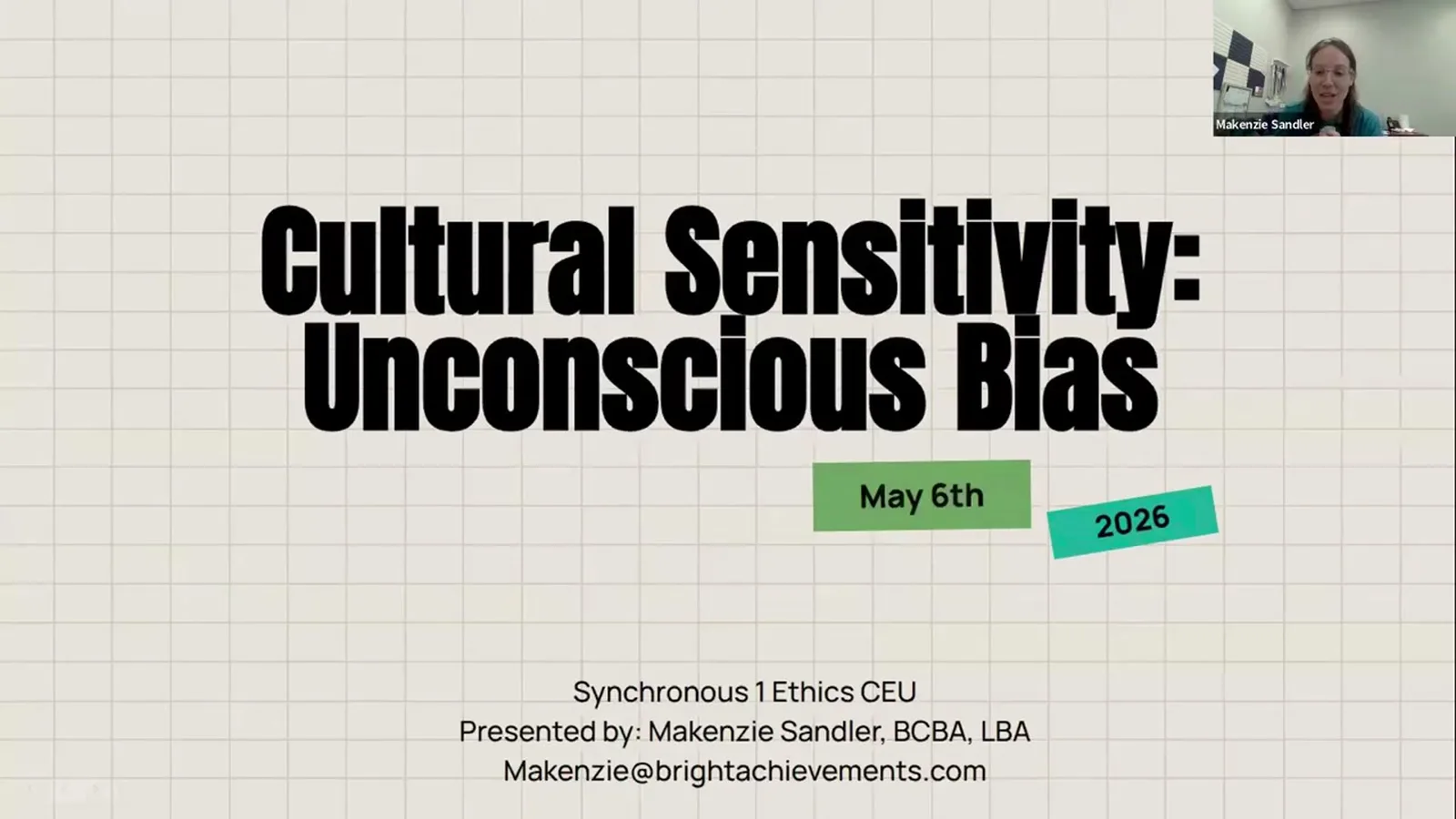
Cultural Sensitivity: Unconscious Bias
Mackenzie SandlerThe Behaviorist Bookclub
Sandler introduces the ACT concept of hidden or masked values to help clinicians push past a caregiver's stated preference (e.g., 'stop the stimming') to the…
On this page · 8 sections▾
Values are the things a person cares about most over the long run. In ABA, we use values to guide the goals we pick and the plans we build. They point us toward a life the learner and family actually want.
This matters for BCBAs, RBTs, teachers, and parents. When goals match a learner's values, the work feels meaningful. When they do not, we can push change that no one asked for. So learning to find values is a core skill.
What a value is (and is not)#
Different experts define values in different ways. Brian Middleton gives the most technical view. He roots values in verbal behavior and reinforcement.
large classes of verbal, uh, verbally constructed, highly potent, long-term positive reinforcers values-based interventions, AKA committed action involve statements or rules that function as verbally, verbal motivating operations, also known as augmentals, um, that increase or decrease the effectiveness of stimuli as reinforcers or punishment punishers From the talk — Brian Middleton
That is a mouthful. In plain terms, a value is a strong, lasting thing we care about. It shapes what feels rewarding day to day. It is not a single task to finish.
Middleton draws a clear line around what values are not. He keeps the list short and firm.
Values are not goals. Values are not avoidance. Values are not people or things. From the talk — Brian Middleton
The dead man test#
One quick check helps sort values from behaviors. Middleton uses the "dead man test" from behavior analysis. If a dead person can do it, it is not a value.
Values must pass the dead man test. Period. Like if, if they don't pass the dead, if it doesn't pass the dead man test, it's not a value. From the talk — Brian Middleton
"Being quiet" fails the test. A dead person is quiet. "Connecting with friends" passes, because it takes active living. This test keeps us honest about what we chase.
Hidden values behind a request#
Caregivers often ask for a goal that hides a deeper want. Mackenzie Sandler calls these hidden or masked values. The stated request is the surface. The value sits underneath.
the concept of hidden values or like masked values where somebody was like, oh, well, I value my kid quote unquote acting this way. But in reality, what they value is safety or independence. From the talk — Mackenzie Sandler
A parent might say "stop the hand flapping." The real value could be safety or belonging. Our job is to name that gently and check if we heard it right. You can reflect it back: it sounds like you value X. That keeps the family in the driver's seat.
Values pull us toward the future#
 Advertisement
Tom Sabo frames values through Skinner's work. Values help us act for a future that has not come yet. Words make distant rewards feel close and worth it.
These verbal statements that we make to ourselves that augment the salience of distal remote reinforcers are the stuff of valuing. From the talk — Tom Sabo
Sabo points to a specific reading for those who want depth. He recommends Skinner's book Beyond Freedom and Dignity. The chapter on values is the key part, he says. Near the very end, Skinner finally talks about behaving with respect to a future that has not happened yet.
This view fits daily practice. A simple prompt like "what do I care most about" can surface a value. Then plans can build toward it.
How to be a values detective#
Middleton warns against just asking a learner to name values. Many learners cannot answer that in the abstract. Instead, we gather clues from what we see.
We watch what a person seeks out and returns to. We label those choices out loud, which is called tacting. We notice what they ask for, which is manding. We also read permanent products, like drawings, saved items, or a made bed.
These clues build a picture over time. No single moment gives the full answer. Patience and observation do the heavy lifting here.
Why this shapes ethical practice#
Values keep our work tied to the person, not our own habits. When we skip them, we risk pushing a goal that only serves adults. When we center them, goals gain real social value.
This is why the neurodiversity lens matters here. A value driven goal respects how the learner wants to live. It moves us away from making someone look "normal" and toward helping them thrive.
What the research says#
Values in ABA now have growing research support. One team built a tool to help analysts ask about culture and values in a structured way. The Values-Centered Assessment Tool covers stakeholders, communication, and family practices. Expert review showed strong content validity (Kwak, D., Blair, K. C., & Russo, D. (2024). Development of the Values-Centered Assessment Tool (VCAT) to Inform Culturally Responsive Behavioral Services. Behavior Analysis in Practice, 17(4), 977-995).
Values can also clash, and the field is studying how to handle that. One paper offers a decision model for when a client's values conflict with their culture or with the practitioner's own bias. It asks the analyst and family to work together. Together they refine goals that increase the client's access to reinforcers, for their cultural groups too (Delgado, D., Meindl, J. N., Al-Nasser, T., & Ivy, J. W. (2023). When Cultural Awareness Reveals Conflicting Cultural Values: A Pragmatic Approach. Behavior Analysis in Practice, 17(1), 13-25). Both papers point to the same idea. Values are assessed with the family, not assumed.
FAQ#
What is the difference between a value and a goal in ABA? A goal is a task you can finish and check off. A value is an ongoing direction you keep moving toward. You can meet a goal, but you never "complete" a value. Goals serve values, not the other way around.
How do I find a nonverbal learner's values? You act like a detective and gather clues. Watch what they choose, seek out, and return to. Label those choices and note what they ask for. Read permanent products like saved items or finished work. Patterns over time reveal what matters.
What are hidden or masked values? These are the deeper wants behind a stated request. A caregiver may ask to stop a behavior. The real value could be safety, independence, or belonging. Naming the hidden value helps you set a goal the family truly supports.
Want a cultural angle on this same skill? The talk Cultural Sensitivity: Unconscious Bias shows how bias can hide a family's real values.
 Advertisement
Keep learning
Earn free BCBA CEUs on openceu
Browse on-demand recordings from verified ACE providers and earn CEUs across autism, ABA, and behavior analysis. Detailed certificate, delivered the moment you finish.
Keep going with a free learning path
Supervision, Done Right
Four supervision CEUs that build on each other. What reflective supervision is, how to build a supervision system, how to assess supervisee competence instead of counting hours, and how supervision affects provider outcomes. The BACB asks supervisors for three supervision CEUs per cycle. This covers it.